


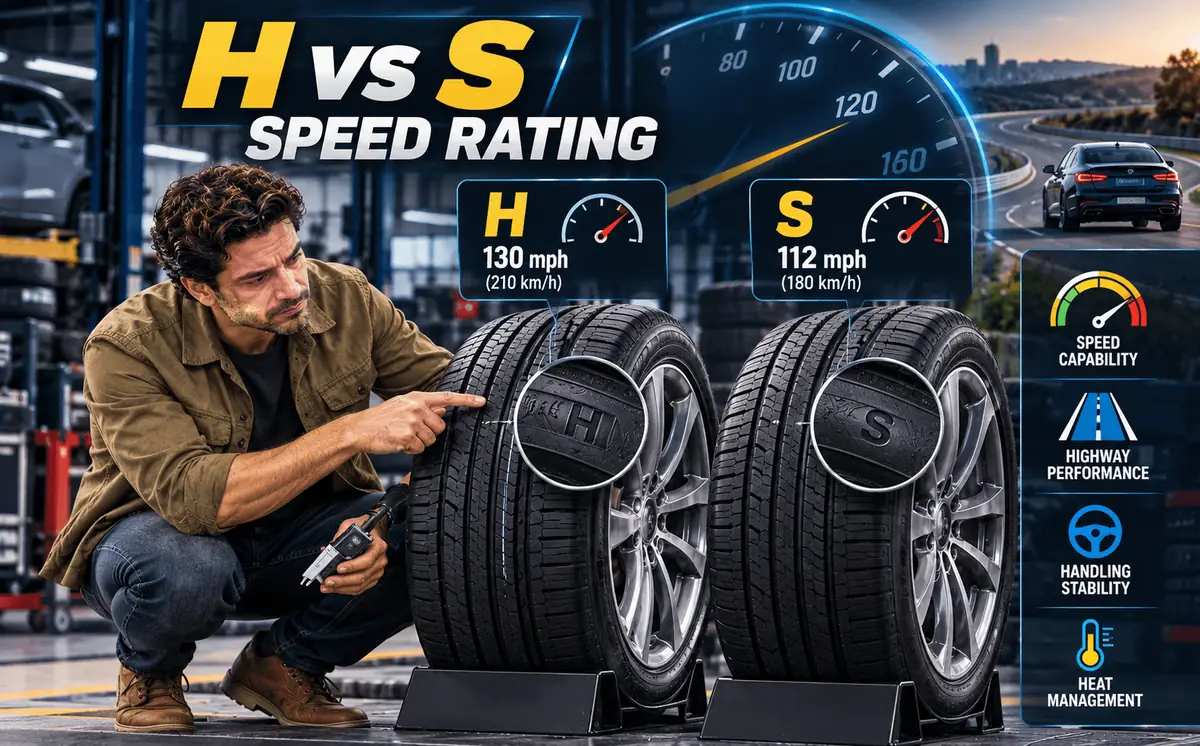
The speed rating is the single letter at the end of your tire’s service description, and it is easy to ignore. After all, almost no one drives at 112 mph, let alone 130. But the difference between an S-rated tire and an H-rated tire is about much more than top speed. It reflects how the tire is built, how it handles heat, how it responds to the steering wheel, and how much safety margin it leaves you at everyday highway speeds.
Here is how the two ratings compare, who each one suits, and what to do when it’s time to replace your tires.
Table of Contents
Speed Ratings in Brief
A speed rating indicates the maximum speed a tire can sustain, when properly inflated and carrying its rated load, under standardized laboratory testing. Exceed it and the tire can overheat, compromising its structure and risking tread separation or a blowout.
The two ratings in question:
- S: up to 112 mph (180 km/h)
- H: up to 130 mph (210 km/h)
The H rating is the higher of the two. It sits above S, T (118 mph), and U (124 mph) on the scale, a quirk explained by the system’s history: H was one of the original European ratings, and other letters were slotted in later to fill the gaps.
| Rating | Max Speed | Typical Vehicles | Character |
|---|---|---|---|
| S | 112 mph / 180 km/h | Economy cars, family sedans, minivans, light trucks | Comfort, tread life, value |
| H | 130 mph / 210 km/h | Sport sedans, coupes, many crossovers and touring cars | Sharper handling, more heat resistance |
Inside an S-Rated Tire
S-rated tires are built for everyday passenger use. They are common on economy cars, family sedans, minivans, and many light trucks, and they handle all legal U.S. highway speeds with ample margin.
Because they don’t need the reinforcement required for sustained speeds near 130 mph, S-rated tires can be tuned for comfort and longevity: more compliant sidewalls that soak up bumps, and compounds that favor long tread life. They are typically among the more affordable options in a given size.
Best for: commuters and family drivers who want a comfortable ride, long wear, and good value, and whose vehicle manufacturer specifies an S rating.
Inside an H-Rated Tire
An H-rated tire must withstand the heat and stress of sustained speeds up to 130 mph. That typically calls for stiffer sidewalls, a more robust belt package, and compounds that resist heat buildup. The benefits show up long before the speedometer climbs: the tire flexes less in corners, steering feels more responsive, and the tire runs with more thermal margin at ordinary highway speeds.
H-rated tires are found on sport sedans, coupes, many crossovers, and a wide range of touring vehicles. They balance performance and comfort, making them well suited to drivers who spend a lot of time on the highway or enjoy a more engaging drive.
None of that makes 130 mph a reasonable cruising speed. The rating describes structural capability, not a recommendation, and local speed limits always apply.
Best for: drivers of sportier or heavier vehicles, high-mileage highway commuters, and anyone whose vehicle manufacturer specifies H.
H vs S: Where You Feel the Difference
Handling
The H-rated tire’s stiffer construction means less sidewall flex and quicker response to steering inputs. On a highway ramp or a winding road, it feels more planted and precise. An S-rated tire is softer and more forgiving, with slightly slower turn-in.
Comfort
The S-rated tire usually has the edge. Its more compliant construction absorbs expansion joints and broken pavement more effectively. Some modern H-rated touring tires narrow this gap considerably, but a firmer ride is the usual trade-off for the extra stiffness.
Heat and Safety Margin
An H-rated tire is engineered to dissipate the heat of much higher speeds, so at 70 or 75 mph it operates further from its limits than an S-rated tire. That margin matters most on long, hot highway drives, with a fully loaded vehicle, or when pressure has crept a little low.
Tread Life and Price
S-rated tires often use compounds focused on longevity and tend to cost less. H-rated tires may wear somewhat faster and cost more, though the gap varies widely by model. The treadwear warranty on a specific tire is the best guide.
Speed Rating and Load Index Work Together
On the sidewall, the speed rating follows the load index, as in 95H. The load index tells you how much weight the tire can carry; the speed rating tells you how fast it can carry that weight. A tire’s ability to support its load depends on not overheating, which is why the two are always considered together.
When replacing tires, match or exceed both the load index and the speed rating your vehicle manufacturer specifies. Our tire load index guide explains how to read the numbers.
Replacing Tires: Up Is Fine, Down Is Not
Moving up from S to H is generally fine. You gain handling precision and heat resistance, though you may notice a slightly firmer ride and pay a little more. Make sure the load index and size remain correct.
Moving down from H to S is not recommended. Your vehicle’s suspension, steering, and stability systems were developed around the stiffer characteristics of the original tire, and a lower-rated replacement can make handling feel vague and reduce your safety margin. Some tire shops will decline to install a lower speed rating than the placard specifies, and using non-spec tires can complicate warranty and insurance matters if a tire-related failure occurs.
Winter tires are the accepted exception. Dedicated winter tires often carry lower speed ratings because of their soft compounds and heavily siped tread, and fitting them for the cold months is standard practice. Observe their lower speed limit while they’re on.
Matching: keep the same speed rating on all four tires, and ideally the same make and model. Mixing ratings, especially on the same axle, can create uneven handling and wear. If you must mix temporarily, observe the limit of the lowest-rated tire.
How to Choose
1. Start with the placard. The door-jamb sticker or owner’s manual lists the minimum speed rating for your vehicle. Never go below it for regular use.
2. Consider your driving. Lots of highway miles, hot climates, or a preference for sharp handling all favor H. Mostly urban driving at moderate speeds makes S a perfectly sensible choice if your vehicle calls for it.
3. Account for loads. Heavily loaded vehicles run their tires hotter. If you regularly carry full loads or tow within your vehicle’s limits, the extra thermal margin of a higher rating is worth considering.
4. Weigh the budget. Higher speed ratings generally cost more. Balance price against the benefits you’ll actually use.
Keeping Speed-Rated Tires at Their Best
A speed rating assumes a tire in good condition. Maintenance keeps that true:
- Inflation: check pressure at least monthly. Under-inflation causes heat buildup that can undermine a tire’s speed capability; over-inflation reduces traction and makes the ride harsher.
- Rotation and alignment: rotate every 5,000 to 8,000 miles and have alignment checked after hard impacts or if you see uneven wear. Uneven wear can lead to more heat and less grip.
- Tread depth: replace at 2/32 of an inch at the latest, and consider replacing performance-oriented tires sooner, since worn tread disperses water poorly at speed.
- Load and speed limits: stay within the tire’s rated load and speed.
Myths Worth Dropping
“A higher rating is always better.” Not necessarily. A higher rating brings sharper handling but often a firmer ride and sometimes shorter tread life. The right rating is the one that suits your vehicle and driving.
“Speed ratings are only about top speed.” They also reflect construction, heat resistance, and durability, which affect how the tire behaves at normal speeds.
“Speed ratings are a marketing gimmick.” They come from standardized testing and are an important part of a tire’s safety certification.
“Only sports cars need to care.” Every vehicle has a specified rating chosen for its weight and performance.
“A brief burst above the rating is harmless.” Excess speed builds heat quickly. Stay within the limit.
Frequently Asked Questions
H. An H-rated tire is rated up to 130 mph, while an S-rated tire is rated up to 112 mph.
Yes. Going up in speed rating is generally fine, as long as size and load index are correct. Expect slightly sharper handling and possibly a firmer ride.
It isn’t recommended for regular use. The exception is dedicated winter tires, which commonly carry lower ratings.
Often a little faster, because they may use more grip-oriented compounds, but it varies by model. Check the treadwear warranty.
Yes. Higher-rated tires usually have stiffer construction, which improves steering response and stability even at everyday speeds.
It’s best not to. Keep all four tires on the same rating, and never mix on the same axle.
The Verdict
S-rated tires are an excellent match for many everyday cars, minivans, and light trucks. They ride comfortably, often last a long time, and cost less, with more than enough capability for legal highway driving.
H-rated tires earn their place on sportier and heavier vehicles and for drivers who log long, fast highway miles. Their stiffer construction delivers sharper handling and a larger thermal safety margin.
Start with whatever your vehicle manufacturer specifies, feel free to step up if you value the handling, and avoid stepping down except for dedicated winter tires.
 Summarize this article with:


















Leave a comment