


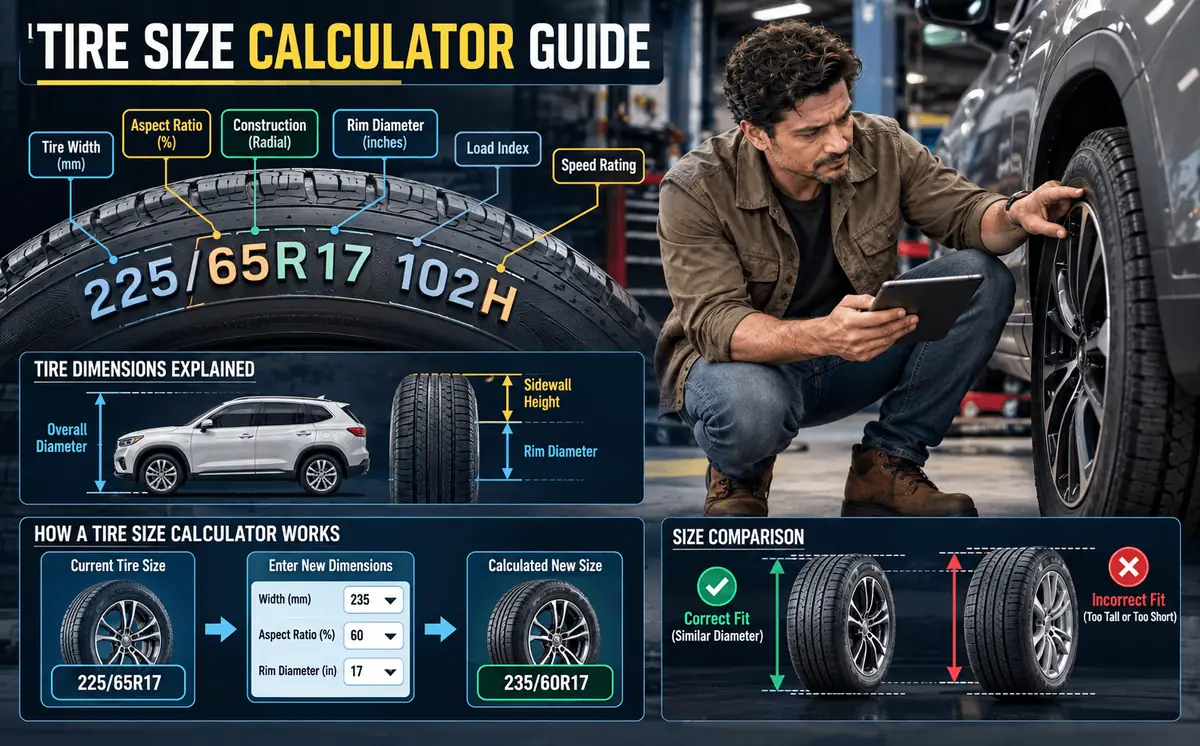
Every tire carries a dense string of numbers and letters on its sidewall, and most drivers never decode it. That’s a missed opportunity, because those markings tell you exactly what the tire is, what it fits, how much it can carry, how fast it can go, and how old it is. Knowing how to read them helps you buy the right replacement, avoid unsafe substitutions, and spot problems before they turn into failures.
This guide walks through the code piece by piece, covers the other important sidewall markings, and explains the alternative sizing systems you’ll see on trucks, off-road vehicles, and imports.
Table of Contents
Why Tire Size Matters
Safety. The right size keeps your brakes, anti-lock braking system (ABS), and electronic stability control (ESC) working as designed. A different overall diameter changes the wheel-speed data these systems rely on and throws off your speedometer. The size also comes with a load capacity and speed rating chosen for your vehicle.
Performance. Width and sidewall height determine the contact patch and how the tire absorbs bumps. A wider footprint generally improves grip; a taller sidewall generally improves comfort.
Efficiency. Larger or wider tires can reduce fuel economy through more weight and rolling resistance.
Longevity. The wrong size can wear prematurely, strain suspension parts, and make the odometer inaccurate.
For most drivers, sticking with the original-equipment (OE) size is the safest and simplest choice.
Where to Find Your Tire Size
- The sidewall of each tire shows the size currently mounted.
- The driver’s door jamb placard lists the OE size, recommended pressure, and often weight ratings.
- The owner’s manual details recommended sizes, types, and pressures.
- The fuel filler door on some vehicles carries the same information.
The placard and manual tell you what the vehicle should have; the sidewall tells you what it actually has. Check that they match, especially on a used car.
Decoding a P-Metric Size: P215/65R16
Tire Type: P, LT, C, ST
- P (Passenger): for cars, minivans, and light SUVs, with a comfortable ride and lower rolling resistance.
- LT (Light Truck): stronger construction for heavier loads and tougher conditions on pickups, vans, and larger SUVs.
- C (Commercial): heavier vans and some trailers, with higher load capacity.
- ST (Special Trailer): built only for trailers, to handle constant towing loads and maintain stability.
The type dictates construction and load capacity, so it must match your vehicle’s requirements.
Section Width: 215
The width in millimeters from sidewall to sidewall. A wider tire generally has a larger contact patch, helping traction, braking, and cornering, but it can add rolling resistance. Vehicle makers choose a width that balances those factors.
Aspect Ratio: 65
The sidewall height as a percentage of width. Here, the sidewall is 65% of 215 mm.
- Higher ratios (70, 75): taller sidewalls that absorb more shock for a softer ride, with a little more flex in corners.
- Lower ratios (55, 50, 45): shorter, stiffer sidewalls that sharpen steering and cornering but transmit more road imperfections.
Construction: R, B, or D
- R (Radial): plies run bead to bead at 90 degrees to the direction of travel, giving flexibility, heat dissipation, efficiency, and comfort. Virtually all modern passenger vehicles and light trucks use radials.
- B (Belted bias): bias construction reinforced with a stabilizing belt.
- D (Diagonal / bias-ply): plies laid diagonally and alternating; robust but hotter-running, less efficient, and harsher.
Our radial vs bias-ply guide explains the differences in depth.
Rim Diameter: 16
The wheel diameter in inches. The tire’s rim diameter must exactly match the wheel’s. If you change wheel size, say from 16 to 17 inches, you need tires sized for 17-inch wheels, usually with a lower aspect ratio to keep the overall diameter similar.
The Service Description: Load Index and Speed Rating
After the size comes a number and a letter, such as 96H.
Load Index
The load index corresponds to the maximum weight one properly inflated tire can carry. A 96 means 1,565 lbs (710 kg). Always choose a load index equal to or higher than the OE requirement; a lower index can lead to tire failure.
| Load Index | Load (lbs) | Load (kg) | Load Index | Load (lbs) | Load (kg) |
|---|---|---|---|---|---|
| 80 | 992 | 450 | 95 | 1,521 | 690 |
| 85 | 1,135 | 515 | 96 | 1,565 | 710 |
| 90 | 1,323 | 600 | 98 | 1,653 | 750 |
| 92 | 1,389 | 630 | 100 | 1,764 | 800 |
Light truck tires also carry a load range (C, D, E, and so on) indicating construction strength. See our load index and load range guides for full charts.
Speed Rating
The speed rating is the maximum speed the tire can sustain at its rated load. H means 130 mph (210 km/h). Exceeding it risks overheating, structural damage, and a blowout. Choose a rating equal to or higher than the OE specification.
| Rating | Max Speed (mph) | Max Speed (km/h) |
|---|---|---|
| S | 112 | 180 |
| T | 118 | 190 |
| U | 124 | 200 |
| H | 130 | 210 |
| V | 149 | 240 |
| W | 168 | 270 |
| Y | 186 | 300 |
A tire rated higher than your vehicle can travel is still limited by the vehicle. Our speed rating comparisons, including H vs T, V vs H, V vs W, and W vs Y, go deeper on specific choices.
Other Important Sidewall Markings
UTQG: Treadwear, Traction, Temperature
The Uniform Tire Quality Grading system, a U.S. Department of Transportation standard, helps compare passenger tires:
- Treadwear: a comparative wear rating. A tire graded 400 should last about twice as long as one graded 200 under standardized test conditions.
- Traction: straight-line wet braking, graded AA (best), A, B, or C.
- Temperature: resistance to and dissipation of heat, graded A (best), B, or C. Higher grades matter more for high speeds and hot climates.
Manufacturers assign these grades based on their own testing, so they’re most useful for comparing tires within the same category. See our UTQG guide for more.
Maximum Air Pressure
The sidewall lists the maximum pressure the tire can safely hold, in PSI and kPa. It is not your operating pressure. Use the pressure on the door placard or in the owner’s manual, and never exceed the sidewall maximum.
DOT Code
The DOT code confirms the tire meets Department of Transportation standards and identifies its plant and production. The last four digits give the manufacture date: “3223” means week 32 of 2023.
Rubber ages regardless of tread depth. Replacement is generally recommended at around six years, and no later than ten, even if the tread looks good. Our tire inspection checklist covers what else to look for.
Other Sizing Systems
P-Metric vs Euro-Metric
Euro-metric sizes look almost identical but usually omit the leading “P” (for example, 215/65R16). They also use slightly different load conventions and commonly mark higher-capacity tires as XL (Extra Load) or RF (Reinforced). Your owner’s manual will tell you which applies.
LT-Metric and Load Range
LT-metric sizes use an “LT” prefix (for example, LT265/70R17) and a lettered load range such as C, D, E, F, G, or H. Each letter indicates a specific ply rating equivalent and maximum load, generally higher than P-metric tires. A Load Range E tire is built for substantially heavier loads than a Load Range C tire.
Flotation Sizing: 35×12.50R15
Common on off-road vehicles and trucks, flotation sizing uses inches:
- 35: approximate overall diameter
- 12.50: section width
- R: radial
- 15: rim diameter
The “x” simply means “by”: 35 inches tall by 12.50 inches wide.
Older Alphanumeric and Numeric Sizing
Older vehicles and some specialty equipment use legacy systems that don’t translate directly to modern metric dimensions. Our vintage tire guide explains how to convert them.
When to Check Your Tire Size
During Routine Maintenance
Every time you check pressure or inspect tread, confirm the tires match the size in your owner’s manual or on the placard.
When Replacing Tires
For most drivers, the OE size is the safest choice. It keeps handling, braking, and safety systems operating as intended.
When Changing Wheels or Sizes
If you’re fitting aftermarket wheels or a different tire size, consider:
- Overall diameter: changes affect the speedometer, odometer, ABS, and traction control.
- Wheel width and offset: must suit the tire size and keep it clear of suspension and fenders.
- Clearance: check at full steering lock and under suspension compression.
- Load index and speed rating: must meet or exceed the OE specification.
- Professional advice: a tire professional can confirm a size change is safe and whether modifications are needed.
Tools That Help
Online tire size calculators compare your current and proposed sizes, showing the difference in overall diameter, the percentage change, the effect on your speedometer, and differences in width and sidewall height. Load index and speed rating charts translate the service description into actual weight and speed limits. Our tire size calculator guide explains the math behind these tools.
Frequently Asked Questions
The first is width in millimeters, the second is the sidewall height as a percentage of that width, and the third is the rim diameter in inches.
A tire 225 mm wide, with a sidewall 65% as tall as its width (about 146 mm), radial construction, fitting a 17-inch wheel. It’s a common size for SUVs and crossovers.
Type (P or LT), width, aspect ratio, construction, rim diameter, then the service description: load index and speed rating, such as 98H.
It’s possible with care, but stay within about 3% of the original diameter, match or exceed load index and speed rating, and check clearance. When in doubt, ask a professional.
In the last four digits of the DOT code: week, then year.
P means a passenger tire, 225 is the width in millimeters, 65 is the aspect ratio (the sidewall height is 65% of the width), R means radial construction and 17 is the wheel diameter in inches.
It is the aspect ratio, the sidewall height as a percentage of width. A 60 has a taller sidewall that absorbs more shock for a softer ride, while a 50 has a shorter, stiffer sidewall for sharper handling and a firmer ride.
The Bottom Line
Your tire’s sidewall is a complete specification sheet. Once you can read size, type, construction, load index, speed rating, UTQG grades, maximum pressure, and DOT date, you can buy with confidence, avoid unsafe substitutions, and know when a tire is due for retirement.
Your next steps:
1. Decode the size, service description, and DOT date on your current tires.
2. Compare them with your door placard and owner’s manual.
3. Bookmark a tire size calculator if you’re considering wheel or size changes.
4. Ask a tire professional before deviating from the OE specification.
 Summarize this article with:
















Leave a comment