


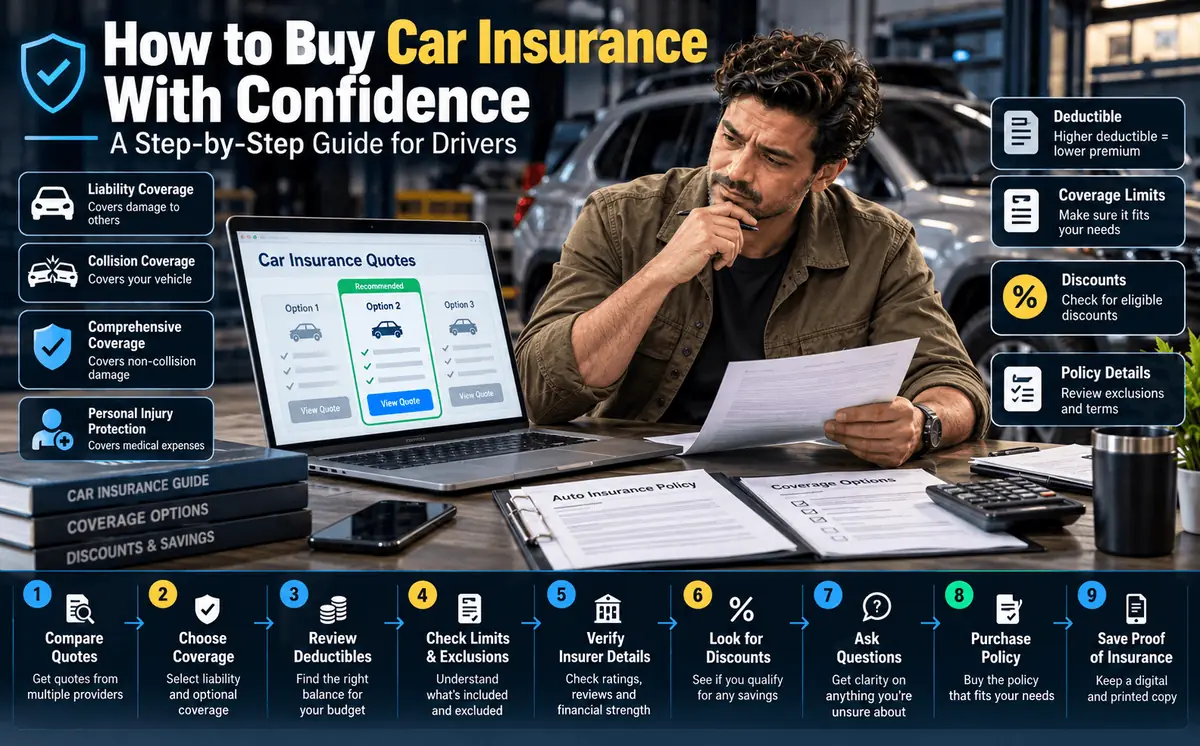
Car insurance is one of those purchases most people make in a hurry. A new car is waiting at the dealership, or a renewal notice shows up with a higher price, and the easiest move is to pick the first quote that looks reasonable. The trouble is that a policy you do not understand is only tested when something goes wrong, and that is the worst moment to discover your coverage was thinner than you thought.
Buying insurance with confidence comes down to understanding a handful of coverages, choosing limits that actually protect you, comparing companies on more than price, and knowing how your policy works after you sign. This guide walks through each step. It is general consumer information, not legal or financial advice; insurance rules vary by state, so confirm specifics with your state insurance department, agent, or insurer.
How this guide was put together: This guide summarizes rules for general information; it is not legal or insurance advice, and terms vary by state and provider. Checked on October 22, 2026.
Table of Contents
Why Car Insurance Matters
- It is legally required almost everywhere. Nearly every state requires drivers to carry at least a minimum amount of liability insurance or prove financial responsibility. Driving uninsured can lead to fines, license or registration suspension, and in some cases more serious penalties.
- It protects your finances. Even a modest collision can cause thousands of dollars in damage, and injury claims can run far higher. Without insurance, those costs fall on you.
- It provides legal defense. If you are sued after an accident, your liability coverage generally pays for your legal defense as well as settlements or judgments, up to your policy limits.
- It brings peace of mind. Knowing you are covered lets you focus on driving rather than worrying about what could happen.
Step 1: Understand the Main Types of Coverage
A typical auto policy is a bundle of separate coverages, each protecting against a different kind of loss.
| Coverage | What It Pays For | Typically Required? |
|---|---|---|
| Bodily injury liability | Injuries you cause to other people, including medical bills and legal costs | Required in nearly all states |
| Property damage liability | Damage you cause to other people’s vehicles or property | Required in nearly all states |
| Collision | Damage to your own car from a crash with another vehicle or object, regardless of fault | Optional by law; usually required by lenders and lessors |
| Comprehensive | Damage to your car from non-collision events: theft, vandalism, fire, flood, falling objects, hitting an animal | Optional by law; usually required by lenders and lessors |
| Uninsured/underinsured motorist | Your injuries, and in some states vehicle damage, when the at-fault driver has no insurance or too little | Required in some states |
| Personal injury protection (PIP) | Medical expenses for you and your passengers regardless of fault, and in many states lost wages and other costs | Required in no-fault states |
| Medical payments (MedPay) | Medical expenses for you and your passengers regardless of fault | Optional in most states |
Key Terms to Know
- Premium: what you pay for the policy, usually for a six- or twelve-month term.
- Deductible: what you pay out of pocket on a collision or comprehensive claim before insurance pays the rest.
- Limits: the maximum your insurer will pay for a covered claim. Liability limits are often written as three numbers, such as 100/300/100, meaning $100,000 for bodily injury per person, $300,000 for bodily injury per accident, and $100,000 for property damage.
- Declarations page: the summary page of your policy listing drivers, vehicles, coverages, limits, deductibles, and premium.
- Exclusions: situations the policy does not cover.
Step 2: Decide How Much Coverage You Need
Liability: Go Beyond the State Minimum
State minimum liability limits are often low, and a serious accident can exceed them quickly. If damages go beyond your limits, you can be held personally responsible for the rest.
Many consumer advocates suggest carrying at least 100/300/100 in liability coverage, and more, such as 250/500/100, if you have significant assets to protect. Drivers with substantial assets often add an umbrella policy, which provides extra liability protection above both auto and home policies.
Collision and Comprehensive
These coverages make sense when your car is newer, financed or leased, or worth more than you could comfortably replace out of pocket. Lenders and leasing companies almost always require them.
On an older car, compare the annual cost of collision and comprehensive with the car’s current value. When the coverage costs a large share of what the car is worth, dropping it may make financial sense, as long as you could handle repairing or replacing the car yourself.
Uninsured and Underinsured Motorist Coverage
Not every driver on the road carries insurance, and many carry only state minimums. Uninsured and underinsured motorist coverage protects you and your passengers when the at-fault driver cannot pay. It is relatively inexpensive and is worth serious consideration even where it is optional.
Optional Extras
- Rental reimbursement pays for a rental car while yours is being repaired after a covered claim.
- Roadside assistance covers towing, jump-starts, lockouts, and flat-tire help; check whether you already have it through your manufacturer, credit card, or an auto club.
- Gap insurance covers the difference between what you owe on a loan or lease and the car’s actual cash value if it is totaled or stolen, which can matter a lot on a new car with a small down payment.
- New car replacement and accident forgiveness are offered by some insurers and can be worth comparing.
Step 3: Know What Affects Your Rate
Insurers price policies based on how likely they think you are to file a claim and how expensive those claims could be.
- Age and experience. Young drivers, especially those under 25, usually pay the most. Rates tend to fall with experience.
- Driving record. Accidents, tickets, and especially DUI or DWI convictions raise premiums significantly, often for several years.
- Vehicle. Make, model, and year matter. Sports cars, luxury vehicles, and cars that are expensive to repair or popular with thieves generally cost more to insure. Our guide to Mercedes-Benz insurance explains why luxury cars cost more.
- Location. Urban areas with more traffic, theft, and vandalism usually have higher rates than rural areas.
- Credit-based insurance score. In many states, insurers use a credit-based score as one rating factor. Some states restrict or prohibit this practice.
- Insurance history. Gaps in coverage and a history of frequent claims can raise your rates.
- Coverage choices. Higher limits, lower deductibles, and added coverages increase your premium.
- How much you drive. Low annual mileage can lower your rate with many insurers.
Step 4: Get Ready to Shop
Start shopping about a month before your current policy renews, which gives you time to compare without pressure. Some insurers also offer better pricing when you shop ahead rather than at the last minute.
Gather the information insurers will ask for:
- Driver’s license numbers and dates of birth for everyone on the policy
- Vehicle identification numbers (VINs), makes, models, and years
- Your current policy’s declarations page, so you can compare like with like
- Details of any accidents, claims, or violations in recent years
- Estimated annual mileage and where the car is parked overnight
Then collect quotes from at least three to five insurers, including a mix of large national companies, regional insurers, and, if you like, an independent agent who can quote several carriers at once.
Step 5: Compare Quotes the Right Way
The lowest price only matters if the coverage is the same. When comparing:
- Use identical coverages, limits, and deductibles in every quote.
- Check what is included. Some quotes include rental reimbursement or roadside assistance; others do not.
- Look at the total cost for the term, including any fees for monthly payments.
- Ask about discounts each insurer offers, and make sure all that apply to you are included.
- Weigh the company, not just the price. A cheap policy from an insurer with a poor claims reputation can cost you dearly when you need it.
Evaluating Insurance Companies
- Financial strength. Independent rating agencies such as A.M. Best, Moody’s, and Standard & Poor’s grade insurers on their ability to pay claims. Strong ratings matter.
- Customer satisfaction and claims handling. Industry surveys, such as those from J.D. Power, and consumer publications rate insurers on service and claims experience. Look for consistency in how claims are handled.
- Complaint records. Your state insurance department and the National Association of Insurance Commissioners (NAIC) publish complaint data that shows how an insurer compares with its size.
- Coverage options. Some companies offer features others do not, such as rideshare coverage, accident forgiveness, or new car replacement.
- Ease of doing business. Consider how you prefer to interact, whether through a local agent, a phone line, or an app.
Step 6: Take Advantage of Discounts
Common discounts include:
- Multi-policy (bundling) with home, renters, or other insurance
- Multi-car for insuring more than one vehicle with the same company
- Safe driver for a clean record
- Good student for young drivers who maintain good grades, typically around a B average or better
- Defensive driving course completion
- Low mileage or usage-based programs that track your driving
- Safety and anti-theft equipment
- Paid-in-full, paperless, or automatic payment
- Affiliation discounts through employers, alumni groups, or membership organizations
For a deeper look at saving money, see our guide to getting cheap car insurance without sacrificing protection.
Step 7: Read and Understand Your Policy
Once you choose an insurer, read the policy, especially the parts most people skip.
- The declarations page confirms drivers, vehicles, coverages, limits, deductibles, and premium. Check that everything is correct.
- The policy contract explains exactly what each coverage does and the conditions you must meet.
- Exclusions describe situations that are not covered. Common examples include intentional damage, racing, and using a personal vehicle for business purposes such as delivery or ridesharing without the right endorsement.
- Payment and grace periods tell you how long you have to pay before coverage lapses. A lapse can leave you uninsured and lead to higher rates later.
If anything is unclear, ask your agent or insurer to explain it before you need to rely on it.
Step 8: Know How to File a Claim
If you are in an accident:
- Make sure everyone is safe and call 911 if anyone is hurt or the scene is dangerous.
- Exchange information with other drivers and get contact details from witnesses.
- Document everything with photos of the vehicles, the scene, and any injuries, and get a police report when appropriate.
- Notify your insurer promptly. Many policies require prompt notice, and reporting quickly helps the claim move faster. You will receive a claim number.
- Keep records of every conversation, including names, dates, and what was discussed, along with estimates, invoices, and receipts.
- Understand your repair options. Your insurer may recommend a network repair shop. In many states you have the right to choose your own shop; ask your insurer how it works under your policy.
If your claim is approved, the insurer typically pays the shop directly or reimburses you, minus your deductible. If your claim is denied or you disagree with the settlement, you can ask for an explanation, provide additional documentation, use your policy’s dispute process, or file a complaint with your state insurance department.
An at-fault claim can raise your premium at renewal, so for small losses it can be worth weighing the repair cost against your deductible and the potential rate increase.
Step 9: Keep Your Coverage Current
- Review your policy at every renewal. Check the new premium and any changes, and shop around if the price jumps.
- Update your insurer after life changes. Moving, getting married, adding a teen driver, buying a car, changing your commute, or retiring can all affect your rate and coverage needs.
- Never let coverage lapse. If you switch insurers, start the new policy before canceling the old one. If you are temporarily without a car, a non-owner policy can help maintain continuous coverage history.
- Respond quickly to cancellation or non-renewal notices. Insurers must generally give advance notice under state rules, but you will need to secure new coverage promptly.
Special Situations
High-Risk Drivers
Drivers with DUIs, multiple accidents, or serious violations may find standard insurers unwilling to cover them, or very expensive. Options include insurers that specialize in high-risk drivers and state-run assigned risk plans that provide coverage as a last resort. Some violations require an SR-22 or, in a few states, an FR-44 filing to prove you carry the required insurance; letting that coverage lapse can lead to license suspension. Shopping several specialist insurers and completing a defensive driving course can help bring costs down over time.
Young Drivers
- Take a defensive driving course where it earns a discount.
- Keep grades up to qualify for good student discounts.
- Drive a modest, safe, older car rather than a new or sporty one.
- Consider a usage-based program that rewards safe driving.
- Staying on a parent’s policy is often cheaper than buying a separate one.
Older Drivers
- Ask about mature driver discounts, often tied to completing an approved course.
- Review coverage as your driving habits change.
- Consider pay-per-mile or usage-based insurance if you drive less in retirement.
- Check group discounts through membership organizations.
Common Car Insurance Myths
| Myth | Reality |
|---|---|
| Red cars cost more to insure | Insurers do not use color as a rating factor; make, model, engine, and repair costs matter |
| State minimum coverage is enough | Minimum limits are often too low to cover a serious accident, leaving you personally exposed |
| Full coverage covers everything | “Full coverage” usually means liability plus collision and comprehensive; it still has limits, deductibles, and exclusions |
| Paying a ticket quickly makes it go away | A paid ticket is usually an admission of the violation and can still raise your rate; in some states traffic school or contesting it may keep it off your record |
| Your credit never affects your premium | In many states, a credit-based insurance score is one rating factor, though some states restrict it |
Helpful Resources
- Your state insurance department for coverage requirements, consumer guides, complaint data, and help with disputes
- The National Association of Insurance Commissioners (NAIC) for consumer information and insurer complaint records
- The Insurance Information Institute (III) for plain-language explanations of coverage
- Independent agents for side-by-side quotes from several companies
Frequently Asked Questions
At least your state’s minimums, but most drivers are better protected with higher liability limits, often 100/300/100 or more, plus uninsured/underinsured motorist coverage. Add collision and comprehensive if your car is newer, financed, or too valuable to replace out of pocket.
It is an informal term, usually meaning liability plus collision and comprehensive. It does not mean everything is covered; limits, deductibles, and exclusions still apply.
About a month before your policy renews, after any major life change, and whenever your premium rises significantly.
It can make sense when the annual cost of collision coverage is a large share of the car’s value and you could afford to repair or replace the car yourself. Keep it if the car is financed or leased.
An at-fault claim often raises premiums at renewal. Not-at-fault and comprehensive claims may have less effect, depending on the insurer and state.
It is a form your insurer files with the state to prove you carry required coverage, typically after serious violations such as a DUI or driving uninsured. It must be maintained for a set period.
The Bottom Line
Buying car insurance with confidence is less about finding a secret deal and more about understanding what you are buying. Learn the main coverages, choose liability limits that truly protect you, compare several insurers with identical quotes, and judge companies on their financial strength and claims reputation as well as price. Then read your policy, keep it current as your life changes, and never let coverage lapse. Do that, and your insurance will be there when you need it, at a price that makes sense.
Related: Insuring an imported right-hand drive car can be different; see our guide to right-hand drive cars in the US.
Sources
Specs, warranty terms and prices were checked on October 22, 2026. Prices change often.
- FTC: Auto warranties and routine maintenance (warranty coverage and aftermarket parts)
 Summarize this article with:
















Leave a comment