


Maybe a pothole bent a wheel, maybe the factory alloys are covered in curb rash, or maybe you just want a different look. Either way, the first question is what new rims will actually cost, and the answer stretches from about $60 for a basic steel wheel to several thousand dollars for a single carbon fiber wheel. The sticker price per wheel is also only part of the bill, because mounting, sensors and hardware add up quickly across four corners.
A quick note on terms: strictly speaking, the rim is the outer lip of the wheel that holds the tire bead, but most drivers and many retailers use “rim” to mean the whole wheel. This guide follows that common usage. It covers typical prices by material and size, OEM versus aftermarket wheels, new versus used and refurbished options, the add-on costs that catch buyers off guard, and the fitment details that decide whether a wheel will bolt onto your car at all. All prices are typical US ranges and vary by vehicle, brand, finish and retailer.
How this guide was put together: This guide uses typical US price ranges gathered from retailer listings and published cost guides, with sources listed at the end. Prices vary by vehicle, brand, finish and retailer, and were checked on October 22, 2026.
Table of Contents
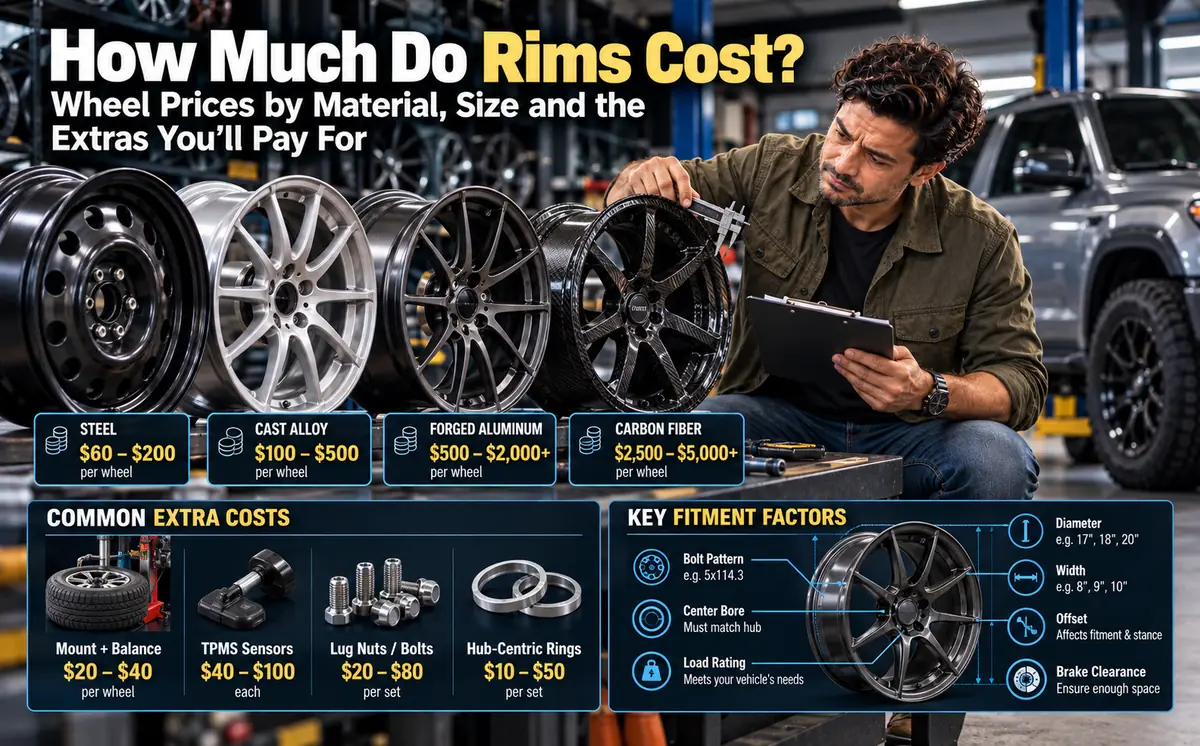
Rim Prices by Material
Material has the biggest single effect on price, because it determines how the wheel is made, how much it weighs and how it handles impacts.
| Wheel Type | Typical Price per Wheel | Typical Set of Four | Best For |
|---|---|---|---|
| Steel | About $60 to $200 | About $240 to $800 | Budget replacements, winter tire sets, work trucks |
| Cast aluminum alloy | About $100 to $500 | About $400 to $2,000 | Most daily drivers and style upgrades |
| Flow-formed alloy | About $200 to $500 | About $800 to $2,000 | Enthusiasts who want lighter wheels without forged prices |
| Forged aluminum alloy | About $500 to $2,000+ | About $2,000 to $8,000+ | Performance cars, track use, premium builds |
| Carbon fiber | About $2,500 to $5,000+ | About $10,000 to $20,000+ | High-end sports and supercars |
Steel Wheels
Steel is the cheapest and toughest everyday option. A hard pothole hit tends to bend a steel wheel rather than crack it, and a bent steel wheel can often be straightened or replaced inexpensively. The trade-off is weight: steel is heavier than aluminum, which adds unsprung and rotating mass and slightly dulls ride, handling and efficiency. Styling is basic, which is why steel wheels usually wear plastic hubcaps.
That combination makes steel the smart choice for a dedicated winter tire set, where salt, slush and hidden potholes punish wheels, and for work vehicles where looks matter less than durability and price.
Cast Aluminum Alloy Wheels
Cast alloy wheels are standard on most new cars and dominate the aftermarket. Molten aluminum is poured into a mold, which keeps costs reasonable while allowing almost any design and finish. They are lighter than steel, shed brake heat well and resist rust, though road salt can still corrode the finish over time.
The price spread is wide. Plain aftermarket alloys in common sizes sit near the bottom of the range, while large-diameter, multi-finish or name-brand designs climb toward the top. Cast alloys are less forgiving of hard impacts than steel and can crack rather than bend.
Flow-Formed and Forged Alloy Wheels
Flow-formed wheels start as castings, then the barrel is spun and pressed under heat to compress the metal. The result is a lighter, stronger barrel at a price between cast and forged.
Forged wheels are machined from a solid billet of aluminum shaped under enormous pressure. The dense grain structure allows a wheel that is both lighter and stronger than a cast equivalent, which is why forged wheels show up on performance cars and race cars. Brands such as BBS, Enkei and OZ Racing sell at the premium end, and custom forged wheels built to order for a specific car can go well past $2,000 per wheel.
Carbon Fiber Wheels
Carbon fiber wheels offer the lowest weight of all, which sharpens acceleration, braking and steering response. They are also the most expensive by a wide margin and are usually offered as factory options on high-end performance models. Repairs are specialized, and impact damage often means replacement rather than a fix, so they make sense only for buyers who value every pound saved and can absorb the cost.
How Size Changes the Price
Within the same material and brand, prices climb with diameter and width. A 15- or 16-inch steel or alloy wheel for a compact car is usually the cheapest. Moving to 18, 20 or 22 inches adds material, machining and finishing cost, so the same design can cost noticeably more for each step up in size. Truck and SUV wheels in large diameters and heavy-duty load ratings also cost more than passenger car wheels.
Bigger wheels carry hidden costs as well. Larger diameters usually mean lower-profile tires, which tend to cost more, ride more firmly and leave the wheel more exposed to pothole and curb damage. If you change wheel diameter, the tire’s sidewall height must shrink to keep the total tire diameter close to stock, so your speedometer, ABS and stability systems stay accurate. Our guide to reading tire sizes explains how to match a new size.
OEM vs. Aftermarket Rims
OEM wheels come from the automaker and are the exact wheels your car shipped with. Buying one new from a dealer is often the most expensive way to replace a single wheel; a factory alloy commonly runs about $250 to $800, and wheels for luxury or performance models can exceed $1,000 each. The advantage is a guaranteed match in appearance and fitment.
Aftermarket wheels come from independent manufacturers and span the full price range, from budget castings to premium forged designs. Within this group:
- Replica wheels copy the look of an OEM design at a lower price, and are a common way to replace one damaged factory wheel without paying dealer prices.
- Name-brand wheels from established companies usually bring better quality control, clearer load ratings and warranties against defects, and they tend to hold resale value better.
- Generic or unbranded wheels cost the least and come in a wide range of sizes, but quality, finish durability and warranty support can be inconsistent.
- Custom wheels built to order in a chosen size, width, offset and finish sit at the top of the market.
If you want to replace a single damaged wheel and keep the set matched, an OEM or close replica is the logical route. If you are changing the look of the whole car, aftermarket sets usually deliver more design and size choice for the money.
New, Used and Refurbished Rims
Buying used can cut the price substantially, often by a third to well over half of new. Used OEM wheels from salvage yards, wheel recyclers and online marketplaces are a popular way to replace a single damaged factory wheel, and used sets can also include discontinued designs that are no longer sold new.
The risk is hidden damage. Check any used wheel for bends, cracks, previous welding, heavy corrosion around the bead seat and lug holes, and curb rash. Ask whether it has been straightened or repaired, and if possible have a tire shop spin it on a balancer to check for runout before you mount a tire. Used wheels rarely come with a warranty.
Refurbished wheels sit in between. A specialist straightens, repairs and refinishes the wheel, and many sell remanufactured OEM wheels with a limited warranty at a lower price than new from the dealer. You can also refurbish your own wheels: cosmetic curb rash repair typically costs about $75 to $200 per wheel, straightening a bent alloy runs roughly $75 to $200, and a full strip and refinish can reach $150 to $300 or more. Cracked alloy wheels are best replaced, and many shops will not weld them.
The Add-On Costs Most Buyers Forget
The wheel price is only the start. These extras are where a budget plan can slip.
| Add-On | Typical Cost | When You Need It |
|---|---|---|
| Mounting and balancing | About $15 to $50 per wheel | Every time a tire goes onto a new wheel |
| TPMS sensors | About $40 to $100 per sensor, plus programming | Most vehicles from 2008 onward with direct TPMS |
| Lug nuts or bolts | About $20 to $80 per set | When the new wheel needs a different seat type or thread length |
| Wheel locks | About $25 to $60 per set | Optional theft deterrent |
| Hub-centric rings | About $10 to $30 per set | When the wheel’s center bore is larger than your hub |
| Valve stems | About $3 to $10 each | New stems with each mounting, unless TPMS is used |
| Wheel alignment | About $100 to $200 | If the suspension was damaged or you change size significantly |
Mounting and Balancing
A tire shop mounts each tire onto its wheel and balances the assembly with small weights so it rolls without vibration. Proper balancing protects ride quality, steering feel and tire wear. Many retailers include it when you buy tires and wheels together as a package.
TPMS Sensors
Most modern vehicles use direct tire pressure monitoring, with a sensor mounted inside each wheel. When you buy a second set of wheels, such as a winter set, you usually need four more sensors, and they must be programmed or relearned to the car. Some wheel and tire packages come with sensors installed. Moving your existing sensors to new wheels is possible, but it costs labor and leaves your old wheels without them.
Lug Nuts and Hub-Centric Rings
Aftermarket wheels often need different lug nuts than your factory set. The seat, which is the shape where the nut meets the wheel, comes in conical, ball and flat styles, and the wrong seat can let the wheel loosen. Some retailers include the correct hardware; many do not, so ask. Hub-centric rings fill the gap between a larger wheel bore and your hub so the wheel centers precisely, which helps prevent vibration.
Add these up and a set of four wheels can easily carry $150 to $500 or more in extras before tires enter the picture. If the new wheels require new tires because the size changed, that cost can rival the wheels themselves.
Fitment: What Has to Match
A wheel that does not fit is no bargain at any price. Confirm these specifications before buying, using your owner’s manual, the door-jamb placard, or a retailer’s vehicle lookup.
- Bolt pattern. The number of lug holes and the diameter of the circle they sit on, such as 5×114.3 or 4×100. It must match your hub exactly.
- Diameter and width. Measured in inches, such as 18×8. Width determines which tire sizes fit safely.
- Offset. The distance in millimeters between the wheel’s mounting surface and its centerline. A higher positive offset pulls the wheel inward toward the suspension, while a lower or negative offset pushes it outward toward the fender. Too much in either direction causes rubbing, changes steering feel and adds stress on wheel bearings.
- Center bore. The hole in the middle that fits over the hub. It must be equal to or larger than your hub, with hub-centric rings filling any gap.
- Load rating. Every wheel has a maximum load it can carry. It must meet or exceed what your vehicle requires, which matters most on trucks, SUVs, EVs and anything that tows.
- Brake clearance. Large brake calipers on performance models may not clear some wheel designs, even in the correct size.
When in doubt, buy from a retailer that guarantees fitment for your exact year, make, model and trim.
Where to Buy and Who Should Install
Tire and wheel retailers offer in-person advice, fitment checks and installation, often with mounting and balancing bundled into a wheel and tire package. Online retailers usually have the largest selection and sharp prices, and many ship mounted and balanced packages ready to bolt on. Auto parts stores carry a narrower range, mostly steel and basic alloy wheels. Dealers remain the main outlet for new OEM wheels.
Bolting on a pre-mounted, balanced wheel and tire package is a reasonable DIY job if you have a proper jack, jack stands and a torque wrench. Tighten lug nuts in a star pattern to the torque in your owner’s manual, then recheck torque after the first 50 to 100 miles. Mounting tires on bare wheels, balancing and programming TPMS sensors require shop equipment, so most buyers pay a shop for that part of the job.
Frequently Asked Questions
A basic steel replacement can cost under $100, a used or replica alloy typically runs about $100 to $300, and a new OEM alloy from a dealer often costs $250 to $800 or more. Add mounting, balancing and possibly a TPMS service kit to the wheel price.
Curb rash and minor bends are usually cheaper to repair, typically about $75 to $200 per wheel. Cracked alloy wheels, severe bends or damage near the lug holes generally call for replacement, because a compromised wheel can fail under load.
Yes. Prices rise with each step up in diameter and width, and larger wheels usually require pricier low-profile tires. They are also more vulnerable to pothole damage, which adds to long-term costs.
Sometimes. Wheel and tire packages often include hardware and sensors, but bare wheels frequently do not. Confirm before ordering so you are not surprised by an extra bill for sensors and lug nuts.
Not always. Swapping wheels of the same size does not change alignment settings. An alignment makes sense if the old wheel was damaged in an impact that may have affected the suspension, or if you notice the car pulling or uneven tire wear after the change.
Steel wheels are a popular choice for winter tire sets because they cost less, tolerate salt and potholes well and bend rather than crack. Alloy wheels work fine in winter too, but keep them clean to protect the finish from salt.
Strictly, the rim is the outer lip of the wheel that holds the tire bead, and the wheel is the whole part that bolts to the car. Most drivers and many retailers use rim to mean the whole wheel.
Not automatically. Larger wheels cost more at each size step and usually need lower-profile tires, which tend to cost more, ride more firmly and leave the wheel more exposed to pothole and curb damage.
What to Budget for New Rims
For most drivers, a set of four aftermarket cast alloy wheels in a common size lands somewhere around $600 to $1,600, plus roughly $150 to $500 for mounting, balancing, sensors and hardware. Steel wheels cut that substantially and are hard to beat for winter sets. Forged and carbon fiber wheels deliver real weight savings, but their prices only make sense for performance-focused buyers.
Start with fitment, set your budget for the whole package rather than the wheels alone, and decide whether new, used or refurbished best suits the job. For a single damaged factory wheel, a used or refurbished OEM wheel is often the best value. For a full style upgrade, a name-brand aftermarket set from a retailer that guarantees fitment gives you the most confidence for the money.
Sources
Specs, warranty terms and prices were checked on October 22, 2026. Prices change often.
- Synchrony: How much do rims cost? (price ranges by material and installation cost)
- Rent-A-Wheel: How much do rims cost? (price ranges)
 Summarize this article with:














Leave a comment