


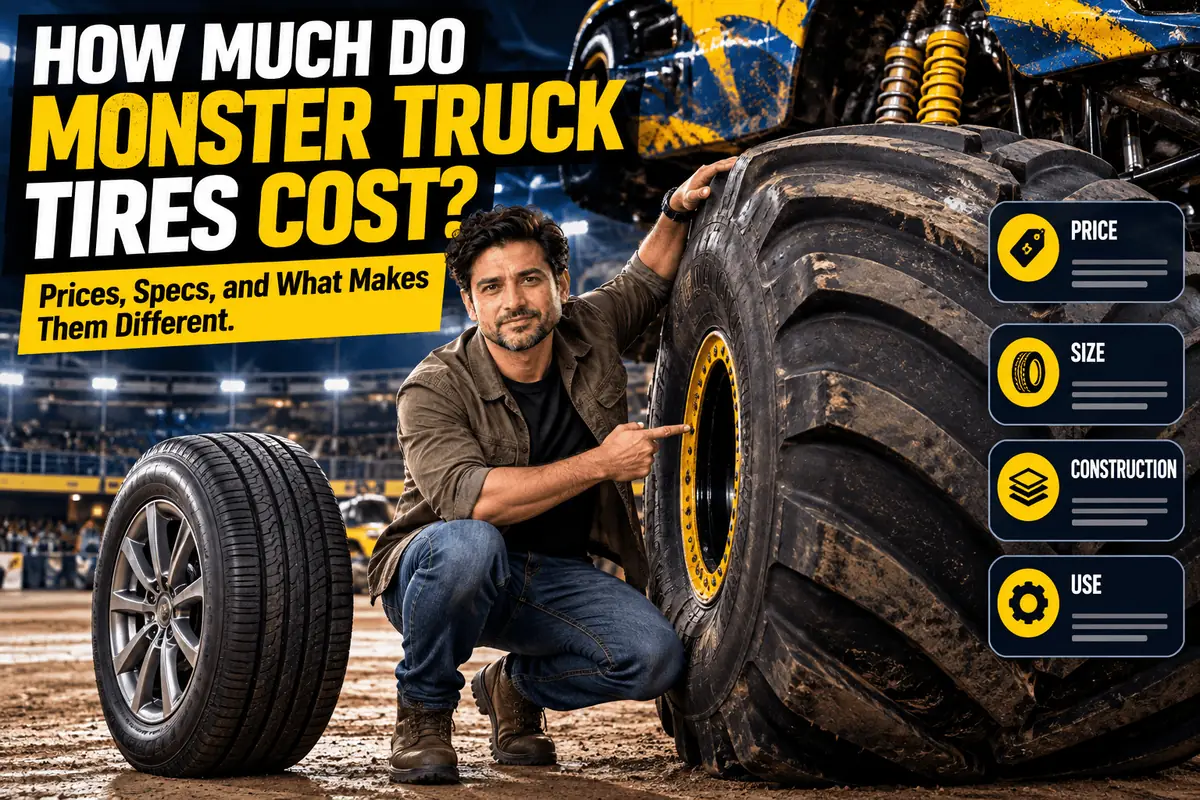
Sit in the stands at a monster truck show and the tires are the first thing you notice. They stand taller than most of the people in the pit area, they launch a multi-ton truck into the air and they absorb landings that would flatten an ordinary truck. It is natural to wonder what one of those things costs, and whether any of it relates to the big mud tires you see on lifted pickups at the local trailhead.
The short answer is that a single monster truck tire is widely reported to cost in the low thousands of dollars, with commonly cited figures running from roughly $2,000 to more than $4,000 each. This guide explains what drives that price, how the tires are built and maintained, how long they last and how they compare with the largest off-road tires you can buy for your own truck.
How this guide was put together: Monster truck tire prices are not published by the arena series, so the figures here come from press coverage, listed at the end. Checked on October 22, 2026.
Table of Contents
The Short Answer: Reported Prices Per Tire
Monster truck tires are not sold at retail tire shops, and the major arena series do not publish a price list, so every figure here is as reported rather than an official number. Published estimates generally fall between about $2,000 and a little over $4,000 per tire, and a figure around $2,600 per tire turns up often in coverage of the sport.
At those prices, a full set of four would land roughly in the $8,000 to $16,000 range, before wheels, mounting, spares or any of the labor teams put into preparing them. Treat those totals as ballpark math based on reported per-tire costs rather than a quote anyone has published.
| Item | Reported or Approximate Cost |
|---|---|
| Single monster truck tire | About $2,000 to more than $4,000, as reported |
| Commonly cited single-tire figure | Around $2,600 |
| Set of four, tires only | Roughly $8,000 to $16,000, based on reported per-tire prices |
| Consumer 40-inch-plus mud tire | Several hundred dollars to more than $1,000 each |
Why Monster Truck Tires Cost So Much
Sheer Size and Material
The standard arena tire measures 66 inches tall and 43 inches wide and mounts on a 25-inch wheel. That is a lot of rubber, fabric and steel bead in a single tire, and the raw material alone puts it in a different price class from anything on a passenger vehicle.
Low Volume
Only a small number of trucks compete in the major series, so these tires are made in tiny quantities compared with consumer tires. There are no economies of scale to spread the cost of molds, engineering and testing.
Purpose-Built Engineering
The tires have to survive repeated hard landings, sideways impacts, wheelies, flips and car crushing, all while giving enough grip on loose dirt to launch the truck. That takes specialized construction and compounds and a lot of testing before a tire ever reaches an event.
Who Makes Them: BKT and Monster Jam
BKT, the tire brand of India-based Balkrishna Industries, has been the official and exclusive tire manufacturer of Monster Jam since 2014, and the partnership has been extended through 2031. Every truck in the series runs on BKT tires.
The current tire is BKT’s FL 354 pattern, which the company describes as the fourth generation it has developed specifically for Monster Jam. Compared with earlier versions, it has more tread depth in the center, a more rounded shape, a width reduced by about 60 millimeters and extra blocks in the shoulder area for better traction when a truck lands at an angle.
The Farm Tire Origins
Purpose-built tires are a fairly recent development. For decades, monster trucks ran on large flotation tires, often called terra tires, borrowed from agricultural equipment such as fertilizer spreaders. Those tires spread a heavy machine’s weight across soft fields, which also made them a natural fit for a truck that needed to roll over cars and loose dirt. The famous Bigfoot 5 went even further, using 10-foot tires originally made for an Arctic land train.
Size, Weight and Pressure
| Spec | Monster Jam Figure |
|---|---|
| Height | 66 inches |
| Width | 43 inches |
| Wheel diameter | 25 inches |
| Weight | About 645 pounds for the tire and wheel combined |
| Inflation pressure | About 23 psi (1.6 bar) |
Weight figures vary depending on whether the wheel is included. Monster Jam lists about 645 pounds for the tire and wheel together, while BKT quotes roughly 211 kilograms, or about 465 pounds, for the tire alone. Older agricultural-style tires were often reported to weigh considerably more.
Tire Pressure
Monster Jam lists its trucks’ tires at about 23 psi. That may sound similar to a car tire, but it is a modest pressure for a tire carrying a truck that weighs several tons and lands from big jumps. Much lower figures, around 10 psi, are frequently quoted for monster trucks in general, so pressure clearly varies by truck, tire and setup. The relatively soft tire acts as part of the suspension, flexing on landings to soak up energy and spreading out to improve traction on dirt.
Monster truck tires do double duty as springs. The way they flex on a landing matters almost as much as the shocks.
Hand-Cut Tread: Shaving Rubber to Save Weight
One of the most distinctive traditions in monster truck racing is cutting tires by hand. Because early trucks ran on heavy farm tires, crews learned to carve down and groove the tread to remove weight. Historical accounts describe teams sharpening the tread bars and grooving the tires deep enough to cut the weight by about a third. Some reports describe crews spending 8 to 12 hours per tire with a heated knife and removing as much as 300 pounds of rubber, though figures vary from source to source.
Lighter tires help in several ways. Less rotating mass lets the truck accelerate faster and makes it easier to control in the air. Cutting also lets teams shape the tread for grip on a particular kind of dirt, and shorter tread bars throw less dirt into the stands. The arrival of purpose-built tires has changed how much cutting is needed, but tire preparation remains part of the work crews do between shows.
How Long the Tires Last and How Many Teams Use
There is no fixed lifespan. A tire can last through roughly a season of shows if the truck avoids major damage, or it can be ruined in a single run if a hard crash or an impact tears it. Freestyle runs with big jumps, backflips and rollovers are especially punishing.
That unpredictability is why teams think in terms of sets and spares rather than individual tires. Each truck runs four tires, and teams generally keep extras on hand so that a torn or damaged tire does not end a weekend. How many tires a team works through in a year depends on the number of events, the style of competition and plain luck, and no reliable published figure exists for a typical team.
Other Costs Around the Tires
The tires are only part of the bill. Teams also handle mounting on large beadlock wheels, inspections before and after each event, pressure adjustments, cutting and preparation, cleaning and transport. Those labor and equipment costs never show up in a per-tire price, but they add up across a touring season.
Can You Buy a Monster Truck Tire?
Occasionally. Used monster truck tires show up for sale from teams and collectors, sometimes for display, novelty builds or private trucks. Prices on the used market vary widely with condition, and a worn competition tire is not something to trust on another truck without a careful inspection. For most people, a monster truck tire makes more sense as a garage centerpiece than as a functional purchase.
How They Compare With Consumer “Monster” Mud Tires
The biggest tires most truck owners will ever buy are 40-inch and larger mud-terrain tires for lifted pickups and off-road rigs. They share the aggressive look but very little else.
Size. A 40-inch tire is big for a road vehicle, yet a 66-inch monster truck tire is more than half again as tall. The jump to 42, 44 or even larger sizes still leaves consumer tires far short of arena dimensions.
Construction. Consumer mud tires are DOT-approved for highway use, with load ratings and speed ratings tested for road driving. Monster truck tires are built purely for competition and are not street tires.
Price. Large mud-terrain tires commonly cost from several hundred dollars to more than $1,000 each, depending on brand, size and wheel diameter. For example, one retailer lists a Nitto Mud Grappler in 40×15.50R20 at about $810 per tire. That makes even premium 40-inch tires a fraction of the reported price of a single monster truck tire.
Use. A 40-inch mud tire has to work on the highway, on trails, in rain and often through winter, and it is expected to last tens of thousands of miles. A monster truck tire only has to survive a few minutes of extreme abuse at a time.
If you are shopping for big tires for your own truck, focus on the right size for your lift and gearing, the load rating your truck needs and how much of your driving happens on pavement. Bigger mud tires add weight, noise and fuel consumption, and they can strain brakes and drivetrain parts if the rest of the truck is not upgraded to match.
Frequently Asked Questions
Reported prices generally run from about $2,000 to more than $4,000 per tire, with a figure around $2,600 commonly cited. There is no official public price list, so treat these numbers as estimates.
The standard size used in Monster Jam is 66 inches tall and 43 inches wide, mounted on a 25-inch wheel. That makes the tire taller than many adults.
Monster Jam lists about 645 pounds for the tire and wheel combined. BKT quotes roughly 211 kilograms, about 465 pounds, for the tire alone.
BKT has been the official and exclusive tire manufacturer of Monster Jam since 2014, and the partnership runs through 2031. Its current tire uses the FL 354 pattern, the fourth generation developed for the series.
Monster Jam lists about 23 psi for its trucks, while figures around 10 psi are often reported for monster trucks in general. The relatively low pressure lets the tire flex and absorb energy on landings.
Cutting and shaving the tread removes weight, which helps acceleration and control in the air, and lets crews shape the tread for grip on dirt. The practice dates to the era when trucks ran on heavy agricultural tires.
The Final Word on Monster Truck Tire Costs
Monster truck tires sit in a price class of their own, with reported costs in the low thousands of dollars per tire and a full set likely running into five figures. The price reflects enormous size, specialized construction and tiny production runs, plus the hours of preparation and the constant risk that a single crash ruins a tire.
For truck owners, the useful comparison is the 40-inch-plus mud tire, which looks the part and costs several hundred dollars to more than $1,000 each. It will never land a backflip, but it will carry you to the trailhead and home again, which is a job no monster truck tire was ever built to do.
Sources
Specs, warranty terms and prices were checked on October 22, 2026. Prices change often.
- SlashGear: How big are monster truck tires ($2,000 to over $4,000 per tire, size, weight, lifespan)
- Top Gear Philippines: BKT on monster truck tires (2015) (manufacturer background)
 Summarize this article with:












Leave a comment