


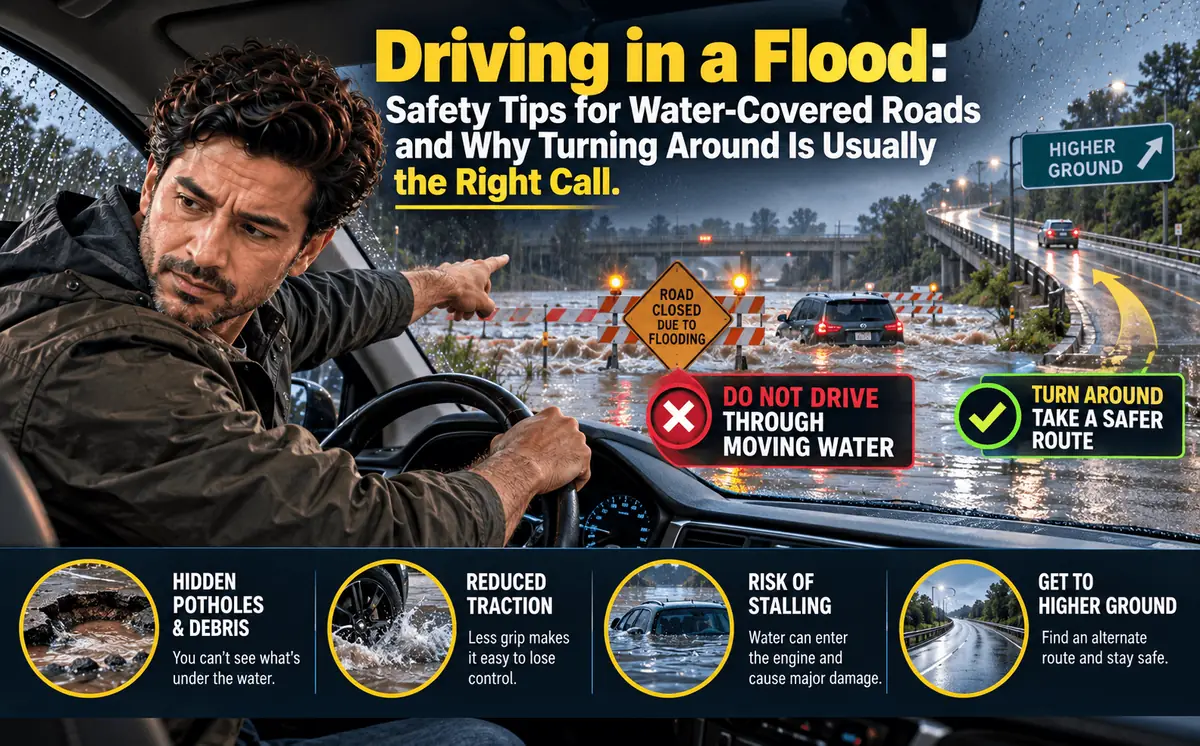
Most flood-related driving emergencies begin with the same thought: it doesn’t look that deep. Water across a road is almost impossible to judge from behind the wheel. A stretch that looks like a wide puddle can hide a washed-out section of pavement, a missing manhole cover, or a current strong enough to push a car sideways off the road.
The single most important flood-driving tip is also the simplest. If water is covering the road and you cannot be certain how deep it is or whether it is moving, do not drive into it. The National Weather Service sums it up in four words: turn around, don’t drown.
This guide explains why floodwater is so dangerous, how to prepare your car before heavy rain, how to handle wet roads and hydroplaning when you have no choice but to drive, what to do if your car stalls or gets caught in water, and how to check your vehicle afterward.
Table of Contents
Why Floodwater Is So Dangerous for Drivers
It Takes Less Water Than You Think
Water is heavy, and moving water carries a surprising amount of force. According to the National Weather Service, about 12 inches of moving water can float many cars, and 2 feet of rushing water can carry away most vehicles, including SUVs and pickups. Just 6 inches of fast-moving water is enough to knock an adult off their feet.
That is why “it’s only a few inches” is such a dangerous assumption. A small amount of water can still stall an engine, wash out traction, or begin to lift a vehicle, leaving the people inside stranded in exactly the place they least want to be.
What You Can’t See Can Hurt You
Floodwater is usually murky, which means you cannot see what is underneath. Common hidden hazards include:
- Sections of road that have been undermined or washed away entirely
- Deep potholes that have opened up under the water
- Dislodged manhole covers
- Submerged debris, from branches to downed power lines
- Currents that are much stronger than the surface suggests
Floodwater can also rise quickly. A crossing that was passable an hour ago may not be now, and a road you drove in on may not be one you can drive out on.
Water Destroys Traction
Even when water is shallow, it creates a serious risk of hydroplaning, when a layer of water builds up between the tires and the road. A hydroplaning car has very little steering or braking ability, and that loss of control can send it into another vehicle or off the road.
The Best Flood Strategy: Stay Informed and Stay Off the Road
The safest flood drive is the one you do not take. When heavy rain or flooding is forecast:
- Check conditions before you leave. Monitor the National Weather Service, your state or local government’s emergency information, and local news for flood warnings, road closures, and alternative routes.
- Take flood warnings seriously. If authorities advise against travel, postpone the trip if you can.
- Plan around low-lying roads. Know which routes near you tend to flood, and choose higher ground.
- Never drive around barricades. Road closures exist because officials know something about the road ahead that you cannot see.
- Keep checking. Conditions during a flood can change rapidly, so information from earlier in the day may already be out of date.
Prepare Your Car Before Heavy Rain
If you live somewhere prone to heavy storms or flooding, a few checks improve your safety on wet roads.
- Tires: Adequate tread depth is your main defense against hydroplaning, because the grooves channel water out from under the tire. Worn tires lose that ability quickly. Our guide to checking tire tread depth shows how to measure yours.
- Brakes: Wet roads lengthen stopping distances, so your brakes need to be in good working order.
- Fluids: Keep engine oil, coolant, and brake fluid at the recommended levels.
- Wipers and lights: Good wiper blades and working headlights are essential when rain is heavy.
Keep an emergency kit in the car with a first aid kit, water, non-perishable food, a flashlight, and a portable phone charger. If you are stranded or waiting for help, these supplies make a real difference.
If You Have to Drive in Heavy Rain
Slow Down and Smooth Out
On wet roads, reduce your speed well below what you would drive in dry conditions and hold a steady pace. Lower speeds reduce the risk of hydroplaning and give you more time to react.
- Avoid sudden braking, hard acceleration, and sharp steering. Each one can break the tires’ already-limited grip.
- Brake gently and early, and accelerate smoothly.
- Increase your following distance substantially, since stopping distances grow on wet pavement.
Judging Standing Water
When you come across water on the road, the safe default is to treat it as too deep unless you can clearly see the road surface beneath it and know it is not moving. If the water is opaque, you cannot see the pavement, or there is any sign of current, turn around and find another route.
Never try to drive through moving water. Even if it looks shallow, the current can push your car off the road, and the pavement underneath may already be gone. Remember too that deep water can do serious damage to the engine, transmission, and electrical systems, sometimes enough to total the vehicle.
Bridges and Low-Water Crossings
Bridges and low-water crossings are among the most dangerous places during a flood. Fast-moving water can push vehicles off a crossing, and the structure itself may have been damaged or undermined by the flood, raising the risk of collapse.
Do not attempt to cross if water is flowing over the road or the river is running high and fast. If conditions on a bridge look questionable, take another route or wait for the water to recede. It is always better to arrive late than to gamble on a crossing.
How to Handle Hydroplaning
Hydroplaning can happen at any speed, but it is more likely at higher speeds and in deeper water. You may notice the steering suddenly feels light or loose, the car feels as though it is floating, or the engine revs without a matching gain in speed as the drive wheels lose grip.
If it happens:
- Ease off the accelerator. Do not slam on the brakes or accelerate; either can make the skid worse.
- Hold the steering wheel firmly and keep your inputs small and controlled.
- Look and steer where you want to go. Keep your eyes on your intended path and steer gently in that direction as grip returns.
- Avoid sudden movements. A sharp turn or hard brake just as the tires bite again can cause another loss of traction.
- Slow down gradually once you have control, braking gently.
If Your Car Stalls or Gets Caught in Floodwater
If your car stalls in water, or water is rising around it, your safety matters far more than the vehicle. Do not try to restart or push the car in rising or moving water.
- Stay as calm as you can. Clear thinking is your biggest asset.
- Turn on your hazard lights so others can see you.
- Call 911 if you have a working phone. Give your exact location and describe the situation.
- Get out if the water is rising or moving. Unbuckle your seat belt, unlock the doors, and lower the windows while the car still has electrical power. Water pressure can make doors very difficult to open once water is against them, so if the door will not open, leave through the window.
- Get to higher ground, such as the roof of the car if the water is too dangerous to cross, or higher land nearby if you can reach it safely.
- Avoid wading through deep or moving water. It can hide open manholes, debris, and strong currents. If you absolutely must walk through water, use a stick or pole to probe the ground ahead of you.
- Help others only if it is safe. Do not put yourself at risk in moving water.
- Wait for emergency responders once you are somewhere safe. Do not go back to the vehicle or re-enter the water.
- Get medical attention if anyone is hurt or has been exposed to floodwater, which is often contaminated.
- Report the incident to the police and your insurance company once you are safe.
When to Call for Help
Do not hesitate to call emergency services if:
- Your car has stalled or is stuck in rising water
- Water is rising rapidly around the vehicle and you feel unsafe or trapped
- Anyone needs medical attention
- You have reached high ground but are stranded with no safe way to continue
For a car that is stuck somewhere safe, away from water, roadside assistance may be the right call instead. When in doubt, err on the side of caution.
After the Flood: Checking Your Vehicle
If your car has been driven through deep water or sat in a flood, it needs a careful inspection before you rely on it again.
If water may have reached the engine’s air intake, do not start the engine. Water drawn into the cylinders can cause severe internal damage. Have the car towed to a repair shop instead.
Once it is safe to assess the car, work through these checks:
| What to Check | What to Look For | Why It Matters |
|---|---|---|
| Interior | Damp carpets, upholstery, or footwells; musty smells | Trapped moisture leads to mold, odors, and electrical problems |
| Engine oil and transmission fluid | Milky or cloudy appearance, or a level that has risen | Water contamination causes rapid wear and can lead to failure; a fluid change is a sensible precaution |
| Other fluids | Signs of contamination in brake fluid, coolant, and differential fluid | Contaminated fluids lose their protective properties |
| Brakes | Reduced performance or unusual noises | Wet pads and rotors brake poorly, and water and debris can cause damage |
| Electrical system | Warning lights, flickering gauges, malfunctioning accessories | Water and electronics are a costly combination, and problems can surface weeks later |
| Underbody | Mud, debris, or damage | Debris can trap moisture and accelerate corrosion |
Right after driving through water, test your brakes gently at low speed. Light pressure on the pedal for a short distance helps dry the pads and rotors. If braking still feels weak or sounds wrong, have the brakes inspected.
Keep an eye out for warning lights or new noises in the days and weeks that follow. Flood damage to electrical systems is notorious for appearing gradually, and having a qualified technician inspect the car early can prevent more expensive problems later. If the car was submerged, contact your insurance company as well; comprehensive coverage typically includes flood damage, and a heavily flooded car may be declared a total loss.
Flood damage also matters if you ever buy a used car. Our guide to test driving a used car explains how to spot signs that a vehicle has been through a flood.
Frequently Asked Questions
According to the National Weather Service, around 12 inches of moving water can float many cars, and 2 feet of rushing water can carry away most vehicles, including SUVs and pickups.
The safest choice is to avoid it. Only consider shallow standing water when you can clearly see the road surface underneath and are sure the water is not moving. Never drive into moving water or around a barricade.
Do not try to restart it. Turn on your hazards, call 911, and if water is rising or moving, unbuckle, lower the windows, and get out, then move to higher ground or onto the roof of the car if crossing the water is unsafe.
Ease off the accelerator, hold the wheel firmly, and steer gently in the direction you want to go. Avoid hard braking or sudden steering until the tires regain grip, then slow down gradually.
Not until it has been checked. If water may have reached the engine’s air intake, do not start it at all; have it towed. Even if the car runs, have the fluids, brakes, and electrical system inspected, since flood damage often shows up later.
Yes. Tread grooves channel water away from the contact patch. As tread wears down, the tire’s ability to clear water drops sharply, making hydroplaning much more likely.
The Bottom Line
Floodwater is one of the few driving hazards where the right answer is almost always the same: don’t go in. It is impossible to judge depth or current from the driver’s seat, it takes surprisingly little moving water to float a car, and what lies under the surface is anyone’s guess.
Stay informed when storms are forecast, keep your tires and brakes in good shape for wet roads, and treat any water across the road as too deep until you know otherwise. If you ever do end up in trouble, remember that the car is replaceable and you are not. Get out, get to higher ground, and let the water win this one.
 Summarize this article with:












Leave a comment