


The first real storm of the season tends to sort drivers into two groups. One group creeps along with white knuckles, feeling the car push wide at every turn on worn all-seasons. The other group drives home with something closer to normal confidence because it bolted on a set of dedicated winter tires in November. If you are reading this, you are probably trying to join the second group without paying top-tier prices to do it. Cooper aims the Discoverer True North squarely at that driver.
In practice, the Cooper Discoverer True North is one of the more interesting answers to that problem. Despite the Discoverer name, which Cooper usually reserves for its truck and SUV tires, the True North is a studless ice and snow tire that fits everything from compact sedans to midsize SUVs. It carries the three-peak mountain snowflake symbol, leans on a high-silica compound and dense siping. Also, it comes without the price premium attached to the best-known winter names. This review explains what the tire does well, where it gives ground and which drivers should put it on their shortlist.
How this review was put together: We have not road-tested the Cooper Discoverer True North. This review is based on the manufacturer’s published information and retailer listings, with sources listed at the end. Warranty terms and prices change, so confirm them for your size before you buy.
Table of Contents
What the Discoverer True North Is (and What It Is Not)
Let’s clear up the biggest point of confusion first. The True North is a dedicated winter tire, built for cold-weather use from late fall to early spring. It is not an all-terrain tire, not an all-season tire and not a tire meant for year-round use. Cooper optimized its tread compound and pattern for temperatures where ordinary all-season rubber starts to harden and lose grip. However, that same softness works against it on hot summer pavement.
Cooper previewed the tire at the SEMA Show in late 2017 and put it on sale for the 2018 winter season. The original launch covered 17 passenger car sizes. At the time, Cooper pitched it as a winter tire that keeps the responsiveness of a touring tire rather than feeling vague and soft. The lineup has grown considerably since then and now includes a long list of crossover and SUV fitments. As a result, a tire with car roots ended up wearing a Discoverer badge.
It is also a studless design. You cannot add metal studs to the True North. Consequently, it stays legal everywhere states restrict studs, and it spares you the noise and pavement wear that come with them. Drivers who want the option of studs should look at Cooper’s Evolution Winter instead, which our Cooper Evolution Winter review covers in detail.
Cooper Tire has been part of Goodyear since June 2021, but Cooper still sells the True North under its own name, with its own warranty program.
Discoverer True North at a Glance
| Specification | Cooper Discoverer True North |
|---|---|
| Category | Studless ice and snow winter tire |
| Vehicle types | Coupes, sedans, minivans, crossovers and SUVs |
| Rim diameters | 15 to 20 inches |
| Size count | Roughly 40-plus sizes |
| Speed ratings | T (118 mph) and H (130 mph), depending on size |
| Load range | Standard load and XL, depending on size |
| Severe snow rating | Yes, three-peak mountain snowflake (3PMSF) |
| Studdable | No |
| Treadwear warranty | None (typical for winter tires) |
| Workmanship and materials | 6 years, free replacement for the first 2/32 inch of wear, then prorated |
| Test drive | 45-day exchange program |
Tread Design and Technology
A Compound Built for the Cold
Overall, the most important part of any winter tire is invisible. Cooper says the True North uses the highest silica content of any of its winter tires, and that compound stays pliable as temperatures fall. That flexibility is what lets the tread conform to the micro-texture of cold pavement, packed snow and ice rather than skating over it.
In fact, this is the reason a winter tire outperforms an all-season tire even on cold, dry roads. Below roughly 45 degrees Fahrenheit, a typical all-season compound firms up and loses some of its ability to grip. A dedicated winter compound such as the True North’s keeps working in exactly the conditions where you need it most.
Biting Edges and Siping
Cooper’s own headline for the True North is biting edges, and the tread is packed with them. High sipe density across the tread blocks creates hundreds of thin slits that open slightly as the tire rolls, giving the rubber edges something to claw with on ice and hard-packed snow. A saw-tooth center groove adds more edges down the middle of the footprint where braking and acceleration forces concentrate.
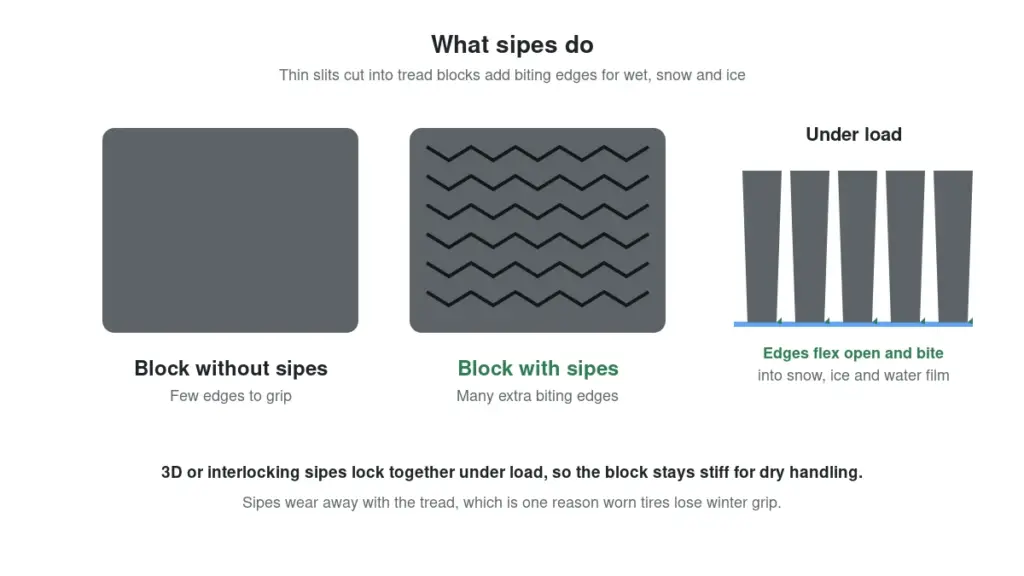
The practical benefit is most noticeable when starting from a stop on a slick intersection or braking on a glazed off-ramp. Edges are what keep the tire from spinning or sliding when the surface offers almost no friction.
Snow-Groove Technology
Cooper’s Snow-Groove Technology traps snow inside the tread rather than letting it all clear out. That sounds counterintuitive, but snow sticks to snow better than rubber sticks to snow. By holding a layer of packed snow in the grooves, the tire improves its grip in fresh and deep snow. In addition, Cooper credits the feature with better traction, handling and stopping power.
Handling Water and Slush
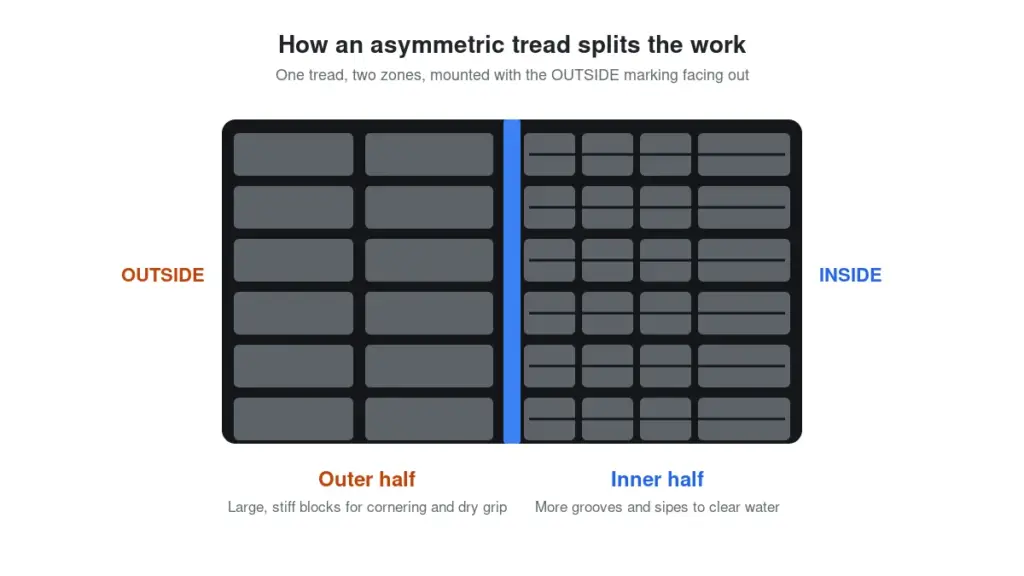
Winter roads are often wet rather than white, and slush is one of the most treacherous surfaces a driver can encounter. The True North uses a circumferential center groove and wide lateral notches to push water and slush out of the contact patch. The pattern is asymmetric, with a more open, higher-void layout toward the center and inboard shoulder for wet traction. Meanwhile, wider outboard shoulder blocks add cornering stability on cleared roads.
Construction
Beneath the tread, the True North uses a two-ply polyester casing, two wide steel belts and a single-ply nylon reinforcement. That nylon layer helps the tire hold its shape at speed and contributes to the steering response Cooper promised at launch. It is a conventional passenger tire build rather than a heavy-duty light truck construction. Therefore, it suits the cars and crossovers the tire is meant for.
How the True North Performs in Winter Conditions
Snow
Snow is where the True North earns its 3PMSF symbol. To display that marking, a tire must exceed a standardized traction benchmark on medium-packed snow. For that reason, it sits in a different class from all-season tires that carry only an M+S stamp. Our 3PMSF marking explained article goes deeper into what that test measures.
In practice, the combination of soft compound, dense siping and Snow-Groove Technology gives the True North the kind of snow traction most commuters need: confident starts, predictable stops and the ability to climb an unplowed residential street without drama. Drivers coming off all-season tires usually notice the difference immediately.
Ice
Ice is the hardest test for any studless tire, and it is where the most expensive premium winter tires tend to justify their pricing. The True North’s siping and cold-flexible compound give it a real advantage over all-season tires on glare ice, but no studless tire turns ice into dry pavement. Drivers in places where black ice and freezing rain are routine should still leave extra following distance and take corners gently.
Wet and Slushy Roads
The True North’s open grooves and lateral notches handle slush well for a tire at this price, which matters in regions where storms come with freeze-thaw cycles and roads are wet more often than they are snow-covered. Its hydroplaning resistance depends heavily on remaining tread depth, as it does with any winter tire, so keep an eye on the tread as the seasons pass.
Cold, Dry Pavement
Much of a winter tire’s life is spent on bare, cold roads between storms. Here the wide outboard shoulder blocks and the nylon-reinforced construction help the True North feel more planted than some softer studless designs. It will never feel as crisp as a summer or all-season tire in July, but its cold-weather manners on clear pavement are part of what Cooper meant when it talked about touring-tire responsiveness.
Ride Comfort and Noise
Studless winter tires have a reputation for a mushy feel and a constant hum, and the True North works to soften that reputation. Cooper says the tread runs quietly in winter, and the pliable compound helps soak up the sharp edges of frost heaves and broken pavement. The ride is comfortable rather than plush, which fits a tire meant for daily driving through an entire cold season.
You should still expect more noise and more squirm than an all-season tire produces. That is the trade-off for deep, heavily siped tread blocks, and it is shared by every tire in this category.
Tread Life and Warranty
Like most dedicated winter tires, the True North comes with no mileage-based treadwear warranty. Instead, Cooper covers workmanship and materials for six years, with free replacement during the first 2/32 inch of wear and prorated coverage after that. Uniformity issues are covered for the first 2/32 inch of wear, and the tire is part of Cooper’s 45-day test drive program, which lets buyers exchange the set for another Cooper tire if they are not satisfied. Warranty terms change from time to time, so confirm the current details when you buy.
How long a set lasts comes down to how you use it. Swapping the tires off in spring is the single biggest factor, because running soft winter rubber through hot weather wears it quickly and erodes the sipes that make it work. Our guide on how long winter tires last explains how to judge when a set has reached the end of its useful winter life, which usually happens well before the legal minimum tread depth.
Install the True North in a set of four. Cooper recommends it, and mixing winter tires on one axle with all-seasons on the other upsets the car’s balance in a skid.
Sizes and Fitment
Size coverage is one of the True North’s strongest selling points. The tire runs from 15-inch sizes such as 195/65R15 through 20-inch fitments such as 235/55R20 and 265/50R20. That range covers compact sedans, popular midsize cars and minivans, and a wide swath of crossovers and SUVs on 17- and 18-inch wheels.
Speed ratings are T or H depending on size. Many crossover and SUV fitments are T-rated, while numerous car sizes carry an H rating. If your vehicle originally came with H- or V-rated tires, a T-rated winter tire is a common and generally accepted choice for the cold season, but check your owner’s manual and local rules first.
Price and Value
Cooper has built its reputation on value rather than prestige, and the True North follows that pattern. It gives you a 3PMSF-rated studless winter tire with modern compound technology and a broad size lineup, usually without the cost of the flagship winter tires from Michelin and Bridgestone. Prices vary widely by size and retailer, so compare a few quotes before you buy.
How It Compares With Key Rivals
| Tire | Type | Studdable | Best For |
|---|---|---|---|
| Cooper Discoverer True North | Studless winter | No | Value-focused drivers of cars, crossovers and SUVs |
| Bridgestone Blizzak DM-V2 | Studless winter for SUVs and light trucks | No | SUV owners who want a premium benchmark |
| Michelin X-Ice Snow SUV | Studless winter for SUVs | No | Drivers who want a warrantied winter tire |
| General Altimax Arctic 12 | Studdable winter | Yes | Drivers who want the option of studs |
Cooper Discoverer True North vs. Bridgestone Blizzak DM-V2
The Blizzak DM-V2 is Bridgestone’s studless tire for SUVs and light trucks, and it is the name many winter shoppers compare everything else against. Choose the Blizzak if your winters bring frequent ice and you are willing to pay for a top-tier option. Choose the True North if you want strong snow capability at a lower price, or if you drive a car or small crossover in sizes where the DM-V2 does not apply.
Cooper Discoverer True North vs. Michelin X-Ice Snow SUV
Michelin’s X-Ice Snow SUV stands out because it carries a 40,000-mile treadwear limited warranty, which is unusual in the winter category. Choose the Michelin if you want written mileage protection and do not mind paying a premium for it. Choose the True North if upfront cost matters more and you plan to manage tread life yourself through careful seasonal swaps.
Cooper Discoverer True North vs. General Altimax Arctic 12
Of course, the Altimax Arctic 12 is a studdable winter tire, which is the key difference. Choose the General if you live in a rural or mountainous area where studs are legal and ice is a constant threat. Choose the True North if you prefer a quieter studless setup, drive where studs are restricted or simply do not want to deal with stud seasons and pavement noise.
Who Should Buy the Discoverer True North
The True North makes the most sense for drivers who face real winters but spend most of their time on maintained roads. Commuters in the Midwest, Northeast and Mountain West who deal with regular snow, slush and cold pavement will get the most out of it.
- Owners of sedans, minivans, crossovers and SUVs who want one winter tire family that covers nearly any vehicle in the household
- Drivers switching from all-season tires who want a clear step up in snow traction without paying premium-brand prices
- Families who want a 3PMSF-rated tire for school runs and commuting on plowed and salted roads
- Shoppers who prefer a studless tire for quieter running and broad legal use
Who Should Look Elsewhere
- Drivers in areas where glare ice and freezing rain are constant may prefer a premium studless tire or a studded setup
- Owners of heavy-duty pickups and LT-sized trucks will need a light truck winter tire with appropriate load ranges
- Anyone hoping to run winter tires year-round should choose an all-weather tire instead, since soft winter rubber wears quickly in warm weather
- Buyers who want a mileage warranty on their winter tires will find better protection from rivals such as the Michelin X-Ice Snow SUV
Pros and Cons
Pros
- Studless design with the three-peak mountain snowflake rating for severe snow
- High-silica compound that Cooper says stays flexible in the cold
- Dense siping and Snow-Groove Technology for traction in snow and on ice
- Wide size range from 15 to 20 inches covering cars, crossovers and SUVs
- Six-year workmanship and materials coverage plus a 45-day test drive
- Strong value compared with premium winter flagships
Cons
- No treadwear mileage warranty
- Not studdable for drivers who face constant ice
- More noise and less precise steering than an all-season tire, as with any studless winter tire
- Not offered in LT sizes for heavy-duty trucks
More Cooper reviews: Cooper Cobra Instinct, Cooper Discoverer EnduraMax and Cooper Discoverer Snow Claw
Frequently Asked Questions
No. Despite carrying the Discoverer name, the True North is a dedicated studless winter tire. It is meant for cold-weather driving on paved roads covered in snow, slush and ice, not for off-road trails or year-round use.
No. The True North is a studless design and has no stud pockets. Drivers who want the option of studs should look at Cooper’s Evolution Winter or another studdable winter tire.
Similarly, it does not carry a mileage-based treadwear warranty, which is normal for winter tires. Cooper covers workmanship and materials for six years, with free replacement during the first 2/32 inch of wear, and the tire is part of Cooper’s 45-day test drive program.
Indeed, it is a clear upgrade over all-season tires on ice, thanks to its cold-flexible compound and dense siping. Premium studless tires and studded tires can still offer more bite on glare ice, so drivers in especially icy regions should weigh those alternatives.
The tire comes in rim sizes from 15 to 20 inches, covering coupes, sedans, minivans, crossovers and many SUVs. It is not offered in LT sizes, so heavy-duty pickups need a light truck winter tire instead.
Buy four. Cooper recommends installing the True North in complete sets, and mixing winter tires with all-season tires creates a traction imbalance between the axles that can make the car unstable in a slide.
Swap them off once daytime temperatures consistently stay above about 45 degrees Fahrenheit. Running a soft winter compound through warm weather accelerates wear and shortens the number of winters the set will last.
The Bottom Line on the Discoverer True North
The Cooper Discoverer True North does what a winter tire for everyday drivers should do. It delivers 3PMSF-rated snow traction, meaningful gains on ice and slush over all-season tires and acceptable comfort for daily commuting, all in a size range broad enough to cover almost any car or crossover in the driveway. Cooper’s high-silica compound, dense siping and Snow-Groove Technology give it a credible technical foundation, and its value positioning makes a dedicated winter set more attainable.
It is not the last word in ice traction, and it lacks the mileage warranty a few rivals offer. If your winters are dominated by glare ice or you drive a heavy-duty truck, look elsewhere. For the large majority of drivers who face snow, slush and cold pavement on maintained roads, the True North is a smart, cost-conscious way to make winter driving safer and far less stressful.
Sources
Specs, warranty terms and prices were checked on October 23, 2026. Prices change often.
- Cooper Discoverer True North on the manufacturer’s site (official product page: specs, sizes and warranty terms; accessed October 29, 2026)
 Summarize this article with:












Leave a comment