


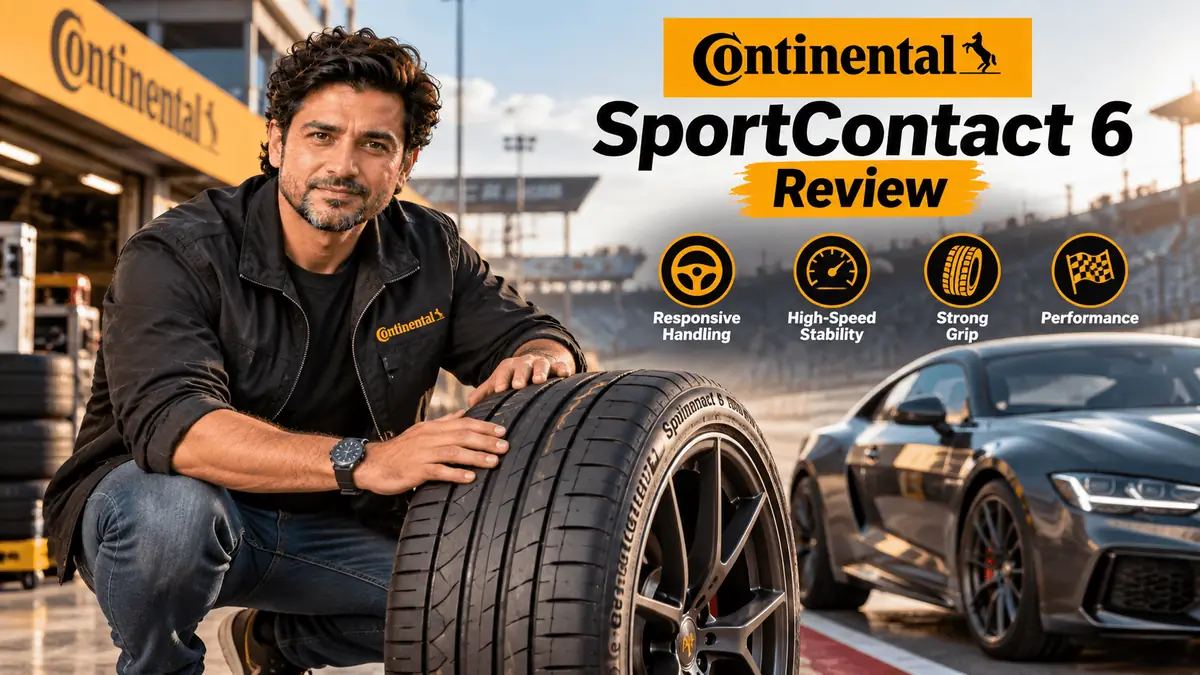
Some performance tires try to be all things to all drivers. The Continental SportContact 6 does not. It is a summer tire built for sports cars, performance coupes, and high-powered sedans, and every part of it points toward grip, steering precision, and stability at speed. If you own a car that deserves that kind of tire and you drive it in warm weather, the SportContact 6 belongs on your shortlist. If you need one set of tires to get through January, it does not.
The SportContact 6 succeeded the SportContact 5 and has since been followed by the SportContact 7, so it now occupies an interesting spot: a proven, high-level summer tire that can sometimes be found at a better price than the newest generation. That makes the question less “Is it good?” and more “Is it still the right buy?”
How this review was put together: We have not road-tested the SportContact 6. This review is based on the manufacturer’s design information and retailer listings, with sources listed at the end. Checked on October 22, 2026.
Table of Contents
Where the SportContact 6 Fits
Continental groups its summer performance tires into tiers. The SportContact 6 sits in the max-performance summer category alongside the SportContact 7 and the ExtremeContact Sport. It competes directly with the Michelin Pilot Sport 4S, the Bridgestone Potenza RE050A, and Pirelli‘s P Zero family.
Those rivals set a very high bar, and the SportContact 6 meets it where it counts most for enthusiasts: dry grip and steering response.
Dry Performance: The Reason to Buy It
On dry pavement the SportContact 6 is outstanding. Grip in corners is tenacious, turn-in is immediate, and the tire communicates clearly through the steering wheel, so drivers can feel how much margin remains. That feedback is what separates a good performance tire from a great one. Raw grip numbers matter, but confidence comes from knowing what the tire is doing.
Braking is equally strong. Stops from highway speed are short and consistent, and the tire stays composed when braking and turning overlap, such as when a corner tightens unexpectedly.
The tire’s construction supports this behavior. A silica-enhanced tread compound works with a stiff casing and reinforced sidewalls to limit flex under load. The result is a tire that stays planted and predictable when the car is leaned hard into a corner.
For rear-wheel-drive muscle cars and powerful sports cars, the SportContact 6 also puts power down well, with good traction when launching and accelerating out of corners.
Wet Roads: Strong, With Specialists Ahead
Summer tires are not just dry-weather tires. They are warm-weather tires, and warm weather includes thunderstorms. The SportContact 6 handles rain competently. An asymmetric tread with wide circumferential grooves clears water from the contact patch, and the silica-rich compound keeps grip high on wet pavement. Braking and cornering in the rain remain confident.
Where it trails slightly is outright hydroplaning resistance. Some rivals, the Michelin Pilot Sport 4S in particular, are known for exceptional standing-water performance. Drivers who routinely face heavy summer downpours may find that worth weighing.
Ride, Noise, and Daily Driving
For a max-performance tire, the SportContact 6 is reasonably civilized. Ride quality is firm but not punishing, and tread noise is controlled well enough for daily commuting. It will not match a luxury touring tire for quietness, and noise rises slightly above that of a grand touring tire at highway speed, but it should be livable for most sports car and sport sedan drivers.
Cold Weather: A Firm Limit
This is the most important caveat in the review. The SportContact 6 is a dedicated summer tire. Its compound stiffens as temperatures approach freezing, and it has neither the siping nor the rubber chemistry needed for snow or ice. It should not be driven in winter conditions.
Drivers in climates with real winters should plan for a second set of wheels and winter tires, or choose an ultra-high-performance all-season such as the Continental ExtremeContact DWS06 Plus if they need one tire year-round.
Tread Life and Cost
Max-performance summer tires trade longevity for grip, and the SportContact 6 is no exception. SimpleTire lists no mileage warranty, and tread life depends on the vehicle, the size, and, most of all, the driver. Aggressive driving and track days will shorten that considerably.
Rivals such as the Bridgestone Potenza RE050A can last somewhat longer. The SportContact 6’s advantage is the level of grip and feedback it delivers while it lasts.
Pricing reflects its premium position. It typically costs 20% to 30% more than mainstream touring tires, but it is competitive with other top-tier summer performance tires in the same sizes.
SportContact 6 vs. Its Main Rivals
| Tire | Where it stands out | Main trade-off vs. SportContact 6 |
|---|---|---|
| Continental SportContact 6 | Dry grip, steering feedback, stability at speed | Tread life is modest |
| Michelin Pilot Sport 4S | Excellent wet grip and hydroplaning resistance | Usually priced higher |
| Bridgestone Potenza RE050A | Durability, often longer tread life | Less of a benchmark for dry precision |
| Pirelli P Zero | Wide OE use on performance cars | Character varies by specific P Zero version |
Choose the SportContact 6 if dry-road precision and feedback matter most and you can find it at a good price.
Choose the Pilot Sport 4S if you want the strongest all-around wet performance and are willing to pay for it.
Choose the Potenza RE050A if longevity carries more weight than the last increment of grip.
Pros and Cons
Pros
- Excellent dry grip, handling, and braking
- Precise, communicative steering
- Strong high-speed stability and composure
- Confident wet traction and braking
- Reasonably comfortable for a max-performance tire
Cons
- Short tread life compared with touring and grand touring tires
- Somewhat more road noise than luxury touring tires
- Summer-only: unsuitable for snow, ice, or near-freezing temperatures
- Premium pricing
Who Should Buy the SportContact 6?
Best for: Owners of sports cars, performance coupes, and high-powered sedans who drive in warm climates or run winter tires in the cold months.
Good fit for: Enthusiasts who do occasional track days and want a street tire with strong feedback and grip.
Look elsewhere if: You need year-round capability, you prioritize long tread life, or you want the newest generation’s refinements, in which case the SportContact 7 is the logical next step.
Frequently Asked Questions
No. It is a summer tire and should not be used in snow, on ice, or in near-freezing temperatures.
There is no official figure or mileage warranty; expect short tread life typical of max-performance summer tires.
Yes. It offers strong wet grip and braking, though some rivals, such as the Michelin Pilot Sport 4S, have an edge in resisting hydroplaning in deep standing water.
The SportContact 7 is the newer design and is the better choice if you want the latest version. The SportContact 6 remains a strong performer and can make sense if it is available in your size at a meaningful discount.
Final Verdict
The Continental SportContact 6 is a serious summer tire for serious drivers. Its dry grip, steering feedback, and composure at speed put it among the best in its class, and its wet performance is strong enough for real-world summer driving. The trade-offs are the usual ones for this category: modest tread life, a premium price, and zero winter capability. For the right car in the right climate, it is an easy tire to recommend.
Sources
Specs, warranty terms and prices were checked on October 22, 2026. Prices change often.
- SimpleTire: Continental SportContact 6 (no mileage warranty, prices ($205–$528), ratings)
 Summarize this article with:













Leave a comment