


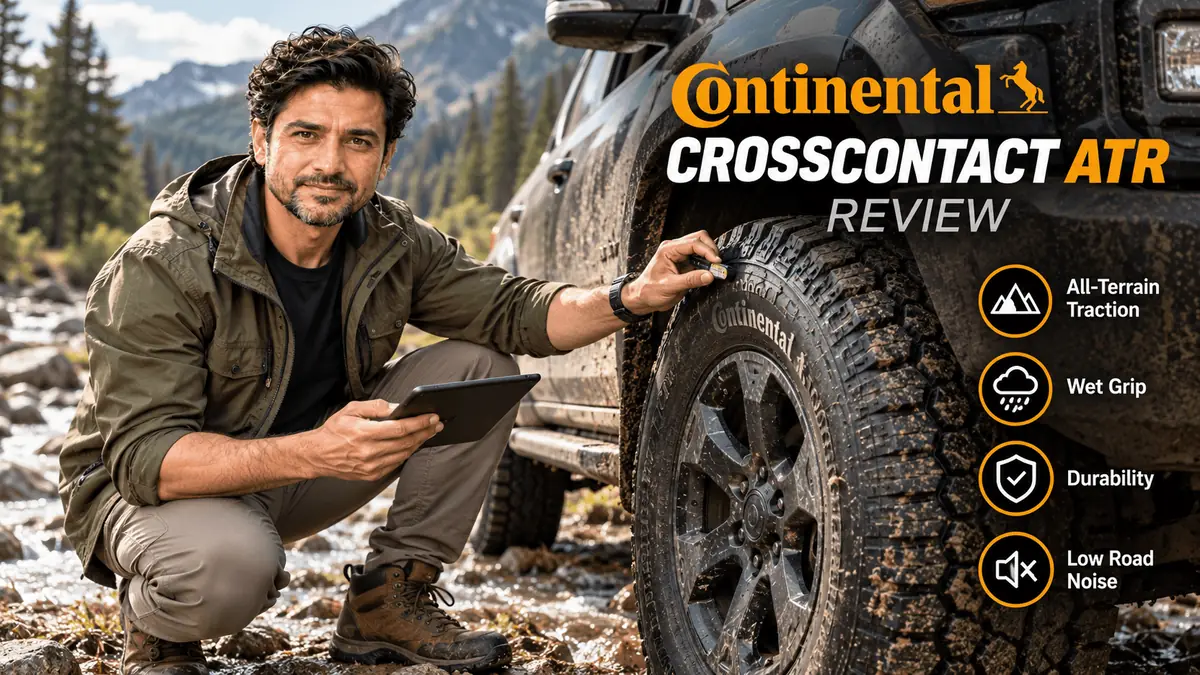
If you drive a pickup, SUV, or crossover, the all-terrain tire you choose shapes how the vehicle feels every single day. Pick something too aggressive, and your commute becomes loud and harsh. Pick something too mild, and the first muddy trail becomes a problem. The Continental CrossContact ATR aims squarely at the middle ground, pairing genuine off-road capability with on-road manners that make it easy to live with.
It isn’t the most extreme all-terrain tire on the market, and it doesn’t try to be. It’s a well-rounded choice for drivers who split their time between pavement and trail.
How this review was put together: We have not road-tested the CrossContact ATR. This review is based on the manufacturer’s design information and retailer listings, with sources listed at the end. Checked on October 22, 2026.
Table of Contents
The Case for the CrossContact ATR
- On-road refinement: A quiet, comfortable ride and precise handling for an all-terrain tire.
- Real off-road traction: Deep grooves and interlocking blocks grip mud, gravel, sand, and rocky ground.
- Year-round usability: Strong wet traction and respectable snow and ice performance.
- Longevity: A wear-resistant compound designed for even wear (no mileage warranty).
Construction and Technology
The CrossContact ATR’s tread uses a dual-compound design: a more durable outer layer for treadwear and off-road traction, and a softer inner layer for on-road comfort and grip. Continental‘s TractionPlus Technology adds interlocking tread blocks and sipes that improve traction on mud, gravel, and sand, while wide grooves expel water, mud, and debris.
Underneath, high-strength steel belts and a polyester casing provide durability, puncture resistance, and a smooth ride. The sidewalls are reinforced to resist cuts and abrasions, which helps on rocky trails. Continental also applies its EcoPlus Technology to reduce rolling resistance and improve fuel efficiency.
Pavement Performance
Dry Roads
For an all-terrain tire, the CrossContact ATR is impressive on dry pavement. Large tread blocks and a rigid pattern resist squirm, so steering is precise and high-speed stability is confident. Braking is strong, with short stopping distances, and the tire stays composed under hard braking without excessive noise or vibration.
Wet Roads
Wet performance is a standout. Siped tread blocks and wide circumferential grooves channel water away, keeping the tire in contact with the road and providing strong hydroplaning resistance. Wet braking is short compared with many competitors, and handling and lateral grip stay predictable during heavy downpours.
Comfort and Noise
The CrossContact ATR rides remarkably smoothly for an all-terrain tire. Its tread design and casing absorb road imperfections on pavement and cushion occupants on gravel roads and light trails. A variable-pitch tread design reduces the drone typical of aggressive off-road treads, leaving only a moderate amount of tire roar at highway speeds.
Off-Road Capability
Off the pavement, the CrossContact ATR’s deep, wide grooves and sturdy blocks grip gravel, dirt, and mud, and the tread clears mud effectively to avoid clogging. Its open pattern and biting edges dig into sand and loose soil, and its compound resists cutting and chipping on rocky surfaces. It can even handle mild to moderate rock crawling.
That said, dedicated mud-terrain tires still perform better in the most extreme conditions.
Snow and Ice
The CrossContact ATR offers respectable winter performance for an all-terrain tire. Deep, interlocking grooves and sipes grip packed snow and slush, and a compound that stays pliable in cold temperatures helps on icy surfaces. It’s a meaningful step up from many highway tires in snow, but it isn’t a substitute for dedicated winter tires in areas with prolonged heavy snow and ice.
Tread Life and Warranty
Continental’s wear-resistant compound, an optimized tread design and pitch sequence, and a robust two-ply polyester casing give the CrossContact ATR strong durability and even wear. The CrossContact ATR does not carry a mileage warranty, according to SimpleTire‘s listing (checked October 2026), though it is covered by Continental’s limited warranty of up to 72 months against defects. Aggressive off-road use or neglected rotations will shorten tread life.
Sizes
| Rim diameter | Example sizes |
|---|---|
| 15 inches | 235/75R15, 265/75R15 |
| 16 inches | 245/70R16, 265/70R16, 285/75R16 |
| 17 inches | 265/65R17, 285/70R17 |
| 18 inches | 265/60R18, 285/65R18 |
| 20 inches | 275/60R20, 285/55R20 |
Crossovers and SUVs typically use 16- to 18-inch sizes, while light trucks and pickups often use 17- to 20-inch sizes. Check your owner’s manual, load rating, and clearance before choosing.
Price and Value
The CrossContact ATR usually falls in the mid-to-upper price range compared with all-terrain tires from BFGoodrich, Goodyear, and Michelin. Its blend of comfort, capability, and long tread life helps offset the higher upfront cost.
How It Compares
| Rival | How the CrossContact ATR compares |
|---|---|
| BFGoodrich All-Terrain T/A KO2 | Better on-road manners and a quieter ride; the KO2 remains the better choice for hardcore off-roading |
| Falken Wildpeak AT3W | The CrossContact ATR edges it in wet-weather performance and treadwear |
| Goodyear Wrangler All-Terrain Adventure with Kevlar | The Goodyear offers exceptional puncture resistance; the Continental delivers better on-road performance and ride quality |
Who Should Buy It
The CrossContact ATR suits owners of pickups, SUVs, and crossovers who drive on pavement daily but regularly venture onto dirt trails, gravel paths, and snowy roads. Its comfort makes it a good fit for family vehicles and commuters, and its durability suits drivers who want long service life.
Pros and Cons
Pros
- Excellent dry and wet performance on pavement
- Capable off-road traction and durability
- Impressive snow and ice grip for a non-winter tire
- Quiet, comfortable ride at highway speeds
- No mileage warranty
- Wide range of sizes
Cons
- Less extreme off-road capability than dedicated mud-terrain tires
- Priced above budget all-terrain options
- Tread can wear faster with aggressive off-road use or skipped rotations
- Limited choice of aggressive sidewall styling
Frequently Asked Questions
Yes, for mud, gravel, sand, and mild to moderate rock crawling. For the most extreme conditions, a mud-terrain tire is better.
For an all-terrain tire, yes. Its variable-pitch tread reduces drone, leaving only moderate road noise at highway speeds.
It does not carry a mileage warranty. It is covered by Continental’s limited warranty of up to 72 months against defects in materials and workmanship.
No. It handles snow and ice better than many highway tires, but dedicated winter tires are safer in areas with prolonged heavy snow and ice.
Respectably, for an all-terrain tire. Deep interlocking grooves and sipes grip packed snow and slush, and the compound stays pliable in the cold, but it is not a substitute for winter tires in prolonged heavy snow and ice.
Final Verdict
The Continental CrossContact ATR is one of the more livable all-terrain tires available. It’s quiet and composed on pavement, strong in the rain, respectable in snow, and and genuinely capable off-road.
Hardcore off-roaders will still prefer a more aggressive tread. For everyone else who wants one tire for the commute and the trail, the CrossContact ATR is a strong, balanced choice.
Sources
Specs, warranty terms and prices were checked on October 22, 2026. Prices change often.
- SimpleTire: Continental CrossContact ATR (no mileage warranty)
 Summarize this article with:











Leave a comment