


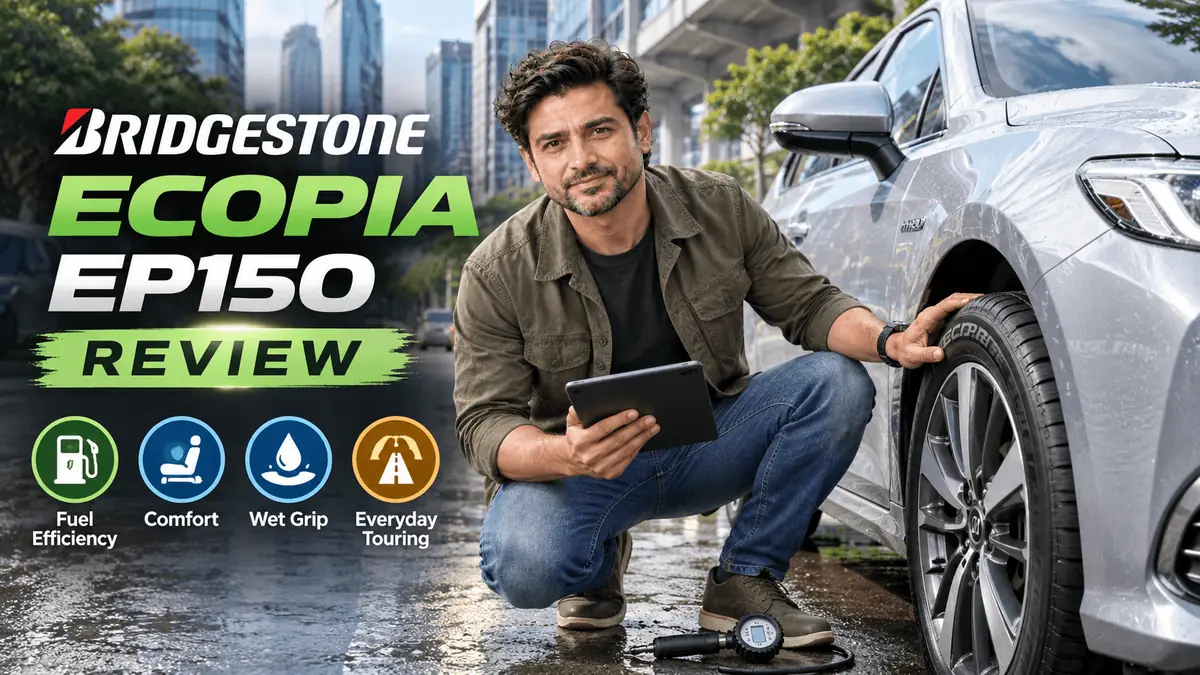
The Bridgestone Ecopia EP150 exists for one main reason: to help drivers spend less on fuel. As part of Bridgestone‘s Ecopia family, it focuses on low rolling resistance, and it pairs that efficiency with a quiet ride and dependable everyday traction.
It is best suited to commuters and highway drivers who want to keep running costs down. Here is how it performs.
How this review was put together: We have not road-tested the Ecopia EP150. This review is based on the manufacturer’s design information and retailer listings, with sources listed at the end. Checked on October 22, 2026.
Table of Contents
Design Built Around Efficiency
Every part of the EP150 targets lower energy loss. A lightweight but strong casing reduces overall weight, a silica-enriched Ecopia compound lowers rolling resistance while holding grip, and Bridgestone’s NanoPro-Tech technology uses advanced polymers to keep the tread rigid and the contact patch consistent over the tire’s life. A low-deformation sidewall design further limits energy loss as the tire rolls.
Tread Pattern and Grip
The asymmetric tread uses multiple circumferential grooves and sipes to clear water and resist hydroplaning. Rigid tread blocks and high-density siping provide stable dry grip and responsive steering, and a continuous center rib supports efficient rolling. Multi-angled sipes and deep grooves give it reasonable bite in light snow, making it workable in regions with mild winters.
Ride Comfort and Noise
A specialized compound absorbs road vibrations, and variable-pitch grooves and optimized siping reduce pattern noise. A polyester casing ply helps insulate the cabin. The result is a smooth, quiet ride on highways and city streets, well suited to long commutes.
Fuel Efficiency
Low rolling resistance is the EP150’s headline benefit. By minimizing energy loss, it helps reduce fuel consumption and emissions, with the biggest savings going to drivers who log high mileage. Actual gains depend on the vehicle, driving style, and the tires being replaced.
Durability and Warranty
The compound resists irregular wear such as cupping and feathering, and the tread pattern spreads wear evenly. Bridgestone covers the EP150 against defects in materials and workmanship; SimpleTire lists no mileage warranty for it, so check treadwear coverage for your size.
Sizes and Price
The EP150 comes in a wide range of sizes, from 15-inch fitments for compact and midsize sedans from Honda, Toyota, and Nissan to larger sizes for minivans and crossovers. SimpleTire listed sizes from about $110 to $185 per tire in October 2026; compare it against efficiency tires from Michelin, Goodyear, and Continental in your size.
| Consideration | Ecopia EP150 |
|---|---|
| Best for | Commuters and highway drivers focused on fuel savings and comfort |
| Main strengths | Low rolling resistance, quiet ride, dependable wet and dry grip |
| Main limitations | Limited in severe winter conditions; not a performance tire |
| Price position | About $110 to $185 per tire (SimpleTire) |
How the EP150 Fits in the Ecopia Family
Bridgestone’s Ecopia line spans several efficiency-focused tires. The Ecopia EP422 and EP422 Plus are grand touring all-season tires with long treadwear warranties, the Ecopia EP500 sits in the grand touring summer category, and the Ecopia H/L 422 Plus brings the same efficiency approach to SUVs and crossovers. The EP150 is the more budget-conscious option, aimed at everyday commuting cars where low running costs matter most.
Is It Right for You?
| Your situation | EP150 fit |
|---|---|
| High-mileage commuter in a mild climate | Excellent |
| Eco-conscious driver focused on emissions | Excellent |
| Driver who wants sporty handling | Poor; consider a performance all-season tire |
| Regular snow and ice | Poor as a year-round tire; pair with winter tires |
Maximizing Fuel Savings
The EP150’s efficiency depends on correct inflation. Underinflated tires flex more and waste energy, cancelling out much of the benefit of a low-rolling-resistance design. Checking pressures monthly is the single easiest way to get the fuel savings you paid for.
Getting the Most From a Set
- Rotate on schedule, typically every 5,000 to 7,000 miles, to keep wear even across all four tires.
- Check pressures monthly with the tires cold, using the figure on the door-jamb placard rather than the maximum printed on the sidewall.
- Check alignment after a hard pothole or curb strike, or whenever the vehicle pulls or the steering wheel sits off-center.
- Inspect regularly for cuts, bulges, and embedded debris, and replace tires at the wear bars (2/32″).
Pros
- Low rolling resistance for better fuel economy
- Quiet, comfortable ride
- Good dry and wet traction
- Even wear
- Competitive pricing
Cons
- Not suited to severe winter conditions
- Not designed for spirited driving
- No mileage warranty listed at SimpleTire
Who Should Buy It
- Eco-conscious drivers who want to cut fuel use and emissions.
- Commuters and highway drivers who value a quiet, comfortable ride.
- Drivers in mild-winter regions who need year-round traction without dedicated winter tires.
Drivers in areas with harsh winters should pair the EP150 with winter tires for the cold months.
Frequently Asked Questions
An efficiency-focused tire from Bridgestone’s Ecopia line, designed to lower rolling resistance and fuel use.
Yes. Its variable-pitch tread and casing construction keep road noise low.
It handles light snow in mild climates, but it is not suitable for severe winter conditions.
SimpleTire listed sizes from about $110 to $185 per tire in October 2026.
Final Verdict
The Ecopia EP150 is a practical, efficient tire that makes daily commuting cheaper and quieter. It is not exciting and not built for harsh winters, but for drivers who want lower fuel bills and a comfortable ride at a reasonable price, it delivers.
Sources
Specs, warranty terms and prices were checked on October 22, 2026. Prices change often.
- SimpleTire: Bridgestone Ecopia EP150 (no mileage warranty listed, prices)
 Summarize this article with:













Leave a comment