


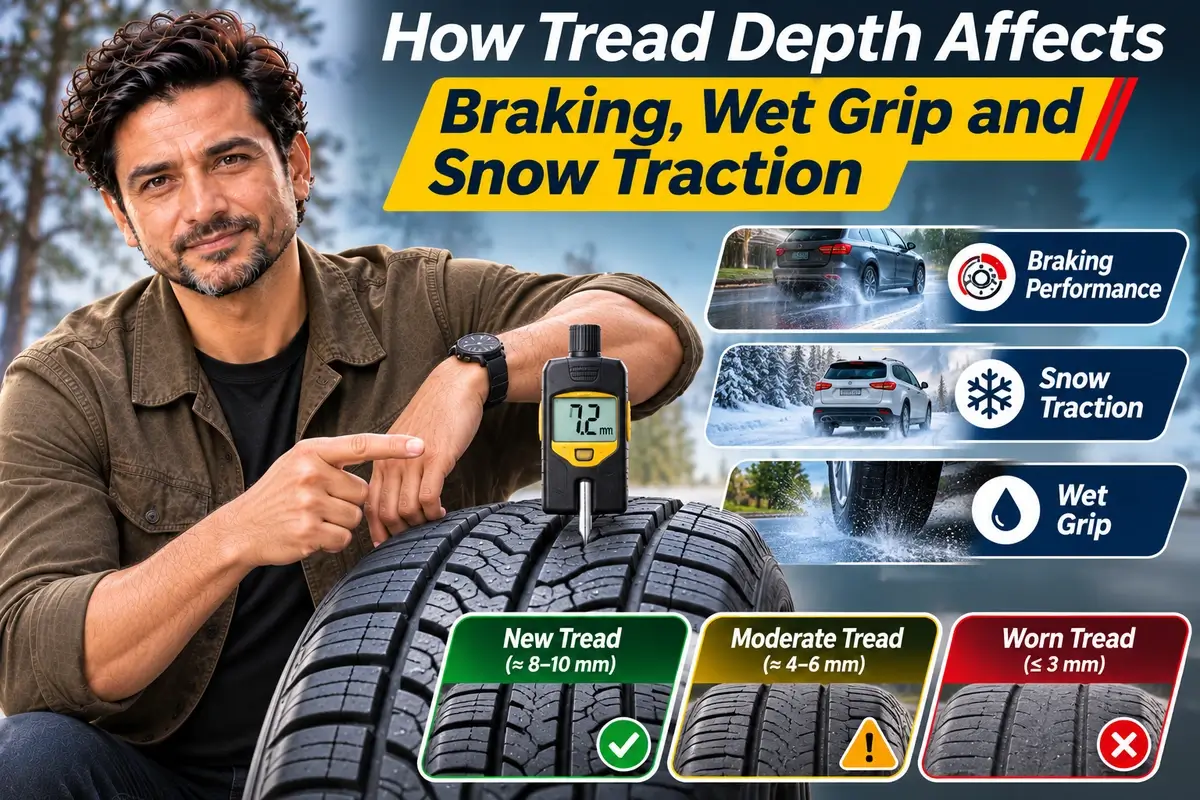
A tire with 3/32 of an inch of tread left is perfectly legal in most of the United States. On a dry afternoon it may even stop a little shorter than it did when new. Then the rain starts, and that same tire needs dozens of extra feet to bring the car to a halt, because the grooves that once moved water out of the way are nearly gone. That gap between “legal” and “safe” is where most drivers get caught. Here is how tread depth affects braking and grip in the dry, the wet and the snow.
Tread depth does not fade in a neat straight line from good to bad. Some kinds of grip barely change as a tire wears, while others fall off sharply in the last few 32nds.
How this guide was put together: This guide is general information based on manufacturer guidance, federal rules and industry practice, with sources listed at the end. Prices are typical ranges, not quotes, and policies change; checked on October 23, 2026.
Table of Contents
What Tread Depth Measures and Where Tires Start
Tread depth is the distance from the top of the tread rubber to the bottom of the deepest grooves. In the US it is measured in 32nds of an inch, while most other markets use millimeters.
Most new passenger car tires start with roughly 10/32 to 12/32 of an inch (about 8 to 9.5 mm), depending on the category. Winter tires, all-terrain and mud-terrain tires usually start deeper, while ultra-high-performance summer tires often start shallower. Racing slicks sit at the far end of the scale, with almost no tread at all, which tells you something about what tread is really for.
Two figures matter most for everyday drivers:
- 2/32 of an inch (1.6 mm) is the legal minimum in most US states and the level marked by the wear bars molded into the grooves. The European Union uses the same 1.6 mm limit.
- 4/32 of an inch (about 3 mm) is where independent testers and many safety organizations recommend replacing tires if you regularly drive in the rain.
The space between those two numbers is small on a tread gauge and large on a wet road.
Why Grooves Matter: Tread Is a Water Management System
On dry pavement, grip comes from rubber touching road. Grooves and sipes actually reduce the amount of rubber in contact with the surface, which is why a slick racing tire grips so well in the dry and so badly in the wet.
Once the road is wet, the job changes. The tire has to push water out of the contact patch quickly enough for the rubber to reach the pavement. Circumferential grooves channel water toward the back of the tire, lateral grooves send it out the sides and sipes wipe away the thin film that remains. Every 32nd of tread that wears away reduces the volume those channels can carry. At highway speed a tire has a fraction of a second to clear each patch of road, so lost groove volume shows up quickly as lost grip.
That is the core reason tread depth affects performance so unevenly. Dry grip depends mostly on rubber compound and contact area. Wet grip, hydroplaning resistance and snow traction depend heavily on open space in the tread, and that open space is exactly what wear takes away.
Wet Braking: What Testing Shows
Wet braking is where worn tread costs the most, and the numbers from independent testing are hard to ignore.
Tire Rack’s 60 mph Wet Stops
Tire Rack compared stopping distances from 60 mph on wet asphalt that does not drain well, using the same tires at different tread depths on a sedan and a light truck.
| Tread Depth | Sedan Stopping Distance | Sedan Speed When the New-Tire Car Has Stopped | Light Truck Stopping Distance |
|---|---|---|---|
| New | 205 ft | 0 mph | 216 ft |
| 4/32 inch | 270 ft | 35 mph | 261 ft |
| 2/32 inch | 400 ft | 50 mph | 287 ft |
Read the sedan column carefully. At 4/32, the car needed 65 more feet than it did on new tires. At 2/32, it needed 195 more feet, nearly double the original distance. When the car on new tires came to a stop, the car on legally worn tires was still moving at about 50 mph. That is not a slightly longer stop. That is the difference between stopping before an intersection and sliding through it.
AAA’s Findings at 4/32
AAA ran its own wet-pavement testing in 2018, comparing new all-season tires with tires worn to 4/32, and reached a similar conclusion. Stopping distances from 60 mph grew by an average of 43 percent, which worked out to an extra 87 feet for passenger cars and 86 feet for light trucks. A vehicle on worn tires was still traveling around 40 mph at the point where an identical vehicle on new tires had stopped. Handling ability on wet roads dropped by 33 percent for cars and 28 percent for light trucks.
Both studies point the same way. The decline begins well before the legal minimum, and it accelerates sharply over the last couple of 32nds.
Wear bars mark the legal limit, not the safe limit. By the time tread is flush with them, wet stopping distances can be close to double what they were when the tire was new.
Hydroplaning: When the Tire Starts to Float
Hydroplaning happens when water builds up in front of the tire faster than the tread can clear it. The tire rides up on a wedge of water and loses contact with the road. Steering goes light, braking does little and the car keeps traveling in whatever direction it was already heading.
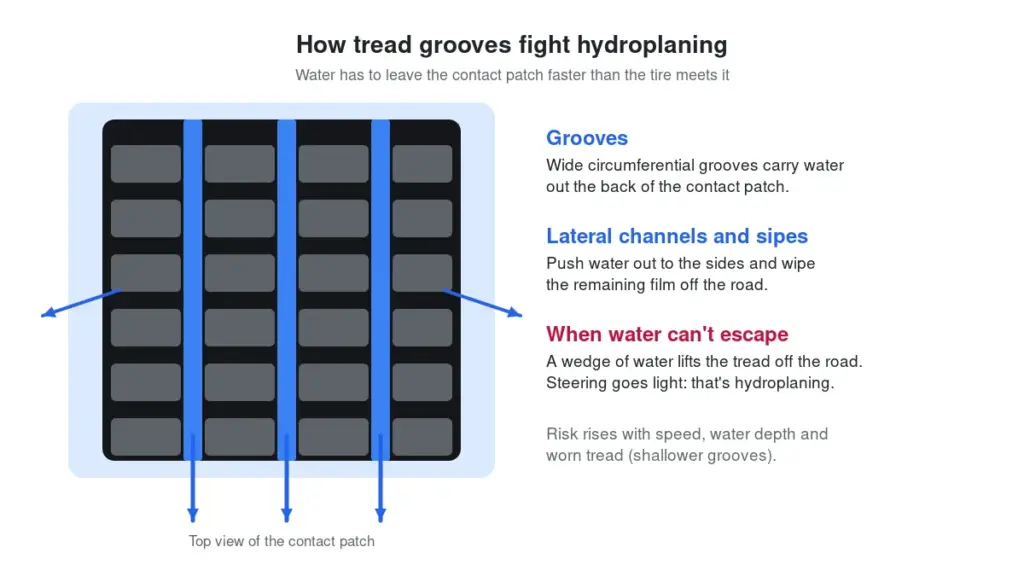
Speed, water depth, tire width, inflation pressure and vehicle weight all influence when that happens, but tread depth is the factor the driver controls most directly. Deep grooves give water somewhere to go. Shallow grooves fill almost instantly, so a worn tire can begin to hydroplane at lower speeds and in shallower water than the same tire did when new. Tire Rack’s tread depth guidance notes that tires begin losing hydroplaning resistance as early as 6/32, even though they are still well above any replacement threshold at that point.
The practical takeaway: if your tires are near 4/32 or below, slow down meaningfully in heavy rain and give yourself far more following distance than feels necessary. Underinflation makes the problem worse by softening the footprint and closing up the grooves, so worn tires and low pressure are a particularly bad combination.
Dry Roads: The Surprising Exception
Here is the part that runs against intuition. On dry pavement, worn tires often brake and handle about as well as new ones, and sometimes slightly better. Consumer Reports has noted that dry braking and handling may improve as tires wear.
The reason is mechanical. Tall, fresh tread blocks squirm and flex under hard braking and cornering. As the blocks get shorter they become stiffer, so the tread moves less and the contact patch stays more stable. This is the same principle behind shallow performance tread and racing slicks.
That small dry advantage can mislead drivers. A worn tire that feels sharp on a sunny commute gives no warning of how it will behave in the first heavy rain, which is a big reason people keep worn tires too long.
Performance Tires
High-performance summer tires lean into this trade-off from the start. They begin with less tread depth than typical all-season tires, accepting reduced wet and hydroplaning margin in exchange for crisper response and stronger dry grip. As they wear, dry grip may hold up or improve slightly while wet traction drops. Owners who drive these tires in the rain should be especially strict about replacing them at around 4/32 rather than waiting for the wear bars.
Snow and Slush: Depth Matters Even More
Snow traction depends on tread depth in a different way. A tire grips snow partly by packing it into its grooves and using that trapped snow to grip the snow on the road, since snow sticks to snow better than rubber does. Deep grooves and dense siping also give the tread more biting edges to dig into packed snow and slush.
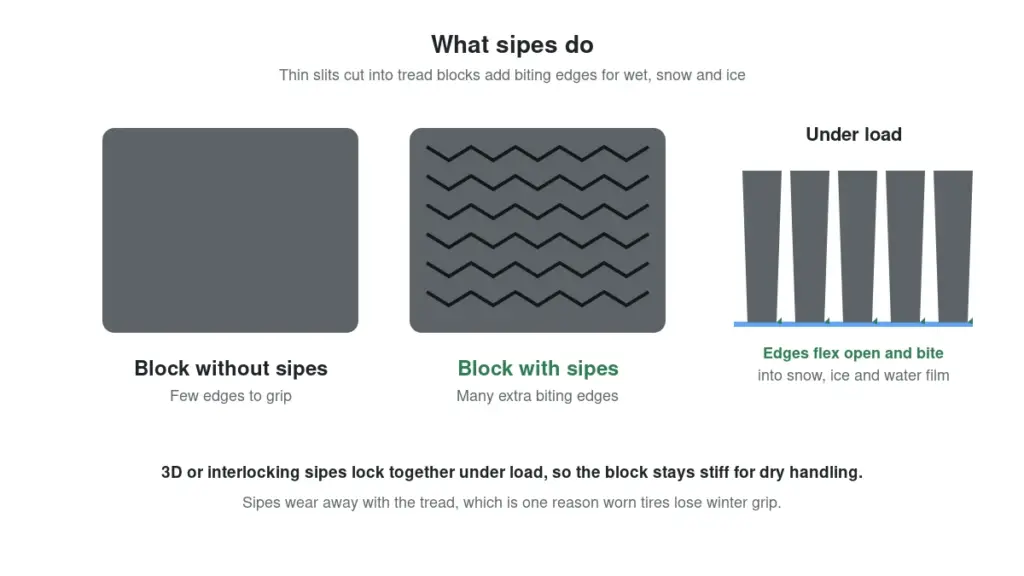
As tread wears, the grooves hold less snow and the sipes get shallower or disappear, so snow traction drops earlier than wet grip. Tire Rack’s tread depth guidance describes 6/32 as the point where tires begin losing snow and slush traction, and recommends considering replacement at about 5/32 for drivers who expect snow-covered roads.
Winter tires rely on more than tread depth. Their softer compounds stay flexible in freezing temperatures, which helps the tread conform to ice and packed snow. Even so, a winter tire worn down to the middle 32nds has lost much of what made it worth buying. If you are trying to judge whether last year’s set has another season in it, our guide on how long winter tires last covers the warning signs beyond tread depth alone.
Off-Road and All-Terrain Tires
Off-road tires start with deep tread and wide, self-cleaning voids because loose surfaces need open space. As the lugs wear, the tire packs up with mud sooner, so an all-terrain or mud-terrain tire can feel worn out off-road long before it reaches a legal limit.
What Happens at Each Stage of Wear
Pulling the testing together gives a useful picture of how a typical all-season tire behaves across its life.
| Tread Depth | Dry Roads | Wet Roads | Snow and Slush |
|---|---|---|---|
| 10/32 to 8/32 | Full grip; tread may feel slightly soft | Strongest water evacuation and braking | Best traction the tire will offer |
| 6/32 | Unchanged or slightly sharper | Still good, but hydroplaning resistance starts to decline | Snow traction begins to drop |
| 5/32 | Unchanged | Noticeably longer stops in heavy rain | Time to replace if you face snow regularly |
| 4/32 | Often similar to new | Stopping distances significantly longer | Poor in deep snow |
| 2/32 | Still acceptable in the dry | Severe loss of braking; high hydroplaning risk | Unsuitable |
Fuel Economy: Worn Tires Actually Roll Easier
Here is another common misconception. Worn tires do not hurt fuel economy. They help it slightly. A tire with less tread has less rubber flexing and heating as it rolls, so rolling resistance falls as the tread wears. Tire Rack estimates rolling resistance drops by about 20 percent between new and worn, and that drivers can expect roughly a 2 to 4 percent drop in fuel economy after switching from worn tires to a new set of the same model. Electric vehicle owners often see a larger dip in range.
That small gain is never a reason to keep worn tires, since a few percent in fuel economy is trivial next to an extra 65 to 195 feet of wet stopping distance.
Keeping Track of Your Tread
You do not need special equipment to stay ahead of tread wear, but you do need to check it regularly.
- Tread depth gauge: An inexpensive gauge gives an actual number in 32nds and is the most reliable way to track wear over time.
- Wear bars: Raised bars across the bottom of the grooves sit at 2/32. If the tread is flush with them, the tire is at the legal limit and should already have been replaced.
- Coin tests: The quarter and penny tests give a quick read at roughly 4/32 and 2/32. Our guide on how to check tire tread depth explains both methods step by step.
Check the tread about once a month and before long trips, and measure across the inner, center and outer parts of the tread. A tire that is much lower on one edge or in the center is telling you something about alignment or inflation, and uneven wear can push one part of the tread into the danger zone while the rest still looks fine.
Rotation and Pressure Stretch Your Safe Miles
Front tires on most cars handle steering and most of the braking load, so they wear differently from the rears. Rotating every 5,000 to 8,000 miles, or on your owner’s manual schedule, keeps all four wearing evenly, and correct inflation prevents the uneven wear that both underinflation and overinflation cause. Our article on what happens if you don’t rotate your tires shows how quickly skipped rotations lead to mismatched tread.
When it is time to replace, buying a full set keeps grip balanced front to rear. If you replace only two, most shops install the newer pair on the rear axle to reduce the risk of the rear sliding out in wet conditions. All-wheel-drive owners should follow the vehicle manufacturer’s guidance on matching tread depth across all four tires.
Related guides: Should You Shave Tires to Match Tread Depth?
Frequently Asked Questions
The legal minimum in most states is 2/32 of an inch, but testing shows wet braking deteriorates significantly well before that. Replacing at 4/32 is a sound target if you drive in rain, and around 5/32 makes sense if you regularly face snow-covered roads.
They can. Shorter tread blocks flex less, so dry braking and handling may hold steady or improve slightly as tires wear. The problem is that wet braking, hydroplaning resistance and snow traction all decline at the same time, so dry-road feel is a poor guide to whether a tire is still safe.
In Tire Rack’s testing from 60 mph on wet asphalt, a sedan needed 65 extra feet at 4/32 and 195 extra feet at 2/32 compared with new tires. AAA found that tires worn to 4/32 increased wet stopping distances by an average of 43 percent.
Yes, directly. Grooves give water a path out from under the tire. As they get shallower, the tire can begin to ride on top of the water at lower speeds and in shallower puddles. Speed, tire width and inflation pressure also play a role.
Deeper tread flexes more as it rolls, which increases rolling resistance. A new set can reduce fuel economy by a few percent compared with the worn tires it replaced, and that difference shrinks as the new tires wear in.
Most new passenger tires start around 10/32 to 12/32 of an inch. Winter and off-road tires often start deeper, while high-performance summer tires frequently start shallower.
The Bottom Line on Tread Depth and Safety
Tread depth barely matters on a dry road and matters enormously on a wet or snowy one. As a tire wears, dry grip holds steady or even improves slightly, rolling resistance falls and the tire can feel perfectly fine. Meanwhile, its ability to clear water and grip snow is shrinking, and independent testing shows wet stopping distances climbing sharply in the final few 32nds.
That is why the legal limit makes a poor replacement target. Plan on new tires around 4/32 if you see regular rain and about 5/32 if you see regular snow, rotate on schedule so the set wears evenly and check the tread every month. The last 2/32 of a tire’s life is rarely worth what it costs you in wet braking distance.
Sources
Specs, warranty terms and prices were checked on October 23, 2026. Prices change often.
- NHTSA: Tires (tire safety, pressure, tread and DOT codes)
 Summarize this article with:










Leave a comment