


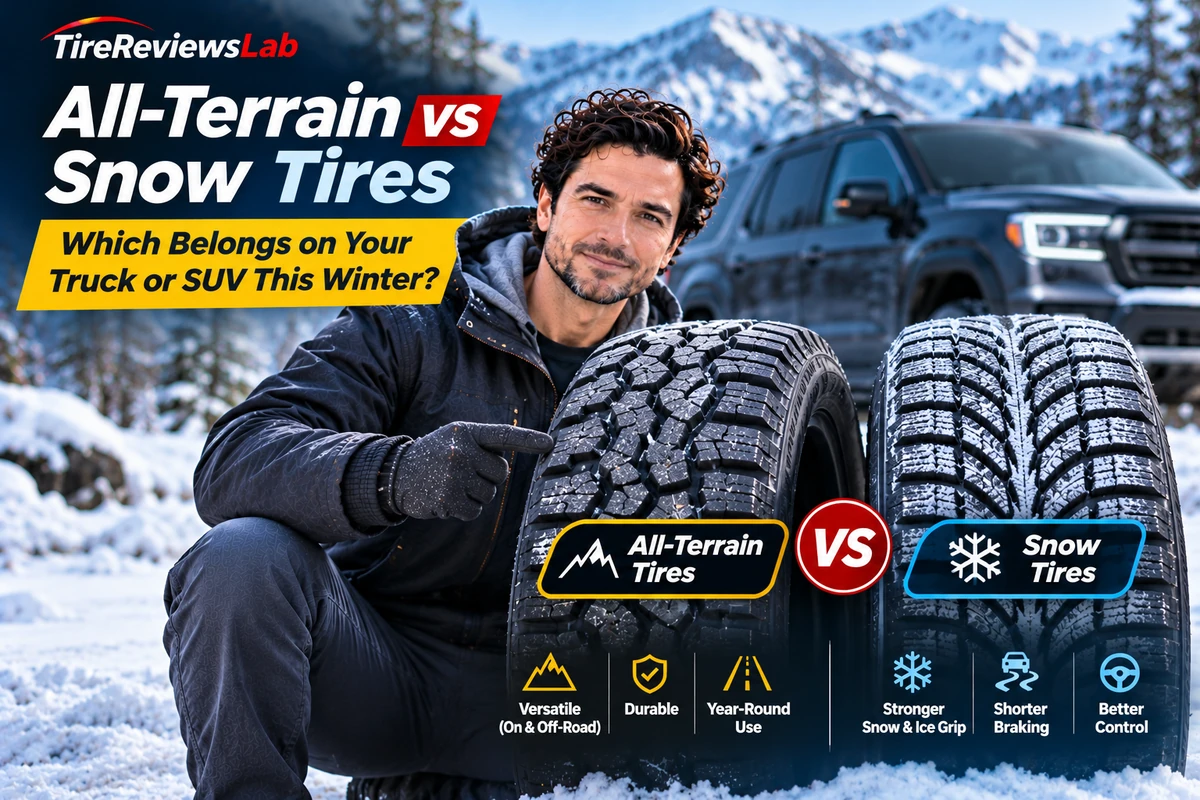
If you drive a truck or SUV in a place that gets real winter, you have probably heard both arguments. One camp says a good set of all-terrains with four-wheel drive will handle anything. The other says nothing replaces a dedicated set of snow tires once the roads ice over. In the all-terrain vs snow tires debate, both camps are partly right, and the difference between them comes down to where you live, what you drive on and how much hassle you are willing to accept.
This comparison breaks down how all-terrain and snow tires are built, how they behave on snow, ice and dry pavement, what they cost to own and where the newer generation of severe-snow-rated all-terrains fits in. By the end you should know which setup matches your winters rather than someone else’s.
How this guide was put together: This guide is general information based on manufacturer guidance, federal rules and industry practice, with sources listed at the end. Prices are typical ranges, not quotes, and policies change; checked on October 23, 2026.
Table of Contents
All-Terrain vs Snow Tires: Built for Different Problems
The core difference is simple. An all-terrain tire is a generalist that trades a little pavement refinement for toughness and grip on loose surfaces. A snow tire, more commonly called a winter tire, is a specialist that gives up tread life and warm-weather manners to grip cold, slippery roads.
How All-Terrain Tires Are Built
All-terrain tires use an open tread pattern with large blocks and wide, deep voids between them. Those voids let the tread dig into gravel, dirt and mud, then clear the debris as the tire rotates. Many designs add stone ejectors, small raised features at the bottom of the grooves that push out rocks before they can drill into the casing, along with shoulder lugs that bite when the tire is aired down or climbing out of a rut.
Construction is heavier than a highway tire. Thicker sidewalls, and in light-truck sizes extra plies, resist cuts, bruises and punctures from rocks and trail debris. The tread compound is tuned for durability and chip resistance across a wide temperature range, which is why all-terrains last a long time but stiffen up in deep cold.
How Snow Tires Are Built
Winter tires start with the rubber. Their compounds stay soft and pliable well below freezing, where an all-season or all-terrain compound begins to harden and lose grip. Many tire makers suggest winter tires start to pay off once temperatures routinely drop below about 45°F, even on dry roads.
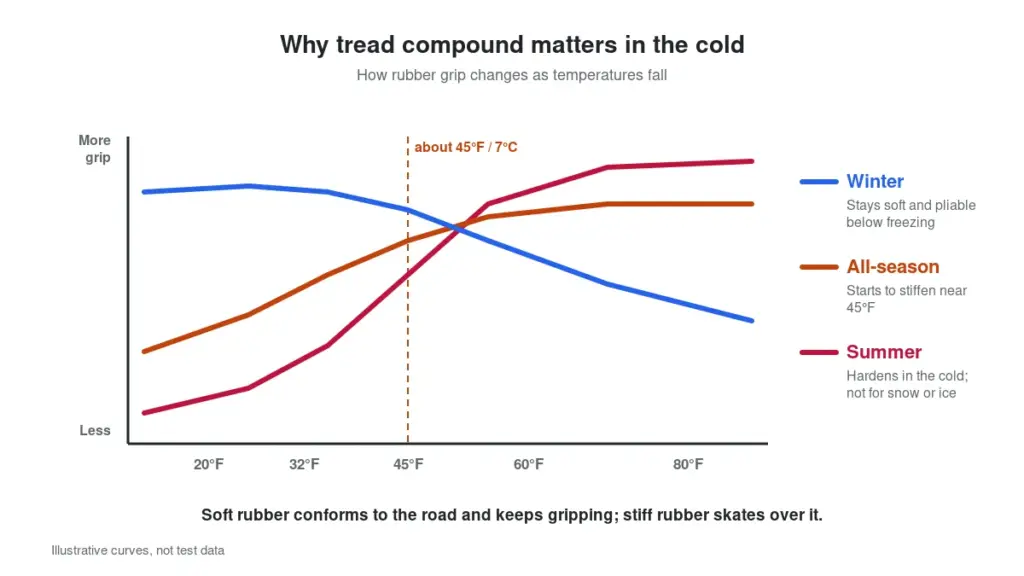
The tread adds thousands of biting edges. Dense siping, the thin slits cut across each block, opens up as the tire flexes and grabs at snow and ice. Deep, directional grooves pack snow into the tread on purpose, because snow grips snow better than rubber grips snow, then release slush and water from the contact patch. Some premium winter tires go further with ice-specific compounds that help wick away the thin film of water that makes ice so slippery.
On Snow and Ice: Where the Gap Opens Up
In a few inches of fresh snow on a truck with four-wheel drive, a quality all-terrain feels competent. The big tread voids find traction in loose snow and the vehicle’s drivetrain does the rest. That experience can make winter tires seem unnecessary.
The trouble starts when conditions get harder. On packed snow, ice and cold, wet pavement, the all-terrain’s large blocks and relatively firm compound offer far fewer biting edges and less ability to conform to the surface. The tire can still pull you forward, especially with four driven wheels, but stopping and turning depend entirely on tire grip. Four-wheel drive helps you go. It does nothing to help you stop.
A winter tire’s siping and cold-weather compound shine exactly there. Braking distances on ice and packed snow are where winter tires post their biggest advantage over every non-winter category, and cornering grip on icy curves follows the same pattern. Slush is another weak spot for big-block all-terrains, since the tread can ride up on a layer of wet snow instead of cutting through it.
Four-wheel drive gets you moving, but only the tires decide how quickly you stop. That is where winter tires earn their place.
The Middle Ground: 3PMSF-Rated All-Terrains
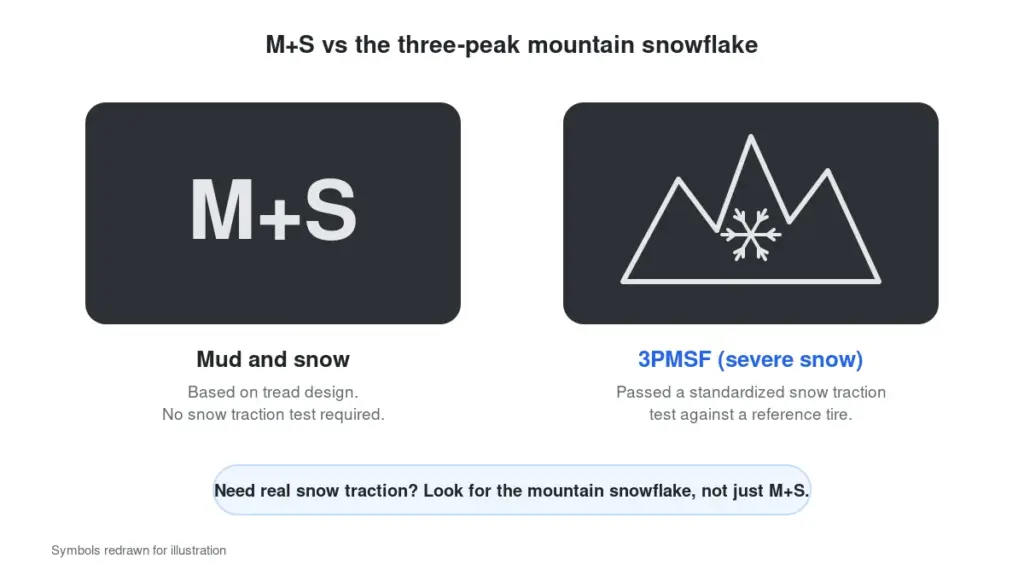
The line between these categories has blurred. A growing number of all-terrain tires now carry the Three-Peak Mountain Snowflake symbol, the same marking found on dedicated winter tires. Our explainer on the 3PMSF mountain snowflake marking covers it in depth, but the short version is that a tire earns the symbol by beating a standard reference tire by a set margin in a standardized acceleration test on medium-packed snow.
Several popular all-terrains carry the symbol in many or all of their sizes, including the BFGoodrich All-Terrain T/A KO2 and its successor the KO3, the Falken Wildpeak A/T3W and AT4W, the Toyo Open Country A/T III and the Yokohama Geolandar A/T G015. They generally add more siping and snow-friendly tread features than older all-terrain designs. Because the rating can vary by size and load range, confirm the symbol is molded into the sidewall of the exact size you are buying.
These tires are a real step up from all-terrains without the rating, and from the M+S marking alone, which is based on tread geometry rather than a performance test. Their limits matter, though:
- The 3PMSF test measures acceleration traction on packed snow. It does not test braking on ice.
- The rubber is still an all-season-style compound tuned for durability, so it firms up in deep cold more than a winter compound does.
- Passing the test sets a minimum. A dedicated winter tire typically clears that bar by a wide margin.
For drivers in moderate snow regions who want one set of tires all year, a 3PMSF all-terrain is often the most sensible compromise. For drivers facing regular ice, long stretches of subfreezing weather or mountain passes with traction requirements, it narrows the gap without closing it.
All-Terrain vs Snow Tires Side by Side
| Factor | All-Terrain (No 3PMSF) | 3PMSF-Rated All-Terrain | Dedicated Snow Tire |
|---|---|---|---|
| Deep or loose snow | Good with 4WD | Very good | Excellent |
| Packed snow | Fair | Good | Excellent |
| Ice | Weak | Fair | Best available without studs |
| Cold, dry pavement | Firm compound, reduced grip | Better than standard A/T | Strong grip below about 45°F |
| Gravel, dirt, mud | Excellent | Excellent | Poor fit for off-road use |
| Warm-weather use | Year-round | Year-round | Should come off in spring |
| Tread life | Long, often with a mileage warranty | Long, often with a mileage warranty | Shorter, usually no mileage warranty |
| Road noise | Moderate to loud | Moderate to loud | Usually moderate |
Braking, Handling and Everyday Driving
On dry, warm pavement, the roles reverse. A winter tire’s soft compound and flexible blocks feel vague in quick maneuvers and wear quickly in summer heat, while an all-terrain feels planted and sure-footed. That is why winter tires are a seasonal tool rather than a year-round choice.
All-terrains have their own on-road compromises. The open tread and heavy construction tend to lengthen braking distances on wet pavement compared with a highway tire, and the stiff sidewalls make for a firmer ride. Neither tire is the best choice for crisp handling, but on cold winter roads the winter tire is plainly the safer one.
Tread Life and Durability
All-terrains are built to last. Their durable compounds and robust construction resist abrasion, and many models carry treadwear warranties in the tens of thousands of miles. Keeping them rotated and aligned is what lets you collect on those warranties.
Winter tires wear faster per mile, especially if they stay on into warm weather. Their soft compound abrades quickly on dry, warm pavement, and most winter tires carry no mileage warranty at all. The math changes once you account for seasonal use. Because winter tires only run part of the year, and your other tires rest while they do, a set can last several winters for drivers who swap promptly in spring.
Fuel Economy, Noise and Ride Comfort
Large tread blocks, heavier carcasses and stiffer sidewalls give all-terrains more rolling resistance than highway tires, so expect a modest fuel economy penalty on pavement. Winter tires also roll with somewhat more resistance than a typical all-season, though the difference is usually small. Whatever you run, correct inflation does more for efficiency than tire choice, and cold weather drops pressure quickly, so check it often through the winter.
Noise tends to favor the winter tire. Big all-terrain lugs produce a noticeable hum at highway speeds, especially as they wear, while winter tires usually generate a softer, higher-pitched sound. Ride comfort leans the same way: the all-terrain’s reinforced sidewall gives a firmer ride, while a winter tire’s more flexible construction tends to ride softer. Tire makers continue to refine both categories, and today’s premium all-terrains are noticeably quieter than the designs of a decade ago.
What Each Choice Really Costs
Comparing sticker prices alone misses the real expense. Winter and all-terrain tires in comparable sizes often land in a similar price range, but the ownership models differ.
- One set of all-terrains means one purchase, one set of mounting costs and no seasonal swaps. You get long tread life and a mileage warranty, but you accept weaker ice performance.
- All-terrains plus winter tires means two sets of tires. A dedicated set of wheels for the winter tires adds upfront cost but saves on mounting and balancing every spring and fall. Each set wears only part of the year, so the combined cost per mile is lower than it first appears.
- One set of 3PMSF all-terrains costs about the same as a standard all-terrain set and buys meaningful snow capability without the swaps.
How to Choose Between All-Terrain vs Snow Tires
Choose a Standard All-Terrain If
- You regularly drive gravel, dirt roads or trails and see only occasional light snow.
- Your winters are mild and roads are cleared quickly.
- You want maximum tread life and the convenience of one tire all year.
Pick a 3PMSF-Rated All-Terrain If
- You see regular snow but rarely face sheet ice or long subfreezing stretches.
- You want one set of tires that handles both trail use and moderate winter driving.
- You need a tire that meets traction requirements where severe-snow-rated tires qualify, though local rules vary.
Choose Dedicated Snow Tires If
- Your winters bring frequent ice, heavy snowfall or long stretches well below freezing.
- You commute daily regardless of weather and cannot wait for plows.
- You are willing to store a second set and swap them each season, ideally on their own wheels.
Many truck and SUV owners in snowy states end up running both: all-terrains from spring through fall and winter tires once temperatures drop. If you are also weighing passenger-car options, our comparison of winter tires vs all-season tires covers the same trade-offs for non-off-road vehicles, and our roundup of the best all-terrain tires for snow narrows down specific models.
Related guides: How to Identify All-Season Tires and What Does HT Mean on a Tire?
Frequently Asked Questions
Most all-terrains handle light and moderate snow reasonably well, especially on a four-wheel-drive vehicle, because their open tread grips loose snow. They are much weaker on ice and packed snow, where their large blocks and firmer compound offer less grip than a winter tire.
No. A 3PMSF all-terrain has passed a standardized snow traction test and is a clear improvement over all-terrains without the rating, but the test does not cover ice braking. A dedicated winter tire still offers better grip on ice and in deep cold.
Four-wheel drive improves acceleration in snow but does nothing for braking or cornering grip. If you regularly drive on ice or packed snow, winter tires make a far bigger safety difference than the drivetrain does.
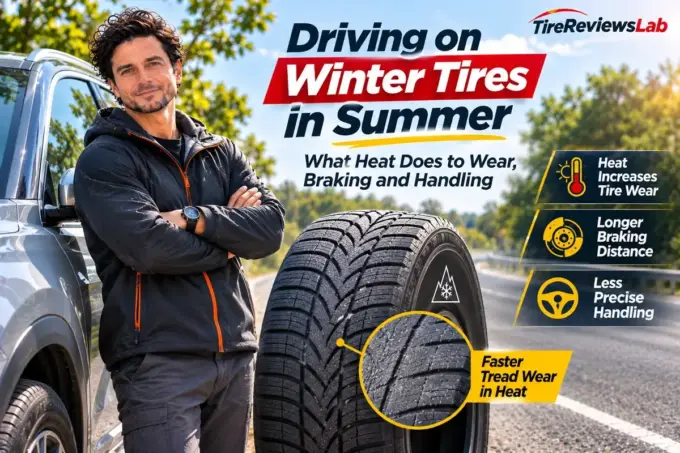
It is a poor idea. The soft compound wears quickly in warm weather, and handling and wet braking suffer on hot pavement. Swap back to your regular tires once temperatures stay consistently above about 45°F.
Per mile, yes. All-terrains use durable compounds and often carry mileage warranties, while winter tires wear faster and usually have no mileage warranty. Since winter tires only run a few months a year, a set can still last several seasons.
M+S indicates the tread geometry meets a mud and snow design definition, with no performance test required. The 3PMSF symbol requires passing a standardized snow traction test, making it a more meaningful indicator of winter capability.
All-Terrain vs Snow Tires: The Verdict
All-terrain tires are the better all-around choice for owners who split time between pavement and dirt and face only light or occasional snow. They last longer, cost less to own over time and never need a seasonal swap. A 3PMSF-rated all-terrain extends that versatility into regular snowfall and is a strong single-tire setup in moderate winter climates.
Dedicated snow tires remain the clear winner wherever ice, deep cold and heavy snow are routine. Their stopping and cornering grip on frozen roads is something no all-terrain fully matches. If your winters are serious, run winter tires for the cold months and keep your all-terrains for the rest of the year.
Sources
Specs, warranty terms and prices were checked on October 23, 2026. Prices change often.
- NHTSA: Tires (tire safety, pressure, tread and DOT codes)
 Summarize this article with:










Leave a comment