


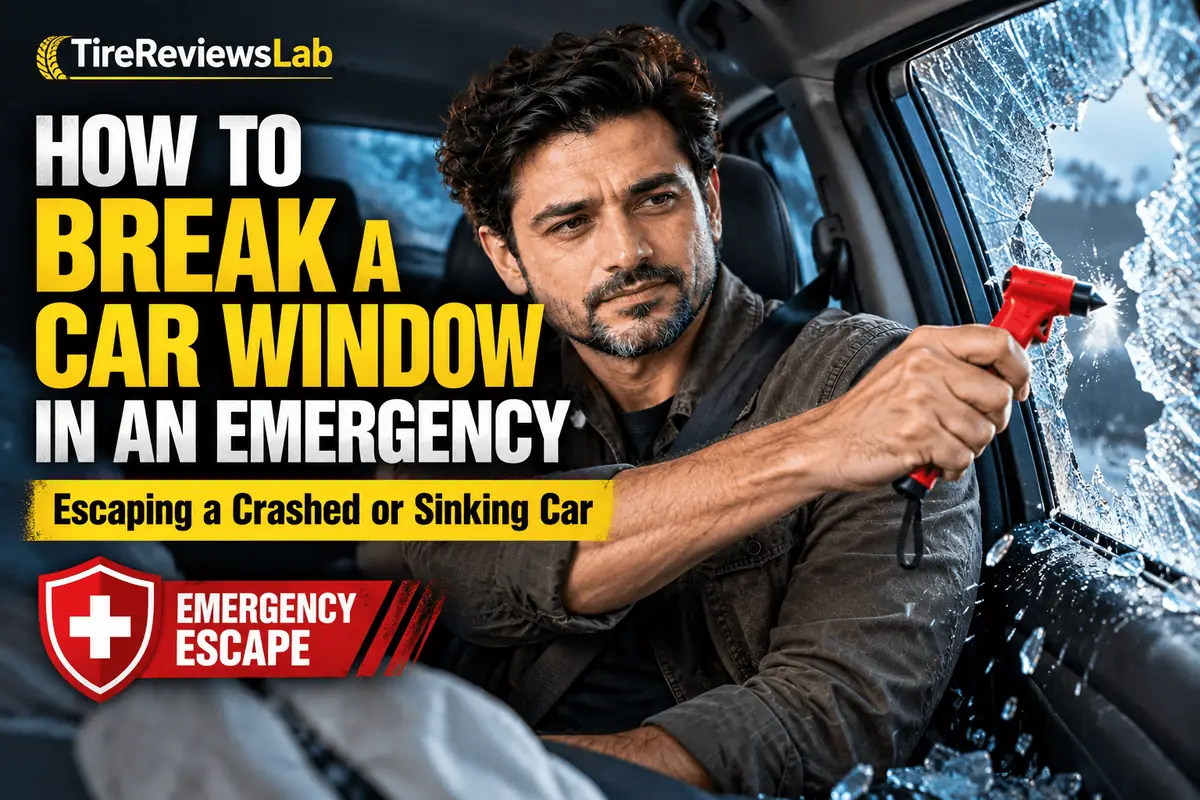
Most drivers never think about their side windows as an exit. Then a crash jams the doors, or the car leaves the road and lands in a canal, and the window becomes the only way out. In those moments there is no time to work out where to hit the glass or what to hit it with. You need to know already.
This guide is about one thing: getting yourself and your passengers out of your own vehicle when the doors won’t help you. It covers the tools that work, the exact spot to strike, the glass that won’t break no matter what you do, the order of operations in a submerged car and where to keep an escape tool so you can reach it while still belted in.
Table of Contents
Why Some Car Windows Shatter and Others Won’t
Cars use two very different kinds of safety glass, and knowing which is which decides whether your escape plan works.
Tempered glass is heat-treated so that it holds a great deal of stored tension. It resists a broad, blunt blow surprisingly well, which is why kicking or elbowing a side window rarely works. Hit it with a hard, sharp point, though, and that stored tension releases at once. The whole pane crumbles into small, blunt-edged cubes that fall away from the frame. That is the glass you want to break.
Laminated glass is a sandwich of two glass layers bonded to a plastic interlayer. When it is struck, it cracks into a spiderweb but the interlayer holds everything together. Every modern windshield is laminated, and so are many rear windows. A growing number of vehicles also use laminated side windows to cut cabin noise and reduce the chance of occupants being thrown out in a rollover.
That last point matters more than most owners realize. A spring-loaded window punch or emergency hammer can crack laminated glass, but it cannot clear it out of the frame. If your car has laminated side glass, a window breaker will not give you a way out through that window.
| Window | Usual Glass Type | Can an Escape Tool Clear It? |
|---|---|---|
| Windshield | Laminated | No. It cracks but stays in one piece |
| Front side windows | Tempered on most cars, laminated on some | Yes if tempered, no if laminated |
| Rear side windows | Usually tempered | Yes if tempered |
| Rear window or liftgate glass | Tempered on many cars, laminated on some | Yes if tempered |
| Sunroof | Varies by vehicle | Depends on construction, and rarely a practical exit |
How to Check Your Own Windows
Look at the small printed label, often called the “bug,” in a lower corner of each window. Many manufacturers mark it with “tempered” or “laminated,” or with the equivalent abbreviations. You can also lower the window slightly and look at the top edge: laminated glass shows a thin line of plastic interlayer between two layers of glass. Your owner’s manual or dealer can confirm it if the markings are unclear.
Do this check on every window, not just the driver’s door. Many cars mix glass types, with laminated front side windows and tempered rear ones. Once you know which windows can be broken, you know where to send everyone in an emergency.
The Right Tool for the Job
Breaking tempered glass is about concentrating force into a tiny point, not about strength. That is why purpose-made escape tools work and improvised objects often don’t.
Spring-Loaded Window Punches
These compact tools hold a hardened steel pin behind a spring. Press the tip firmly against the glass and the spring fires the pin into it, which is enough to shatter tempered glass. They need no swing and very little strength, so they work in a cramped cabin, underwater or with an injured arm. Many are small enough for a keychain, and most combine the punch with a shielded seatbelt cutter.
Emergency Hammers
An escape hammer has a hardened, pointed steel head, usually on both ends, with a seatbelt cutter built into the handle. It works well but needs room to swing, which you may not have in a crumpled cabin or with water rising. Under water, resistance slows any swing dramatically, which gives the spring-loaded punch a clear edge.
Improvised Objects
A regular hammer or heavy tool may break tempered glass if it has a hard point and you can strike hard, but it is far less reliable. A flat face spreads the force out, and that is exactly what tempered glass is built to resist. Fists, elbows, feet, phones and headrest posts are slow, uncertain and can cause serious injury. Treat them as a last resort and buy a proper tool instead.
| Tool | Strengths | Limitations |
|---|---|---|
| Spring-loaded punch | No swing or strength needed, works underwater, very compact | Must be pressed firmly and squarely against the glass |
| Escape hammer | Effective, usually includes a belt cutter | Needs room to swing, slower under water |
| Ordinary hammer or tool | Already in some vehicles | Unreliable, no belt cutter, injury risk |
No escape tool will clear laminated glass. Its job is to defeat tempered windows and cut jammed belts.
Where to Strike: The Corner, Not the Center
Aim for a lower corner of a tempered side window, roughly an inch or two in from the edges of the frame. The center of the pane flexes when struck and soaks up the energy. Near the corner, the glass is held rigid by the frame, so the force goes into fracturing it.
- Pick a tempered side window, ideally one on the side facing away from water flow or traffic.
- Turn your face away and shield your eyes with your free arm if you can.
- Place the tool on a lower corner of the glass, not in the middle.
- Press a spring-loaded punch firmly until it fires, or strike sharply with a hammer point.
- Once the glass crumbles, use the tool or a covered hand to knock remaining pieces out of the frame, especially along the bottom edge you will climb over.
Tempered glass breaks into small pieces with relatively blunt edges, but they can still cut. Move quickly, and don’t drag bare skin along the frame.
Never aim for the windshield. It is laminated, it will not shatter clear and you will spend precious seconds on glass that cannot become an exit.
Escaping a Submerged Car: Seatbelt, Windows, Out
A car that goes into water usually floats briefly, nose down because of the heavy engine, before sinking. That short window is your best chance to get out. Your goal is to leave while the car is still at or near the surface, before the water outside rises above the windows.
Rescue and cold-water survival experts teach a simple sequence. Practice saying it out loud with your family so no one has to think about it.
- Seatbelt. Unbuckle yourself first. If the buckle jams, use the belt cutter on your escape tool.
- Windows. Open a window immediately. Power windows may keep working briefly after the car enters the water, so try the switch at once. If it won’t open, break a tempered side window at the corner.
- Children. Unbuckle children, oldest first so they can help, and push them out through the window ahead of you. Tell them to hold on to the car or float until you follow.
- Out. Climb out through the window, and get to the roof or swim to shore. Once you are safe, call 911.
What Not to Do
- Don’t call 911 before you get out. In a sinking car, every second goes to escape. Make the call once you are out of the water.
- Don’t try the door. Water pressure outside a submerged door makes it extremely hard to push open, and an open door floods the cabin faster.
- Don’t wait for the cabin to fill. The old advice to let the car flood so pressure equalizes wastes the time when escape is easiest, and many people lose consciousness or become disoriented before the doors would open.
- Don’t attack the windshield or a laminated window. Know in advance which windows in your car are tempered and go straight to one of them.
If you are unsure whether a window is tempered and it doesn’t break on the first try, move to another side window at once rather than repeating strikes on the same pane.
Escaping After a Crash
On land, the urgency is different but the principles are the same. Most crash occupants are safer staying belted in place until help arrives. Breaking out makes sense when the car is on fire, filling with smoke, in the path of traffic or about to be hit again, and the doors are jammed.
- Switch off the ignition if you can do it quickly.
- Try every door and the unlock switch before breaking glass. Crash damage often jams one door while leaving others usable.
- Cut a jammed seatbelt with the belt cutter if the buckle won’t release.
- Break a tempered side window at a corner, clear the edges and climb out away from traffic.
- If the car has rolled, brace yourself with one hand on the roof before releasing the belt so you don’t drop onto your head and neck.
- Once out, move well away from the vehicle and the road, then call 911.
Keep the Tool Within Reach
An escape tool in the trunk or glove box is almost useless. In a sinking or burning car you may be upside down, pinned by an airbag or unable to lean across the cabin. The tool needs to be reachable while you are sitting buckled in your seat.
Good locations include:
- On your keychain, if it is a compact spring-loaded model
- Clipped to the sun visor or headliner
- In a mount on the center console or lower dash
- In the driver’s door pocket, though a door pocket may be out of reach if that side takes the impact
Put a second tool where front and rear passengers can reach it, and make sure everyone old enough knows where it is and how to use it. Check that the tool is secured so it doesn’t become a projectile in a crash. Some manufacturers suggest replacing spring-loaded tools after use or after a long period, so follow the instructions on the packaging.
Hot Cars, Children and Pets
People sometimes look up this topic after seeing a child or animal locked in a hot car. If you encounter that situation, call 911 first and follow the dispatcher’s instructions. Many states have good Samaritan laws that offer some protection to people who break into a car to rescue a child or pet in danger, but the laws vary considerably from state to state, and some cover only children or only certain people. Calling 911 brings trained help and is usually a condition of any legal protection that does exist.
Frequently Asked Questions
Strike a lower corner of a tempered side window, an inch or two in from the frame. The corner is held rigid, so the force fractures the glass instead of flexing it. The center of the window absorbs a blow much more effectively.
Not in any useful way. Windshields are laminated, so they crack into a web but stay in one piece, held together by the plastic interlayer. Use a tempered side or rear window instead.
Check the label in the corner of each window for a “tempered” or “laminated” marking, or lower the window and look for a thin plastic layer between two sheets of glass. Your owner’s manual or dealer can confirm it. Many cars mix types, so check every window.
Spring-loaded punches work well underwater because they don’t rely on a swing. Hammer-style tools still work but are slower because water resists the swing. Neither type will clear laminated glass.
Seatbelt, windows, children, out. Unbuckle, open or break a tempered side window right away, push children out ahead of you and then climb out yourself. Call 911 only after you are out of the vehicle.
No. Water pressure makes a submerged door very hard to open, and opening it floods the cabin faster. Go out through a window while the car is still near the surface.
Somewhere you can reach while buckled in, such as your keychain, the sun visor or a console mount. A tool in the glove box or trunk may be impossible to reach after a crash or in a sinking car.
The Bottom Line on Breaking a Car Window
Escaping through a window comes down to preparation more than strength. Learn which of your windows are tempered and which are laminated, keep a spring-loaded punch with a belt cutter where every occupant can reach it, and aim for a lower corner when you strike.
If the car goes into water, follow seatbelt, windows, children, out, and save the 911 call for when you are safely outside. A few minutes spent checking your glass and mounting a tool today is the difference between knowing your way out and searching for it when there is no time left.
 Summarize this article with:
















Leave a comment