


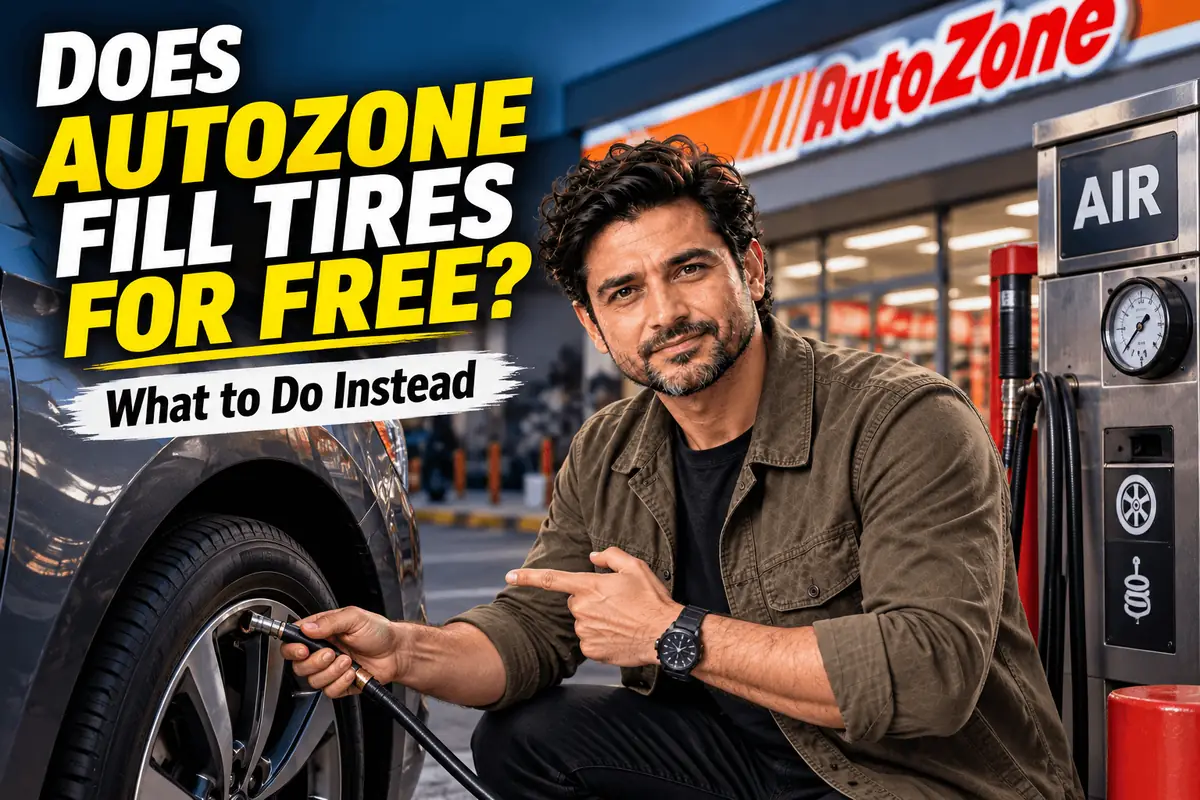
The low-pressure light comes on, and the nearest place with an auto-parts sign is an AutoZone. It seems like the obvious stop. Auto parts store, car people, surely an air hose somewhere out front. In most cases, though, you will not find one. AutoZone is a parts retailer, not a service garage, and its stores generally do not have a public air compressor for filling tires.
That does not mean the trip is wasted. AutoZone sells the tools that let you fill your own tires anywhere, and its free services cover other common problems. And if all you need is a few psi right now, free air is usually closer than you think, especially in the two states that require gas stations to provide it. Here is what AutoZone can and cannot do for a low tire, and where to go instead.
Table of Contents
The Short Answer: No Free Air at Most Stores
AutoZone stores are built around selling parts and accessories to do-it-yourself drivers and professional shops. They do not sell or mount tires, and they do not run service bays where technicians work on cars. Because of that, most locations have no air station in the parking lot and no shop compressor available for customers.
Individual stores occasionally do things differently, and an employee may be willing to help in a pinch. Do not plan on it. If your tire is low and you need air today, call the store first or head straight to one of the options later in this guide.
What AutoZone Offers for a Low Tire
Where AutoZone helps is on the product side. If you buy the right equipment once, you never have to hunt for an air hose again.
Portable Tire Inflators
AutoZone stocks a range of portable inflators and compressors from brands such as Slime, Viair, NOCO, AstroAI, ARB and DeWalt. They fall into a few categories:
- 12-volt inflators plug into the vehicle’s power outlet and are the most common choice for keeping in the trunk.
- Cordless inflators run on rechargeable tool batteries, which is convenient if you already own that battery platform.
- Heavier-duty compressors suit trucks, SUVs and off-road rigs with larger tires that take longer to fill.
Many inflators let you set a target pressure and shut off automatically when they reach it, which makes topping off much harder to get wrong.
Tire Pressure Gauges
A good gauge is the cheapest piece of tire equipment you will ever own and one of the most useful. AutoZone carries both pencil-style and digital gauges. Even if your car has a tire pressure monitoring system, a handheld gauge tells you exact pressure in each tire, and it lets you check the spare, which most systems ignore.
Puncture Repair Kits and Sealant
If the tire is losing air because of a nail or screw, AutoZone also sells plug kits and tire sealants. These can get you home or to a shop, but treat them as temporary. A proper repair is done from the inside of the tire by a tire shop.
Can You Borrow an Inflator Through Loan-A-Tool?
AutoZone’s Loan-A-Tool program lets you borrow specialty tools by leaving a deposit equal to the tool’s price. Return the tool in good condition within 90 days and the deposit is refunded in full. The program focuses on job-specific tools for brakes, suspension, steering, engine work and air conditioning. Tire inflators and pressure gauges are not a standard part of the lineup, so ask your local store rather than counting on one being available.
Other Free Services at AutoZone
AutoZone does offer several useful services at no charge, even if air is not one of them.
| Service | What You Get |
|---|---|
| Battery testing | A free test of your battery’s condition at any US store, with no appointment |
| Battery charging | Most car batteries can be charged in about 30 minutes |
| Starter and alternator testing | Free bench testing of removed parts to help diagnose charging and starting problems |
| Check engine light scan | A free code read through AutoZone’s Fix Finder service |
| Loan-A-Tool | Specialty tools borrowed against a refundable deposit |
| Installation help | Battery and wiper installation on many vehicles when you buy the part |
None of these will fix a low tire, but they are worth knowing about when you are already standing in the store.
Where to Find Free Air for Your Tires
If you need air right away, these are the best places to look.
Gas Stations in States That Require Free Air
Two states have laws that make free air easy to find.
- California: Since 2000, state law has required every service station to provide free compressed air, free water and an air pressure gauge to customers who buy motor vehicle fuel. Stations must post a sign saying so, along with a toll-free number for complaints. If a station refuses after you buy gas, you can report it.
- Connecticut: State law requires gas stations to provide free air for tires, and you do not need to buy fuel first. Stations must post notice that air is available.
Everywhere else, many gas station air machines are coin- or card-operated, though some stations leave them free and others will switch the machine on for paying customers if you ask at the counter.
Convenience Store Chains
Several regional chains are known for free air at many of their locations. QuikTrip and Wawa are two of the better-known examples. Availability can still vary by location, so check before you rely on a particular stop.
Tire Shops
Tire shops are often the best option, because they have accurate equipment and staff who can spot a nail or a leaking valve while they are at it. Chains such as Discount Tire, Les Schwab, Firestone Complete Auto Care and Big O Tires commonly check and adjust tire pressure for free, often whether or not you bought your tires there. Discount Tire, for example, offers free pressure checks. Call ahead if you are in a hurry, since busy shops may ask you to wait or book a time.
Warehouse Clubs
Costco tire centers fill tires with nitrogen for members, and Sam’s Club offers tire checks and air for members at its tire and battery centers. Both are convenient if you are already a member and already making the trip.
The most reliable free air is the air you carry. A portable inflator in the trunk turns a low-tire hunt into a five-minute job.
How to Fill Your Tires Correctly
Free air is only useful if you put in the right amount.
- Find the recommended pressure on the placard inside the driver’s door jamb or in the owner’s manual. Do not use the maximum pressure molded into the tire sidewall.
- Check pressure when the tires are cold, ideally before driving or after the car has sat for a few hours. Driving warms the tires and raises the reading.
- Remove the valve cap and press the gauge or air chuck firmly onto the valve stem so it seals.
- Add air in short bursts, checking the pressure between bursts.
- If you overshoot, press the small pin in the center of the valve to let a little air out, then check again.
- Replace the valve caps and repeat on all four tires. Check the spare too if it is accessible.
If you have just driven to a gas station and the tires are warm, a common approach is to fill to a few psi above the placard pressure and recheck once they cool. If you have no gauge at all, our guide to checking tire pressure without a gauge covers rough methods that will tide you over until you can get an accurate reading.
Why Monthly Checks Matter
Tires lose air gradually, and they lose more when the weather turns cold. An underinflated tire flexes more, builds heat, wears faster on the shoulders and hurts fuel economy, and badly underinflated tires are more prone to failure. An overinflated tire has a smaller contact patch, which reduces grip and makes the ride harsher. A monthly pressure check takes a few minutes and catches slow leaks before they become flats.
When Air Is Not Enough
If a tire keeps losing pressure every few days, adding air is only buying time. Look for a nail, screw or cut in the tread, and have a tire shop inspect it. Punctures in the tread area are often repairable, but sidewall damage, bulges and cracks mean the tire should be replaced.
Frequently Asked Questions
Generally no. AutoZone stores are parts retailers without service bays, so most locations do not have an air station for customers. A specific store may help informally, but do not count on it.
Not reliably. Some employees may help if they have equipment on hand, but it is not a standard service. A gas station, tire shop or your own portable inflator is a more reliable option.
Not usually. AutoZone’s Loan-A-Tool program lends specialty tools against a refundable deposit for up to 90 days. Tire inflators are not a standard part of it, so ask your local store. Buying an inflator is the more dependable choice.
California requires service stations to provide free air, water and a pressure gauge to customers who buy fuel. Connecticut requires gas stations to provide free air for tires without requiring a purchase.
No. AutoZone sells tire-related accessories such as inflators, gauges, plug kits and sealants, but it does not sell or mount tires. For tire installation or repair, visit a tire shop.
Keep a portable 12-volt or cordless inflator and a pressure gauge in your vehicle. You can top off a tire at home, on a road trip or in a parking lot without searching for an air machine.
Our Take on AutoZone and Tire Air
AutoZone is the wrong stop if you need someone to fill a low tire for you. Most stores have no air station, and the company does not offer tire service. It is the right stop if you want to solve the problem for good, since it stocks inflators, gauges and puncture kits that make you independent of air machines entirely.
For air right now, head to a gas station, especially in California or Connecticut where the law works in your favor, or to a tire shop that will check your pressure and look for the cause of the leak. Then pick up an inflator and a gauge so the next low-pressure warning is a minor errand rather than a search.
 Summarize this article with:














Leave a comment