


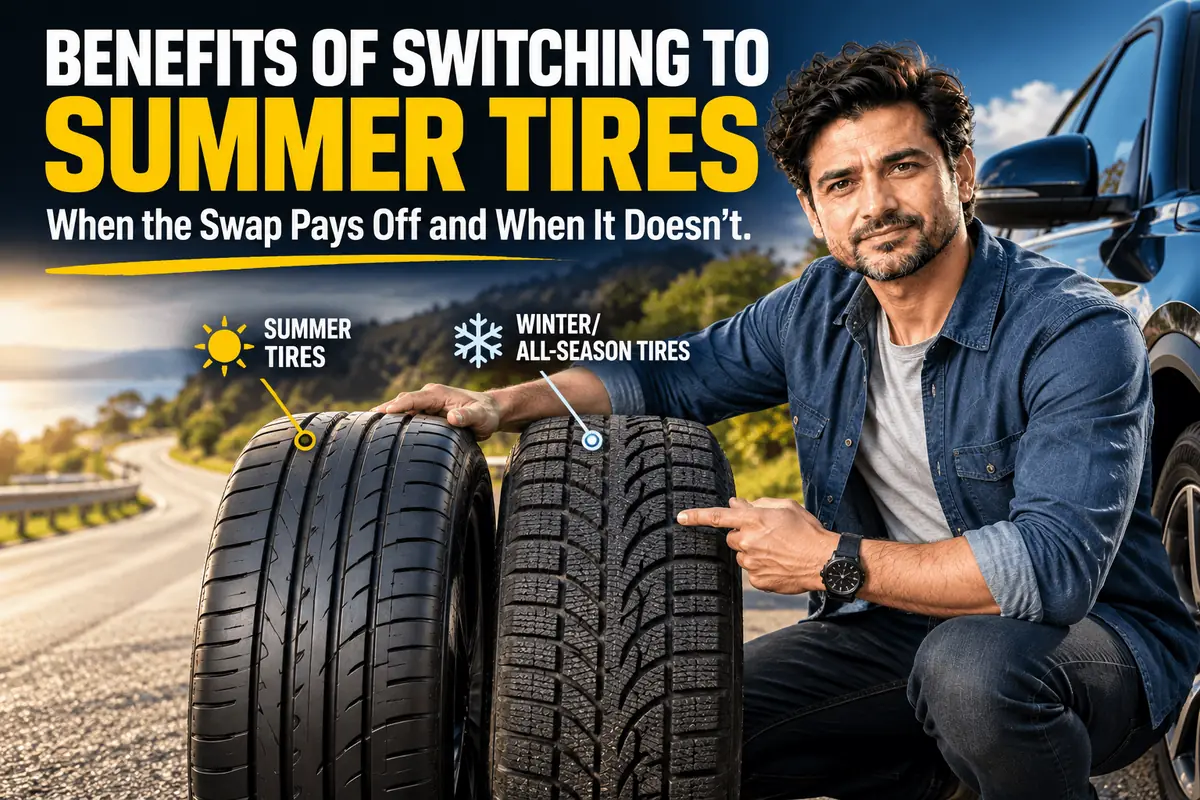
Every spring, a familiar question comes up in driveways across the northern half of the country. The winter tires are coming off anyway, so is it worth putting a dedicated set of summer tires on in their place, or should the car just run all-seasons until the snow returns? The answer depends less on the tire itself and more on your car, your climate and how much you care about what happens when you brake hard or turn in quickly on a warm day.
If you want the head-to-head breakdown of the two tire types, our summer vs all-season tires comparison covers that ground. This article takes a different angle. It looks at the switch itself: the temperature that makes it worthwhile, the real performance you gain, when to make the change, how to store the off-season set, what running two sets actually costs and which drivers are better off not bothering at all.
Table of Contents
What You Actually Gain From the Switch
A summer tire is a specialist. Its tread compound stays soft and pliable in warm weather, and its tread pattern uses larger, stiffer blocks with fewer sipes and grooves than an all-season. That combination puts more rubber on the road and keeps the tread blocks from squirming under load. In practical terms, it changes how a car feels and how it behaves at its limits.
Sharper Grip in Corners and Under Acceleration
The most noticeable change is lateral grip. A summer tire holds a line through a corner with more authority, and the car takes a set more quickly when you turn the wheel. On a powerful rear-drive car, the improved traction off the line also means less wheelspin and cleaner power delivery. This is why summer tires come as original equipment on most sports cars and many performance sedans: the chassis is tuned around that level of grip, and a less capable tire leaves part of the car’s ability on the table.
Shorter Stops on Warm Pavement
The benefit that matters most for everyday safety is braking. A softer compound that keeps its elasticity in the heat bites harder into the road surface, and that shortens stopping distances on warm, dry pavement. In an emergency stop, a few feet can be the difference between a close call and a crash. That advantage carries over to wet roads as well, provided the temperature stays above the summer tire’s comfort zone.
Rain Is Not the Weak Spot You Might Expect
Many drivers assume summer tires are dry-weather tires. In reality, a good summer tire handles warm rain very well. Wide circumferential grooves channel water out of the contact patch, and the sticky compound keeps grip on wet asphalt. Les Schwab notes that summer tires excel at resisting hydroplaning at highway speeds compared with all-season alternatives. What a summer tire cannot handle is cold, whether wet or dry, which is where the switch-timing question comes in.
Steering Feel and Confidence
Stiffer tread blocks and a firmer construction translate into steering that responds faster and communicates more clearly. Turn-in is crisper, mid-corner behavior is more predictable and the car feels more settled during quick lane changes at highway speed. For drivers who enjoy a winding road, that added precision is often the reason they made the switch in the first place.
The 45°F Rule: Why Temperature Decides Everything
The single most important number for summer tire owners is roughly 45°F. Michelin uses 45°F as its dividing line for seasonal tire selection and says summer tires provide excellent cornering and braking above that point, while warning that they are even more sensitive to cold than all-seasons. Les Schwab suggests running summer tires when average daily temperatures are 44°F and up. Tire Rack puts the trouble zone at around 40°F and below, explaining that as temperatures drop into the 40s the tread compound shifts from a pliable elastic to an inflexible plastic, which sharply reduces traction.
Those figures line up closely, and they point to a practical rule: summer tires belong on the car once daily temperatures settle consistently above about 45°F, and they should come off before temperatures fall back toward that range in the fall.
The important detail is that this is about temperature, not snow. A summer tire on a 35°F morning has less grip than a properly rated tire even when the road is perfectly dry. Michelin makes that point directly: on a cold, dry road, summer tires provide less traction because the compound is no longer in its optimal state. On snow or ice, the reduction in grip is severe.
The threshold is the daily temperature, not the calendar. A dry 38°F morning is already outside the range where summer tires do their best work.
Cold Can Damage the Tire, Not Just the Grip
There is a second reason to respect the threshold. Tire Rack warns that exposing summer tires to freezing temperatures can cause tread compound cracking or tread block chipping, and that this damage typically is not covered by the manufacturer’s warranty because it results from improper use. If your car sits outside through a cold snap on summer tires, avoid driving it or flexing the tires until temperatures rise, and plan the fall swap early enough that it never comes to that.
When to Make the Swap
For most of the northern US, temperatures settle above 45°F sometime in April or May, which makes late spring the usual window for installing summer tires. The return trip to winter or all-season tires generally happens in October or November, before the first hard frost and the first snow.
Regional differences are large. A driver in the Southeast or the Sun Belt may be able to run summer tires for most or all of the year, while someone in the upper Midwest or the mountain West has a far shorter window and must watch for late spring cold snaps. Use local forecasts rather than a fixed date.
A few timing guidelines help:
- Wait in spring until overnight lows stop dipping toward freezing, not just until the first warm afternoon.
- In fall, swap early rather than late. Running all-seasons or winter tires on a mild October week costs you little, while running summer tires into a freezing morning risks both grip and damage.
- Book the fall appointment ahead of time. Tire shops get busy the moment the first cold front arrives.
- Check the pressure after every swap, since tires that have been in storage often lose air.
Storing the Off-Season Set
A second set of tires is only a good investment if it survives storage in good condition. Rubber ages faster with heat, sunlight and ozone, so where and how you store the set matters.
- Clean each tire with soap, water and a brush, then let it dry completely so moisture does not corrode the wheels.
- Mark each tire’s position on the car so you can rotate them on the next install.
- Place the tires in plastic bags or tire totes to protect them from UV light and dust.
- Store them in a cool, dry, dark spot, such as a garage or shed, rather than outdoors.
- Keep them away from ozone-producing equipment such as generators, compressors, furnaces, sump pumps and central vacuum units, as well as solvents, fuel and lubricants.
- Store unmounted tires upright when possible, or stack them no more than four high. If the tires are mounted on wheels, inflate them to the recommended pressure to prevent flat spots.
For summer tires specifically, avoid an unheated location that drops well below freezing if you have a choice. Tire Rack’s cold-weather warning applies to tires sitting in storage as well, and a heated garage, basement or a shop’s storage program is the safer option in very cold climates. Many tire retailers offer seasonal storage for a fee, which also takes the lifting and cleaning off your hands.
What Running Two Sets Really Costs
The financial case for the switch is more balanced than it first appears.
The biggest expense is the second set of tires. Summer performance tires range widely in price, and premium models in larger sizes can be expensive. If you buy a second set of wheels so that the swap is a simple bolt-on job, that adds to the upfront cost but saves mounting and balancing fees every spring and fall. Without spare wheels, you pay for dismounting and remounting twice a year.
There are offsetting factors. While one set is on the car, the other is not wearing at all, so each set lasts more calendar years than a single set run year-round. Spread across the full ownership period, the total number of tires you buy may not rise as much as you expect.
Tread life is the catch. Les Schwab notes that summer tires use shallower grooves and a special tread compound that can provide less tread life than all-season tires, and that they often need replacement at 4/32 inch of remaining tread for the best hydroplaning resistance. Running them aggressively, or in temperatures below their range, speeds that wear further.
| Cost Factor | What to Expect |
|---|---|
| Second set of tires | The largest upfront cost, varying widely by size and performance level |
| Spare wheels | Optional extra cost that removes mounting fees at every swap |
| Seasonal swaps | Twice-yearly labor, cheaper with a dedicated set of wheels |
| Storage | Free at home, or a seasonal fee at a tire shop |
| Tread life | Typically shorter than all-season tires, with replacement often advised at 4/32 inch |
| Wear on each set | Each set only wears for part of the year, stretching its calendar life |
Who Benefits Most, and Who Should Skip It
Strong Candidates for Summer Tires
- Sports car and performance car owners. If the car came from the factory on summer tires, the suspension and stability systems were tuned around that grip, and switching back to them is the way to get the car you paid for.
- Enthusiast drivers. Anyone who regularly drives winding roads, attends autocross or track days, or simply values sharp steering will feel the difference immediately.
- Drivers in cold-winter states who already own winter tires. You are already swapping tires twice a year. Choosing summer tires instead of all-seasons for the warm months adds little hassle and a lot of capability.
- Drivers in warm climates. Where temperatures rarely approach 45°F, a summer tire can serve nearly year-round, removing the swap problem entirely.
Drivers Who Should Probably Skip It
- Commuters who want one set and long tread life. If your priorities are mileage, low cost per mile and never thinking about your tires, a good all-season or all-weather tire is the better fit.
- Drivers in regions with unpredictable spring and fall cold. If temperatures swing above and below 45°F for months at a time, the summer tire’s usable window shrinks and the risk of being caught out grows.
- Owners with nowhere suitable to store a second set. Storage in a hot, sunny or freezing location shortens the life of the tires you paid extra for.
- Drivers who prioritize a quiet, soft ride. Firmer construction and stiffer tread blocks can bring a busier ride and more road noise than a touring all-season.
Choosing the Right Summer Tire
Once you decide to switch, match the tire to the car and the way you drive it. Start with the size, load index and speed rating listed on your door placard or in the owner’s manual. Within that size, decide where you sit on the spectrum from comfort-oriented summer touring tires to max-performance and track-capable models. A daily-driven sedan gains most of the braking and wet-grip benefits from a high-performance summer tire without the harsher ride and faster wear of a max-performance compound.
Check the UTQG treadwear grade and any mileage warranty when comparing models, keeping in mind that many summer tires carry shorter warranties than all-seasons or none at all. Independent reviews and test results are useful for comparing wet braking and noise, two areas where summer tires differ widely.
Frequently Asked Questions
Switch once daily temperatures settle consistently above about 45°F. Michelin uses 45°F as its dividing line, and Tire Rack notes that summer tire grip drops sharply as temperatures fall into the low 40s. Watch the overnight lows rather than reacting to the first warm afternoon.
Yes, as long as it is warm. Summer tires use wide grooves to clear water and a sticky compound that holds wet asphalt well, and they resist hydroplaning effectively at highway speed. Cold rain is a different story, because the compound loses grip as temperatures fall toward 45°F and below.
It can. Tire Rack warns that freezing temperatures can lead to tread compound cracking or tread block chipping, and that this damage is typically not covered by warranty. Store summer tires somewhere that stays above freezing if possible, and avoid driving on them in sub-freezing conditions.
Generally no. Their shallower grooves and softer, grip-focused compound usually deliver less tread life than an all-season tire. Running two sets offsets this, because each set wears only for part of the year.
It can be, especially if you already swap to winter tires each year. You gain stronger braking and better grip on warm roads. If you only want one set of tires and the longest possible tread life, a quality all-season or all-weather tire is the more practical choice.
No, but it helps. With dedicated wheels, each swap is a quick change that avoids mounting and balancing charges. Without them, you pay for remounting the tires every spring and fall.
Our Verdict on Making the Switch
Summer tires deliver real, measurable advantages once the weather warms up: firmer grip in corners, shorter stops on warm pavement, strong wet traction and steering that feels more connected. For performance car owners and drivers who already run winter tires, the switch is one of the most effective upgrades available, and it often restores the handling the car was engineered to have.
The trade-offs are just as real. You need to respect the 45°F threshold in both directions, find proper storage, budget for a second set and accept shorter tread life. If you want a single set that you can forget about all year, stay with all-seasons. If you want your car at its best from late spring through early fall, make the switch and time it by the thermometer.
 Summarize this article with:
















Leave a comment