


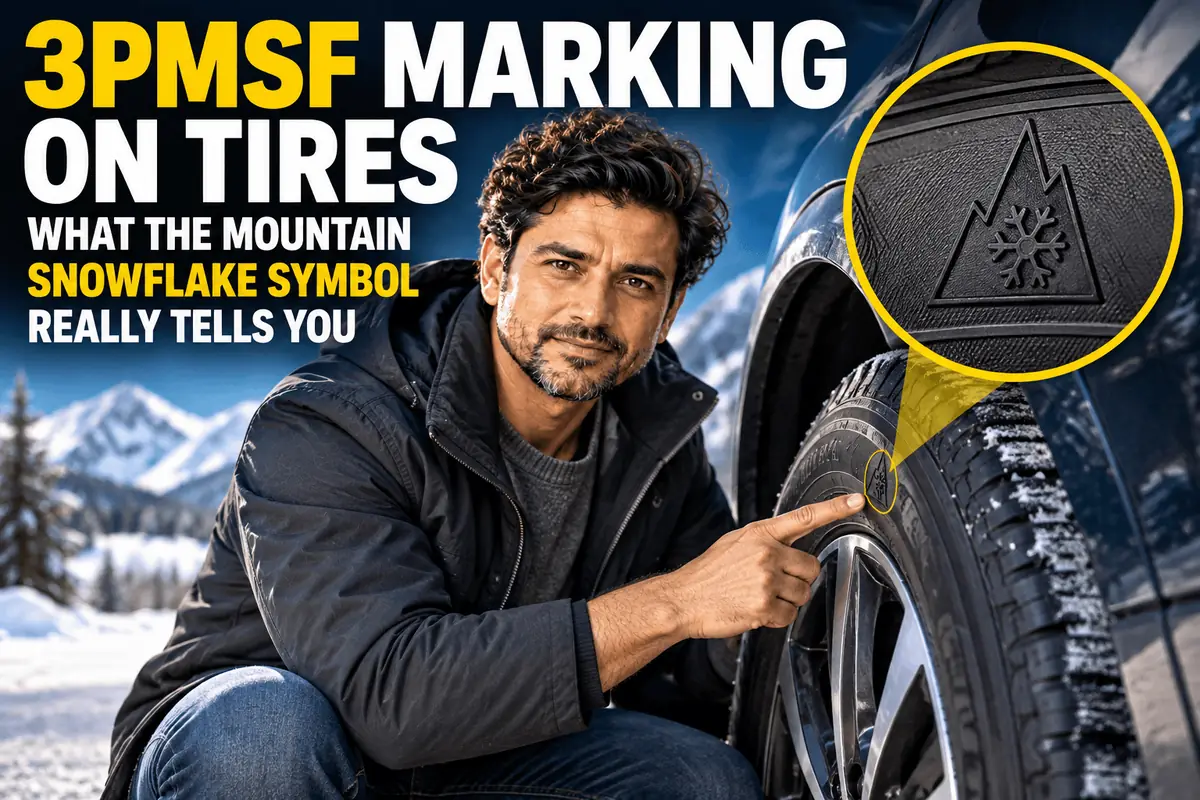
You are shopping for tires before winter, and two candidates look almost identical on paper. One has a small mountain with a snowflake molded into the sidewall. The other just says M+S. The price gap is modest, the salesperson calls both “good in snow,” and you are left wondering whether that little pictogram is worth paying attention to. It is, but probably not for every reason you have heard.
The three-peak mountain snowflake, usually shortened to 3PMSF, is the only common winter marking in North America backed by an actual traction test. That makes it a useful filter. It also has firm limits: it measures one specific kind of snow performance, says nothing about stopping on ice and appears on tires that range from all-weather commuters to dedicated studless winter tires. This guide explains what the symbol means, how a tire earns it, how it compares with M+S and how to use it when you buy.
Table of Contents
What the 3PMSF Symbol Looks Like
The symbol is a pictogram of a mountain with three peaks and a snowflake inside it. It sits on the sidewall near the tire size, load index and speed rating, and it is molded into the rubber during manufacturing, so it is permanent. You may also hear it called the severe snow symbol, the mountain snowflake or, in Europe, the Alpine symbol. These names all refer to the same marking.
The symbol uses no letters at all. If you see “M+S,” “M/S” or “M&S” on a sidewall, that is a different and much older designation, covered below. Some tires carry both markings side by side, which is common on all-weather tires and many winter tires.
How a Tire Earns the Three-Peak Mountain Snowflake
The marking dates to 1999, when the tire industry associations in the United States and Canada agreed on a performance-based standard for severe snow tires. Unlike M+S, a tire has to prove something to carry it.
The Test Itself
The test follows ASTM F1805, a standardized procedure for measuring traction on snow. Engineers compare the candidate tire against a Standard Reference Test Tire, or SRTT, on a medium-packed snow surface. The test measures acceleration traction, essentially how well the tire can put power down and pull the vehicle forward on snow without spinning.
To qualify, the candidate must reach a traction index of at least 110 compared with the reference tire’s 100. Put simply, it needs at least 10% more snow acceleration grip than the SRTT. The threshold is 112 when the 16-inch version of the reference tire is used.
Self-Certification
Tire makers run or commission the test and certify their own products. There is no government agency stamping each tire before it reaches the store. The standard is still meaningful, because the procedure and the threshold are fixed and public, but it works on manufacturer compliance rather than independent approval of every model.
What the Test Does Not Measure
This is the part most marketing skips. The 3PMSF test covers acceleration on medium-packed snow and nothing else. Braking on snow, cornering on snow, slush resistance, deep snow and ice traction are not part of it. A tire that passes has shown it can launch on packed snow better than a fairly ordinary reference tire. That is a valuable baseline, but it is a floor, not a ranking.
| Performance Area | Part of the 3PMSF Test? |
|---|---|
| Acceleration traction on medium-packed snow | Yes |
| Braking distance on snow | No |
| Cornering grip on snow | No |
| Traction or braking on ice | No |
| Slush, deep snow or wet-road performance | No |
| How far above the threshold a tire scores | No, it is pass or fail |
That last row matters. A tire that scores 111 and one that scores far higher carry the identical symbol. The marking cannot tell you which is better.
3PMSF Versus M+S
M+S stands for mud and snow. It predates the mountain snowflake by decades and is based entirely on tread geometry. A tire qualifies when its tread pattern has enough open groove area and void at the edges to meet a dimensional definition. No snow test is required, and the manufacturer simply applies the marking when the tread design meets that geometric standard.
As a result, M+S appears on a huge range of tires, including many ordinary all-season tires that are adequate in light snow but were never engineered with winter as a priority. Some highway truck tires carry it too.
| Feature | 3PMSF | M+S |
|---|---|---|
| Basis | Snow traction performance test | Tread geometry only |
| Snow test required | Yes, ASTM F1805 acceleration on medium-packed snow | No |
| Minimum standard | At least 110% of the reference tire | Groove and void dimensions |
| Typical tires | All-weather and dedicated winter tires | Most all-season tires, many truck tires |
| Ice performance indicated | No | No |
If the choice is between a 3PMSF tire and an M+S-only tire for a snowy climate, the 3PMSF tire has at least demonstrated measured snow traction. The M+S tire may be fine, but nothing on the sidewall proves it.
M+S describes what the tread looks like. The mountain snowflake describes how the tire performed in a snow test. Only one of those is evidence.
Why 3PMSF Says Nothing About Ice
Ice is where drivers get into the most trouble, and it is the condition the mountain snowflake does not address. Ice grip depends heavily on a rubber compound that stays soft in deep cold, dense siping that creates thousands of biting edges and, on some tires, micro-porous or textured tread materials that wick away the thin film of water on top of ice. A tire can do well in a packed-snow acceleration test without excelling at any of those things.
The industry has recognized this gap. A separate ice grip symbol, a mountain pictogram with ice, now exists for tires that pass a dedicated ice braking test under a different ASTM standard. Few tires sold in the US carry it so far, but its existence underlines the point: the snowflake alone is not an ice rating.
For drivers who regularly face glare ice, freezing rain or polished intersections, the symbol is a starting requirement rather than the finish line. Look at the tire’s intended category and published ice performance before buying.
All-Weather Tires Versus Dedicated Winter Tires
Both of these categories carry the mountain snowflake, and that is where much of the confusion comes from.
All-Weather Tires
All-weather tires are year-round tires built to clear the 3PMSF threshold while still handling summer heat and dry pavement reasonably well. Their compounds and siping lean further toward winter than a typical all-season tire, which lets them earn the symbol, but they still have to survive July on hot asphalt. That compromise is the whole point. They suit drivers in regions with real but moderate winters who do not want to swap tires twice a year or store a second set.
Dedicated Winter Tires
Dedicated winter tires, including studless ice-and-snow models and studdable designs, give up summer capability entirely in exchange for the best possible cold-weather grip. Their softer compounds, deeper tread and aggressive siping make them clearly superior on ice and in harder winter conditions. They usually exceed the 3PMSF threshold by a comfortable margin, but the symbol on their sidewall looks exactly like the one on an all-weather tire.
Which One Fits Your Winter
| Driving Situation | Better Choice | Why |
|---|---|---|
| Occasional snow, mild winters, mostly cleared roads | All-weather | Earns the symbol and works year-round without a seasonal swap |
| Frequent snow, regular ice, long cold stretches | Dedicated winter | Much stronger on ice and in deep cold |
| Mountain passes, unplowed rural roads | Dedicated winter, studdable if allowed | Maximum grip where conditions are worst |
| No real winter at all | All-season | A 3PMSF tire adds little value without snow |
Running dedicated winter tires year-round is a poor idea. Their soft compound wears quickly on warm pavement and loses steering precision and braking performance in the heat. Swap back to all-season or summer tires once temperatures stay mild, and store the winter set cool, dry and out of direct sunlight.
Chain Laws, Traction Laws and Winter Tire Rules
The mountain snowflake has legal weight in several places, though the details vary and change over time.
- Colorado: When the state’s passenger vehicle Traction Law is active, 4WD and AWD vehicles comply with tires that have at least 3/16-inch of tread and carry the mountain-snowflake symbol, an all-weather rating or an M+S marking. Two-wheel-drive vehicles generally need chains or an approved alternative traction device instead. Fines apply for noncompliance.
- Oregon: Tires marked with the mountain/snowflake emblem count as traction tires. On vehicles rated at 10,000 pounds gross vehicle weight or less that are not towing, traction tires can be used in place of chains where signs allow, though drivers may still be required to carry chains.
- Quebec: Passenger vehicles registered in the province must run winter tires from December 1 through March 15, and the law requires those tires to carry the three-peak mountain snowflake.
Rules shift from season to season and differ between chain-control levels, so check the state transportation department or road-conditions site before a winter trip. A 3PMSF tire does not automatically exempt you from every chain requirement, especially on heavier vehicles or when towing.
How to Shop Using the Symbol
Treat the mountain snowflake as a qualifying filter, then narrow from there.
- Decide whether you need a year-round tire or a seasonal winter tire based on how often you see snow and ice.
- In snowy regions, rule out tires that carry only M+S if snow traction is a priority.
- Among 3PMSF tires, look at the tire’s category: all-weather, studless winter or studdable winter.
- If ice is a regular concern, favor dedicated winter tires and look for strong published ice braking results.
- Match the correct size, load index and speed rating for your vehicle, and buy a full set of four so the car handles evenly.
Tread depth matters as much as the symbol. Winter traction drops off well before a tire reaches its legal minimum, because shallow grooves cannot pack and release snow. A worn 3PMSF tire can perform worse than a fresh M+S tire. Our guide to sidewall markings explains the rest of the codes you will find next to the symbol, including size, load index, speed rating and date of manufacture.
Keep Them Working
- Check pressure monthly when the tires are cold, since pressure drops as temperatures fall.
- Rotate on the schedule in your owner’s manual to keep wear even.
- Inspect for cuts, bulges and uneven wear, and get an alignment check if wear looks irregular.
- Replace winter tires that are near the end of their usable tread or showing age-related cracking, and check the date code when buying.
Frequently Asked Questions
It stands for three-peak mountain snowflake. The symbol shows a snowflake inside a three-peaked mountain and means the tire passed a standardized snow traction test, reaching at least 110% of a reference tire’s acceleration grip on medium-packed snow.
Not always. Dedicated winter tires carry the symbol, but so do all-weather tires, which are year-round designs. Both cleared the same snow test, yet dedicated winter tires are usually much stronger on ice and in very cold conditions.
For snow, yes. M+S is based only on tread geometry and requires no snow test, while 3PMSF requires measured snow traction. Neither marking tells you anything about ice performance.
The symbol does not tell you. The test covers acceleration on packed snow only, not braking or grip on ice. Studless winter tires and studded tires are the better choices for regular ice, and a separate ice grip symbol now exists for tires that pass a dedicated ice test.
In some places. Colorado’s Traction Law accepts mountain-snowflake tires with at least 3/16-inch of tread on 4WD and AWD vehicles, and Oregon treats them as traction tires for lighter vehicles that are not towing. Requirements vary by state and chain-control level, so check before you travel.
All-weather 3PMSF tires are built for year-round use. Dedicated winter tires are not, because their soft compound wears quickly and handles poorly in warm weather, so swap them out once winter ends.
Yes, if you see real snow. The three-peak mountain snowflake is the only common winter marking in North America backed by an actual traction test, so it is the clearest sign a tire has proven snow capability.
Reading the Snowflake the Right Way
The three-peak mountain snowflake is the most useful winter marking you will find on a North American sidewall, simply because it is tied to a real test. If snow is part of your driving life, it is a sensible minimum, and it separates tires with proven packed-snow traction from M+S tires that only look the part.
Just do not ask it to do more than it can. The symbol says a tire can accelerate on medium-packed snow better than a reference tire. It does not rank tires against each other, and it says nothing about stopping on ice. Use it to build your shortlist, then choose between an all-weather tire and a dedicated winter tire based on how harsh your winters really are.
 Summarize this article with:












Leave a comment