


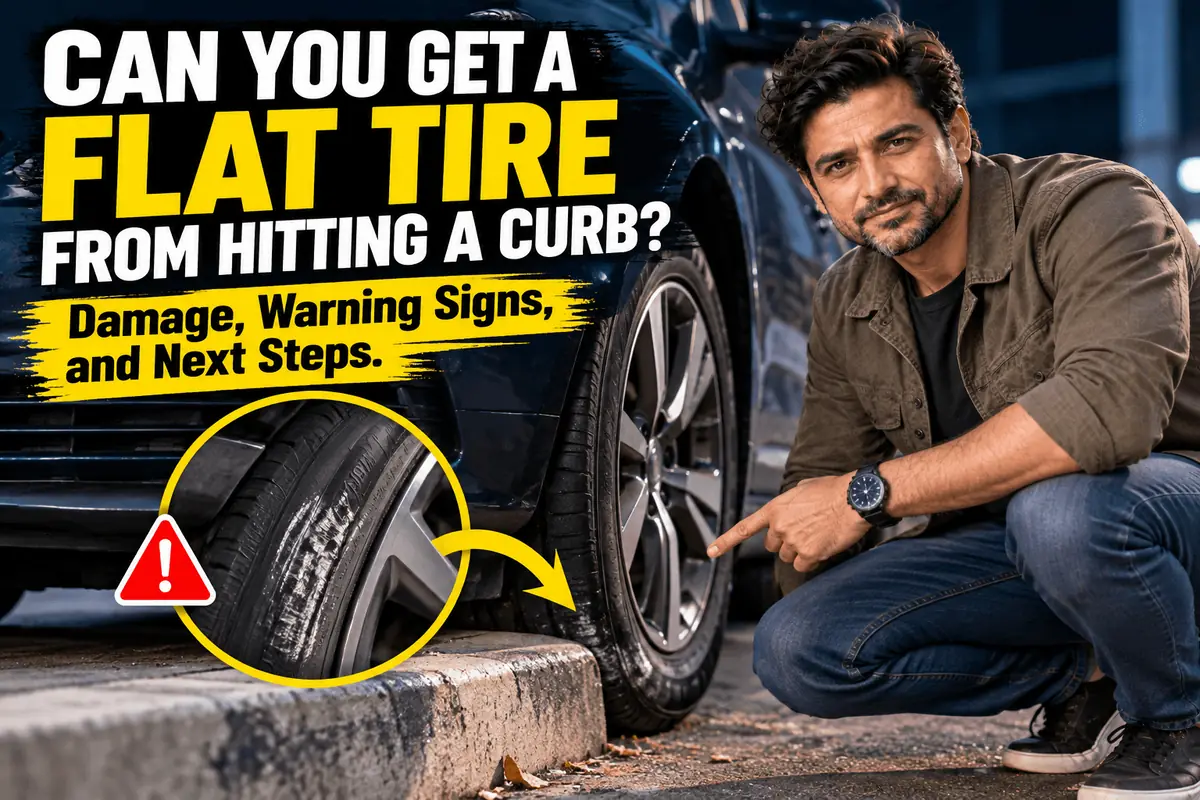
There is no mistaking the sound. A misjudged turn or a tight parallel park ends with a hard thud and a jolt through the steering wheel, and you immediately wonder whether the tire survived. Sometimes it goes flat on the spot. Sometimes it looks perfect, holds air for a week and then starts losing pressure for no obvious reason.
Yes, you can get a flat tire from hitting a curb, and it can happen in more ways than most drivers realize. The tire itself can be cut or crushed, the wheel can bend and leak at the bead, the valve stem can break and internal damage can surface days later. Below, we walk through each failure mode, what to inspect right after the hit, how to spot alignment and suspension damage, why low-profile tires are especially exposed and how to decide between a repair and a replacement.
Table of Contents
How a Curb Strike Causes a Flat
A curb is a hard, square edge, and tires handle that kind of impact poorly. The tread is reinforced with steel belts, but the sidewall is a flexible band of rubber and fabric cord with no belt protection. Most curb damage lands there, on the wheel’s lip or both.
Pinch or Impact Break
When the tire hits the curb hard enough, the sidewall compresses until it is trapped between the curb edge and the metal wheel flange. The internal cords get pinched and can snap. In a severe case, the sidewall tears open and the tire deflates at once. In a milder case, the rubber survives but the broken cords leave a weak spot. Technicians call this an impact break.
Sidewall Cut or Bulge
Scraping along a rough or sharp curb edge can slice the sidewall directly. Even without a cut, broken cords let air push into the rubber layers and form a bulge or bubble on the side of the tire. A bulge may hold air for now, but the structure behind it is compromised, and it can fail suddenly at speed.
Bead Unseating
The bead is the reinforced inner edge of the tire that seals against the wheel. A sideways blow, such as sliding into a curb at an angle, can push the bead away from the rim for an instant. Air escapes, and if the bead does not reseat cleanly, the tire goes flat quickly.
Bent Wheel and a Slow Leak at the Bead
Sometimes the tire is fine and the wheel takes the hit. A bent or dented rim lip no longer forms a perfect seal against the bead, so air seeps out slowly. Alloy wheels can also crack. This kind of leak often shows up as a tire that needs topping off every few days.
Damaged Valve Stem
The valve stem sits close to the edge of the wheel. A curb strike can crack a rubber stem, bend a metal one or damage a TPMS sensor built into the valve. A broken stem may leak quickly or seep slowly.
Delayed Failure From Internal Damage
The most dangerous outcome is the one you cannot see. Cords broken inside the tire do not always show on the outside right away. The tire may hold pressure normally, but with each mile of flexing, the weak area grows until a bulge appears or the tire fails. That delay is why a curb hit deserves follow-up even when nothing looks wrong.
| Failure Mode | How Fast It Shows Up | Typical Warning Sign |
|---|---|---|
| Sidewall tear or cut | Immediately | Rapid air loss, visible gash |
| Bead unseating | Immediately or within minutes | Fast deflation after an angled hit |
| Bulge from broken cords | Immediately or over days | Bubble on the sidewall |
| Bent or cracked wheel | Hours to days | Slow leak, vibration, visible dent in the rim lip |
| Damaged valve stem | Immediately or over days | Hissing at the stem, slow leak |
| Internal impact break | Days to weeks | Late bulge, unexplained pressure loss |
What Makes a Curb Hit Worse
Several factors decide whether a curb strike leaves a scuff or a ruined tire.
- Speed. A gentle bump at parking-lot speed gives the tire time to flex and recover. A strike at road speed concentrates the force and is far more likely to cut, pinch or bend something.
- Angle. A head-on hit, where the tire climbs into the curb face, drives the sidewall into the wheel flange. A shallow, sliding contact is more likely to scrape the sidewall and scuff the wheel.
- Curb height. Taller curbs reach more of the sidewall and are more likely to contact the wheel lip.
- Tire pressure. An underinflated tire compresses further on impact, so the sidewall is easier to pinch against the rim.
- Tire age and condition. Old, weathered rubber is less forgiving than a fresh tire.
- Sidewall height. Low-profile tires have far less cushion between the curb and the wheel, which we cover in detail below.
What to Check Right After You Hit a Curb
If the car steers normally and there is no warning light, find a safe place to stop as soon as practical. If the steering pulls hard, you hear flapping or the TPMS light comes on, pull over right away and do not keep driving on a tire that is going flat.
- Park on level ground away from traffic and set the parking brake.
- Look at the sidewall of the tire that hit, from the tread down to the wheel, for cuts, gouges, exposed cords and any bulge or bubble. Run a gloved hand along the sidewall to feel for raised spots you might miss in poor light.
- Turn the steering wheel so you can see the front tire more fully, and roll the car a few feet to check the part of the sidewall that was against the ground.
- Inspect the wheel lip for dents, flat spots, cracks or missing chunks of metal. A deep gouge in an alloy wheel deserves a closer look from a shop.
- Look at the valve stem. It should stand straight with no cracks or bends.
- Check the tire’s pressure with a gauge and compare it with the figure on the driver’s door jamb placard.
- Recheck the pressure the next morning and every day or two for the following week. A slow drop points to a bent wheel, a leaking bead, a damaged stem or internal damage.
Any bulge on the sidewall means the tire should not be driven, even if it is holding air. Install the spare and get the tire replaced.
If the tire is flat, use the spare or call for roadside assistance. Most compact spares carry speed and distance limits printed on the tire or in the owner’s manual, and those limits are there for a reason.
Alignment and Suspension Damage
A curb hit hard enough to worry about the tire is often hard enough to knock the alignment out or bend a suspension part. Watch for these signs on the drive afterward.
- The car pulls to one side on a straight, level road.
- The steering wheel sits off-center when you are driving straight.
- A new vibration comes through the steering wheel or the seat, which can point to a bent wheel or a damaged tire.
- The steering feels loose or wanders, or you hear clunking over bumps.
- The tire starts wearing unevenly in the following weeks, especially on one shoulder.
Driving on bad alignment wears tires quickly and unevenly, and a bent tie rod or control arm affects how safely the car steers and brakes. If you notice any of these signs, have the alignment checked and the steering and suspension components inspected. Many shops recommend an alignment check after any hard curb strike, even when the car seems to drive normally.
Why Low-Profile Tires Are More Vulnerable
The aspect ratio in a tire size, such as the 40 in 245/40R19, gives the sidewall height as a percentage of the tire’s width. The lower that number, the shorter the sidewall. Low-profile tires look sharp and sharpen steering response, but they leave very little rubber between the curb and the wheel.
That has two consequences. First, the sidewall has less room to compress before it pinches against the rim, so impact breaks and bulges are more likely. Second, the large wheel sits closer to the curb, so the rim lip itself takes more of the impact and bends or cracks more easily. Drivers with low-profile tires should treat even moderate curb hits as a reason for a careful inspection.
Repair or Replace After a Curb Hit?
Curb damage usually lands where a tire cannot be repaired. Under industry repair guidelines followed by reputable shops, only punctures in the tread area, no larger than 1/4 inch, can be fixed, and the sidewall and shoulder are excluded.
| Damage | Repair or Replace | Why |
|---|---|---|
| Light cosmetic scuff on the sidewall rubber, no depth | Usually fine to keep | Surface rubber only; monitor it |
| Cut or gouge in the sidewall | Replace | Sidewall repairs are not permitted |
| Bulge or bubble on the sidewall | Replace | Internal cords are broken |
| Exposed cords or steel | Replace | Structural damage |
| Tire driven while flat after the hit | Usually replace | Internal damage from running flat is common |
| Bead leak with no tire damage | Often fixable | The tire can be reseated or the bead cleaned and sealed |
| Bent wheel with an undamaged tire | Repair or replace the wheel | Minor bends can sometimes be straightened; cracks mean a new wheel |
| Broken valve stem | Repair | The stem or TPMS valve can be replaced |
A tire shop can dismount the tire to inspect the inside for damage that is not visible from the outside. That inspection is worth asking for after a hard hit, especially if you see unexplained pressure loss. For a closer look at what different marks mean and how to judge them, our guide to sidewall damage covers the topic in depth.
When you do replace a tire, consider the other three. On an all-wheel-drive vehicle, many manufacturers require all four tires to be close in tread depth, so one new tire may mean shaving it to match or replacing more than one. Check your owner’s manual before you buy.
How to Avoid Curb Damage
- Slow down when parking, turning tight corners and navigating drive-thrus. Speed is the biggest single factor in how much damage a curb does.
- Use your mirrors and camera. Tilting the passenger mirror down when parallel parking shows you the curb line.
- Swing wider on turns so the rear wheels clear the corner, since they track inside the front wheels.
- Approach curbs at a gentle angle rather than head-on when you must pull close.
- Keep tires properly inflated. Correct pressure gives the sidewall more resistance to pinching.
- Watch for hidden curbs in snow, heavy rain and poorly lit areas.
Frequently Asked Questions
It is less likely, but it can happen, particularly with low-profile tires, underinflated tires or a curb hit at a sharp angle. A low-speed bump is more likely to cause scuffing or a slow leak from a bent wheel lip than an instant flat.
Delayed air loss usually comes from a bent wheel that no longer seals against the bead, a damaged valve stem or internal cord damage that worsens with driving. A shop can dismount the tire and check the wheel and the inside of the tire to find the cause.
Yes. A bulge means the internal cords are broken and only the rubber is holding air in that spot. The tire can fail without warning, so replace it and use the spare until you do.
No. Industry repair guidelines do not allow repairs to the sidewall or shoulder, so a cut or puncture in either area means replacing the tire.
If the car pulls, the steering wheel is off-center or a new vibration appears, get the alignment checked and the suspension inspected. After a hard hit, a check is a good idea even if the car feels normal.
Yes. The wheel lip can bend or crack while the tire stays intact. A bent wheel often causes a slow leak at the bead or a vibration, and a cracked alloy wheel should be replaced.
Our Take on Curb Strikes and Flat Tires
A curb can flatten a tire immediately through a sidewall tear, a pinch break or an unseated bead, and it can also cause the kind of slow, delayed leak that leaves you puzzled a week later. Bent wheels, damaged valve stems and hidden internal breaks are just as much a part of the story as the obvious gash.
After any solid curb hit, inspect the sidewall and wheel lip, watch the pressure for several days and pay attention to how the car steers. Most curb damage lands in the sidewall, which means replacement rather than repair, so do not gamble on a bulging or cut tire. A slower approach to tight spaces and correct tire pressure will prevent most of these problems in the first place.
 Summarize this article with:












Leave a comment