


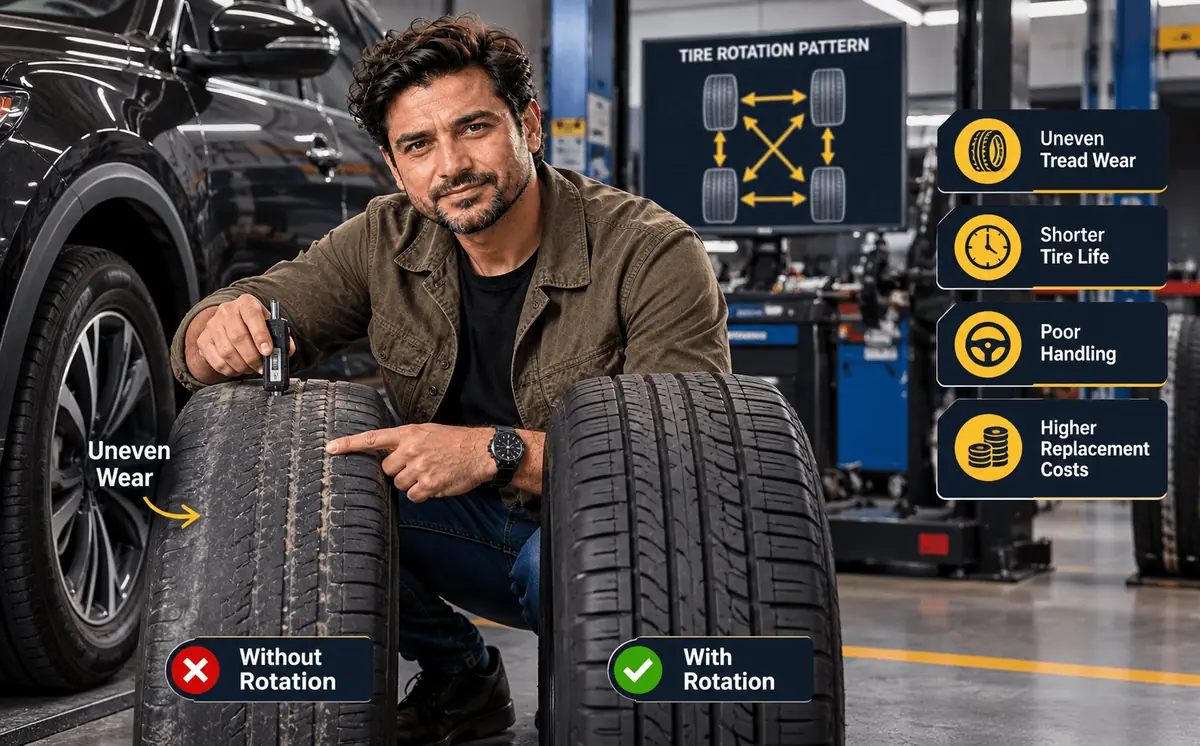
Tire rotation is the maintenance item drivers skip most easily. Nothing breaks, no warning light comes on, and the car seems to drive fine the next day. The problem is that the damage builds quietly over tens of thousands of miles, and by the time you notice it, you are usually looking at a pair of worn-out front tires, a humming noise you cannot get rid of or a warranty claim that goes nowhere.
Skipping rotations does not ruin tires overnight. It changes how they wear, and that change ripples into tire life, ride quality, wet-weather grip, warranty coverage and, on all-wheel-drive vehicles, the drivetrain itself. Here is what actually happens when tires stay in the same position for too long, and why a job that takes a shop a few minutes is worth keeping on schedule.
Table of Contents
Why Each Tire Position Wears Differently
Every corner of a car puts a different kind of work on its tire. The front tires steer, so they scrub through every turn and parking-lot maneuver. The front brakes do most of the stopping, because weight shifts forward under braking. On a front-wheel-drive car, the front tires also put down all of the engine’s power. Front-engine vehicles carry more weight over the front axle as well.
Add it up, and the front tires on a typical front-wheel-drive car do far more work than the rears. Rear-wheel-drive vehicles spread the load more evenly, with acceleration wearing the rears and steering wearing the fronts, but the two axles still wear in different ways. Even all-wheel-drive vehicles, which send power to all four corners, wear their front tires differently because the fronts steer.
Rotation exists to share that work out. Moving tires to new positions at regular intervals lets each one spend time on the hard-working axle and the easier one, so all four wear down at roughly the same rate.
The Consequences of Never Rotating Your Tires
Uneven Wear Sets In Early
The most direct result is uneven wear, and it shows up in two ways. First, one axle wears faster than the other. On front-wheel-drive cars, the front tires can reach replacement depth while the rears still have plenty of tread left.
Second, the wear across each individual tire becomes uneven. Turning loads push hard on the outer shoulders of the front tires, so those edges wear faster than the center of the tread. Over time the shoulders round off while the middle of the tread stays comparatively deep. Rear tires on front-wheel-drive cars have their own problem: they roll freely with little load and no driving force, which makes them prone to irregular wear patterns of their own.
Once these patterns are established, they tend to feed on themselves. A tire with a worn shoulder or irregular tread blocks keeps wearing that way even after it moves, which is why the first rotation, early in a tire’s life, matters so much.
Shorter Tire Life and Early Replacement in Pairs
When one axle wears out first, you lose the full mileage the set could have delivered. Instead of replacing four tires together at the end of a long life, you end up replacing two tires early, then the other two some time later.
That creates its own headaches. You pay for installation twice. You end up with mismatched tread depths, and sometimes mismatched tire models if your original tire has been discontinued. And because the remaining pair is partly worn, the car’s handling balance changes between the new and old tires. Tire retailers generally recommend installing the newer, deeper tires on the rear axle, which means more shuffling and more cost.
| Issue | Rotated Regularly | Never Rotated |
|---|---|---|
| Wear between axles | Even across all four tires | One axle, usually the front on FWD, wears much faster |
| Wear across the tread | Consistent, predictable | Shoulder wear, cupping or feathering |
| Replacement pattern | All four together | Two early, two later |
| Ride and noise | Stays close to new-tire character | Growing hum, roar or vibration |
| Treadwear warranty | Claim supported by records | Claim often denied or reduced |
More Noise, More Vibration
Uneven wear does not just shorten tire life. It changes how the tire sounds and feels. Two patterns cause most of the trouble.
Cupping, also called scalloping, leaves a series of dips around the tire’s circumference. It often shows up on tires that sit in one position for long periods, and it is frequently worsened by worn shocks or struts. Cupped tires produce a rhythmic hum or roar that rises with speed and is easy to mistake for a bad wheel bearing.
Feathering happens when individual tread ribs wear at an angle, sharp on one side and rounded on the other. You can often feel it by running a hand across the tread: smooth in one direction, rough in the other. Feathering is commonly linked to alignment problems, particularly toe settings, and staying in one position lets it develop faster.
Both patterns add vibration and road noise, and neither goes away once established. Rotating may slow the damage, but the tire will not wear back to smooth.
Reduced Wet Grip on the Worn Axle
Tread depth is what lets a tire push water out of the contact patch. As tread wears, the grooves hold less water, and the tire’s resistance to hydroplaning drops. This happens to every tire eventually, but skipping rotations concentrates the loss on one axle well before the others.
That imbalance matters. If the front tires are much more worn than the rears, the car is more likely to push wide in a wet corner and need more distance to stop in the rain. If badly worn tires end up on the rear, the back of the car can lose grip first, which is harder for most drivers to control. Keeping tread depth similar front to rear keeps wet handling predictable.
Uneven tread depth does not just cost you mileage. It changes how the car behaves on wet roads, and it does so gradually enough that many drivers never notice until they need the grip.
Treadwear Warranty Claims Can Be Denied
Many tires carry a treadwear (mileage) warranty, and nearly all of those warranties require regular rotation at the interval spelled out in the terms. If a tire wears out early and you cannot show rotation records, the claim may be denied or reduced. Uneven wear is often treated as evidence that the tires were not maintained.
Even when a claim is approved, the payout is prorated, so the records are what keep you from losing what little value the warranty offers. Keep the receipts from every rotation, with dates and mileage.
Drivetrain Stress on All-Wheel-Drive Vehicles
This is the consequence with the biggest potential bill. On an all-wheel-drive vehicle, the drivetrain expects all four tires to have nearly the same rolling circumference. A tire with less tread is slightly smaller in diameter, so it has to spin a little faster to cover the same distance.
When front and rear tires wear at different rates, that difference becomes constant. The center differential, transfer case or clutch-type coupling has to make up for the mismatch on every mile, not just in corners. That creates extra heat and wear inside components that were never meant to slip continuously, and repairs to them can be expensive.
Some automakers specify how closely tread depth must match across all four tires on their all-wheel-drive models, and the tolerances can be tight. Check your owner’s manual for the exact figure. Regular rotation is the simplest way to stay within it, and it also reduces the chance that a single damaged tire forces you to replace all four, or to have a new tire shaved down to match the others.
How Often Should You Rotate Your Tires?
A typical interval is every 5,000 to 7,500 miles, which lines up neatly with many oil change schedules. That convenience is why so many drivers simply rotate at every oil change. Some vehicles with longer oil change intervals may call for rotation more often than oil service, so do not assume the two always match.
Your owner’s manual is the authority. It lists the rotation interval and the pattern the automaker recommends for your specific vehicle, and tire manufacturers publish their own guidance in their warranty booklets. If you tow, carry heavy loads or drive hard, rotating toward the shorter end of the range makes sense.
Rotation Patterns by Drivetrain
The right pattern depends on what wheels drive the vehicle and what kind of tires it wears.
- Front-wheel drive: Forward cross. The front tires move straight back to the rear on the same side, and the rear tires cross to the opposite side as they move to the front.
- Rear-wheel drive and four-wheel drive: Rearward cross. The rear tires move straight forward on the same side, and the front tires cross to the opposite side as they move to the rear.
- All-wheel drive: An X-pattern, with each tire moving diagonally to the opposite corner, or a rearward cross, depending on the automaker’s recommendation.
- Directional tires: Front to back on the same side only, so each tire keeps rolling in the direction marked on its sidewall.
- Staggered fitments (different sizes front and rear): Side to side on the same axle, if the tires are non-directional. Staggered directional tires generally cannot be rotated without being dismounted and remounted on the wheels.
- Vehicles with a matching full-size spare: A five-tire rotation that brings the spare into service can spread wear across all five tires.
For a full walkthrough of these patterns, plus how alignment fits into the picture, see our tire rotation and alignment guide.
Warning Signs You Have Waited Too Long
You do not need special tools to spot the damage from skipped rotations. Watch and listen for these signs:
- Front tread noticeably shallower than the rear, or the reverse
- Rounded or worn outer shoulders on the front tires
- A hum or roar that rises with speed and did not used to be there
- New vibration through the steering wheel or seat
- Tread blocks that feel saw-toothed or uneven when you run a hand across them
- A tread depth gauge showing several 32nds of an inch of difference between axles
If you see these patterns, rotate the tires and have the alignment and suspension checked too. Cupping and feathering often point to worn parts or alignment issues that rotation alone will not fix.
Frequently Asked Questions
Yes. Your tires will wear unevenly, with one axle wearing out well ahead of the other, so you lose mileage and end up replacing tires in pairs sooner than necessary. You also invite noise, vibration, weaker wet grip on the worn axle and possible denial of a treadwear warranty claim.
A typical interval is every 5,000 to 7,500 miles, or at every oil change on many vehicles. Going a little past that once will not cause lasting harm, but skipping rotations repeatedly lets uneven wear patterns set in, and those cannot be reversed. Follow the interval in your owner’s manual.
It can affect your treadwear warranty. Most mileage warranties require regular rotation, and without records a claim for early wear may be denied or reduced. Keep dated receipts showing the mileage at each rotation.
Yes. They need them more than most. All-wheel-drive systems depend on all four tires having nearly the same rolling circumference. When tread depths drift apart, the drivetrain works constantly to make up the difference, which adds heat and wear to costly components. Some automakers set strict limits on tread depth differences, so check your manual.
No. Rotation prevents uneven wear and can slow existing patterns, but a cupped or feathered tire will not wear back to smooth. If the damage is significant, have the alignment and suspension checked and consider whether the affected tires need replacing.
New tires should follow the normal rotation schedule from the start. The first rotation is especially important, because wear patterns that form early tend to persist for the rest of the tire’s life. Waiting a year or more before the first rotation gives those patterns time to set in.
Often little or nothing. Walmart has listed rotation at about $5 per tire, roughly $20 for four, and Discount Tire rotates tires bought and installed there free for their life; many retailers include free rotations with a tire purchase.
The Verdict on Skipping Rotations
Not rotating your tires does not cause a sudden failure, which is exactly why so many drivers let it slide. What it causes is a slow, compounding loss: one axle wears out early, noise and vibration creep in, wet grip fades unevenly, warranty claims become harder to win and, on all-wheel-drive vehicles, the drivetrain absorbs stress it was never built to handle.
The fix is cheap and simple. Rotate every 5,000 to 7,500 miles or at the interval in your owner’s manual, use the pattern that matches your drivetrain and tires, and keep a record each time. It is one of the least expensive ways to protect what you spent on a set of tires.
 Summarize this article with:
















Leave a comment