


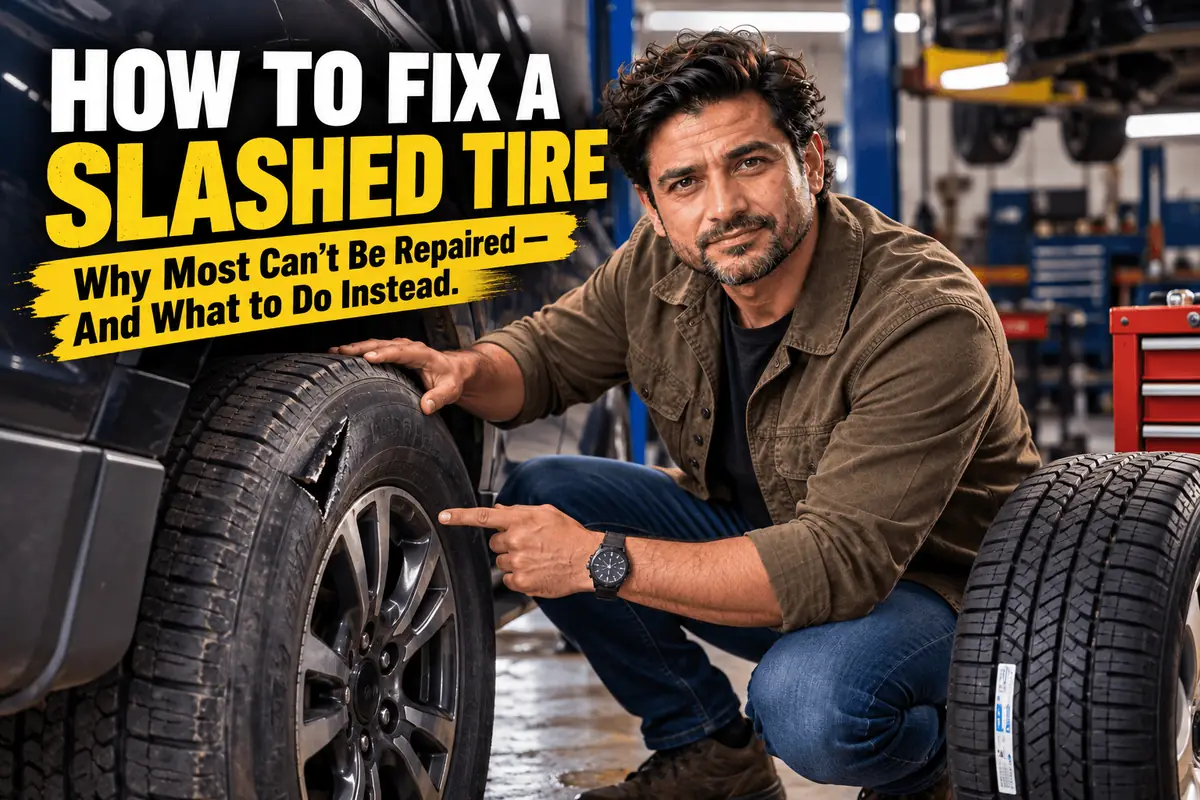
Walking out to find a tire flattened by a deep cut is a bad start to any day. The first instinct is to grab a plug kit or a can of sealant and get moving, because a repair sounds cheaper and faster than a new tire. Unfortunately, a true slash is almost never something you can fix.
The hard truth is that a cut in the sidewall or shoulder, or a gash in the tread larger than a small puncture, cannot be safely repaired, and the tire has to be replaced. What you can control is what happens next: getting the car safe without making the damage worse, deciding whether any repair is possible, handling a vandalism claim correctly, and choosing whether to replace one tire, two or all four. This guide walks through each step.
Table of Contents
Can a Slashed Tire Be Repaired?
In most cases, no. Whether any tire damage is repairable depends on where it is, how large it is and what kind of injury it is. A slash usually fails on all three counts.
Sidewall and shoulder cuts are never repairable. The sidewall flexes constantly as the tire rolls and carries much of the load. It has no steel belts under it to support a repair, so a patch cannot hold reliably there. The shoulder, where the tread rounds over into the sidewall, flexes in a similar way and is equally off limits. Vandals target the sidewall because it is exposed and easy to reach, which is why most slashed tires are a total loss.
Tread punctures are repairable only within strict limits. Industry guidance from the U.S. Tire Manufacturers Association (USTMA) allows repairs only in the tread area, away from the shoulder, and only for punctures up to about 1/4 inch (6 mm) in diameter. A knife cut in the tread is usually longer than that and forms an irregular tear rather than a round hole, which puts it outside repair limits too.
| Type of Damage | Repairable? | Why |
|---|---|---|
| Cut or slash in the sidewall | No | The sidewall flexes constantly and cannot hold a repair |
| Cut or puncture in the shoulder | No | Same flexing problem as the sidewall |
| Slash or tear in the tread longer than 1/4 inch | No | Exceeds industry repair limits |
| Nail or screw hole in the tread, 1/4 inch (6 mm) or smaller | Usually yes | Within USTMA guidance if done correctly |
| Any damage with bulges, exposed cords or internal damage | No | The tire’s structure is compromised |
| Tire driven on while flat | Often no | Running flat can destroy the inner sidewall |
What a Proper Repair Looks Like
When damage does fall within the limits, the correct repair is a patch-plug combination installed from inside the tire. The technician removes the tire from the wheel, inspects the inner liner for hidden damage, fills the injury with a rubber stem and seals the inner liner with a patch. A plug pushed in from the outside, or a patch alone, does not meet industry guidance as a permanent fix. Repairs should not overlap, and a tire worn to 2/32 inch of tread is due for replacement rather than repair. Run-flat tires follow their manufacturer’s own rules, and many cannot be repaired at all.
Our tire patch vs plug comparison explains in more detail why the combination repair is the standard.
What to Do Right Away
Don’t Drive on It
A slashed tire usually loses air quickly. Driving on a flat or badly underinflated tire overheats and destroys what is left of it, can damage the wheel and suspension, and leaves you with very little control. Even a short trip to a nearby shop can turn a replaceable tire and an intact wheel into a much bigger bill.
Fit the Spare or Call for Help
If you have a spare and a safe, level place to work, swap it on using the jack and lug wrench that came with the car. Many compact spares carry speed and distance limits, often printed on the tire or in the owner’s manual, so drive gently and head straight to a tire shop.
If the car has no spare, if you are on a busy roadside, or if more than one tire has been cut, call roadside assistance through your insurer, automaker or auto club and have the car towed.
Why Sealant Won’t Save You
Tire sealant kits work by coating the inside of the tire with liquid that plugs small punctures as air pushes it into the hole. A slash is far too large and too irregular for sealant to bridge, and sealant cannot do anything for a sidewall cut. Pumping sealant into a slashed tire wastes the kit and creates a mess the shop has to clean out of the wheel. Save sealant for small tread punctures, and even then, treat it as a way to reach a shop.
Inspect the Damage Before You Decide
Once the car is safe, take a careful look at the tire. A few signs make the decision for you:
- A cut anywhere on the sidewall or shoulder
- A gash or tear in the tread longer than about 1/4 inch
- Visible cords, belts or fabric
- A bulge, blister or deformation near the damage
- Several cuts on the same tire
Any one of these means replacement. Tires with only a small, round puncture in the center of the tread may be repairable, but a professional still needs to remove the tire and inspect it from the inside before making that call.
Intentional slashing tends to leave clean, straight cuts with sharp edges, often on the sidewall, and sometimes on more than one tire. Nails and screws leave small round holes in the tread. That distinction matters when you file a police report or an insurance claim.
If It Was Vandalism: Document, Report and Claim
Slashed tires are often the result of vandalism, and the paperwork you gather in the first hour makes the insurance claim much smoother.
- Photograph the damage before moving the car. Take close-ups of every cut and wide shots showing the car’s location and surroundings.
- Note the date, the time you found the damage, and where the car was parked and for how long.
- File a police report, usually through your local department’s non-emergency line or online reporting system, and keep the report number. Insurers commonly ask for it.
- Check for nearby camera footage, including your own dash cam, doorbell camera or home security system.
- Contact your insurance company to open a claim and ask how your deductible applies.
- Keep every receipt for towing, replacement tires and installation.
Comprehensive coverage on an auto policy typically covers vandalism, including slashed tires, minus your deductible. Liability-only policies generally do not. If a single tire costs less than your deductible, a claim may not be worth filing, but when several tires are cut, the math often changes. If you bought a road hazard plan with your tires, read its terms as well, since some plans exclude vandalism.
Replacing a Slashed Tire: One, Two or Four?
Once replacement is certain, the next question is how many tires to buy. The answer depends on the tread depth of your remaining tires and on your drivetrain.
Match What You Have
The new tire should match the size, load index and speed rating listed on your door placard, and ideally the same brand and model as the others. Mixing tread designs on the same axle can make the car handle unevenly, especially in rain or snow.
Tread Depth Is the Deciding Factor
| Situation | Usual Recommendation |
|---|---|
| Other tires are nearly new | Replace just the slashed tire with an identical one |
| Other tires are moderately worn (two-wheel drive) | Replace the pair on the same axle |
| Other tires are close to replacement anyway | Replace all four |
| All-wheel drive with worn tires | Follow the owner’s manual tread-depth limit; often all four, or one tire shaved to match |
When you replace only two tires, tire makers generally recommend mounting the new pair on the rear axle. Deeper tread at the rear helps prevent the back of the car from sliding out on wet roads.
All-Wheel-Drive Considerations
All-wheel-drive systems are sensitive to differences in tire diameter. A new tire has a slightly larger rolling diameter than worn ones, so it turns at a different speed, and the drivetrain constantly tries to compensate. Over time that can strain the center differential or coupling. Many automakers set a maximum allowable tread-depth difference between tires, so check your owner’s manual before buying a single tire. If the other three are only lightly worn, some tire shops can shave a new tire down to match their tread depth. If they are well worn, replacing all four is usually the safer and cheaper choice in the long run.
What It Costs
Replacement tires span a wide price range, from budget models through premium brands, and mounting, balancing, new valve stems and disposal fees add to the bill. If your vehicle has tire pressure monitoring sensors, make sure the shop handles them correctly during installation.
How to Lower the Risk of It Happening Again
No measure makes a car immune to vandalism, but a few habits make it a less attractive target.
- Park smart. Choose well-lit spots with steady foot or vehicle traffic. A locked garage is best for overnight parking.
- Add cameras. A dash cam with a parking mode records activity around the car while it sits, and visible home security cameras overlooking the driveway deter vandals and capture evidence if something happens.
- Light it up. Motion-activated lights over a driveway or parking pad discourage people from lingering near the car.
- Know your neighbors. In residential areas, neighbors who know your car are more likely to notice someone tampering with it.
- Watch the TPMS. A tire pressure warning will not stop a slasher, but it alerts you to sudden air loss before you drive far.
If the incidents repeat, document each one separately, report each to the police, and ask your insurer whether they recommend any additional measures.
Frequently Asked Questions
No. Sidewall cuts cannot be safely repaired with a patch, a plug or sealant, because the sidewall flexes constantly and has no belt support behind it. Any tire with sidewall damage needs to be replaced.
Industry guidance from the USTMA limits repairs to punctures of about 1/4 inch (6 mm) or smaller in the tread area, away from the shoulder. Larger holes, cuts and tears, and any damage in the shoulder or sidewall, mean the tire must be replaced.
No. A plug kit is meant for small, round punctures in the tread, and even then a plug alone is not considered a permanent repair. A slash is too large and irregular for a plug to seal, and the tire needs replacement.
Comprehensive coverage typically covers vandalism, including slashed tires, after you pay your deductible. A police report number and clear photos will help the claim. If the replacement cost is close to or below your deductible, paying out of pocket may make more sense.
Not always. If the remaining tires are nearly new, one identical replacement is often fine. Worn tires may call for replacing a pair or all four, and all-wheel-drive vehicles usually have a maximum tread-depth difference specified in the owner’s manual.
It is not. A slashed tire typically loses air fast, and driving on it can destroy the tire, damage the wheel and reduce control. Fit the spare or call roadside assistance instead.
Put on the spare or call for help rather than using sealant, which will not seal a slash and makes a mess for the shop. Most slashed tires are a total loss because vandals target the sidewall, and you will want a police report if you plan an insurance claim.
Final Word on Dealing With a Slashed Tire
A slashed tire is a replacement job, not a repair job. Cuts in the sidewall or shoulder, and gashes in the tread larger than about 1/4 inch, put a tire beyond safe repair, and neither a plug kit nor sealant changes that. Only small tread punctures within USTMA limits qualify for a repair, and only when a shop installs a patch-plug combination from inside the tire.
The smartest response is calm and methodical: keep the car parked, fit the spare or call for help, photograph everything, and file a police report if it was vandalism so your comprehensive coverage can do its job. Then choose replacements that match your remaining tires, respect your AWD system’s tread-depth limits, and put the deeper tread on the rear axle. Handle it that way, and an infuriating morning becomes a manageable expense rather than a safety risk.
 Summarize this article with:















Leave a comment