


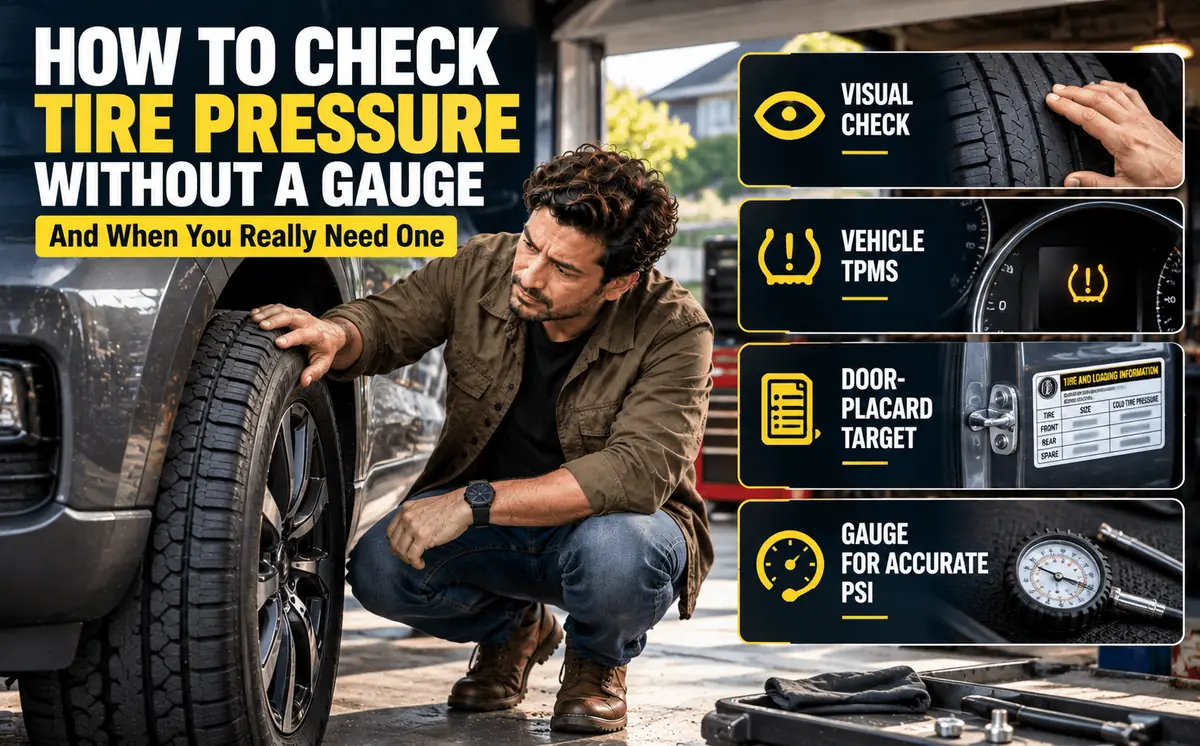
The steering feels a little vague, the dashboard has a light you have not seen before, or one corner of the car simply looks lower than the others. You want to know whether a tire is low, and the gauge you meant to buy is still on the shopping list. Driving on a soft tire is a bad gamble, so the practical question is what you can learn right now, with what you have.
Here is the short answer: you can get a useful reading without a handheld gauge, but only some methods give you a number. Your car’s tire pressure monitoring system and the readout on a gas station air machine can tell you actual PSI. Looking at the tire, pressing on it and paying attention to how the car drives can only flag a problem that is already fairly serious. This guide walks through each option, explains what it can and cannot tell you, and makes the case for the inexpensive tool that ends the guesswork.
How this guide was put together: This guide is general information based on common manufacturer and industry guidance; your owner’s manual is the controlling source. Prices are typical ranges, not quotes. Checked on October 22, 2026.
Table of Contents
Start With the Number You Are Aiming For
Every check is pointless without a target, and that target is not printed on the tire. Look for the tire and loading information placard, usually a sticker on the driver’s side door jamb. Some vehicles put it on the inside of the fuel door or the glove box door, and the owner’s manual lists the same figures. Many passenger cars land somewhere in the 30 to 35 PSI range, but trucks, SUVs and performance cars can differ, and the front and rear figures are not always the same.
The number molded into the tire sidewall is the maximum pressure that tire can safely hold. It is not a recommendation for your car, and filling to it will leave you with a harsh ride, less grip and accelerated wear in the center of the tread.
Cold Pressure vs Hot Pressure
The placard figure is a cold pressure. A tire counts as cold when the car has been parked for at least three hours, or has been driven only a short distance, about a mile. Once you drive, the air inside heats up and the pressure climbs, often by several PSI. That rise is normal and already accounted for in the vehicle maker’s recommendation.
Two rules follow from that. First, the most accurate check happens in the morning before you drive. Second, never let air out of a hot tire to bring it down to the placard number. When it cools, it will be underinflated.
Outside temperature matters too. Tire pressure changes by roughly 1 PSI for every 10°F swing in air temperature, which is why the first cold snap of fall triggers so many warning lights. Tires also lose air slowly through the rubber over time, roughly a PSI a month on a healthy tire, so pressure that was correct in spring will not stay correct by itself.
Method 1: Read Your TPMS Display
If your car was built for the US market from the 2008 model year onward, it has a tire pressure monitoring system, and this is the best gauge-free tool you own. There are two kinds, and they tell you very different things.
Direct TPMS uses a sensor inside each wheel that measures actual air pressure and sends it to the car. Many vehicles with direct systems show the PSI for each tire on the instrument cluster or the infotainment screen, usually under a vehicle settings or tire pressure menu. If yours does, you effectively have four built-in gauges. Readings from these sensors are generally close to a good handheld gauge, typically within a PSI or two.
Indirect TPMS has no pressure sensors. It watches wheel speed through the antilock braking system and infers that a tire is low when it starts spinning faster than the others, because a softer tire has a slightly smaller rolling diameter. Indirect systems cannot show you a PSI number, and they need to be reset after you adjust pressure so they relearn the baseline.
What the Warning Light Really Means
The amber light shaped like a tire cross-section with an exclamation point is not a precision alert. Federal rules require the system to warn you when a tire falls 25% or more below the placard pressure. On a car that calls for 35 PSI, that means the light may stay off until a tire drops to around 26 PSI. A tire can run 4 or 5 PSI low for weeks, wearing faster and costing fuel, without any warning.
A light that comes on and then goes off after a few miles usually points to a tire sitting right at the threshold on a cold morning. The air warms, the pressure rises, and the warning clears, but the tire is still low. A light that flashes for a minute or so at startup and then stays lit typically signals a system fault, such as a dead sensor battery, rather than low pressure.
Method 2: Use a Gas Station Air Machine With a Readout
Plenty of drivers who do not own a gauge are a short drive from one. Many gas station air machines now have a digital display that shows pressure as soon as you press the chuck onto the valve stem. Some let you dial in a target PSI before you start, then fill the tire and beep or shut off automatically when it gets there.
To get the most out of one:
- Check the placard first so you know the target for front and rear tires.
- If the machine lets you set a target, enter the placard pressure.
- Remove the valve cap and press the chuck firmly and straight onto the stem so you do not hear air hissing past the seal.
- Read the pressure, add air as needed, and recheck after filling.
- Replace every valve cap, since caps keep dirt and moisture out of the valve core.
Keep two cautions in mind. These machines live outdoors and get handled roughly, so their readouts are not always calibrated, and two machines can disagree by a few PSI. And if you drove a fair distance to reach the station, your tires are warm and will read higher than their cold pressure. In that case, it is reasonable to set them a few PSI above the placard figure and recheck them cold the next morning, ideally with a gauge you trust.
Method 3: Look Closely at the Tires
A visual check costs nothing and takes a minute, but it catches only big problems. Park on flat, level pavement and look at each tire from the side and from the front or rear.
- Sidewall bulge near the ground. A tire that sags outward where it meets the pavement, with a wide, flattened look at the bottom, is likely low.
- Uneven stance. Compare tires on the same axle. One that sits visibly lower or looks fatter at the base than its partner deserves attention.
- Wear patterns. Wear concentrated on both outer shoulders points to a history of underinflation, while wear down the center points to overinflation. These patterns build over thousands of miles, so they describe how the tire has been treated, not its pressure today.
The limits are significant. A radial tire can be seriously underinflated and still look almost normal, and low-profile tires with short, stiff sidewalls hide it especially well. Small drops of a few PSI, the kind that quietly erode fuel economy and tread life, are invisible.
Method 4: The Hand-Press and Thumb Test
Pressing on the tire adds touch to what you can see. Place your palm or thumb on the sidewall, not the tread, and push firmly. A properly inflated tire feels firm and gives only slightly. A tire that feels soft, lets your thumb sink in easily, or flexes noticeably more than the others is probably low. A tire that feels rock hard with almost no give may be overinflated, though that is harder to judge by hand.
The test works best as a comparison. Press every tire with the same force, in the same spot, and look for the odd one out. If one feels clearly softer than the rest, you have a lead worth following up.
Where hand testing falls short:
- It cannot give you a number, and it only detects fairly large differences.
- Two people pressing the same tire can reach different conclusions.
- Run-flat tires and many performance tires have reinforced sidewalls that can feel firm even when pressure is low.
- If all four tires have leaked down together over months, they will feel equally soft, and comparison tells you nothing.
Method 5: Pay Attention to How the Car Drives
The car itself sends signals when a tire is low, although by the time you notice them, the tire is usually well below spec. Watch for:
- Steering that feels heavier or slower to respond than usual, especially at parking-lot speeds
- A vague, floaty or wandering feel on the highway that needs constant small corrections
- More body lean or a sloppy, delayed feel through corners
- A pull to one side, which can come from one low tire, although alignment problems cause the same symptom
These cues are worth noticing, but never drive aggressively to test for them. If the car starts to feel different, pull over somewhere safe and run the visual and hand checks.
How the Methods Compare
| Method | Gives You a PSI Number? | What It Can Reliably Catch | Main Limitation |
|---|---|---|---|
| Direct TPMS per-tire display | Yes | Small and large pressure differences | Not every car shows individual readings |
| TPMS warning light | No | A tire about 25% below placard pressure | Stays off while tires run moderately low |
| Gas station machine readout | Yes | Small and large differences | Calibration varies, tires are often warm on arrival |
| Visual inspection | No | Severe underinflation | Low-profile tires hide low pressure |
| Hand or thumb press | No | One tire much softer than the others | Subjective, fooled by stiff sidewalls |
| Driving feel | No | Significant pressure loss | Symptoms overlap with alignment and suspension issues |
Only two gauge-free methods produce an actual number: a direct TPMS readout and a gas station machine with a display. Everything else tells you to go find a number.
If You Suspect a Low Tire on the Road
Get completely off the road onto level ground, turn on your hazards and set the parking brake. A visible bulge, cut or blister on the sidewall means the tire should not be driven; use the spare or call roadside assistance. A tire that looks intact but soft can usually be driven gently, at reduced speed, to the nearest air pump. Avoid highway speeds, since an underinflated tire flexes more and builds heat, and heat is what leads to failure. If that tire keeps losing air over the following days, it likely has a puncture or leaking valve and needs a shop inspection.
Why a Cheap Gauge Still Wins
Every method above has its place, but none replaces a handheld gauge for routine maintenance. A basic stick, dial or digital gauge often costs less than $15, fits in a glove box, and gives you a repeatable number in seconds, cold, in your own driveway, before the tires have warmed up on the drive to an air pump.
That precision pays off. Correct pressure keeps the tread contacting the road evenly, which protects grip in the wet, keeps the tire from overheating, and helps it wear evenly. According to the US Department of Energy, underinflated tires lower gas mileage by about 0.2% for every 1 PSI drop in the average pressure of all four tires, and keeping them properly inflated improves mileage by an average of 0.6%, and by up to 3% in some cases.
Whatever you choose, use it once a month and before long trips, with the tires cold. Gauges can drift with age, so if yours starts disagreeing with your TPMS display or a shop’s gauge by more than a couple of PSI, it is time to replace it. For help deciding what pressure is right when you carry heavy loads or tow, see our guide to choosing the right tire pressure.
Frequently Asked Questions
Only when it is very low. A radial tire can lose a substantial share of its pressure and still look close to normal, and low-profile tires disguise it even better. A visible sag or bulge at the bottom of the sidewall is a real warning, but a normal-looking tire is not proof that pressure is correct.
The warning is required to come on when a tire drops 25% or more below the pressure on the door-jamb placard. For a car that calls for 35 PSI, that is roughly 26 PSI. Because the light stays off above that point, it is a safety backstop, not a substitute for monthly checks.
Usually. Direct TPMS systems that show a reading for each tire are usually close to a quality handheld gauge, typically within a PSI or two. Read them when the tires are cold for a figure you can compare with the placard. Indirect systems do not measure pressure at all, so they cannot show a number.
Cold. The placard pressure is based on tires that have sat for at least three hours or been driven only about a mile. Hot tires read several PSI higher, and releasing air to match the placard while they are hot leaves them underinflated once they cool.
At least once a month and before any long trip, plus after a big drop in outside temperature. Tires lose air gradually even when nothing is wrong, and pressure falls about 1 PSI for every 10°F of cooling, so a monthly habit catches drift before it costs you tread life or grip.
Use the air machine’s built-in gauge, or your car’s TPMS display if it shows each tire’s pressure, and fill to the placard figure with the tires cold. A basic gauge costs under $15 and is more reliable.
The Takeaway on Gauge-Free Pressure Checks
You can absolutely check tire pressure without a gauge, as long as you know which methods give you facts and which give you hints. A direct TPMS display or a gas station machine with a readout will tell you actual PSI. Looking at the tires, pressing on them and noticing how the car drives will only reveal a tire that is already well below where it should be, and the TPMS warning light waits until a tire is about a quarter low.
Use those rough checks to decide whether you need air right now, then set the pressure properly against the door-jamb placard with the tires cold. The simplest fix of all is to spend a few dollars on a gauge, keep it in the glove box and use it once a month. It turns an educated guess into a number you can trust.
Related: Truckers sometimes use a mallet instead of a gauge; see what a tire thumper is and where it falls short.
Sources
Specs, warranty terms and prices were checked on October 22, 2026. Prices change often.
- NHTSA: Tires (tire safety and maintenance)
 Summarize this article with:















Leave a comment