


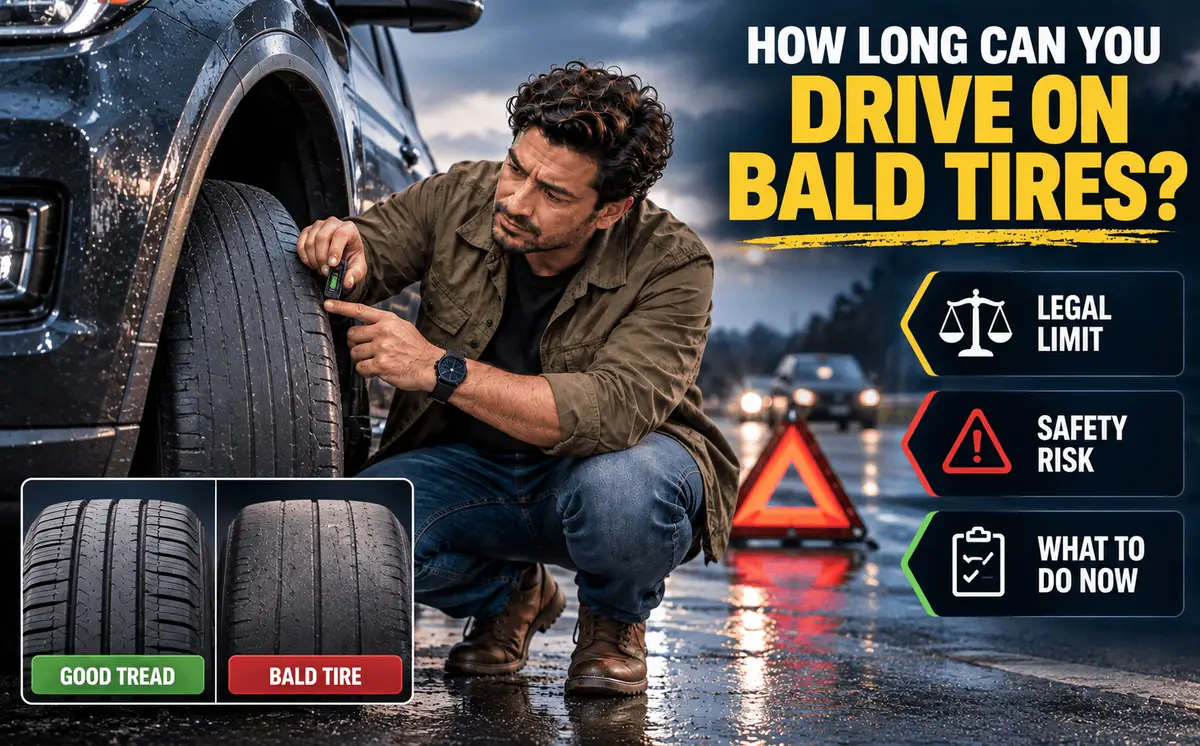
You just noticed it: the tread on one or more of your tires looks almost smooth, maybe with a bald stripe across the middle or a patch where something that looks like fabric is showing through. Money is tight, a tire shop visit is not on this week’s calendar, and the car still seems to drive fine. So how long can you keep going?
The answer is that you shouldn’t drive on bald tires at all, beyond the shortest, slowest trip needed to replace them. There is no safe mileage figure, because bald tires do not fail on a schedule. They fail when you need grip the most: in a sudden downpour, on a hard stop at a yellow light, or when the worn rubber finally gives way at highway speed. Here is what makes a tire legally and practically bald, why the risk climbs so steeply, and what to do if you are stuck driving on worn tires right now.
Table of Contents
What Counts as a Bald Tire?
A tire does not have to be completely smooth to be bald. In most US states, a passenger tire is legally worn out once its tread reaches 2/32 inch, which is a little under 1.6 mm. New passenger tires typically start with roughly 10/32 to 11/32 inch of tread, so a tire at 2/32 inch has lost most of the depth that lets it clear water and grip the road.
Tire makers build a visible warning into every tire to mark that point. Tread wear indicator bars are small raised bridges of rubber molded into the bottom of the main grooves, running across the tread. On a healthy tire, they sit well below the surface. When the tread wears down until the bars are flush with the surrounding rubber, the tire has reached 2/32 inch and needs replacing.
Other signs of a bald or failing tire include:
- Exposed cords, belts or fabric. If you can see threads, wire or a fabric-like layer through the rubber, the tire has worn past the tread into its structure. Do not drive on it except to get it replaced, and even that is a risk.
- Smooth bands or patches. A strip worn bald in the center or along one shoulder still makes the whole tire unsafe, even if the rest has tread left.
- Missing or faint sipes. The thin slits in the tread blocks are often shallower than the main grooves and disappear first, so their absence is an early warning.
The Quick Coin Check
Two coins give a fast reading. Insert a penny into a main groove with Lincoln’s head pointing down. If you can see the top of Lincoln’s head, the tread is at or below 2/32 inch and the tire is worn out. Do the same with a quarter: if you can see the top of Washington’s head, the tread is at or below 4/32 inch, which is a sensible point to start shopping for replacements.
Check several spots across and around each tire, since wear is often uneven. For the full method, including tread depth gauges and how to read uneven wear, see our guide to checking tread depth.
The Legal Minimum: 2/32 Inch in Most States
The 2/32-inch standard is the most common legal limit in the United States, and it is the figure most inspection programs and police officers work from. There are exceptions. California, for example, sets its passenger-vehicle minimum at 1/32 inch in any two adjacent grooves, and treats a bald tire as an infraction with a fine per tire. A handful of states have no specific tread depth number at all, relying instead on general laws against operating unsafe vehicles.
Those differences matter less than they appear. A tire at 2/32 inch is already well past the point of good wet-road performance, and no state law makes a worn-out tire safe. Penalties also vary widely by state, from small fines to inspection failures, so treat the legal limit as a floor, not a target.
| Tread Depth | Coin Reference | What It Means |
|---|---|---|
| 10/32 to 11/32 inch | Neither coin head visible | Typical new passenger tire |
| 4/32 inch | Top of Washington’s head visible on a quarter | Wet grip noticeably reduced; plan to replace |
| 2/32 inch | Top of Lincoln’s head visible on a penny | Legally worn out in most states; replace now |
| Below 2/32 inch or cords showing | Wear bars flush or below surface | Bald; do not drive except to replace |
Why Bald Tires Are So Dangerous
Hydroplaning Comes Sooner and Harder
Tread grooves are channels that move water out from under the tire so the rubber can stay in contact with the pavement. As the grooves get shallower, they hold and move less water. At some speed, the water cannot escape fast enough and the tire rides up onto a film of it. That is hydroplaning, and while it lasts, steering and braking inputs do almost nothing.
A deep-treaded tire can resist hydroplaning up to fairly high speeds on a wet road. A bald tire can start to float at much lower speeds and in shallower water, including the standing water in ruts and puddles that you barely notice until the steering goes light.
Stopping Distances Grow, Even Before a Tire Is Bald
The loss of grip starts well before the legal limit. In AAA testing, cars on tires worn to 4/32 inch needed an average of 87 additional feet to stop from 60 mph on a wet road compared with new tires, an increase of about 43%. Handling on wet pavement dropped by about a third. Those were tires with twice the legal minimum depth. At 2/32 inch and below, the margin shrinks further.
On dry pavement, the gap between new and worn tires is smaller, which is part of why bald tires feel deceptively normal on a sunny day. The danger shows up the first time the road is wet.
Snow and Ice Become Nearly Impossible
Winter traction depends on tread depth and on the sipes that create biting edges in snow and on ice. A bald tire has neither. Even at low speeds, a car on bald tires may struggle to climb a slight grade, stop at an intersection or hold a line through a turn on a snow-covered street.
Blowout and Puncture Risk Rises
Tread rubber is part of what protects a tire’s belts and casing. With most of it gone, there is less material between the road and the tire’s structure, so nails, glass and potholes do more damage. Heat is also harder on a thin, worn tire. Once cords are exposed, the tire can fail suddenly, and a blowout at highway speed is one of the most dangerous failures a driver can face.
A bald tire can feel fine for weeks on dry roads. That is exactly what makes it dangerous: it gives no warning before the first hard stop in the rain.
Warning Signs That Your Tires Are Getting Close
Tires usually announce their decline before they are fully bald. Watch for:
- Longer stops or earlier ABS activation in the wet, or a feeling that the car slides more easily than it used to
- Vague or floaty steering on wet roads, especially through standing water
- More road noise than the tires made when newer
- Vibration through the steering wheel or seat, which can point to uneven wear or internal damage
- Uneven wear patterns: wear in the center often suggests overinflation, wear on both shoulders suggests underinflation, wear on one edge points to alignment, and cupping or scalloping suggests worn suspension parts
Uneven wear deserves attention on its own. A tire can look fine on the outside while the inner shoulder is worn to the cords, so look at the full width of the tread, not just the part you see from the curb.
Stuck on Bald Tires? What to Do Right Now
If your tires are bald today and you cannot replace them on the spot, the goal is to get to a tire shop with as little exposure to risk as possible. That means planning the trip like a careful errand, not continuing normal driving.
- Consider not driving at all. A tow, a mobile tire installer that comes to you, or a ride to the shop and back may cost less than you expect and removes the risk entirely. If cords are showing, these are the only sensible options.
- Check the tire pressure. Inflate to the figure on the driver’s door jamb placard, not the maximum on the sidewall. Correct pressure helps a worn tire keep its shape and run cooler.
- Wait out the rain. If you have any flexibility, drive only on dry roads. Wet pavement is where bald tires are most likely to lose grip.
- Avoid highways. Choose the shortest route on lower-speed roads, and keep your speed well below the limit.
- Leave far more space. Increase your following distance substantially, brake early and gently, and take corners slowly.
- Go straight to the shop. Make no extra stops, and replace the tires that day if at all possible.
If one tire is in much worse shape than the others, and your spare is in good condition and rated for the trip, swapping it in may be a safer short-term option. Temporary compact spares carry their own speed and distance limits, usually printed on the tire or in the owner’s manual.
Insurance and Liability
Driving on bald tires can also cause trouble beyond a ticket. If you are involved in a crash, worn tires can become a factor in determining fault, and insurers may examine vehicle condition when handling a claim. The specifics depend on your state, your policy and the circumstances, so the practical point is general: a known bald tire is a risk you carry legally and financially as well as physically.
Replacing Bald Tires Without Overspending
Replacing tires is rarely a pleasant expense, but a few choices help:
- Match the specifications. Use the size, load index and speed rating listed on the door placard or in the owner’s manual, and never go below the original load or speed rating.
- Choose for your climate. All-season tires suit most drivers in mild-winter regions; winter tires make sense where snow and ice are routine.
- Look at the treadwear rating and warranty. A higher UTQG treadwear number generally points to longer tread life, though often with some trade-off in grip.
- If you can only buy two, put them on the rear axle. Tire makers recommend installing the newer tires at the rear regardless of drivetrain, because worn rear tires make a car more likely to slide its rear end out of line on wet roads.
- Check for rebates and payment plans. Many retailers and manufacturers run seasonal promotions.
For help picking a replacement, see our buying guides to the best all-season tires and the best budget tires.
How to Keep Tires From Going Bald Early
Good habits stretch tread life and help you spot trouble before it becomes urgent.
| Habit | How Often | Why It Matters |
|---|---|---|
| Check tire pressure | Monthly and before long trips | Underinflation wears the shoulders; overinflation wears the center |
| Rotate tires | Every 5,000 to 8,000 miles, or per the owner’s manual | Evens out wear between front and rear |
| Check alignment | Yearly, or after a hard pothole or curb hit | Misalignment wears one edge quickly |
| Measure tread | Monthly | Catches uneven wear before it reaches the cords |
| Inspect for age and damage | At every rotation | Rubber ages even when tread remains |
Remember that tire pressure drops roughly 1 psi for every 10°F fall in temperature, so a set that was correct in September may be low by December. Age matters too: rubber hardens and cracks over time, so a tire with plenty of tread can still need replacing. Follow the age guidance from your vehicle and tire manufacturers, and have older tires inspected regularly.
Frequently Asked Questions
There is no safe number. A bald tire can fail or lose grip on the very next wet road, hard stop or pothole. If you have no other option, drive only the shortest distance needed to reach a tire shop, at low speed, on dry roads and away from highways.
In most states, yes. The most common legal minimum is 2/32 inch of tread. California sets its passenger-vehicle limit at 1/32 inch, and a few states rely on general unsafe-vehicle laws instead of a specific number. Penalties range from fines to failed inspections, depending on the state.
Look for wear bars that sit flush with the tread, smooth bands across the tire, or visible cords and fabric. A penny inserted head-down that shows the top of Lincoln’s head means the tread is at or below 2/32 inch.
Treat 2/32 inch as the absolute limit and 4/32 inch as the point to start replacing, especially if you drive in rain or snow. AAA testing found that tires worn to 4/32 inch already needed considerably longer distances to stop on wet roads than new tires did.
They are less obviously dangerous on dry pavement, which is why they can feel normal. They are still more vulnerable to punctures, heat damage and blowouts, and the risk changes instantly the moment the road gets wet.
Yes, if the other two still have healthy tread. Install the new pair on the rear axle, regardless of whether the car is front-, rear- or all-wheel drive. Some all-wheel-drive vehicles require all four tires to be closely matched in tread depth, so check the owner’s manual first.
The Bottom Line on Bald Tires
The question of how long you can drive on bald tires has a short answer: only as far as the nearest tire shop, and preferably not even that far under your own power. Grip falls off well before the legal 2/32-inch limit, wet roads expose the weakness immediately, and exposed cords mean the tire can let go at any moment.
If your tires are bald, make replacing them the next thing you do. Get a tow or a mobile installer if you can, drive slowly on dry, low-speed roads if you cannot, and use the coin check or a tread gauge every month afterward so you see the next set wearing out long before it gets this far.
 Summarize this article with:














Leave a comment