


Watch any race and the commentary keeps circling back to tires: who is on softs, whose rears are graining, when the pace will fall off a cliff. For fans, and for drivers shopping for performance road tires, it is hard to tell how much of that is real engineering and how much is broadcast drama, or whether any of it matters for the tires on your own car.
It does. A racing tire is a road tire with every compromise stripped away, which makes it the clearest possible illustration of how grip, heat and wear trade against each other. Here is how racing tires are built, why they behave the way they do, how the major spec-tire series handle them, and what that knowledge means when you buy a performance street tire or a 200-treadwear track-day tire.
How this guide was put together: This guide explains general racing-tire engineering for road-car drivers; it is not based on our own testing. Checked on October 22, 2026.
Table of Contents
Grip Is a Heat Problem
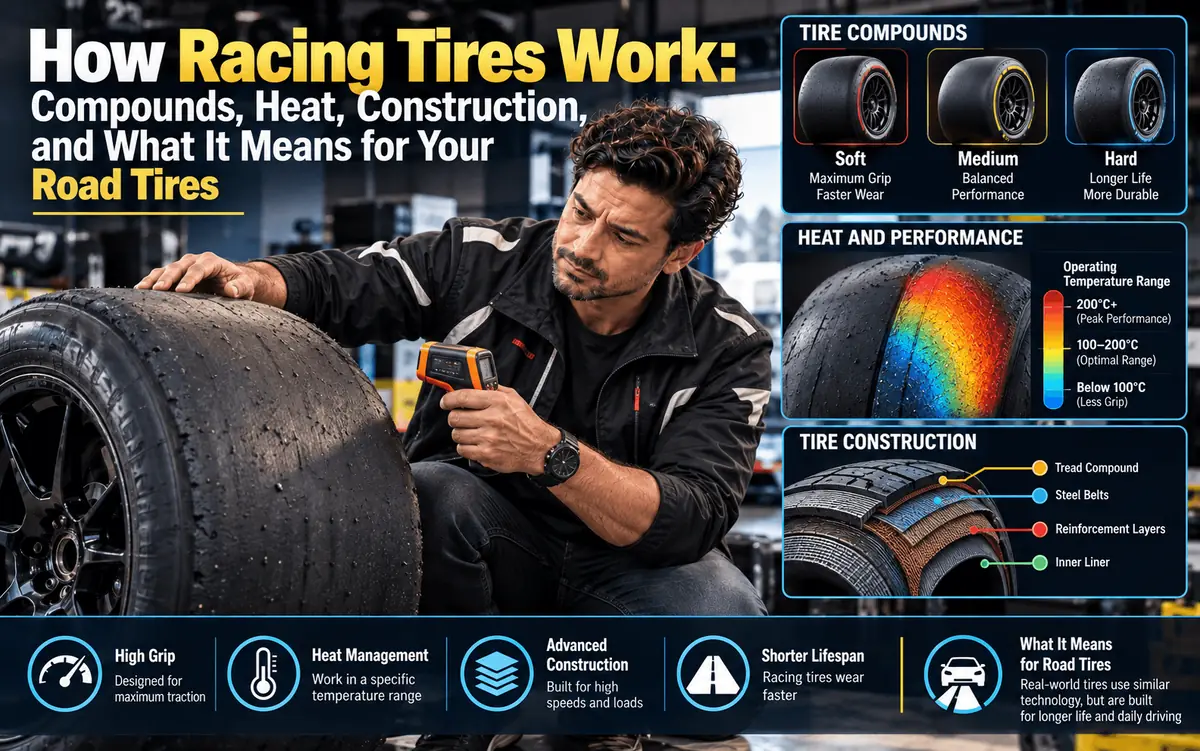
A passenger car compound has to grip in the rain, stay pliable in freezing weather, last tens of thousands of miles and keep rolling resistance low. A racing compound chases one goal: maximum grip for a limited time.
That grip comes largely from a property called hysteresis. As the tread rolls over the microscopic peaks and valleys of the asphalt, the rubber deforms around them. A perfectly elastic material would spring back instantly and return almost all of that energy, producing little grip. Racing rubber is viscoelastic: it flows into the texture of the surface and recovers slowly, turning some of the energy of deformation into heat. That internal friction, together with molecular adhesion between rubber and road, is what lets a slick hold a car through a corner at speeds a street tire could never sustain.
The catch is that a compound’s hysteresis depends heavily on temperature. Engineers tune racing compounds so they deliver their best grip inside a specific operating window, a temperature range far hotter than a street tire ever runs. Below that window the rubber is too stiff to conform to the road and grip falls away sharply. Above it, the compound softens too much, wears rapidly and can begin to break down internally.
That is why race cars weave and brake hard behind a safety car. Drivers are working heat back into tires that cool quickly at low speed, because a tire that drops out of its window can take several corners to recover.
Compounds and Operating Windows
Most top-level series offer more than one dry compound, and choosing between them is central to strategy.
- Softer compounds reach their operating window quickly and generate more grip, but they wear and overheat sooner.
- Harder compounds need more energy to come up to temperature and offer less peak grip, but they hold up longer and tolerate heat better.
Track layout, asphalt roughness, weather and setup all shift which compound works best. Exact operating temperatures are closely guarded and vary by manufacturer, compound and series, so treat any single figure you see quoted with some caution. The principle holds everywhere: every compound has a band where it works, and the engineer’s job is to keep the tire inside it.
Slicks vs Rain Tires
A tread pattern exists to move water. On a dry track, every groove is rubber that is not touching the road, so racing slicks remove the grooves entirely and put the maximum possible area of compound into the contact patch.
The same logic flips in the wet. A slick has no channels to clear standing water, so it rides up onto the water film and hydroplanes at speeds far below racing pace. Rain tires solve that with deep, carefully shaped grooves that pump water out from under the contact patch, and with softer compounds that work at the lower temperatures a wet track allows, since water constantly cools the rubber.
Many series also use an intermediate tire for damp or drying tracks, with shallower grooves than a full wet. Timing the switch can win or lose a race: stay out on wets as the track dries and the soft rain compound overheats, but fit slicks too early and the car has almost no grip in the remaining puddles.
Tire Warmers: Where Series Allow Them
Because a cold racing tire grips poorly, some series let teams preheat tires with electric blankets. Formula 1 has debated banning them for years, but blankets remain permitted under the 2026 regulations, which also tighten the rules against devices that cool wheels and tires.
Other series take the opposite approach. American oval and road racing, including NASCAR and IndyCar, sends cars out on unheated tires, which makes the first laps after a pit stop a real test of driver feel.
Construction: The Structure Under the Tread
The compound produces grip, but the construction, or carcass, decides how that grip is delivered.
Radial Carcasses and Stiff Sidewalls
Most modern circuit racing tires use radial construction, like road tires, but with far stiffer structures. A stiff carcass keeps the tread flat against the track under heavy cornering and braking loads, so the contact patch stays consistent. Sidewall height matters too: Formula 1 moved from 13-inch to 18-inch wheels in 2022, giving the tires much lower-profile sidewalls that flex less and respond more directly, closer in character to modern performance road tires.
Lightweight Reinforcement
Racing tires use lightweight reinforcing materials such as aramid fibers in place of some of the steel common in road tires, cutting unsprung weight so the suspension can keep the tire in contact with the road over bumps and curbs. A tightly reinforced belt also limits how much the tire grows in diameter at very high speed, which helps keep ride height and aerodynamics stable.
The Drag Racing Exception
Top Fuel dragsters take the opposite route. Their huge rear tires use bias-ply construction with soft, wrinkling sidewalls. At launch, the sidewall twists and wrinkles, cushioning the enormous shock to the drivetrain and then unwinding to help fling the car forward.
When Tires Go Wrong: Degradation, Graining and Blistering
Racing tires are meant to perform for a defined stint, not to last, and the way they lose performance shapes every race strategy.
| Problem | What Causes It | What the Driver Feels |
|---|---|---|
| Graining | Tread sliding across the track, often when the tire is below its window, tearing off small rolls of rubber that stick to the surface | Grip fades and the car feels like it is running on marbles until the grained layer wears away |
| Blistering | Excessive heat building inside the tread, often from high loads, high pressures or a compound too soft for the conditions | Pockets of rubber break away, grip drops and the tread can be structurally compromised |
| Thermal degradation | Repeated heating and cooling permanently changing the compound | Steady loss of grip lap after lap |
| The cliff | A worn, overheated tire reaching the end of its usable life | A sudden, dramatic drop in lap time |
| Flat spot | Locking a wheel under braking, scrubbing a patch of tread | Vibration that does not go away |
A typical stint follows a recognizable arc. The tire scrubs in, reaches its window and delivers peak grip, then fades gradually as heat cycles and wear take their toll, until the decline suddenly steepens and lap times that had been slipping by tenths collapse by seconds. That shape drives pit strategy: a car on fresh tires can lap much faster than one on worn rubber, which is the basis of the undercut, where a driver pits first and uses the extra pace to jump a rival who stays out longer.
Graining tends to start when a tire is too cold and slides; blistering comes from too much heat inside the tread. Both trace back to the same root problem: a tire working outside its window.
Pressures and the Gas Inside
Tire pressure is one of the most sensitive setup tools in racing. Engineers set cold pressures in the garage knowing that heat will raise them on track, and they target specific hot pressures once the tire is up to temperature. Too low and the sidewalls flex and overheat; too high and the contact patch shrinks and the center of the tread runs hot.
High-level teams typically fill tires with dry nitrogen rather than shop air. The main advantage is the absence of moisture: water vapor in compressed air makes pressure rise less predictably as the tire heats, while a dry fill behaves more consistently from run to run. Tire suppliers also set minimum pressures and other limits in some series for safety, and on ovals, where cars turn in one direction, NASCAR teams run very different pressures on the left and right sides of the car.
Spec-Tire Series: Who Supplies Whom
Many major series run a single tire supplier, which removes a costly tire war and lets the supplier tune products to the series’ needs.
| Series | Supplier | What Stands Out |
|---|---|---|
| Formula 1 | Pirelli | Sole supplier since 2011; a range of dry slick compounds with three nominated per race weekend, plus intermediate and full wet tires |
| NASCAR | Goodyear | Eagle racing tires, with different left-side and right-side tires on many ovals to suit the asymmetric loads |
| IndyCar | Firestone | Firehawk race tires, with a harder primary tire and a softer alternate tire marked by colored sidewalls on road and street courses |
| Formula E | Hankook | Treaded all-weather tires used in both dry and wet conditions |
Formula 1 uses color-coded sidewalls so fans can follow strategy: red for the softest compound nominated for a weekend, yellow for the middle option and white for the hardest, with green for intermediates and blue for full wets. In a dry race, drivers must use at least two different dry compounds, which forces at least one pit stop.
NASCAR’s approach reflects the demands of oval racing, where the right-side tires carry far more load through long, banked turns. IndyCar’s primary and alternate tires create a similar strategic choice to F1’s, and Firestone has used IndyCar as a showcase for sustainable materials, introducing alternate tires made with natural rubber from the guayule shrub in 2022 and expanding their use to street circuits from 2023.
How Racing Technology Reaches Road Tires
Motorsport works as a high-pressure development lab, and several threads run straight from the race track to the tire store.
- Compound chemistry. The understanding of how rubber behaves across temperatures informs road compounds that balance wet grip, dry grip, tread life and rolling resistance.
- Lightweight reinforcement. Some ultra-high-performance road tires use aramid-reinforced belts or cap plies to control growth at speed and sharpen steering response.
- Sustainable materials. Guayule natural rubber and other renewable or recycled materials are proving themselves in racing before reaching wider production.
Flagship performance lines such as Pirelli’s P Zero, Michelin’s Pilot Sport and Bridgestone’s Potenza all draw on that motorsport development.
Why You Cannot Simply Run Race Tires on the Street
Enthusiasts often ask whether racing slicks would make a street car faster. On public roads, almost always the opposite happens.
- They never get warm enough. Ordinary driving does not generate anywhere near enough heat to bring a racing compound into its window. A cold racing tire can have less grip than an ordinary all-season tire.
- They cannot clear water. A slick has no way to evacuate standing water, so a highway puddle at speed can cause instant hydroplaning. Slicks are not legal for road use anyway.
- Heat cycles harden them. Racing compounds harden with each heat cycle, so a race tire can lose grip with plenty of rubber still on it.
Even DOT-legal, track-focused tires such as the Michelin Pilot Sport Cup 2 and Toyo Proxes R888R carry far less tread depth than a normal street tire, so they hydroplane far more readily in heavy rain.
Frequently Asked Questions
On a dry track, tread grooves only reduce the amount of rubber in contact with the road. Slicks remove them to maximize the contact patch and grip. Grooves return on intermediate and wet tires because their job is to move water out from under the tire.
Racing compounds produce their best grip inside a specific temperature range. Below it, the rubber is too stiff to conform to the road surface; above it, the compound wears quickly and can blister. Drivers weave behind the safety car and teams use tire blankets where allowed to keep tires in that range.
Graining happens when the tread slides across the track, often while the tire is too cold, tearing off small rolls of rubber that stick to the surface and reduce grip. Blistering is caused by too much heat inside the tread, which makes pockets of rubber break away from the surface. One is mostly a cold-tire problem and the other a hot-tire problem.
Pirelli is the sole supplier to Formula 1 and has been since 2011. Goodyear supplies NASCAR, and Firestone, part of Bridgestone, supplies IndyCar. Hankook supplies Formula E.
The key benefit is that a dry nitrogen fill contains no moisture. Water vapor in ordinary compressed air makes pressure rise less predictably as tires heat up, while dry nitrogen gives more consistent pressures, which matters when small changes affect handling.
They are a popular choice for drivers who want a single set of tires for both the commute and occasional track or autocross events. Tires in this extreme performance summer category, such as the Bridgestone Potenza RE-71RS and Yokohama Advan A052, deliver very high dry grip for a street-legal tire, but they wear faster than ordinary performance tires, struggle in cold weather and give up wet-weather margin.
What Racing Tires Teach Performance Tire Buyers
The biggest lesson from racing is that grip always comes with a price. Every step toward more grip, whether through a softer compound, less tread or a narrower temperature window, costs something in tread life, wet-weather safety or cold-weather performance. Road tire buyers face the same trade-off on a smaller scale.
For a daily-driven performance car, a max-performance or ultra-high-performance summer tire captures much of the racing benefit with a usable operating range, a real tread pattern and a reasonable life. If you also run track days or autocross, a 200-treadwear extreme performance tire adds a big step in dry grip, with the understanding that it will wear faster, dislike cold mornings and demand caution in heavy rain. Track tires with even shallower tread belong on cars that see far more laps than highway miles, ideally on a dedicated set of wheels. Whatever you choose, check pressures cold, expect them to rise as the tires warm, and remember that no performance summer tire belongs on cold, icy roads. For more on the categories involved, our guides to summer tires and UTQG ratings cover the street side of the same decision.
Sources
Specs, warranty terms and prices were checked on October 22, 2026. Prices change often.
- NHTSA: Tires (road tire safety and ratings)
 Summarize this article with:
















Leave a comment