


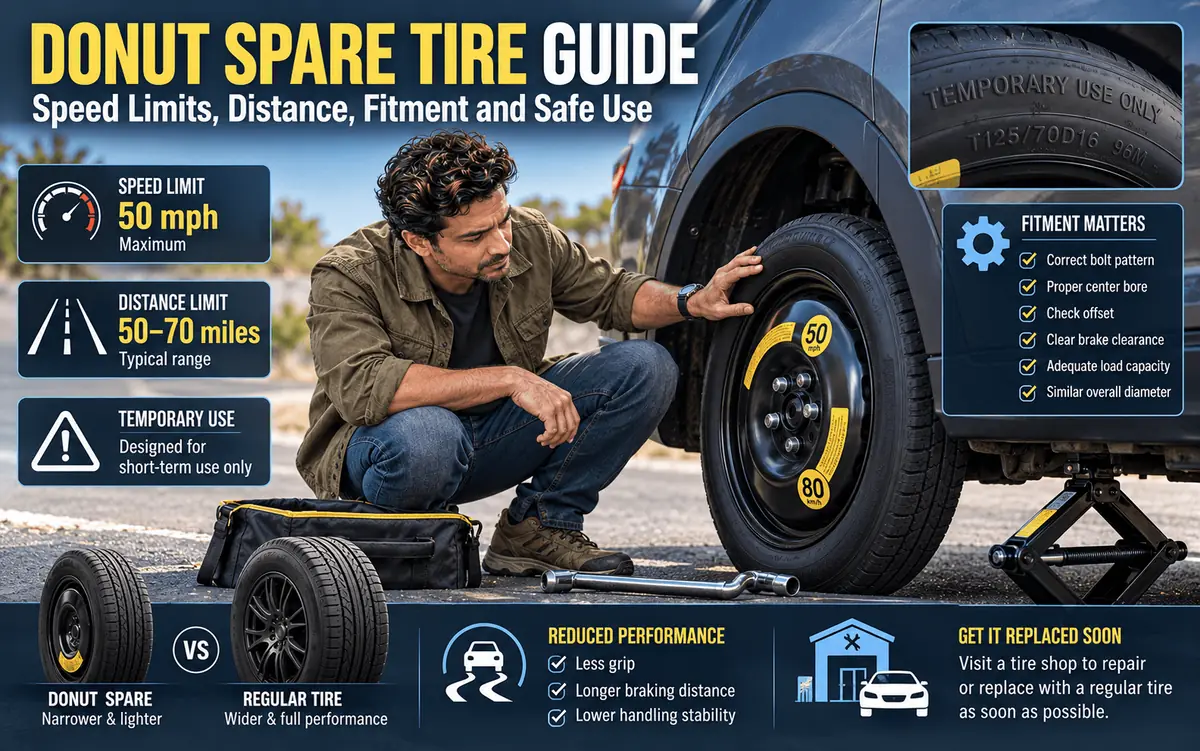
A flat tire on the shoulder raises two urgent questions: will the small spare in your trunk actually fit, and how far and how fast can you drive on it? Get those answers wrong and a temporary fix can turn into a second roadside emergency, with an overheated spare, damaged drivetrain components or a car that brakes and corners poorly at exactly the wrong moment.
A donut spare, more formally called a temporary or compact spare, is a lightweight emergency tire meant to get you to a repair shop and nothing more. This guide covers what makes it different from a regular tire, how to read its sidewall, what determines whether a spare fits your car, how to install it safely, the limits you need to respect on the road, and how to keep it ready for the day you need it.
How this guide was put together: This guide summarizes common manufacturer guidance on temporary spares; your owner’s manual and the spare’s sidewall are the controlling instructions. Checked on October 22, 2026.
Table of Contents
What a Donut Spare Is (and Why It Exists)
A donut spare is a narrow, lightweight tire mounted on its own steel wheel. Automakers use it because it saves trunk space, cuts weight and costs less than a matching full-size spare. The nickname comes from its small, rounded appearance, not from any special mounting design: it bolts onto the hub with your regular lug nuts, just like a normal wheel.
To save space, the tire is built very differently from your road tires:
- Narrow tread: Typical widths are around 125 to 155 mm, versus 205 mm or more for most passenger tires.
- Shallow tread depth: Often about 3/32 to 4/32 inch when new, so it has little ability to clear water and wears quickly.
- Light construction: Thinner, lighter components that are not built to dissipate heat over long distances or high speeds.
- High inflation pressure: Most temporary spares are designed to run at about 60 psi, far higher than regular passenger tires.
You can usually identify a temporary spare by the letter T at the start of its size, such as T125/70R16 or T135/80D17, along with a yellow or orange wheel and a sidewall warning that reads “Temporary Use Only.”
Donut vs. Full-Size Spare
A full-size spare matches your road tires in size and carries no special limits; it simply weighs more and takes up more room. A donut is strictly for emergencies.
| Spare type | Typical speed limit | Typical distance limit | Main advantage | Main drawback |
|---|---|---|---|---|
| Donut (temporary) spare | 50 mph | About 50 to 70 miles | Compact, light, inexpensive | Reduced grip and braking; strict limits |
| Full-size spare | Same as regular tires | No special limit | Restores normal driving | Heavy and takes up space |
| Run-flat tires | Usually 50 mph after a puncture | Usually about 50 miles at zero pressure | No roadside tire change | Costlier, firmer ride, often must be replaced after use |
| Tire sealant and inflator kit | Per kit instructions | Per kit instructions | Saves the most space | Only works on small tread punctures |
The Two Limits You Must Respect
Speed: 50 mph
Nearly every temporary spare carries a maximum speed of 50 mph, printed on the sidewall or the wheel. Above that, the narrow tire builds heat faster than it can shed it, and the risk of tread separation or a blowout climbs. Stick to surface roads when you can. If you must use a highway, stay in the right lane with your hazards on if traffic is moving much faster.
Distance: About 50 to 70 Miles
Most automakers advise driving no more than roughly 50 to 70 miles on a temporary spare, and the owner’s manual gives the figure for your car. The goal is to reach a tire shop, not to finish a road trip. If the nearest shop is farther away than that, plan to have the flat repaired or replaced at the first realistic opportunity, or call roadside assistance for a tow.
Treat the spare’s speed and distance limits as hard rules, not suggestions. Exceeding them stresses the tire and, on some vehicles, the drivetrain too.
Why Distance Matters Beyond the Tire
A donut’s outer diameter is close to your regular tire’s but rarely identical, so it spins at a slightly different speed. Over a short drive that is harmless. Over long distances, the mismatch can make an open or limited-slip differential work continuously. On all-wheel-drive vehicles, it can stress the center coupling or transfer case. Some manuals for AWD vehicles add specific guidance, such as how long a spare may be used or which axle it should go on. Follow it.
Will a Donut Spare Fit Your Car?
The spare that came with your vehicle is matched to it. Problems usually arise with a used spare from a different car, a junkyard find, or a spare left over from a previous vehicle. Several specifications have to line up:
| Fitment factor | What it means | Why it matters |
|---|---|---|
| Bolt pattern | Number of lug studs and the diameter of the circle they sit on (for example, 5×114.3 mm) | Must match exactly or the wheel cannot be secured |
| Center bore | Diameter of the hole that centers the wheel on the hub | Too small and it will not fit; too large and the wheel may not center properly |
| Offset | How far the mounting face sits from the wheel’s centerline | Wrong offset can cause rubbing on brakes or suspension |
| Brake clearance | Room between the wheel’s inner barrel and the brake caliper | Large brakes on performance models may not clear a small spare wheel |
| Load capacity | Maximum weight the spare can carry at its rated pressure | Must be rated for your vehicle’s axle load |
| Outer diameter | Height of the mounted tire | Should be close to your regular tire to avoid drivetrain strain |
Note that the spare’s wheel diameter does not have to match your regular wheels. A car on 18-inch alloys can use a 16- or 17-inch temporary spare, because what matters is the tire’s outer diameter and the wheel’s hub fitment, not the rim size itself.
The safest approach is simple: use the spare size listed in your owner’s manual or on the tire placard on the driver’s door jamb. If you are buying a replacement, give the seller your vehicle’s year, make and model and confirm the part matches the original equipment specification.
How to Install a Donut Spare Safely
- Get to a safe spot. Pull as far from traffic as possible onto firm, level ground and turn on your hazard lights. Avoid soft shoulders and slopes.
- Secure the vehicle. Put an automatic in Park or a manual in gear (first or reverse), set the parking brake and turn off the engine.
- Block a wheel. Chock the wheel diagonally opposite the flat to keep the car from rolling.
- Find the spare and tools. The spare, jack and lug wrench are usually under the trunk floor or cargo area, or slung under the rear of some SUVs and minivans. Remove any wheel lock key if your car uses locking lug nuts.
- Loosen the lug nuts first. With the tire still on the ground, break each nut loose about a half to one turn. Do not remove them yet.
- Jack at the correct point. Place the jack only at the jacking point shown in your owner’s manual, usually a reinforced pinch weld or frame location near the flat. Raise the car until the flat tire just clears the ground.
- Remove the flat. Take off the lug nuts, keep them together, and pull the wheel straight off. Never put any part of your body under the raised car.
- Mount the spare. Align the holes with the studs, slide the spare on, and thread the lug nuts by hand until snug.
- Lower and tighten. Lower the car until the tire carries weight, then tighten the nuts in a star (crisscross) pattern. Use a torque wrench to the specification in your manual if you have one.
- Stow everything. Put the flat, jack and tools away securely so they do not become projectiles in a sudden stop.
- Check pressure and recheck torque. Confirm the spare is at its rated pressure, and have the lug nut torque checked after the first short drive.
Driving on a Donut: What Changes
Even within the speed and distance limits, a car on a temporary spare does not behave normally. The narrow tread offers less grip, especially in rain, so braking distances grow and cornering limits drop. Drive with that in mind:
- Brake early and gently, and leave extra following distance.
- Slow down for corners and avoid sudden steering inputs.
- Avoid potholes and curbs. The short sidewall offers little protection against impact damage.
- Keep loads light. Do not tow a trailer, and avoid carrying heavy cargo.
- Stay on paved roads. A donut is not suited to gravel, dirt or trails.
- Skip the snow chains. Most automakers say chains should not be installed on a temporary spare.
Front or Rear?
You can usually mount the spare wherever the flat occurred, unless your owner’s manual says otherwise. Some manufacturers, particularly for AWD or performance models, recommend placing the spare on a specific axle, which may mean moving a good tire from the rear to the front. If your manual gives an instruction, follow it.
Maintaining Your Spare So It Works When You Need It
Spares are notorious for being forgotten until the worst possible moment. A few minutes of attention a few times a year keeps yours dependable:
- Check the pressure monthly or at every oil change. Temporary spares lose air over time like any tire, and a donut that should hold 60 psi is often found at half that. Most TPMS systems do not monitor the spare, so a gauge is the only way to know.
- Inspect the rubber. Look for cracks in the sidewall or tread, bulges, cuts and any sign of dry rot.
- Mind the age. Rubber ages even when the tire never touches the road. Find the four-digit DOT date code on the sidewall (for example, 2419 means the 24th week of 2019). Many tire and vehicle manufacturers recommend replacing any tire, spares included, around six to ten years after manufacture, and sooner if it shows cracking.
- Store it properly. Keep it secured in its compartment, clean and dry, and check that the hold-down hardware and jack are present and working.
- Do not include it in rotations or balancing schedules. A temporary spare stays in storage until it is needed.
After You Use It
Once your regular tire is repaired or replaced, inspect the donut before you put it away. Check the tread depth, look for damage, and reinflate it to its rated pressure. A spare that was used briefly and carefully can usually go back into service. Replace it if it was driven beyond its limits, run underinflated, hit a pothole hard, shows exposed cords or cracking, or has worn down to its tread wear indicators. Do not attempt to patch or plug a temporary spare; most manufacturers advise replacing it if it is punctured.
Replacement Options
- The same OE spare: Order the size listed in your owner’s manual from a dealer or tire retailer.
- A full-size spare: Some owners upgrade to a full-size spare if space allows. Confirm with your manual that a matching tire and wheel will fit the storage area and that the vehicle supports it.
- Run-flat tires: These replace your regular tires rather than serving as a spare. They require compatible wheels and a tire pressure monitoring system, and they change ride quality, so treat that as a broader tire decision rather than a spare swap.
Donut Spare vs. Run-Flat Tires
These solve the same problem in very different ways. A donut is cheap and keeps your regular tires unchanged, but it requires a roadside tire change and imposes strict limits. Run-flat tires use reinforced sidewalls (or a support insert) to carry the vehicle after losing air, so you can keep driving without stopping to change a tire.
Run-flats are not a license for normal driving, though. Most allow about 50 miles at up to 50 mph at zero pressure, with handling noticeably reduced. They typically cost more, often ride firmer and louder, and many must be replaced rather than repaired after they have been driven flat. Our guide to run-flat tires covers the pros and cons in more depth.
When to Call for Professional Help
A donut change is manageable for most drivers, but some situations call for roadside assistance or a tow:
- Lug nuts are seized, rounded or stripped, or you do not have the wheel lock key.
- The jacking points are badly rusted or damaged, or you are not confident about where to place the jack.
- The damage goes beyond a flat tire, such as a bent wheel, suspension damage after a collision, or a tire that failed violently.
- The spare does not fit the hub, will not seat flat, or rubs the brakes.
- You are on a narrow or busy shoulder, a curve, or a slope where working beside the car is unsafe.
- The weather is severe: heavy rain, snow, ice or darkness on a high-speed road.
- The nearest tire shop is well beyond the spare’s distance limit.
Frequently Asked Questions
The usual maximum is 50 mph, and the exact limit is printed on the tire or wheel. Driving faster lets heat build up in the narrow tire and increases the risk of failure, while also making braking and handling worse.
Most vehicle manufacturers recommend no more than about 50 to 70 miles. Check your owner’s manual for your vehicle’s figure, and get your regular tire repaired or replaced as soon as possible.
Most temporary spares are rated for about 60 psi, but use the pressure printed on the spare’s sidewall or the vehicle’s tire placard. Check it monthly with a gauge, since TPMS usually does not monitor the spare.
Only if every fitment specification matches: bolt pattern, center bore, offset, brake clearance, load capacity and outer diameter. Because those vary so widely between vehicles, the safest choice is the spare size specified for your exact make, model and year.
Usually yes, unless your owner’s manual says otherwise. Some AWD and performance models specify where the spare should be mounted, which can mean moving a good rear tire forward. Follow the manual’s instructions for your vehicle.
Usually not. Most manufacturers recommend replacing a punctured temporary spare rather than patching or plugging it. Its light construction leaves little margin, and a compromised spare defeats the purpose of carrying one.
A donut is a narrow, lightweight temporary spare limited to about 50 mph and 50 to 70 miles, while a full-size spare matches your regular tires and has no special limits.
Replace it if it is damaged or punctured, and by age: tires, including spares, should not stay in service beyond 10 years from manufacture. Inspect it each time you put it back after use.
Final Word on Living With a Donut
A donut spare is a smart compromise when you understand what it is: a short-range, low-speed bridge to a tire shop. Respect the 50 mph limit, keep the trip to roughly 50 to 70 miles, drive gently, and you will get where you need to go without adding a second problem to the first.
The bigger risk is neglect. A spare sitting underinflated or cracked under the trunk floor helps no one. Check its pressure when you check your other tires, note its age, and confirm the jack and lug wrench are in place. If you are ever unsure whether a spare fits or whether it is safe to change a tire where you are, call roadside assistance. That choice costs far less than the alternative.
Sources
Specs, warranty terms and prices were checked on October 22, 2026. Prices change often.
- NHTSA: Tires (tire safety and maintenance)
 Summarize this article with:














Leave a comment