


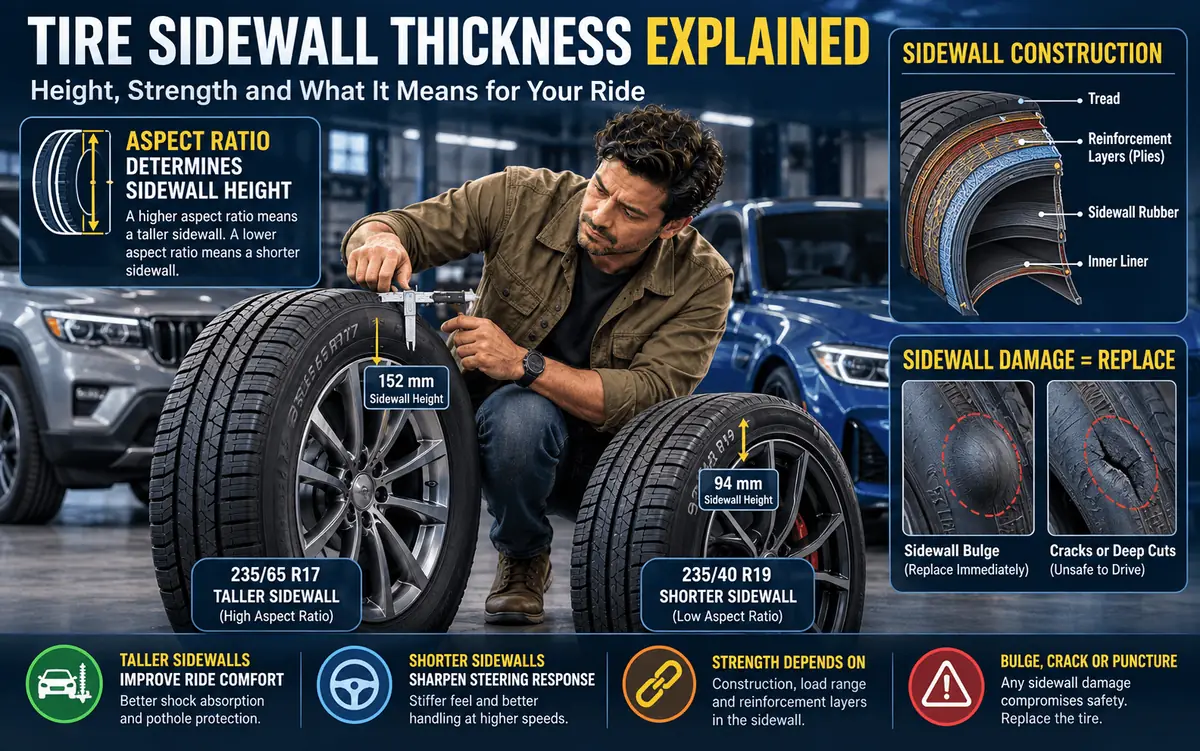
When people talk about “thick” or “thin” sidewalls, they usually mean two different things at once. One is how tall the sidewall is, the band of rubber between the wheel rim and the tread. The other is how strong it is, which depends on its internal construction. A sports sedan on 20-inch wheels has short, stiff sidewalls; a pickup on 17-inch wheels with all-terrain tires has tall, heavily reinforced ones. Both choices come with real trade-offs in comfort, handling and resistance to damage.
Understanding the difference helps when you are shopping for tires, considering larger wheels, or deciding whether that scuff on the side of your tire is something to worry about. This guide explains what the sidewall does, how its height and construction are specified, how each affects the way your vehicle drives, and how to spot sidewall damage that means a tire must be replaced.
How this guide was put together: This guide is general information based on common manufacturer and industry guidance; your owner’s manual is the controlling source. Prices are typical ranges, not quotes. Checked on October 22, 2026.
Table of Contents
What the Sidewall Does
The sidewall is the flexible side section of the tire that runs from the bead, where the tire seals against the wheel, up to the tread. It looks like a simple strip of black rubber, but it carries a surprising amount of responsibility:
- Supporting the load: Together with the air pressure inside, the sidewall helps carry the weight of the vehicle.
- Absorbing impacts: It flexes over bumps and potholes, cushioning the ride and protecting the wheel.
- Controlling the tread: It transmits steering, braking and cornering forces from the wheel to the tread and resists distortion in turns.
- Shielding the structure: Its rubber covers the body plies (the cord layers that form the tire’s skeleton) and protects them from curbs and debris.
- Carrying information: Molded markings show the tire size, load index, speed rating, maximum pressure, DOT code and date of manufacture.
Beneath the outer rubber, a sealed inner liner holds the air. The sidewall rubber is formulated to flex millions of times while resisting weather and ozone, which is why it differs from the harder-wearing tread compound.
Sidewall Height vs. Sidewall Strength
Height: Set by the Aspect Ratio
The visible height of the sidewall is specified in the tire size. In a size such as 225/45R17:
- 225 is the section width in millimeters
- 45 is the aspect ratio: the sidewall height as a percentage of the width
- R17 means radial construction for a 17-inch wheel
So a 225/45R17 tire has a sidewall about 101 mm tall (225 × 0.45), or roughly 4 inches. A lower aspect ratio means a shorter sidewall, often called a “low-profile” tire.
One point causes a lot of confusion: the wheel diameter does not change the sidewall height. A 225/45R17 and a 225/45R20 have exactly the same sidewall height. The 20-inch version is simply mounted on a larger wheel, so the whole tire is taller. To keep the overall diameter the same when moving to a larger wheel, you need a lower aspect ratio, and that is why upsizing wheels almost always means shorter sidewalls.
| Tire Size | Sidewall Height | Typical Application |
|---|---|---|
| 205/65R16 | About 5.2 in (133 mm) | Compact and mid-size sedans |
| 225/55R17 | About 4.9 in (124 mm) | Mid-size sedans, small crossovers |
| 235/45R18 | About 4.2 in (106 mm) | Sport sedans, upscale trims |
| 245/35R20 | About 3.4 in (86 mm) | Performance and luxury cars on large wheels |
| 265/70R17 | About 7.3 in (186 mm) | Pickups and SUVs |
Most mainstream passenger cars and crossovers ride on aspect ratios in the 55 to 65 range, performance cars often use 30 to 45, and trucks and SUVs commonly use 65 to 75 or higher.
Strength: Set by Construction
How tough a sidewall is depends on what is inside it, not just how tall it is. The key factors are:
- Ply count and load range: Light truck (LT) tires use more robust construction, identified by load ranges such as C, D and E (ply ratings of 6, 8 and 10). Higher load ranges carry more weight at higher pressures and resist damage better, but they ride more firmly.
- Extra Load (XL) and reinforced tires: Passenger tires marked XL are built to carry more load at a higher maximum pressure than standard-load tires of the same size.
- Sidewall plies on off-road tires: Many all-terrain and mud-terrain tires use three-ply sidewalls or added protective rubber to resist cuts from rocks and sticks.
- Run-flat reinforcement: Self-supporting run-flat tires have stiff, thickened sidewalls that can carry the vehicle for a limited distance after losing air, often around 50 miles at up to 50 mph, depending on the manufacturer.
The actual rubber thickness of a sidewall is not something you can measure meaningfully at home, and it is not listed as a consumer specification. A tread depth gauge measures groove depth, not sidewall thickness. When shopping, compare aspect ratio, load index and load range, and construction features such as XL, LT or reinforced sidewalls instead.
The Trade-Offs: Taller, Softer Sidewalls vs. Shorter, Stiffer Ones
Benefits of Taller, More Compliant Sidewalls
- A smoother ride. More sidewall gives the tire more room to flex, soaking up bumps and expansion joints before they reach the cabin.
- Better pothole and curb protection. A taller sidewall provides more cushion between the road and the wheel, reducing the risk of bent rims and impact damage to the tire.
- More forgiving behavior. Tires with taller sidewalls tend to break away more progressively at the limit, which many everyday drivers find easier to manage.
- Off-road capability. Tall sidewalls let drivers lower pressure on trails so the tire conforms to rocks and soft ground.
- Lower replacement cost. Tires for smaller wheels with higher aspect ratios are usually less expensive than low-profile sizes.
Benefits of Shorter, Stiffer Sidewalls
- Sharper steering response. With less sidewall to twist, the tread reacts more quickly to steering input, giving a more direct, precise feel.
- Better cornering stability. Short sidewalls deform less in hard turns, keeping the tread flatter on the road and reducing the squirm you feel in quick direction changes.
- Room for bigger brakes and wheels. Low-profile tires make it possible to fit larger wheels and brake hardware within the same overall tire diameter, and many drivers like the look.
The Costs of Each
Low-profile tires ride more harshly and transmit more road noise and impact into the cabin. They also leave less cushion for the wheel, so a pothole that a taller tire would absorb can bend a rim or cause a sidewall bulge. Taller, softer sidewalls trade away some steering precision and can feel less planted in fast corners or emergency maneuvers.
| Characteristic | Taller Sidewall (Higher Aspect Ratio) | Shorter Sidewall (Lower Aspect Ratio) |
|---|---|---|
| Ride comfort | Softer, better at absorbing bumps | Firmer, transmits more impact |
| Steering response | More gradual | Quicker, more precise |
| Cornering stability | More flex in hard turns | Less flex, more planted |
| Pothole and curb protection | Better for tire and wheel | More exposed to impact damage |
| Typical cost | Usually lower | Usually higher |
| Best for | Daily commuting, rough roads, trucks, off-road | Performance driving, smooth roads |
Sidewalls and Safety
Sidewall condition has a direct effect on safety. A failure here is usually sudden, and at highway speed a blowout can make a vehicle difficult to control.
The biggest everyday threat to any sidewall is underinflation. A tire running low on air flexes far more than it was built to, and that flexing builds heat that can break down the rubber and the internal structure. This applies to every tire, tall or short, which is why checking pressure monthly matters. Overloading has a similar effect, so never exceed the load index on the sidewall, and choose LT tires when your truck regularly hauls or tows heavy loads.
Low-profile tires bring a specific added risk: impact damage. With less sidewall to absorb a sharp hit, potholes and curbs are more likely to pinch the tire against the rim, creating internal damage that shows up as a bulge.
If a tire does fail at speed, grip the wheel firmly, stay off the brakes at first, ease off the accelerator and steer to keep the vehicle straight. Let it slow gradually before pulling over.
Off-Road and Specialty Tires
Tires built for trails and work sites treat the sidewall as armor. All-terrain and mud-terrain tires often add extra plies and thicker protective rubber on the sides, and many carry tread blocks that wrap onto the upper sidewall, sometimes called sidebiters. Those blocks bite into ruts and rock ledges and add protection when the tire is aired down and the sidewall bulges outward.
That extra toughness costs something on pavement. Heavily reinforced sidewalls make tires heavier and stiffer, which can mean a busier ride, slower steering response and higher fuel consumption. Our all-terrain tire reviews compare how different models balance trail durability against highway manners.
How to Choose the Right Sidewall for Your Vehicle
Start With the Vehicle Placard
The tire size, load index and pressure on your driver’s door-jamb placard are the baseline. Staying with the original size keeps speedometer accuracy, clearance and stability systems working as engineered.
Think Before Upsizing Wheels
Larger wheels require lower aspect ratios to keep the overall diameter correct. If you are considering a plus-size upgrade, accept that ride quality and pothole protection will decline and tire prices will likely rise. Make sure the replacement size has a load index at least equal to the original.
Match Construction to Your Use
- Daily commuting on rough or pothole-heavy roads: Favor higher aspect ratios and a touring or all-season tire.
- Spirited driving on smooth roads: A lower-profile performance tire delivers sharper response if you can live with the firmer ride.
- Towing, hauling or work trucks: Choose LT tires with the appropriate load range.
- Off-road driving: Look for all-terrain or mud-terrain tires with reinforced, multi-ply sidewalls.
Sidewall Inspection and Care
The sidewall is more vulnerable than the tread, and damage there is far more serious. Inspect your sidewalls whenever you check tire pressure and after any hard hit on a pothole or curb.
Look for:
- Bulges or bubbles: A sign of internal cord damage. Replace the tire immediately.
- Cuts or gouges: Especially any that expose fabric or steel cords.
- Deep cracks: Fine surface crazing from weather and age is common, but cracks that are deep, widespread or reaching the cords mean the tire should be replaced.
- Punctures: Any nail, screw or hole in the sidewall or shoulder.
Sidewall damage cannot be safely repaired. The tire industry limits puncture repairs to the tread area because the sidewall flexes constantly and heats up, and no plug or patch reliably holds there. Never plug a sidewall puncture. Light cosmetic scuffs that do not cut into the rubber are usually harmless, but if you are unsure, have a tire professional inspect it.
To keep sidewalls healthy:
- Maintain correct pressure using the door-jamb placard figure, checked monthly with the tires cold.
- Avoid curbs when parking, and slow down for potholes when you can do so safely.
- Rotate tires regularly for even wear. Our guide to tire rotation and alignment covers the right patterns.
- Store spare or seasonal tires properly, clean, in a cool, dry place away from sunlight and ozone sources such as electric motors.
- Watch tire age. The last four digits of the DOT code show the week and year of manufacture (for example, 2423 means the 24th week of 2023). Many vehicle manufacturers recommend replacing tires about six years after manufacture regardless of tread depth; follow your vehicle and tire maker’s guidance.
Frequently Asked Questions
It is the sidewall height expressed as a percentage of the tire’s width. On a 225/45R17 tire, the sidewall is 45 percent of 225 mm, or about 101 mm tall. A lower number means a shorter, lower-profile sidewall.
Taller and more heavily reinforced sidewalls ride more comfortably and resist impact and cut damage better, which suits trucks, rough roads and off-road use. Shorter, stiffer sidewalls give quicker steering and better cornering stability, which suits performance driving on smooth pavement.
In practice, yes. The wheel size alone does not change sidewall height, but to keep the overall tire diameter correct on a larger wheel, the tire must have a lower aspect ratio, which means a shorter sidewall.
No. Industry repair guidelines allow repairs only in the tread area. A tire with a sidewall puncture, cut into the cords or bulge should be replaced.
They are more vulnerable to pothole and curb impacts because there is less sidewall to absorb the hit, which can lead to bulges and bent wheels. Careful driving and correct inflation reduce the risk.
For regular towing or hauling with a truck or large SUV, LT tires with a load range suited to the weight, such as C, D or E, offer stronger sidewalls and higher load capacity than standard passenger tires. Check your owner’s manual and the trailer’s weight before choosing.
For off-road use, yes. Many all-terrain and mud-terrain tires use three-ply sidewalls or extra protective rubber to resist cuts from rocks and sticks, which is what you want for trail driving.
Choosing Sidewalls With Your Eyes Open
The sidewall shapes how your vehicle rides, steers and survives the road. Its height comes from the aspect ratio in the tire size, and its strength comes from construction: ply count, load range and reinforcement. Taller, more compliant sidewalls favor comfort and protection; shorter, stiffer ones favor precision and cornering grip. Neither is better in every situation.
Start with the size on your door-jamb placard, think carefully before trading sidewall height for bigger wheels, and match construction to how you actually drive. Then keep the tires properly inflated and inspect the sidewalls regularly. A bulge, deep cut or sidewall puncture is never a repair job; it is a signal to replace the tire before it fails.
Sources
Specs, warranty terms and prices were checked on October 22, 2026. Prices change often.
- NHTSA: Tires (tire safety, pressure and maintenance)
 Summarize this article with:














Leave a comment