


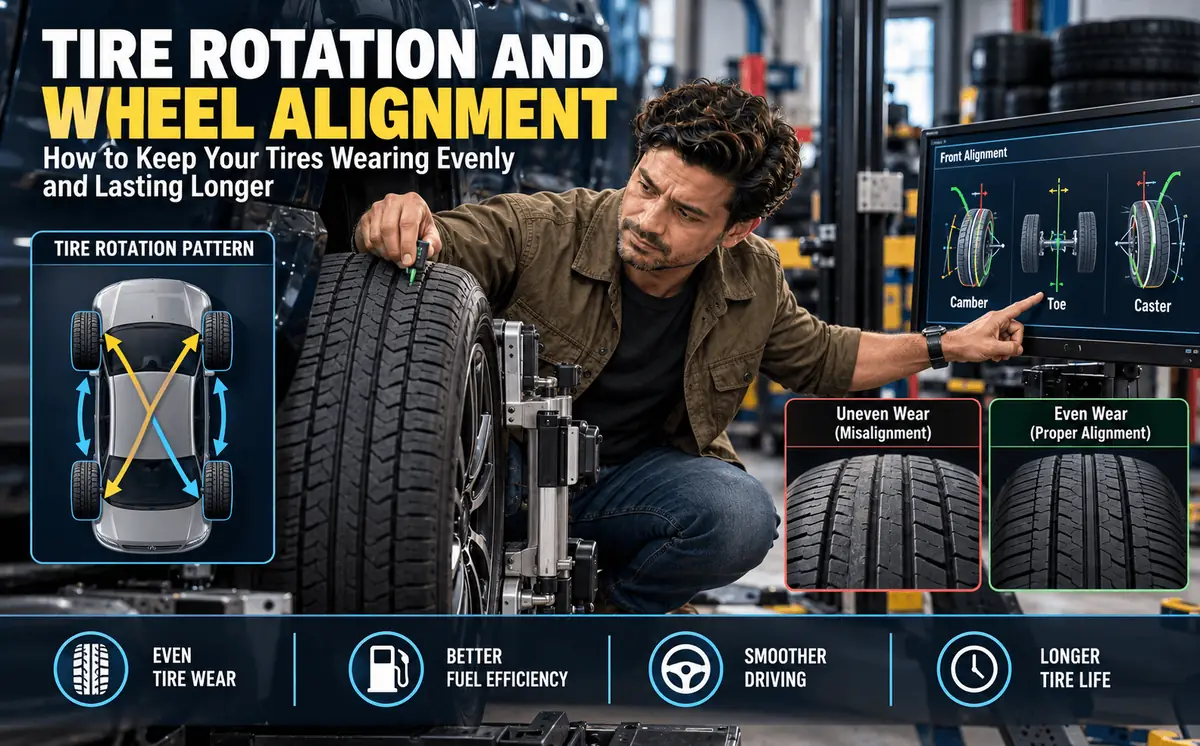
Tires rarely wear out evenly on their own. The front tires on most cars carry the weight of the engine, do most of the braking, and handle all the steering, while the rear tires mostly follow along. Add a wheel that is slightly out of alignment, and one edge of a tire can be bald while the rest still has plenty of tread. Either way, you end up replacing tires sooner than you should, and the car does not grip, steer, or ride as well in the meantime.
Two inexpensive services prevent most of that: tire rotation and wheel alignment. They are often mentioned together, but they do very different jobs. Rotation moves tires to different positions so they share the wear. Alignment adjusts the angles of the wheels so the tires meet the road squarely. This guide explains both, how often you need them, what they cost, and what you can safely do yourself.
How this guide was put together: Service prices here are typical ranges, not quotes. Intervals follow common manufacturer guidance; your owner’s manual is the controlling schedule. Checked on October 22, 2026.
Table of Contents
Rotation vs. Alignment at a Glance
| Feature | Tire Rotation | Wheel Alignment |
|---|---|---|
| What it does | Moves tires to different wheel positions | Adjusts wheel angles to manufacturer specifications |
| Problem it solves | Normal differences in wear between positions | Uneven wear and handling problems caused by incorrect angles |
| Typical frequency | Every 5,000–8,000 miles, or per owner’s manual | Checked about once a year, and after impacts, new tires, or suspension work |
| Typical cost | Roughly $20–$50, often free with tire purchase | Roughly $60–$100 for a basic alignment; more for complex vehicles |
| DIY-friendly? | Yes, with proper equipment | No; requires an alignment machine |
Tire Rotation: Sharing the Wear
Why Tires Wear Unevenly
Each wheel position on a car experiences different forces. On a front-wheel-drive car, the front tires handle acceleration, steering, and most braking, so they usually wear considerably faster than the rears. Rear-wheel-drive cars put the drive forces on the rear tires, while the fronts still take steering and much of the braking. Cornering wears the outer shoulders of front tires, and the weight distribution of each vehicle adds its own pattern.
Left alone, two tires can wear out while the other two still have plenty of life, which means replacing tires in pairs more often than necessary.
The Benefits of Regular Rotation
- Longer tire life. Spreading wear evenly across all four tires lets you get the full mileage out of the set.
- Better, more consistent grip. Tires with similar tread depth give more predictable handling and braking, which matters most in rain and snow.
- A smoother ride. Even wear reduces the chance of vibration and noise from irregular wear patterns.
- Warranty protection. Many tire treadwear warranties require proof of regular rotation.
- Lower long-term cost. Your tires last longer, so you buy new ones less often.
How Often to Rotate
The common guideline is every 5,000 to 8,000 miles, or about every six months, but your owner’s manual has the final word. Many drivers simply rotate the tires with every oil change.
Consider rotating more often if you:
- Drive aggressively, with hard acceleration, braking, or cornering
- Drive frequently on rough, unpaved, or gravel roads
- Notice a difference in tread depth between the front and rear tires
Rotation cannot fix wear caused by a mechanical problem. If you see cupping or scalloping (scooped-out patches around the tread), edge wear on one side, or a vibration, have the suspension, alignment, and tire balance checked as well.
Tire Rotation Patterns
The right pattern depends on your drivetrain and whether your tires are directional or the same size front and rear. Your owner’s manual or tire manufacturer may specify a pattern, and that always takes priority.
| Pattern | How It Works | Typically Used For |
|---|---|---|
| Forward cross | Front tires move straight back; rear tires cross to the opposite sides of the front axle | Front-wheel-drive vehicles with non-directional tires |
| Rearward cross | Rear tires move straight forward; front tires cross to the opposite sides of the rear axle | Rear-wheel-drive, all-wheel-drive, and four-wheel-drive vehicles with non-directional tires |
| X-pattern | All four tires move diagonally: front left to rear right, front right to rear left, and vice versa | An alternative for many vehicles with non-directional tires, often FWD |
| Front-to-rear (same side) | Tires move straight front to back and back to front, staying on the same side | Directional tires, which must keep rolling in the same direction |
| Side-to-side | Tires swap left and right on the same axle | Vehicles with different-size front and rear tires (staggered setups) using non-directional tires |
Directional tires have a tread pattern designed to roll in only one direction, indicated by an arrow on the sidewall. They should stay on the same side of the car, so they move front to back only, unless they are dismounted and remounted on the wheels.
Staggered setups, common on performance cars, use wider tires in the rear than in the front. Those tires cannot move between axles, so rotation, when possible, is limited to side-to-side swaps with non-directional tires. Some staggered directional setups cannot be rotated at all.
Full-size spares can sometimes be included in a five-tire rotation, which spreads wear across one more tire. Temporary compact spares should never be included.
Wheel Alignment: Pointing the Tires the Right Way
What Alignment Means
A wheel alignment, sometimes called a tire alignment, adjusts the angles of the wheels so they are positioned correctly relative to each other, the vehicle, and the road, according to the manufacturer’s specifications. Three main angles are involved:
- Camber is the inward or outward tilt of the wheel when viewed from the front. Too much tilt wears one edge of the tire.
- Toe is whether the wheels point slightly inward or outward when viewed from above. Incorrect toe is one of the fastest ways to wear out tires, often producing a feathered, saw-tooth feel across the tread.
- Caster is the forward or backward tilt of the steering axis when viewed from the side. It affects straight-line stability and how the steering wheel returns to center after a turn.
Why Alignment Matters
- Even tire wear. Misaligned wheels scrub across the road instead of rolling cleanly, wearing tires quickly and unevenly.
- Straight tracking and confident handling. A properly aligned car goes where you point it and feels stable at speed.
- Fuel efficiency. Wheels that drag sideways add rolling resistance and can cost fuel.
- Safety. Even wear and predictable handling both help you keep control, especially in emergencies and bad weather.
Signs Your Alignment Is Off
- The car pulls or drifts to one side on a straight, level road
- The steering wheel is off-center when you drive straight
- Uneven tire wear, especially wear on one edge or a feathered tread pattern
- The steering feels loose, wandering, or vague
- Tires squeal during normal turns
Some symptoms, such as vibration, can also come from unbalanced tires, worn suspension parts, or other issues. Our guide to what causes a car to vibrate when driving helps narrow that down.
When to Get an Alignment
There is no single universal interval, but these are good guidelines:
- Have it checked about once a year, or as your owner’s manual recommends.
- After a hard pothole or curb strike, even if nothing looks damaged.
- When you buy new tires, so the new set starts wearing evenly.
- After replacing suspension or steering parts, such as struts, control arms, or tie rods.
- Whenever you notice pulling, an off-center steering wheel, or uneven wear.
What Happens During an Alignment
- Inspection. The technician checks tires, suspension, and steering components for wear or looseness. Worn parts must be replaced first, because a car cannot hold an alignment with loose components.
- Mounting on the alignment rack. The vehicle is driven onto a rack, and sensors or targets are attached to the wheels.
- Measurement. A computerized system measures camber, caster, and toe and compares them with the manufacturer’s specifications.
- Adjustment. The technician adjusts components such as tie rods and suspension adjusters to bring the angles within specification. Not every angle is adjustable on every vehicle.
- Steering wheel centering. The steering wheel is set straight for straight-ahead driving.
- Road test. A test drive confirms the car tracks straight and handles correctly.
A front-end alignment adjusts only the front wheels. A four-wheel alignment adjusts all four and is needed on most modern cars with adjustable rear suspension. Some vehicles with driver-assistance systems may also need camera or sensor recalibration after alignment work.
What Rotation and Alignment Cost
Prices vary by region, vehicle, and shop, but typical ranges are:
- Tire rotation: roughly $20 to $50. Many tire retailers rotate tires free for the life of tires bought from them, and some shops include it with an oil change.
- Wheel alignment: roughly $60 to $100 for a basic alignment. Four-wheel alignments, larger vehicles, specialized equipment, or extra adjustments can push the price to $200 or more. Some shops sell lifetime alignment packages, which can be worthwhile if you keep your car for years.
Factors that affect price include where you live, the type of vehicle, whether you go to a dealer, independent shop, or tire chain, and whether worn parts need replacing before an alignment can be done.
Compared with the cost of a set of tires worn out early, both services usually pay for themselves.
DIY vs. Professional Service
Rotating Tires Yourself
Rotation is a reasonable DIY job if you have the right equipment and follow safe practices.
You’ll need:
- A floor jack and at least two jack stands, ideally four
- Wheel chocks
- A lug wrench or breaker bar
- A torque wrench to tighten lug nuts to specification
- Your owner’s manual for the correct rotation pattern, lift points, and lug nut torque
Key safety points:
- Never work under or around a car supported only by a jack. Use jack stands at the manufacturer’s lift points.
- Loosen lug nuts slightly while the wheels are on the ground, then raise the car.
- Tighten lug nuts in a star pattern and finish with a torque wrench. Our guide to using a torque wrench explains how.
- Recheck lug nut torque after the first 50 to 100 miles.
- Check and set tire pressures after rotating, since front and rear pressures may differ.
A shop rotation is inexpensive, and shops can also balance the tires, inspect them for damage, and spot problems you might miss.
Leave Alignment to a Professional
Alignment requires precise measurement equipment and manufacturer specifications. Home methods using string and tape measures cannot match a modern alignment machine, and an incorrect alignment can wear out tires quickly or make the car handle poorly. This is a job for a shop.
Pair Rotation and Alignment With Good Tire Habits
- Check pressure monthly, with the tires cold, using the figure on your door-jamb placard. Underinflation wears the shoulders and raises the risk of tire failure; overinflation wears the center and reduces grip.
- Monitor tread depth. Replace tires at 4/32 inch if you regularly drive in rain, and no later than the 2/32-inch legal minimum. Our guide to checking tire tread depth explains the penny and quarter tests.
- Inspect for damage, such as cuts, sidewall bulges, cracks, and embedded nails or screws.
- Store seasonal tires properly. Clean them, keep them in a cool, dry place away from sunlight and ozone sources such as electric motors, store mounted tires on their sides or hung by the rims, and stack unmounted tires carefully.
- Choose the right tires. Use the size, load index, and speed rating on your vehicle’s tire placard, and match the tire type to your climate and driving. Our tire reviews compare models across categories.
Frequently Asked Questions
Typically every 5,000 to 8,000 miles or about every six months, or as your owner’s manual specifies. Many drivers rotate with every oil change.
Rotation moves tires to different positions so they wear evenly. Alignment adjusts wheel angles so the tires meet the road correctly. Rotation spreads normal wear; alignment prevents abnormal wear.
Have it checked about once a year, after any hard impact with a pothole or curb, when you install new tires, after suspension or steering work, and whenever the car pulls or the steering wheel is off-center.
Yes, but only front to back on the same side of the car, so they keep rolling in the direction the arrow indicates.
Usually not. Sometimes it changes the symptom, but a pull usually points to alignment, tire, or brake problems. Have the alignment checked rather than relying on rotation.
It is not practical. Accurate alignment requires a computerized alignment machine and manufacturer specifications.
It is a good idea. Starting new tires on a properly aligned car helps them wear evenly from the first mile.
The Bottom Line
Rotation and alignment are two of the cheapest ways to protect one of the most expensive maintenance items on your car. Rotate your tires on schedule using the right pattern for your drivetrain and tire type, have the alignment checked once a year and after any hard hit, and keep an eye on pressure and tread depth in between. Your tires will last longer, your car will drive straighter, and you will spend less on replacements over the life of the vehicle.
Sources
Specs, warranty terms and prices were checked on October 22, 2026. Prices change often.
- Jiffy Lube: Tire rotation (5,000 to 8,000-mile rotation guidance)
- ThePricer: Jiffy Lube rotation cost (customer-reported rotation prices)
 Summarize this article with:














Leave a comment