


A car that suddenly starts to shake gets your attention fast. Sometimes it is a faint shimmy in the steering wheel at 60 mph. Sometimes it is a pulse through the brake pedal every time you stop, or a shudder through the whole car as you accelerate. Some vibrations are minor annoyances that a tire shop can fix in half an hour. Others are early warnings of a failing part that affects your ability to steer or stop.
The good news is that vibrations are rarely random. Where you feel them and when they happen narrow the list of suspects dramatically. This guide starts with that detective work, then walks through the most common causes, what each one feels like, and when to stop driving and get help.
Table of Contents
Start Here: Where and When Do You Feel It?
Before you look at any part of the car, pay attention on your next drive. Two questions do most of the diagnostic work.
Where Is the Vibration?
| Where You Feel It | What It Often Points To |
|---|---|
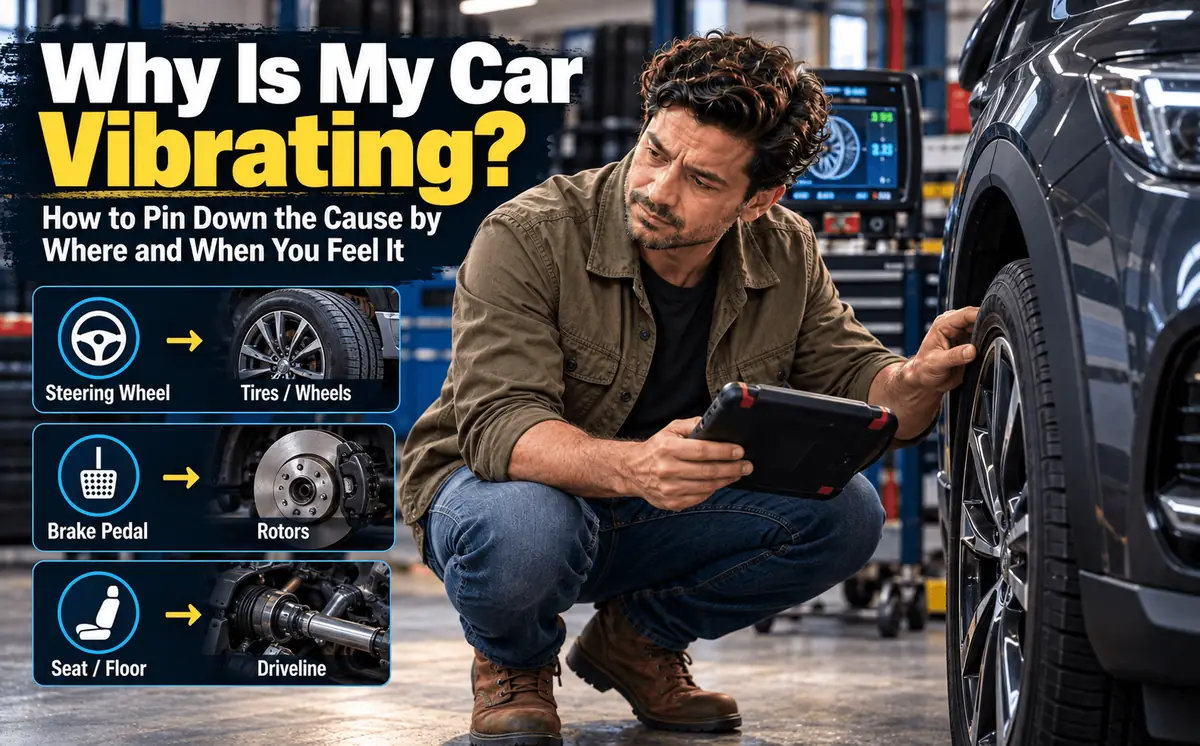
| Steering wheel | Front wheels, front tires, or front suspension components |
| Seat or floor | Driveline, differential, rear wheels, or exhaust system |
| Brake pedal | Brake rotors or other brake components |
| Pedals generally | Engine, transmission, or driveline |
When Does It Happen?
| When It Happens | Likely Suspects |
|---|---|
| Only at certain speeds, often highway speed | Tire balance, uneven tire wear, bent wheels, or driveline components |
| When braking | Warped or unevenly worn rotors, a sticking or damaged caliper, or suspension wear |
| When accelerating | Engine, transmission, driveline (CV joints, U-joints, driveshaft), engine mounts, or wheels and tires |
| At idle or low speed | Engine misfire, worn engine mounts, or engine imbalance |
| Over bumps and rough roads | Worn shocks, struts, or bushings |
| Getting worse as you drive faster | Tire and wheel issues, wheel bearings, or driveline problems |
Make a note of what you observe: the speed at which the vibration starts and stops, whether braking or accelerating changes it, and where in the car you feel it. That information helps a mechanic find the problem faster, which saves you money.
The Most Common Causes of Car Vibration
1. Unbalanced or Unevenly Worn Tires
This is the most common cause, and fortunately one of the cheapest to fix. A tire and wheel assembly is balanced with small weights so its mass is spread evenly around its circumference. When a weight falls off or the tire wears unevenly, the assembly develops a heavy spot. As it spins, that heavy spot makes the tire hop slightly against the road, and the motion travels through the suspension into the cabin.
What it feels like: a vibration in the steering wheel, seat, or floor that typically appears at a certain speed, often on the highway, and gets stronger the faster you go. A front-tire imbalance usually shows up in the steering wheel; a rear-tire imbalance more often through the seat.
The fix: wheel balancing at a tire shop. To prevent it, have the tires rotated and balanced on a regular schedule; many manufacturers suggest every 5,000 to 8,000 miles, but follow your owner’s manual. Uneven wear can also signal an alignment or inflation problem, which our guide to checking tire tread depth explains how to spot.
2. Bent or Damaged Wheels
A hard pothole strike, curb impact, or occasionally a manufacturing defect can bend a wheel. Even a slight bend makes the tire rotate unevenly.
What it feels like: similar to an imbalance, often speed-related and sometimes persisting even after balancing.
The fix: a tire shop can check the wheel for runout. Depending on the damage, a wheel may be repairable or need replacing.
3. Warped or Unevenly Worn Brake Rotors
Brake rotors can develop uneven thickness from excessive heat or uneven wear, a condition commonly called warping. As the rotor turns, the pads grab the thicker and thinner sections unevenly.
What it feels like: a pulsating brake pedal and often a shake through the steering wheel, but only when you are braking, and usually more noticeable when slowing from higher speeds.
The fix: the rotors are resurfaced if enough material remains, or replaced. Brake pads that have worn unevenly can cause vibration too, and pads should be replaced in pairs on the same axle. A sticking caliper can also cause brake vibration and uneven wear. Because this involves your ability to stop, do not put it off.
4. Worn Suspension Components
The suspension’s job is to absorb bumps and keep the tires planted. Shocks and struts control the up-and-down motion of the springs, and rubber bushings, such as those on the control arms, isolate the body from the suspension’s movement.
As shocks and struts wear, they lose their ability to dampen motion, leading to a bouncy, vibrating ride. As bushings deteriorate, they stop absorbing vibration and let it pass straight into the cabin.
What it feels like: vibration or shaking that is worse over bumps and rough pavement, sometimes with clunking noises, excessive bouncing, or a vague, wandering feel.
The fix: inspection and replacement of worn components. Worn suspension can also cause cupped, scalloped tire wear, so it often shows up on the tires too.
5. Worn or Damaged Wheel Bearings and Hubs
Wheel bearings, sets of hardened balls or rollers inside a sealed ring, let the wheel hub spin smoothly. Over time they wear from constant use, dirt and moisture getting in, or loss of lubrication. Hubs can also be damaged by pothole impacts.
What it feels like: vibration through the steering wheel or floor that typically becomes more noticeable at higher speeds and may change when turning or braking. A worn bearing often produces a humming or growling noise that rises with speed as well.
The fix: a mechanic will usually raise the car and check the wheel for play or looseness, and may listen for bearing noise. A failing bearing should be replaced promptly, because a bearing that fails completely can affect wheel control.
6. Drivetrain Problems
The drivetrain carries power from the engine to the wheels, and several of its parts can cause vibration as they wear:
- CV joints on front-wheel-drive and many all-wheel-drive vehicles, and U-joints on rear-wheel-drive driveshafts, let the shafts transmit power at an angle. When worn, they can cause vibration that appears at certain speeds or under acceleration.
- A damaged or unbalanced driveshaft can cause vibration felt through the floor.
- Transmission and differential problems can also show up as vibration.
What it feels like: often a vibration under acceleration, sometimes at a particular speed, felt through the floor or seat.
The fix: professional diagnosis. Driveline repairs vary widely in cost, and catching them early helps keep them manageable.
7. Engine Problems and Worn Engine Mounts
Engine mounts hold the engine in place and isolate its natural vibrations from the rest of the car. When they wear out, the engine moves more than it should, and that movement comes through the cabin.
Misfiring cylinders make the engine run roughly, and less commonly, problems inside the engine, such as worn crankshaft bearings or an imbalance in its rotating parts, can cause vibration that travels through the drivetrain.
What it feels like: shaking that is most noticeable at idle or low speeds, a roughness when accelerating, or a clunk when shifting into gear. A misfire often comes with a check engine light; if that light is flashing, have the car checked right away, because a severe misfire can damage the catalytic converter.
The fix: diagnosis of the misfire’s cause or replacement of the worn mounts.
8. Exhaust System Problems
A loose or damaged exhaust component, such as a broken hanger or a leaking pipe, can rattle against the body and create vibration you feel in the cabin.
What it feels like: vibration or buzzing through the floor, often with rattling or a louder exhaust note.
The fix: replacing broken hangers or repairing the damaged section is usually a simple, inexpensive job.
Causes at a Glance
| Cause | Typical Symptom | Urgency |
|---|---|---|
| Unbalanced or unevenly worn tires | Speed-related shake in the steering wheel or seat | Fix soon; inexpensive |
| Bent wheel | Speed-related shake that balancing doesn’t cure | Fix soon |
| Warped rotors or brake issues | Pulsing pedal and shake when braking | Prompt; affects stopping |
| Worn suspension | Vibration over bumps, bouncing, clunks | Prompt |
| Wheel bearing or hub | Vibration and humming that rise with speed | Prompt; can affect wheel control |
| Drivetrain (CV joints, U-joints, driveshaft) | Vibration under acceleration or at certain speeds | Prompt |
| Engine misfire or worn mounts | Shaking at idle or under acceleration | Prompt; urgent if the check engine light flashes |
| Exhaust | Buzzing or rattling through the floor | Fix soon |
Narrowing It Down Yourself
You can do some useful detective work before visiting a shop:
- Take a deliberate test drive. On a safe road, note when the vibration starts and stops, whether braking or accelerating changes it, and where you feel it.
- Look at the tires and wheels. Check for uneven wear, bulges, visible damage, or a missing balance weight on the rim.
- Check tire pressure. Incorrect pressure can contribute to vibration and uneven wear.
- Consider recent events. Did the vibration start after hitting a pothole, getting new tires, or having brake work done? That is often a strong clue.
- Swap tires if practical. If a vibration moves from the steering wheel to the seat after a front-to-rear tire rotation, the problem is probably in the tire or wheel rather than the car.
Why Professional Diagnosis Matters
Vibrations can have several overlapping causes, and the true source is not always obvious. A good mechanic has the experience and equipment, including wheel balancers, alignment machines, and diagnostic scanners, to measure components precisely and find the root cause rather than guessing.
Some vibrations are symptoms of a bigger problem developing in the suspension or driveline. Catching that early prevents more expensive repairs and keeps a minor issue from becoming a safety hazard. Attempting repairs without the right knowledge and tools can make things worse.
When to Get Help Right Away
Have the car inspected as soon as possible, and consider whether it is safe to drive at all, if you notice:
- Violent shaking, especially if it persists at lower speeds
- Grinding, knocking, or rattling along with the vibration
- Difficulty steering or keeping the car under control
- Vibration that gets worse when accelerating or braking
- A pulsing or soft brake pedal
- A flashing check engine light
Continuing to drive with a severe vibration puts extra strain on other components and can lead to much more expensive repairs, or worse, a loss of control.
How to Prevent Vibrations
Most vibration problems can be prevented or caught early with routine maintenance:
- Rotate and balance your tires on schedule to keep wear even.
- Get a wheel alignment if the car pulls, after a hard impact, or when you notice uneven tire wear.
- Have your brakes inspected regularly, at least once a year.
- Keep tires properly inflated, checking monthly.
- Pay attention to small changes. A faint new vibration is cheaper to fix now than later.
Our guide to making your car last longer covers the full maintenance routine.
Related Reading
Frequently Asked Questions
The most common cause is an unbalanced tire, which typically shows up at a certain speed, often around highway speed. Bent wheels, uneven tire wear, and driveline issues can also cause speed-related vibration.
Usually because of warped or unevenly worn front brake rotors. A sticking caliper or worn suspension parts can also contribute. Because it affects stopping, have it checked promptly.
Yes. A worn wheel bearing can cause vibration that increases with speed, often with a humming or growling noise. It should be replaced promptly.
Common causes include an engine misfire and worn engine mounts. If the check engine light is on, especially if it is flashing, have the car diagnosed soon.
A mild vibration from tire imbalance is usually not an immediate danger, but it should be fixed soon. Severe shaking, vibration with grinding or knocking noises, difficulty steering, or brake-related vibration should be inspected before you keep driving.
Tire balancing is usually inexpensive, while suspension, wheel bearing, brake, and driveline repairs cost more. An accurate diagnosis keeps you from paying for parts you did not need.
The Bottom Line
A vibrating car is telling you something, and it is usually specific. Notice where you feel the shake and when it happens, and you will often have a strong lead before you reach a shop. Steering-wheel shimmies at highway speed usually mean tires or wheels. Pulsing when you brake points to rotors. Shaking over bumps suggests the suspension, and shuddering under acceleration often leads to the driveline or engine mounts.
Start with the simple, inexpensive possibilities, keep up with tire rotations, balancing, and brake inspections, and do not ignore a vibration that is severe, noisy, or affects steering or braking. Caught early, most causes are simple to fix.
 Summarize this article with:














Leave a comment