


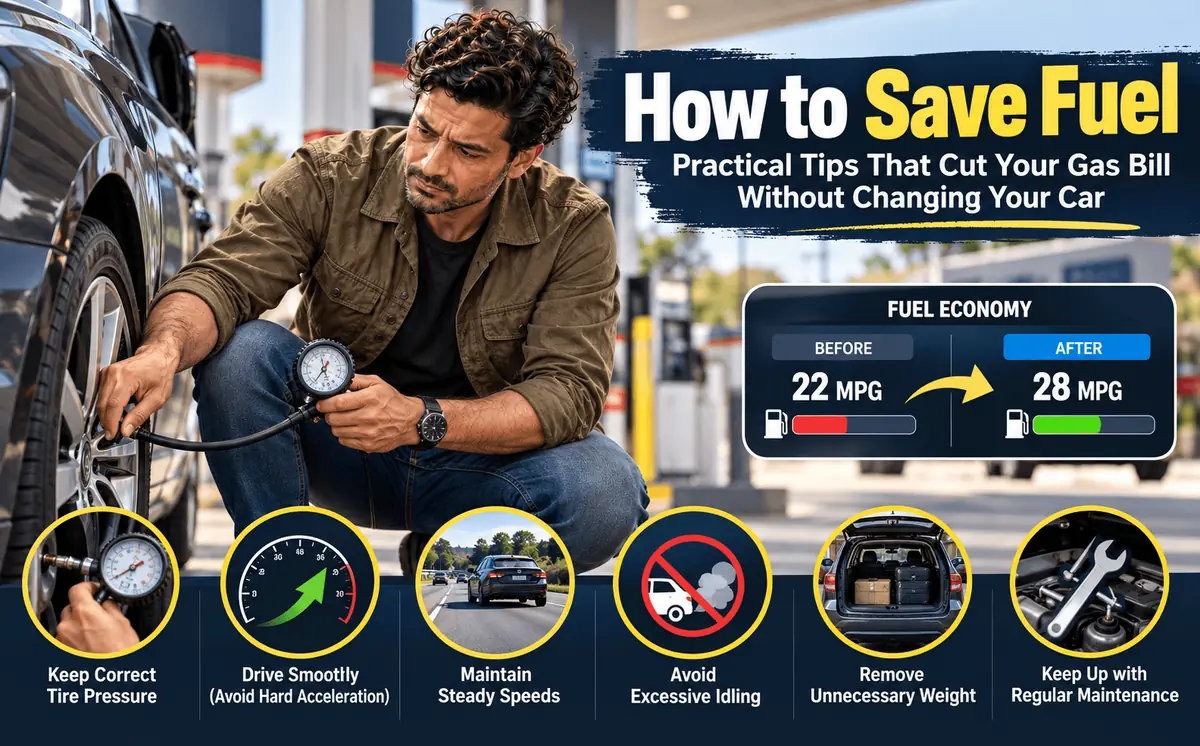
You do not need a new car to spend less on gas. The way most people drive, maintain, and load their current vehicle wastes a meaningful share of every tank: hard launches from stoplights, tires a few pounds low, a roof rack left on all summer, the engine idling in a parking lot while someone runs inside.
Each of those habits costs a little. Together, they add up to real money over a year, along with extra emissions and extra wear on the car. The good news is that nearly all of them are easy to change. The tips below are grouped by where the savings come from, starting with the ones that cost nothing.
Table of Contents
Why Saving Fuel Is Worth the Effort
The financial case is simple: every gallon you do not burn is money that stays in your pocket, and the savings grow the more you drive. There is an environmental case too. Burning gasoline and diesel releases carbon dioxide, a major contributor to climate change, so using less fuel shrinks your carbon footprint. And many fuel-saving habits, such as smoother driving and better maintenance, also reduce wear on the engine, brakes, and tires.
Drive Smoother
How you use the pedals has a bigger effect on fuel economy than almost anything else under your control.
- Accelerate gradually. Rapid acceleration burns a lot of extra fuel. Build speed smoothly instead of launching from every light.
- Anticipate stops. Look well ahead, lift off the throttle early, and coast toward red lights and slowing traffic. Hard braking throws away the energy you just paid for.
- Hold a steady speed. Every speed-up and slow-down costs fuel. Keeping a consistent pace is one of the simplest ways to improve mileage.
- Use cruise control on the highway. On open, level roads, cruise control holds a steady speed far more consistently than most drivers can. Switch it off on hilly terrain, in heavy traffic, and in rain, snow, or ice, where you need full control.
Smooth driving has a bonus: it is safer and easier on your brakes, tires, and transmission.
Stop Idling
An idling engine gets zero miles per gallon. Depending on engine size and whether the air conditioning is running, an idling car burns roughly 0.2 to 0.5 gallons of fuel per hour.
That adds up faster than most people think. Ten minutes of idling a day comes to about 60 hours a year, which at those rates means roughly 12 to 30 gallons burned while going nowhere.
- Turn the engine off when you expect to be parked or waiting for more than about 30 seconds to a minute, outside of traffic. Restarting a warm modern engine uses less fuel than letting it idle for long periods.
- Skip the long warm-up. Modern engines need very little time to warm up. Start the car, give it a few moments, and drive off gently; the engine warms up faster under light load than at idle.
Less idling also means fewer emissions and less engine wear.
Keep Your Tires Properly Inflated
Underinflated tires have more rolling resistance, which makes the engine work harder to keep the car moving. Even a modest drop in pressure noticeably cuts fuel economy.
- Check pressure at least once a month and before long trips, using an accurate gauge.
- Inflate to the pressure on the sticker inside the driver’s door jamb or in your owner’s manual, not the maximum printed on the tire’s sidewall.
- Check when the tires are cold, before driving or after the car has been parked for a few hours.
Keeping tires properly inflated can improve fuel economy by up to about 3%. It also improves handling, extends tire life, and makes the car safer. Tire choice matters too: when it is time for a new set, low rolling resistance tires can help efficiency, and our tire reviews note fuel economy for each model.
Lighten the Load and Cut the Drag
Every extra pound takes energy to accelerate and keep moving, and anything on the roof fights the wind.
- Clean out the trunk and cabin. Remove sports gear, tools, boxes, and anything else you do not need for daily driving.
- Take off roof racks and cargo boxes when you are not using them. They add weight and, more importantly, aerodynamic drag, even when empty.
- Think twice about heavy accessories. Oversized aftermarket wheels and other bulky add-ons can increase fuel use.
Plan Smarter Trips
Sometimes the most efficient mile is the one you avoid.
- Use navigation apps such as Google Maps, Waze, or Apple Maps to route around accidents, construction, and heavy congestion. Less time crawling in traffic means less fuel burned for every mile.
- Combine errands. A cold engine is less efficient, so one trip with several stops uses less fuel than several separate trips from a cold start. Grouping destinations also cuts total distance.
- Leave the car at home for short trips when it is practical. Walking or biking saves fuel and gets you moving, and public transit can be a cost-effective alternative for regular trips.
- Share the ride. Carpooling or ride-sharing with people headed the same way splits the cost and takes cars off the road.
Use the A/C and Windows Wisely
Air conditioning puts extra load on the engine, but open windows create drag, so the right choice depends on your speed.
- Below about 50 mph, opening the windows usually costs less fuel than running the A/C.
- At highway speeds, the drag from open windows becomes significant, and running the A/C is generally more efficient.
When you do use the A/C, set it to the warmest comfortable temperature and use the recirculation or economy setting to reduce how hard the compressor works. Parking in the shade helps too, because the system will not need to work as hard to cool the cabin when you return.
Keep Up With Maintenance
A well-maintained engine runs more efficiently, and several routine items directly affect fuel economy.
| Maintenance Item | How It Affects Fuel Economy |
|---|---|
| Engine air filter | A clogged filter restricts airflow and makes the engine work harder; replace it on the manufacturer’s schedule or sooner if dirty |
| Spark plugs | Worn or fouled plugs cause incomplete combustion and wasted fuel; replace at the recommended interval |
| Tune-ups | A mechanic can inspect and adjust ignition and other components that affect efficiency |
| Tire pressure | Correct inflation keeps rolling resistance low |
Several of these, including air filter replacement and tire pressure checks, are easy to do yourself. Our DIY car maintenance guide for beginners shows how.
Track Your Fuel Economy
You cannot improve what you do not measure. Track your miles per gallon for every tank, either with a fuel log app or a simple notebook: reset the trip meter when you fill up, and divide the miles driven by the gallons you put in at the next fill-up.
Over a few weeks, the numbers reveal patterns. A sudden drop in mpg can point to a maintenance issue, such as low tire pressure or a clogged filter, while steady improvement shows your new habits are working.
When It’s Time for a New Vehicle
If you are already shopping, fuel efficiency deserves a spot near the top of your list.
- Hybrids pair a gasoline engine with an electric motor and can run on electricity alone for short distances, which delivers much better fuel economy, especially in stop-and-go driving.
- Electric vehicles run entirely on battery power and use no gasoline at all.
- Efficient gasoline cars use lightweight materials, aerodynamic designs, and technologies such as start-stop systems and cylinder deactivation to maximize mileage.
Compare the EPA fuel economy ratings of the models you are considering. Our guide for first-time car buyers explains how to factor running costs into the total price of ownership.
Quick Fuel-Saving Checklist
| Habit | Cost | Effort |
|---|---|---|
| Accelerate gently and anticipate stops | Free | Low, once it becomes habit |
| Use cruise control on open highways | Free | Low |
| Turn off the engine instead of idling | Free | Low |
| Check tire pressure monthly | Free or the price of a gauge | Low |
| Clear out extra weight and remove unused roof racks | Free | Low |
| Combine errands and avoid congestion | Free | Moderate planning |
| Choose windows or A/C based on speed | Free | Low |
| Replace air filter and spark plugs on schedule | Low | Low to moderate |
| Track mpg each tank | Free | Low |
Frequently Asked Questions
Smoother driving: gentle acceleration, anticipating stops, and holding a steady speed. It costs nothing and often makes the biggest difference. Keeping your tires properly inflated is a close second.
Yes. An idling car burns roughly 0.2 to 0.5 gallons per hour while going nowhere. Ten minutes a day can add up to roughly 12 to 30 gallons a year.
At lower speeds, below about 50 mph, open windows usually use less fuel. At highway speeds, the drag from open windows outweighs the A/C load, so the A/C is generally the better choice.
Properly inflated tires can improve fuel economy by up to about 3% compared with underinflated ones. Check pressure monthly with the tires cold.
On open, level highways, yes, because it holds a steady speed and avoids unnecessary acceleration. Turn it off on steep hills, in heavy traffic, and on slippery roads.
Not for long. Modern engines warm up quickly, and they warm up faster when driven gently than when idling.
Yes. Extra weight takes more energy to accelerate, and roof racks and cargo boxes add aerodynamic drag even when empty. Remove what you do not need.
The Bottom Line
Saving fuel is less about any single trick than about small habits repeated every day. Drive smoothly, stop idling, keep your tires inflated, carry only what you need, plan your trips, and keep the car maintained. None of it requires spending money, and most of it becomes automatic within a few weeks.
Start tracking your mpg today, pick two or three of these tips, and watch the numbers. The savings at the pump are the easiest way to see that the habits are working.
 Summarize this article with:













Leave a comment