


It happens more often than you might think. A driver buys a used car and discovers the previous owner mounted wide tires on narrow factory wheels. Someone assembling a budget winter setup finds a set of cheap 6-inch steel wheels and the only affordable tire in the right diameter is a 235. Or a compact-car owner wants a beefier look without paying for new wheels.
In each case, a tire shop can usually get a 235 tire onto a 6-inch rim. The real question is whether it belongs there.
How this guide was put together: This guide is general information based on common manufacturer and industry guidance; your owner’s manual is the controlling source. Prices are typical ranges, not quotes. Checked on October 22, 2026.
The short answer
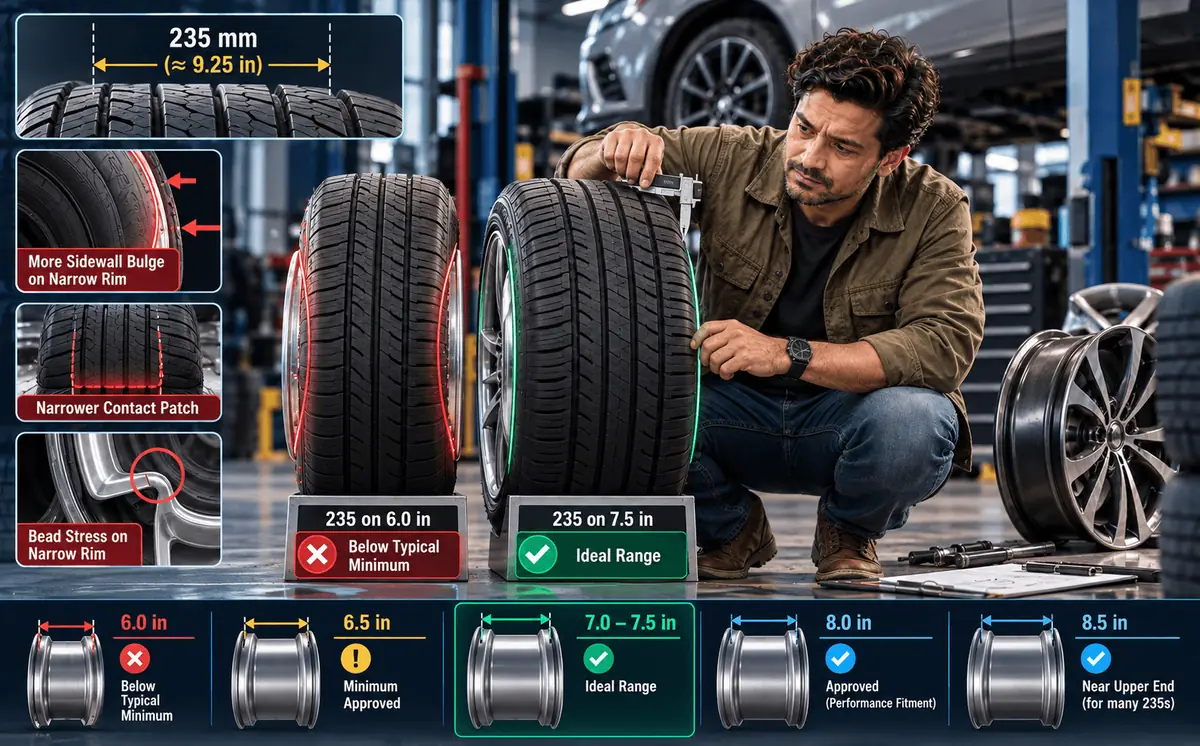
For most 235-width tires, a 6-inch rim falls below the approved fitment range. The sidewalls bulge, the contact patch narrows, handling turns vague, and in an emergency the bead is under stress it was never designed for. It may seem fine at moderate speeds around town, but it is not optimal and not safe as a long-term setup. Look for a rim of at least 6.5 inches, ideally 7 to 7.5 inches, or choose a narrower tire.
Table of Contents
Who Decides What Fits
The Tire and Rim Association (TRA) publishes engineering standards that define the approved rim widths for every tire section width. These are not opinions; they are load-tested specifications that tire manufacturers build their products around and publish on their spec sheets.
For most 235mm passenger tires, the approved range looks like this:
| Rim Width | Status for a Typical 235 Tire |
|---|---|
| 6.0 inches | Below the minimum for most sizes |
| 6.5 inches | Minimum approved width |
| 7.0 inches | Approved |
| 7.5 inches | Approved, common original-equipment fitment |
| 8.0 inches | Approved, performance fitment |
| 8.5 inches | Approved, upper limit for most 235s |
| 9.0 inches | Above the maximum |
The minimum exists because below it, the bead area cannot maintain proper contact with the rim flange at the tire’s rated load and speed. Approved ranges can vary slightly by size and aspect ratio, so the published spec sheet for your exact tire is always the final word. If it does not list 6.0 inches, the fitment is not approved.
When a 235 ends up on a 6-inch rim, it is usually because a shop mounted it without checking fitment data. That is not always careless intent; the tire physically goes on. But being able to mount a tire and being safe to drive on it are two very different things.
What Happens When the Rim Is Too Narrow
The Sidewalls Bulge
When the rim is narrower than the tire was designed for, the lower sidewall angles outward instead of transitioning cleanly from rim flange to tread shoulder. The tire takes on a rounded, bowed profile that looks like mild under-inflation, except that adding air does not fix it. The geometry is wrong, not the pressure.
The Contact Patch Shrinks
It seems logical that a wider tire always means a wider footprint, but rim width controls how flat the tread sits on the road. On a properly matched rim, a 235 tire presents a broad, rectangular contact patch. On a 6-inch rim, the carcass is pinched inward at the bead, the tread edges curl upward, and the footprint becomes narrower and more oval. You lose the very grip you were hoping to gain by going wider.
The Bead Is Under Stress
The bead is engineered to lock against a specific rim flange geometry. On a too-narrow rim, it does not seat the way it was designed to. Under hard cornering and braking, loads shift sideways, and that is exactly when a poorly seated bead can unseat. A tire coming off the rim at highway speed is not a recoverable situation.
The Tire Grows Taller
Because the tire is squeezed narrower at the bead, its section height increases slightly, typically by about 4 to 8 mm depending on aspect ratio. That small change can affect speedometer accuracy, suspension geometry, and the calibration of advanced driver assistance systems on vehicles that have them.
How It Feels on the Road
A 235 tire on a 6-inch rim tends to produce vague, numb steering on center, the disconnected sensation of never being quite sure how much grip is available. The car may track straight, but in a moderate corner it can feel as if the tires are rolling onto their sidewalls.
The ride may actually feel softer than expected, because the extra sidewall flex adds cushioning. That is not a benefit. What keeps you safe is a tire that is predictable, responsive, and firmly seated, not one that feels soft.
When the Risk Becomes Real
At low speeds on quiet streets, a mismatched fitment may never cause an obvious problem, and plenty of cars have been driven for months on the wrong rim width without incident. The danger concentrates in specific situations:
- Emergency braking: under hard ABS braking the tire flexes aggressively in every direction, and a poorly seated bead is most likely to release under combined braking and cornering loads.
- High-speed highway driving: at 70 mph and above, forces on the bead rise substantially, and small seating problems become significant.
- Wet roads: a narrowed, rounded contact patch loses resistance to hydroplaning sooner, and curled tread edges evacuate water less efficiently.
- Heavy loads or towing: near the tire’s maximum load, the sidewall deflects even more, and on a narrow rim it is already compromised.
A Rule of Thumb for Rim Width
A useful mental model: the recommended rim width is roughly 70 to 80% of the tire’s section width in inches.
A 235mm tire is about 9.25 inches wide:
- 70% of 9.25 inches is about 6.5 inches, the practical minimum
- 75% is about 6.9 inches, so 7.0 inches is a solid everyday fitment
- 80% is about 7.4 inches, so 7.5 inches is ideal for most touring and performance tires
A 6.0-inch rim works out to only about 65% of the tire’s width, below the threshold where proper support begins.
Here is a quick reference for common widths. Treat it as a guide and confirm with the specific tire’s spec sheet.
| Tire Width | Minimum Rim | Ideal Rim | Maximum Rim |
|---|---|---|---|
| 205mm | 5.5 in | 6.0–6.5 in | 7.5 in |
| 215mm | 6.0 in | 6.5–7.0 in | 8.0 in |
| 225mm | 6.0 in | 7.0–7.5 in | 8.0 in |
| 235mm | 6.5 in | 7.0–7.5 in | 8.5 in |
| 245mm | 7.0 in | 7.5–8.0 in | 9.0 in |
| 255mm | 7.0 in | 8.0–8.5 in | 9.5 in |
Our guide to how different tire widths affect handling and our tire size explainer offer more background.
How to Measure Your Rim Width
Rim width is measured between the bead seats, from the inside of one bead-seat ledge to the inside of the other, not across the outer flanges. The bead-seat measurement is typically 1 to 1.5 inches narrower than the wheel’s overall outside width, which is why eyeballing a wheel often leads to the wrong conclusion. The width is also usually stamped or cast on the wheel itself, often alongside the diameter (for example, “16×6”).
Your Options If You Already Have This Setup
Option 1: Get Wheels of the Right Width
The cleanest fix is to fit rims in the 7.0 to 7.5-inch range. For a car that came with 6-inch wheels, that usually means aftermarket wheels. A set of four steel or alloy wheels in the 16 to 17-inch range typically costs around $150 to $400 depending on the vehicle. It is real money, but it is the correct solution. Used wheels of the right size can lower the cost further.
Option 2: Choose a Narrower Tire
If you want to keep the 6-inch wheels, fit a tire that suits them. A 205 or 215 is properly supported on a 6-inch rim. You give up a little footprint and gain correct geometry, predictable handling, and a properly seated bead. For most compact cars and small sedans that came with 6-inch wheels, a 205 or 215 is likely what the tire placard calls for anyway.
Option 3: Treat It as Strictly Temporary
If you must drive on the setup briefly, perhaps while waiting for parts or when stranded away from home, keep to surface streets, avoid highways and hard cornering, and replace the setup as soon as possible. It is not a permanent solution.
Option 4: Go Back to the Shop
If a shop has just mounted the tires and you have not driven far, ask them to correct the fitment. A reputable shop will not knowingly mount a tire on an unapproved rim width, and if it did so without telling you, it should make it right.
Does Aspect Ratio Change Anything?
A taller sidewall, say a 235/65R16 rather than a 235/45R18, does provide more flex, which spreads bead stress a little more gradually under cornering load. Some high-profile sizes also have slightly wider approved rim ranges, which is another reason to check the spec sheet for your exact tire.
But the core problem remains: a bead seated on a rim narrower than its approved range. If the specific size you are considering does not list your rim width as approved, a taller sidewall does not make it safe.
Does Tire Brand Matter?
Premium tires from makers such as Michelin, Continental, and Bridgestone often have stiffer bead construction and more precise carcass geometry, so the sidewall bulge may be slightly less pronounced and the bead marginally less likely to unseat. These manufacturers still publish TRA-based fitment ranges, and none of them warrant their tires outside the approved rim widths. A little more margin before failure on an unapproved fitment is not a reason to run it.
A Word About TPMS
Every car sold in the U.S. since 2008 has a tire pressure monitoring system. TPMS warns you when pressure drops a set percentage below the target for the factory tire and wheel combination. It knows nothing about fitment.
On a 235 mounted to a 6-inch rim, the door-placard pressure no longer necessarily applies, because it was set for the original tire and wheel combination. Drivers sometimes raise pressure to stiffen the bulging sidewall, which can keep the TPMS light off while the bead-seating problem remains. A dark TPMS light tells you about air pressure, nothing more. It does not tell you the tire is correctly seated on a correctly sized rim.
Frequently Asked Questions
Physically, yes. But for most 235 sizes, a 6-inch rim is below the approved minimum of 6.5 inches. The bead does not seat as designed, the sidewall bulges, and the contact patch narrows. Most reputable shops will refuse the fitment.
For most 235 sizes, 6.5 inches, with 7.0 to 7.5 inches ideal. Check the spec sheet for your exact tire.
The sidewalls bow outward, the contact patch becomes narrower and rounder, handling turns imprecise, and the bead is stressed. Under hard cornering, emergency braking, or high speed, the bead can unseat.
Narrower rims are common for winter setups, but the rim still has to be within the tire’s approved range. On 6-inch winter wheels, a 205 or 215 is usually the right width.
No. TPMS only reads air pressure. It cannot tell whether the bead is seated correctly or the rim is the right width.
Most 215 tires are approved for a 6-inch rim, and many manufacturers allow certain 225 sizes. Verify with your specific tire’s spec sheet.
Measure between the inner edges of the bead-seat ledges, not across the outer flanges, or read the size stamped on the wheel.
The Verdict
A 235 tire on a 6-inch rim is, for most sizes, an unapproved fitment. It narrows the contact patch, dulls handling, and places stress on the bead that can lead to failure in exactly the situations where you most need your tires to perform: a sudden swerve, a panic stop, a blowout at highway speed.
The fix is straightforward. Fit wheels in the 7.0 to 7.5-inch range for your 235 tires, or step down to a 205 or 215 that suits your existing 6-inch wheels. Either option is safer, and often cheaper, than living with a mismatched setup.
Tires are the only part of your car that touches the road. Get the fitment right.
Sources
Specs, warranty terms and prices were checked on October 22, 2026. Prices change often.
- NHTSA: Tires (tire safety and maintenance)
 Summarize this article with:

















Leave a comment