


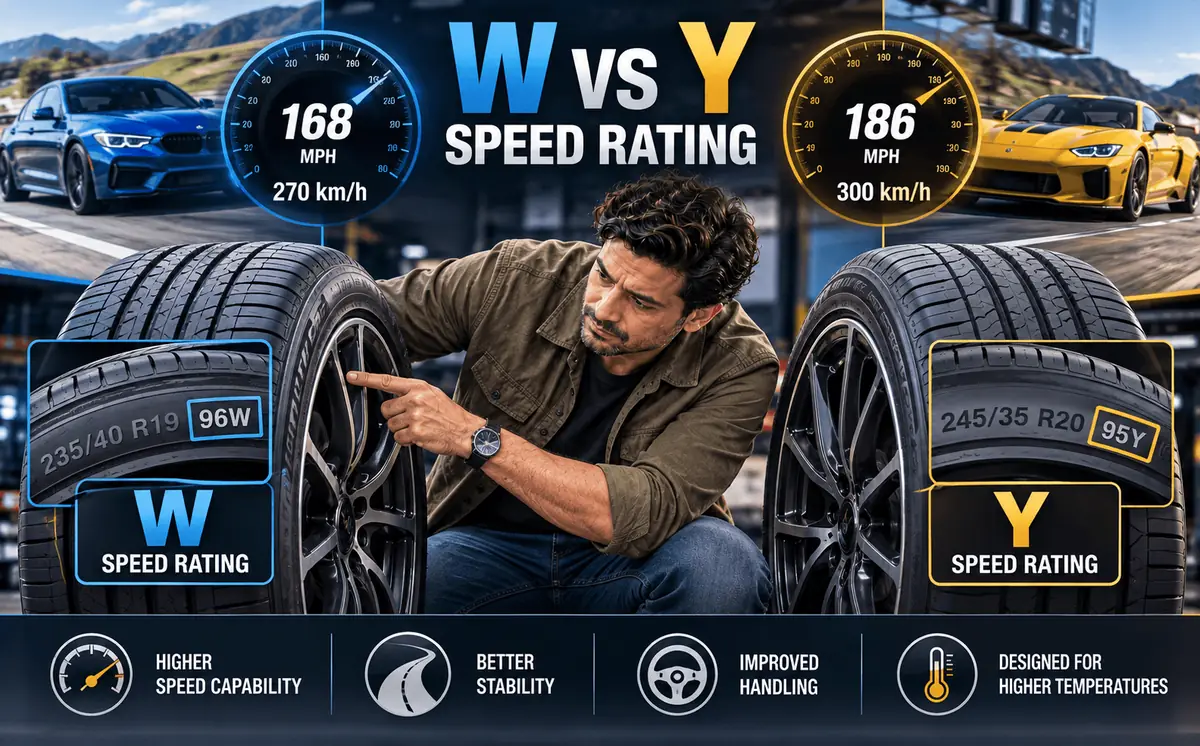
At the top of the speed rating scale, the choice narrows to two letters: W, certified to 168 mph, and Y, certified to 186 mph. Both belong to the world of serious performance cars, and both are built far beyond what any public road allows. So how do you choose between them, and does the extra 18 mph capability matter if you’ll never use it?
For most owners, the answer starts with the vehicle manufacturer’s specification and ends with the specific tire model. Here’s how the two ratings compare and what to consider.
Table of Contents
Speed Ratings in Context
A speed rating indicates the maximum sustained speed a tire is designed and certified for, at its rated load and correct inflation, based on standardized testing. Higher-rated tires use more robust construction and materials to withstand the heat and stress of higher speeds.
| Rating | Max Speed | Typical Vehicles |
|---|---|---|
| V | 149 mph / 240 km/h | Sport sedans, performance trims |
| W | 168 mph / 270 km/h | High-performance sports cars and sport sedans |
| Y | 186 mph / 300 km/h | Supercars, exotic and ultra-high-performance cars |
| (Y) | Above 186 mph | Hypercars and the fastest exotics |
You’ll often see these tires with “ZR” in the size, as in 255/35ZR19 96Y. ZR indicates capability above 149 mph; the W or Y in the service description specifies the exact rating.
The W Rating
W-rated tires are approved for sustained use up to 168 mph. They’re engineered to withstand the heat, stress, and centrifugal forces of very high speeds, using specialized compounds and reinforced internal construction to maintain structural integrity and grip.
You’ll find W-rated tires on high-performance sports cars, powerful sport sedans, and premium coupes. They balance extreme capability with a degree of everyday usability, which makes them a popular choice for enthusiasts who drive their cars daily.
The Y Rating
Y-rated tires are designed and tested for sustained speeds up to 186 mph. Their compounds, internal structure, belts, and tread design are optimized for stability, grip, and durability under the most demanding conditions.
Y-rated tires typically appear on supercars, exotic cars, and powerful grand touring and luxury vehicles whose top speeds require the extra capability. Most drivers will never approach 186 mph, but the rating provides margin for brief bursts of speed and for the heat generated by hard, sustained driving.
The (Y) designation, in parentheses, indicates a tire tested and approved for speeds above 186 mph, reserved for the fastest vehicles.
W vs Y: Key Differences
Vehicle Fit
The primary difference is capability: 168 mph versus 186 mph. That gap matters for vehicles whose top speeds exceed what a W-rated tire is certified for. Automakers specify the required rating for each model based on engine power, aerodynamics, and performance, and that specification is the starting point. Installing a lower rating than specified can compromise safety and handling, particularly at high speed.
Construction and Heat Resistance
Y-rated tires are built to dissipate heat at higher speeds, typically with reinforced belts, cap plies, and bead reinforcements, plus compounds formulated to resist heat and stress. That construction provides a margin for hot weather and hard driving, though both ratings are extremely capable.
Handling and Braking
A speed rating doesn’t directly measure grip, but higher ratings usually go hand in hand with stiffer sidewalls and construction that resists deformation. That tends to sharpen steering response and stability in cornering and emergency maneuvers. In practice, differences between a W-rated and a Y-rated tire depend more on the specific model, compound, and category (summer versus all-season) than on the letter alone. Compare independent test results for the tires you’re considering.
Price
Y-rated tires are generally more expensive than W-rated equivalents, reflecting advanced compounds, reinforced construction, specialized manufacturing, research and development costs, and lower production volumes. The premium varies by brand, model, and size, and is often widest among premium brands.
Safety Considerations
- Don’t go below the specification. A tire with an inadequate speed rating may not withstand the heat generated at the vehicle’s capable speeds, risking tread separation, blowouts, or rapid wear.
- Don’t mix ratings. Different ratings on the same vehicle can cause uneven handling and stability problems, especially in emergency maneuvers. Use the same rating, and ideally the same model, on all four wheels.
- Respect temperature limits. Many W- and Y-rated tires are summer tires whose compounds harden in cold weather. Don’t drive them in near-freezing conditions, snow, or ice.
Choosing Between W and Y
Follow the manufacturer’s recommendation. Your owner’s manual or door placard lists the required rating. If your car specifies Y, use Y or (Y). If it specifies W, W is sufficient, and Y is an acceptable upgrade.
Consider your driving. Regular track days or sustained high-speed driving where legal favor the extra margin of a Y-rated tire. For spirited road driving within legal limits, a W-rated tire is typically all you need on a vehicle that specifies W.
Think about climate. For hot climates and hard driving, higher heat resistance can help. For colder regions, consider whether you need an all-season performance tire or a separate winter set, regardless of rating.
Check load index. The speed rating and load index work together. Make sure the tire’s load index meets or exceeds the specification.
Weigh the budget. If your vehicle specifies W and you won’t use the extra capability, a W-rated tire offers better value.
Maintenance at the Top End
High-performance tires reward careful maintenance:
- Pressure: check regularly and follow the vehicle manufacturer’s recommendations. Under-inflation is especially damaging at high speeds.
- Rotation: rotate as recommended, noting that some performance cars use different front and rear sizes or directional tires that limit rotation options.
- Inspection: watch for cupping, feathering, cracks, bulges, cuts, and embedded objects.
- Replacement: replace at 2/32 of an inch of tread at the latest, and consider replacing performance tires sooner for wet grip. Replace aged tires; many manufacturers recommend replacement somewhere between six and ten years, regardless of tread. Replace damaged tires that can’t be safely repaired, and remember that many manufacturers consider a repaired high-performance tire to have lost its original speed rating.
Myths and Misconceptions
“A higher speed rating means better performance in every way.” Not necessarily. Compound, tread design, and construction determine grip, handling, and ride. A higher rating usually brings stiffer construction, but the specific tire matters most.
“Speed ratings are speed limits.” They’re certified structural capabilities under test conditions, not legal or recommended driving speeds.
“If I don’t drive fast, the rating doesn’t matter.” The rating reflects construction that affects stability and heat resistance at all speeds, and your vehicle was engineered around a specific rating.
“Speed ratings only matter for performance cars.” Every vehicle has a specified rating chosen for its weight and capability.
“Mixing ratings is fine.” It isn’t. Use the same rating on all four wheels.
Where Ultra-High-Performance Tires Are Heading
Manufacturers continue to develop compounds and reinforcing materials that withstand higher speeds and temperatures while improving grip and rolling resistance. Sensor-equipped tires that monitor pressure and temperature in real time are becoming more common, and the growth of powerful electric vehicles, with high weight and instant torque, is driving new performance tire designs. Standards bodies may also refine rating systems as technology evolves.
Expert Tips
1. Prioritize safety over bragging rights. Choose the rating your vehicle requires and your driving demands.
2. Match the rating to the vehicle, meeting or exceeding the manufacturer’s specification.
3. Keep up with maintenance: pressure, rotation, and timely replacement.
4. Consider climate: summer performance tires and cold weather don’t mix.
5. Avoid mixing ratings, and replace in matched sets.
6. Check the load index, especially on heavy grand tourers and EVs.
7. Ask a professional if you’re unsure which rating or model suits your car.
Frequently Asked Questions
W-rated tires are certified to 168 mph; Y-rated tires to 186 mph. Y-rated tires use construction designed for higher speeds and heat.
It isn’t recommended. Stay at or above the specified rating.
Yes. Moving up is acceptable, though you’ll usually pay more.
Often they feel sharper because of stiffer construction, but the specific model and category matter more than the letter.
A tire approved for speeds above 186 mph, used on the fastest exotic and hyper cars.
ZR indicates the tire is rated above 149 mph. The W or Y in the service description gives the exact rating.
The Verdict
W and Y are both top-tier ratings built for vehicles that demand the most from their tires. W-rated tires suit most high-performance sports cars and sport sedans, offering exceptional capability and better value. Y-rated tires are essential for supercars and exotics whose specifications call for them, and a sensible upgrade for owners who push hard on track.
Start with your vehicle’s specification, choose the best tire model for your driving and climate, and keep it impeccably maintained. At these performance levels, that combination matters more than the letter alone.
 Summarize this article with:















Leave a comment