


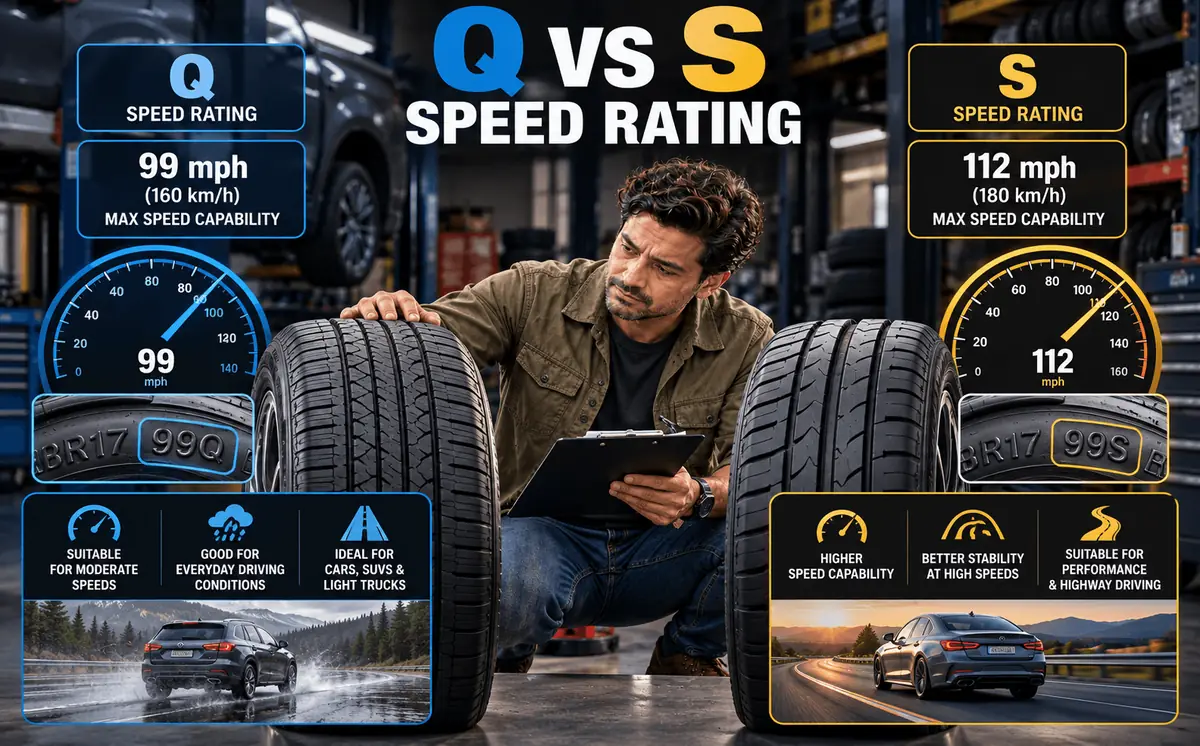
The Q and S speed ratings sit only 13 mph apart: Q-rated tires are certified to 99 mph, S-rated tires to 112 mph. Neither number is a speed most people will ever see on a public road. So why does the difference matter?
Because the letter tells you what kind of tire you’re looking at. Q is the rating of specialists: studless winter tires and aggressive mud-terrain tires that trade high-speed stability for grip in snow, ice, and mud. S is the rating of the everyday highway tire found on family sedans, minivans, and many all-terrain light-truck tires. Understanding the gap helps you pick the right tire for the season, the terrain, and the vehicle, and avoid some costly mistakes.
How this guide was put together: This guide is based on published speed rating standards and common retailer practice; it is not legal advice. Checked on October 22, 2026.
Table of Contents
The Basics
For every letter from B to Y, see our tire speed rating chart. Speed ratings indicate the maximum speed at which a tire can safely carry its rated load when properly inflated, as established by laboratory testing. In those tests, tires are run against large drums at stepped speeds, each held for a set period while the tire carries a substantial share of its maximum load. To earn a rating, the tire must complete the test without failure.
| Rating | Max Speed | Typical Applications |
|---|---|---|
| Q | 99 mph / 160 km/h | Winter tires, mud-terrain tires |
| R | 106 mph / 170 km/h | Light trucks, commercial vans |
| S | 112 mph / 180 km/h | Family sedans, minivans, all-terrain light-truck tires |
| T | 118 mph / 190 km/h | Touring sedans, crossovers |
In a size like P215/65R15 95S, the “S” is the speed rating. Higher ratings typically come with stiffer sidewalls, more heat-resistant compounds, and construction that holds stability at speed, traits that improve handling and braking even at normal speeds.
Why the Two Ratings Differ: The Physics
Heat and Hysteresis
As a tire rolls, the section in contact with the road deforms and then recovers. Not all of the energy is returned; some becomes heat. This is hysteresis. At higher speeds, these cycles happen more often, generating more heat. When heat builds faster than the tire can shed it, internal temperatures climb toward failure.
Q-rated tires typically use compounds and features, such as deep tread blocks, that generate or retain more heat, so they reach their thermal limit at a lower speed. S-rated tires are built to stay thermally stable up to 112 mph.
Centrifugal Force and Tire Growth
Centrifugal force rises with the square of speed, so a modest increase in speed produces a disproportionately larger outward pull. The tire grows slightly in diameter, straining the edges of the steel belts, a primary failure point at speed. Many S-rated tires use cap plies of nylon or aramid wound over the belts to restrain this growth. Q-rated tires often have simpler belt packages sized for lower speeds.
The Standing Wave
As a tire rolls, the sidewall bulges at the contact patch and that deformation travels around the casing. At a critical speed, the sidewall can’t recover before it reaches the road again, and a rippling standing wave forms just behind the contact patch. The rapid flexing produces intense heat very quickly. Tires with tall, flexible sidewalls and heavy, blocky treads, typical of winter and mud tires, reach this threshold at lower speeds. The Q rating keeps them well below it. Stiffer, lower-mass S-rated designs push the threshold higher.
Why Many Winter Tires Are Q-Rated
The lower rating on many winter tires is a deliberate engineering trade-off, not a cost-cutting measure.
- Soft compounds. Winter compounds stay pliable at very low temperatures, which lets the rubber conform to the microscopic texture of ice and snow. That same softness generates more heat at speed.
- Heavy siping. Thousands of tiny slits create biting edges for ice grip, but they also make the tread blocks squirm more, adding heat and reducing stability at high speed.
- Temperature sensitivity. Winter tires are optimized for temperatures below about 45°F (7°C). In warm weather, especially at speed, they soften further, wearing quickly and building heat.
Some performance winter tires carry higher ratings such as R or H, but usually by giving up some of the cold-weather grip that is the reason winter tires exist. Because the safety benefit of winter traction is so large, it is widely accepted to fit lower-rated winter tires to vehicles that normally require higher ratings.
Why Mud-Terrain Tires Are Usually Q-Rated
Mud-terrain tires are designed to keep moving where ordinary tires would bog down. Their large, chunky lugs separated by wide, deep voids let the tire dig in and then fling mud and rocks out as it rotates, keeping the tread clean.
Those features limit speed. Each heavy lug acts like an independent cantilever, and at higher speeds the centrifugal forces on them stress the casing and can cause vibration. Deep, flexible blocks also generate more heat. Engineering an M/T tire for a higher rating would mean smaller lugs, stiffer compounds, and smaller voids, which would undercut its mud performance. The Q rating is the practical balance: fast enough for highway travel to and from the trail, without exceeding the design’s structural and thermal limits.
How All-Terrain Tires Reach an S Rating
Many all-terrain tires earn an S rating by striking a different balance:
- Tie-bars and interlocking blocks connect lugs so they move less independently, reducing squirm and heat at highway speeds.
- Moderate tread depth. All-terrain tires typically have somewhat shallower tread than mud-terrain tires, reducing block mass and centrifugal stress.
- Stiffer sidewall compounds improve on-road response while still allowing flex when aired down off-road.
The result suits overlanders and daily drivers who venture onto forest roads and light trails. An S-rated all-terrain tire won’t match a mud-terrain tire in deep mud or technical rock, and it won’t match a highway tire for quiet comfort, but it handles long highway stretches with real stability. Our guide to all-terrain vs mud-terrain tires goes deeper.
S-Rated Tires: The Highway Standard
S-rated tires are common on family sedans, minivans, passenger vans, crossovers, and some all-terrain light-truck applications. They offer:
- A real safety margin over typical U.S. highway limits of 65 to 75 mph, including occasional higher-speed driving
- Room to optimize comfort, noise, and wear while retaining adequate high-speed capability
- Thermal capacity to cope with a fully loaded family vehicle on a hot summer highway, slight under-inflation, or heavy loads
Compared with Q-rated tires, they generally deliver better steering precision, stability at highway speed, braking on dry and wet pavement, lower heat at sustained speed, and often lower rolling resistance.
How Q vs S Changes Vehicle Behavior
Steering Response
S-rated tires have higher cornering stiffness, so the vehicle responds quickly and predictably when you turn the wheel. Many Q-rated winter and mud tires have lower cornering stiffness: you turn the wheel, the tread squirms, and then the vehicle follows. Drivers often describe Q-rated tires as feeling floaty on the highway and needing frequent small corrections.
Braking: It Depends on the Surface
- Dry pavement: S-rated tires stop noticeably shorter. Deep, flexible Q-rated blocks distort under hard braking.
- Wet pavement: S-rated all-season and summer tires typically keep an advantage over Q-rated winter tires, though the gap narrows.
- Snow and ice: the roles reverse. Q-rated winter tires stop dramatically shorter than S-rated all-season tires.
That reversal is exactly why seasonal tire changes matter. No single tire excels everywhere.
Stability Control
Modern stability and anti-lock braking systems are calibrated around the tire characteristics the vehicle was designed with. A softer Q-rated tire on a vehicle developed around S-rated tires can introduce a slight lag in yaw response, which may cause stability control to intervene earlier or less effectively in evasive maneuvers.
Legal and Insurance Considerations
Rules vary by country and region:
- Germany: winter and all-season tires with the three-peak mountain snowflake (3PMSF) symbol may have a maximum speed below the vehicle’s top speed, but a sticker showing the tires’ maximum permitted speed must be placed in the driver’s field of vision, according to Continental. Rules differ in other European countries, so check locally.
- United Kingdom: there is no winter tire mandate. Insurer policies on lower-rated winter tires vary, so check with your insurer before fitting them.
- Canada: British Columbia requires winter tires (marked M+S or with the mountain/snowflake symbol, with at least 3.5 mm of tread) on many highways from October 1 to March 31, and until April 30 on select mountain and high-snowfall routes, as reported by CBC News. Quebec requires vehicles registered there to have winter tires, marked with the winter pictogram or studded, from December 1 to March 15. Neither rule sets a speed rating.
- United States: we found no federal rule requiring replacement tires to match the original speed rating, but some tire retailers have policies against installing a lower rating than the vehicle’s specification, often with an exception for dedicated winter tires.
Insurance can also matter. Policies generally require a roadworthy vehicle and may require notice of modifications. Leaving Q-rated winter tires on through summer, or fitting cheaper Q-rated tires in place of specified S-rated ones without telling your insurer, could complicate a claim if tire performance is a factor in a crash. For businesses running fleets, the duty-of-care stakes are higher still.
What About Electric Vehicles?
EVs are heavier than comparable gasoline vehicles, often by a significant margin, and deliver strong torque instantly. Both factors stress tires. Flexible Q-rated designs can struggle with those forces and add rolling resistance that cuts range. As a result, more EV-oriented winter tires carry higher ratings, such as R, S, or H, with stiffer sidewalls and heat-resistant compounds. For an EV, choose tires marketed for EV use, and favor higher ratings where available.
Choosing Between Q and S
Choose Q-Rated Tires When…
- You need dedicated winter tires for snow and ice
- Your vehicle is used mainly off-road in mud, sand, or rough terrain
- You rarely drive at sustained highway speeds
- Maximum traction in extreme conditions matters more than high-speed stability
Choose S-Rated Tires When…
- Your driving is mainly highway and city
- You want balanced all-weather performance
- You regularly drive at sustained highway speeds
- You want predictable handling and braking on pavement
- You’re replacing original equipment that came with an S rating
Seasonal Switching
If you run Q-rated winter tires, switch back to your S-rated (or higher) tires once temperatures stay above about 45°F (7°C). Running winter tires in warm weather accelerates wear, reduces fuel economy, degrades handling and braking, increases heat-related risk, and may raise insurance questions. If you’d rather not swap seasonally and your winters are moderate, an S-rated all-season tire is a better year-round compromise than a Q-rated tire.
Q vs S at a Glance
| Feature | Q (99 mph) | S (112 mph) |
|---|---|---|
| Primary applications | Winter, mud-terrain | Family vehicles, all-terrain |
| Handling | Flexible, less responsive | Stiffer, more responsive |
| Dry braking | Longer | Shorter |
| Specialized traction | Superior in snow and mud | Better on dry and wet pavement |
| Highway stability | Lower | Higher |
| Noise | Typically louder | Generally quieter |
| Heat tolerance | Lower | Higher |
Frequently Asked Questions
Yes, if they suit the conditions. But if your vehicle came with S-rated or higher tires, Q-rated tires (other than winter tires in winter) can compromise handling and braking even at legal speeds.
Their soft compounds and heavy siping, which provide winter grip, generate more heat at speed. Fitting lower-rated winter tires for the cold months is widely accepted.
Winter use of Q-rated winter tires is generally accepted. Running them in summer, or fitting lower-rated tires to save money without disclosure, can create coverage problems. Inform your insurer of any tire specification change.
It’s strongly discouraged. If you must temporarily, put the better-matched pair on the rear axle and observe the lowest-rated tire’s speed limit.
Yes, by a wide margin, with better steering, shorter stops, less noise, and better fuel economy. Mud-terrain tires remain better in deep mud and technical terrain.
Heat, centrifugal stress, and the risk of a standing wave all rise sharply, potentially leading to tread separation or a blowout. If it happens, slow down gradually and have the tires inspected.
The Verdict
For most drivers, S-rated tires are the right baseline for everyday highway travel, offering stability, braking, and a comfortable safety margin. Q-rated tires are specialists: indispensable in snow, ice, and mud, but best kept to the conditions they were built for.
Match the rating to your vehicle’s specification and your real driving, switch seasonally if you run winter tires, and you’ll get the best of both. For other comparisons, see R vs S, S vs T and the full speed rating chart.
Legal and regional rules were checked on October 21, 2026, against the sources linked above. Rules change, so confirm them for your location before relying on them.
Sources
Specs, warranty terms and prices were checked on October 22, 2026. Prices change often.
- NHTSA: Tires (tire ratings and safety information)
 Summarize this article with:















Leave a comment