


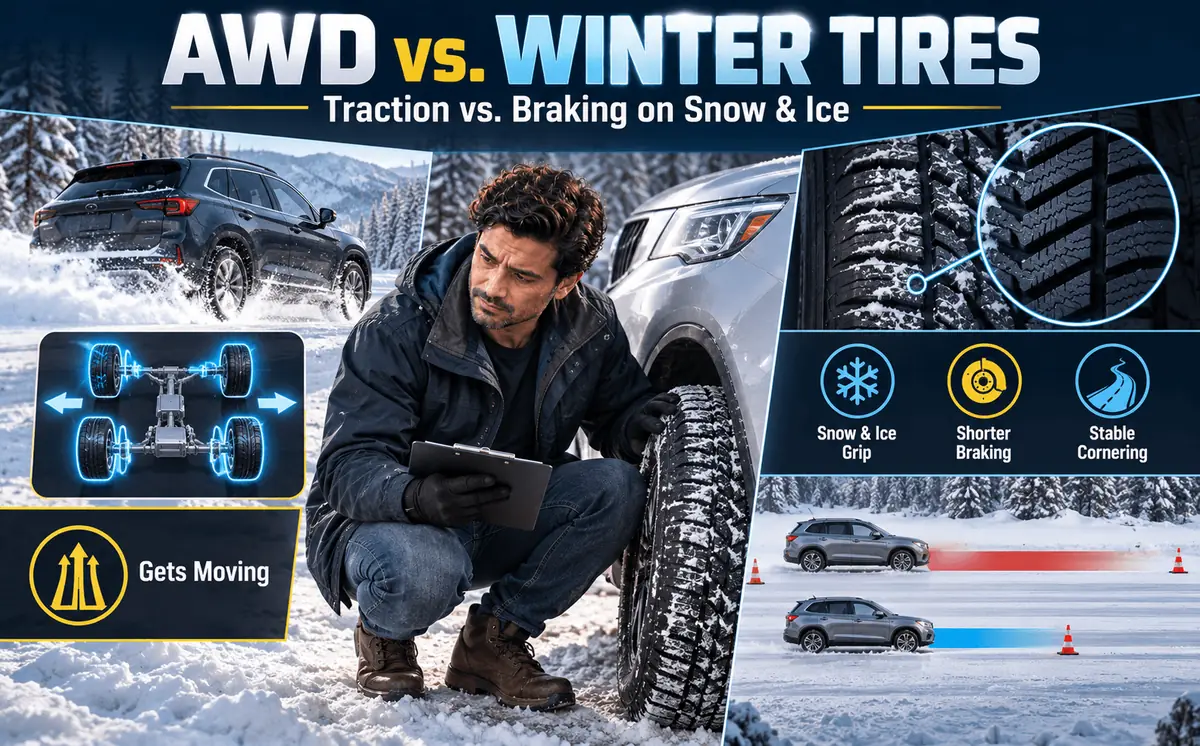
Every winter, the same scene plays out on snowy highways: an all-wheel-drive SUV pulls away from a stoplight without a hint of wheel spin, then slides straight through the next intersection when its driver touches the brakes. All-wheel drive did exactly what it was built to do. It just was never built to stop the car.
AWD has become one of the most sought-after features for drivers in cold-weather states, and for good reason. It makes a car feel planted and eager in slippery conditions. But that feeling creates one of the most persistent misconceptions in winter driving: the idea that an AWD vehicle on all-season tires is ready for anything winter can throw at it.
How this guide was put together: This guide is general winter-driving information; market figures are attributed to the research firms named. Checked on October 22, 2026.
The reality comes down to a simple rule worth remembering: AWD helps you go. Winter tires help you go, turn, and stop. This guide explains why, what the numbers show, and how to set up your vehicle for the safest possible winter.
Table of Contents
Why AWD Is So Appealing in Winter
All-wheel drive is booming. Market research firm Mordor Intelligence estimates the global automotive AWD market at $40.14 billion in 2026, up from $37.44 billion in 2025, and projects it to reach $56.82 billion by 2031, a compound annual growth rate of 7.20%. Much of that demand comes from buyers who want extra capability in rough weather.
The appeal is easy to understand. By sending power to all four wheels, AWD delivers far better traction than a two-wheel-drive car when accelerating or climbing on slippery surfaces. The difference is most obvious when pulling away from a standstill on ice or packed snow, or when climbing a steep, snow-covered hill. The car feels sure-footed, and that sense of security is precisely what many buyers are paying for.
How All-Wheel Drive Actually Works
AWD systems come in two broad forms. Full-time systems drive all four wheels all the time. On-demand systems normally power one axle and send torque to the other when they detect slip. Either way, the goal is the same: if one or more wheels lose grip, route power to the wheels that still have it.
Modern systems are quick and sophisticated. Electronic sensors monitor wheel speed, throttle position, and steering angle, and the system can redistribute power almost instantly. If the front wheels start spinning on an icy patch, more power goes to the rear. The practical benefits are real:
- Less wheel spin when pulling away from a stop sign or traffic light
- More confident merging into fast-moving traffic on slick roads
- Better ability to climb snowy driveways and hills without getting stuck
- More consistent forward progress through slush and unplowed side streets
Where AWD Falls Short: Braking, Steering, and Cornering
Here is the part that catches drivers out. AWD manages how engine power reaches the road. Braking and cornering have nothing to do with engine power. When you press the brake pedal or turn the steering wheel, the only thing working for you is the friction between your four tire contact patches and the road surface.
That means AWD does not shorten your stopping distance on ice by a single foot. It does not help the car hold a line through a snowy curve. If your tires lack grip for those jobs, the drivetrain cannot compensate. Every vehicle, regardless of how many wheels are driven, has exactly the same four small patches of rubber touching the road.
The key distinction: Acceleration depends on the drivetrain and the tires. Braking and cornering depend almost entirely on the tires. AWD improves only the first of those three jobs.
The Overconfidence Trap
AWD can create a risk of its own. Because the car accelerates so easily, it can feel more capable than it really is. Drivers may travel faster than conditions allow, follow too closely, or attempt maneuvers they would never try in a two-wheel-drive car. The first sign of trouble often arrives at the worst possible moment: when they need to stop.
It is a common blind spot. In a Consumer Reports survey of more than 54,000 subscribers who drove AWD or 4WD vehicles in snow, fewer than 15 percent had fitted winter tires. The great majority of AWD drivers are relying on their drivetrain to do a job it cannot do.
Why Winter Tires Make the Difference
Winter tires are not just all-season tires with chunkier tread. Nearly every element of their design is built around cold temperatures, snow, and ice.
Rubber That Stays Soft in the Cold
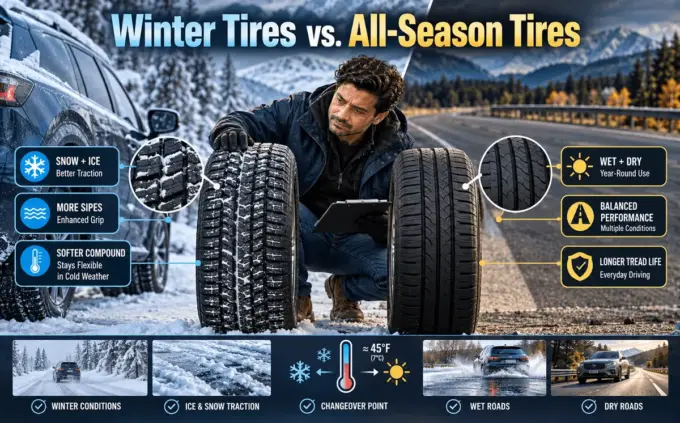
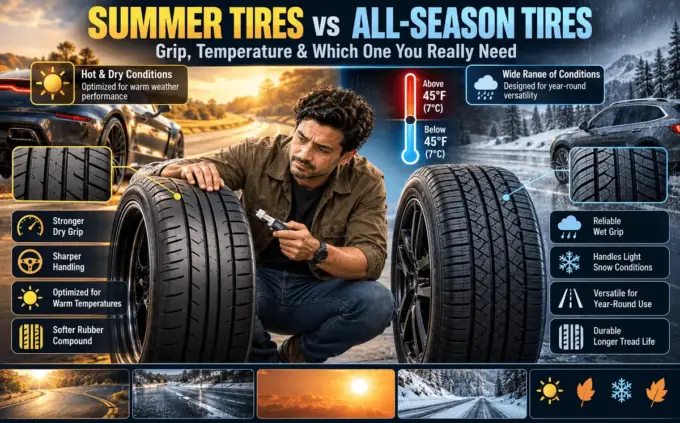
The biggest difference is the compound. All-season tire compounds begin to harden noticeably as temperatures drop below about 45°F (7°C). As the rubber loses elasticity, it conforms less to the road surface, and grip falls away. Winter tires use a high-silica compound that stays flexible well below freezing, so the tread keeps molding itself to cold asphalt, packed snow, and ice. That flexibility is what delivers consistent, predictable grip on a frigid morning.
Deep, Aggressive Tread
Winter tread patterns feature deeper grooves and larger, more open tread blocks than all-season tires. The grooves clear snow and slush from the contact patch so the rubber stays in touch with the road, while the block edges bite into snow for traction under both acceleration and braking.
Thousands of Sipes
Sipes are the tiny slits cut into each tread block, and winter tires have thousands of them. On ice and packed snow, they create a dense network of biting edges that grip like miniature claws, while also helping wipe away the thin layer of water that makes ice so slippery. Without them, a tire tends to skate across ice no matter how sophisticated the drivetrain behind it.
Why All-Season Tires Struggle
All-season tires are a compromise built for dry roads, rain, and light snow. Once temperatures fall and real winter conditions arrive, their compound stiffens and their shallower grooves and fewer biting edges run out of answers. On an AWD vehicle, that means the drivetrain may still get you moving, but the tires cannot deliver the grip needed to stop and steer with confidence.
Look for the Three-Peak Mountain Snowflake
When shopping for winter tires, check the sidewall for the Three-Peak Mountain Snowflake (3PMSF) symbol: a snowflake inside a three-peaked mountain outline. It indicates that the tire has met a specific performance requirement in snow testing.
Many all-season tires carry an M+S (Mud and Snow) marking, which offers some improvement over a basic all-season design but does not certify severe-snow performance. The 3PMSF symbol is the more meaningful indicator of genuine winter capability. Some all-weather tires also carry it; our comparison of all-season and all-weather tires explains where they fit.
Three Setups, Three Very Different Winters
The interplay between drivetrain and tires is easiest to understand by comparing the three most common winter configurations.
| Setup | Getting Moving | Braking | Cornering | Overall Winter Safety |
|---|---|---|---|---|
| AWD + all-season tires | Very good | Weak on snow and ice | Weak on snow and ice | Feels safe, often is not |
| FWD/RWD + winter tires | Fair to good; may struggle on steep, icy hills | Strong | Strong | Often safer than AWD on all-seasons |
| AWD + winter tires | Excellent | Strong | Strong | The best combination available |
AWD With All-Season Tires: The Illusion of Security
This is the most common winter setup in America, and it is the one most likely to mislead its driver. AWD will usually get the car moving on a moderately snowy road without drama. The trouble starts when the driver needs to slow down or change direction. On an icy patch, braking distances stretch out as the tires hunt for grip. A sudden steering correction can produce understeer, where the front of the car plows straight ahead, or oversteer, where the rear steps out.
Two-Wheel Drive With Winter Tires: The Surprising Winner
A front- or rear-wheel-drive car on proper winter tires will, in many situations, be safer than an AWD vehicle on all-season tires. It may need more care pulling away on a steep, icy incline, but it can stop and steer far more predictably. Since braking and steering are what help drivers avoid collisions, that is the trade most safety-minded drivers would take.
AWD With Winter Tires: The Complete Package
Pair AWD with four dedicated winter tires and you get the best of both: the drivetrain’s strong acceleration and climbing ability, plus the tires’ braking and cornering grip. For drivers who face serious winter weather every year, this is the gold standard.
What the Numbers Show
The physics explain why: all-wheel drive helps a vehicle accelerate, but braking and cornering grip come entirely from the tires. An AWD vehicle on all-season tires has no braking advantage on snow and ice over a two-wheel-drive car, and can stop in a longer distance than one fitted with winter tires.
- Winter tires stop about 6 to 7 feet sooner than all-season tires on average, according to figures published by The Safe Driver.
- Snowy roads can increase the distance needed to bring a car to a complete stop by as much as 10 times, according to The Zebra.
Put those figures together and the picture is clear. Snow multiplies stopping distances, and tires are the main tool for pulling them back down. A few feet can decide whether a car stops short of the vehicle ahead or slides into it.
The Driver Still Matters Most
The right equipment is the foundation of safe winter driving, but it does not replace good judgment. Even the best AWD system on the best winter tires can be overwhelmed by too much speed or a careless input.
Slow Down and Leave Room
Drive well below the posted limit when roads are slick, and stretch your following distance to at least eight seconds behind the vehicle ahead. That buffer gives you time to react and room to stop, both of which shrink dramatically on snow and ice.
Keep Every Input Smooth
Sudden movements break traction. Squeeze the brakes gradually, steer smoothly, and feed in the throttle gently to avoid wheel spin. Smooth inputs let the tires keep working within their grip.
Know What ABS and Stability Control Can and Cannot Do
Anti-lock brakes (ABS) prevent the wheels from locking so you can keep steering while braking hard. Electronic stability control (ESC) helps prevent skids by braking individual wheels and trimming engine power when it senses the car is not following the steering. Both are valuable, but both depend on the grip the tires provide. On tires without adequate winter traction, these systems have less grip to work with and cannot perform at their best.
Prepare the Rest of the Car
- Tire pressure: Cold air lowers pressure, which hurts grip and fuel economy. Check it frequently through the winter.
- Coolant: Make sure your antifreeze protection is adequate for the lowest temperatures you expect.
- Battery: Cold weather saps battery power, so have a weak battery tested or replaced before winter.
- Washer fluid: Fill up with a de-icing washer fluid.
Plan Ahead and Know When to Stay Home
Check the forecast and road conditions before heading out. When heavy snow, ice, or whiteout conditions are expected, postponing the trip is often the safest choice. If you must travel, choose main roads that are more likely to be plowed and treated.
Carry a Winter Emergency Kit
Even well-prepared drivers can be stranded. A basic kit should include:
- Blankets and warm clothing
- Non-perishable food and water
- A first-aid kit
- A flashlight with spare batteries
- A portable phone charger
- A shovel
- Sand or kitty litter for traction
- Jumper cables
For travel in remote areas, a satellite communication device is worth considering.
Are Winter Tires Worth the Money?
A set of four winter tires can cost anywhere from several hundred dollars to more than a thousand, depending on the vehicle, tire size, and brand. For AWD owners who believe their drivetrain already has winter covered, that can feel like an unnecessary expense.
Weigh it against the alternative. A single winter collision can bring repair bills, an insurance deductible, medical costs, and potentially legal expenses that dwarf the price of a tire set. Demand reflects that calculation: Verified Market Research projects the winter tire market to reach $42.39 billion by 2031.
There is also a durability argument. When winter tires go on only for the cold months, your all-season or summer tires sit idle for that part of the year, so both sets last longer. Over several seasons, the real added cost of running two sets is smaller than the upfront price suggests. Our breakdown of winter tires versus all-season tires covers costs, storage, and tread life in more detail.
Frequently Asked Questions
No. AWD helps a vehicle accelerate and maintain momentum on slippery roads, but it does nothing to improve braking or cornering. Those depend on tire grip, which is exactly what winter tires improve.
For overall safety, winter tires. A two-wheel-drive car on winter tires will often outperform an AWD vehicle on all-season tires when it comes to braking and cornering, the abilities that matter most for avoiding a crash.
Yes. Four matching winter tires give consistent grip at every corner, which keeps braking and handling balanced and lets the AWD system work as intended.
Around 45°F (7°C). Below that point, all-season compounds begin to stiffen and lose grip, while winter compounds stay pliable. You do not need snow on the ground for winter tires to make a difference.
The Three-Peak Mountain Snowflake symbol indicates that a tire has met a specific performance requirement in snow testing. It is a more meaningful sign of winter capability than the M+S marking found on many all-season tires.
They help, but they cannot create grip that is not there. Both systems rely on the traction the tires provide, so their effectiveness drops when the tires are not suited to the conditions.
Yes. AWD helps a car get moving and climb snowy driveways and hills, but it adds no braking or cornering grip, and the tires still set the limit on traction.
The Bottom Line
All-wheel drive is a genuine asset in winter. It gets you moving, helps you climb, and reduces the odds of getting stuck. What it cannot do is help you stop or steer, and those are the moments when winter accidents happen.
Winter tires are the only piece of equipment that improves all three critical jobs: accelerating, braking, and cornering. If you drive where snow and ice are a regular part of life, the safest setup is AWD paired with four dedicated winter tires. If you can only choose one, choose the tires.
And whichever combination you drive, remember that no hardware substitutes for slower speeds, longer following distances, and smooth, patient inputs.
Sources
Specs, warranty terms and prices were checked on October 22, 2026. Prices change often.
- NHTSA: Tires (tire safety and maintenance)
- Fox News (Consumer Reports): Do you really need AWD in the snow? (survey: under 15% of AWD/4WD owners use winter tires)
 Summarize this article with:














Leave a comment