
Cold-Weather Tire Pressure Calculator
Cold air makes tires read low. This tire pressure temperature calculator takes the pressure on your door placard and tonight’s temperature, then shows what your gauge will read, whether your tire pressure light will come on, and how much air to add.
Low tire or just cold?
Got a reading from your gauge or dashboard? Enter it to see whether the cold explains it.
Always check pressure cold, before driving or after the car has sat for a few hours, and fill to the placard on the driver’s door jamb, not the maximum on the tire’s sidewall.
How temperature changes tire pressure
Air contracts as it cools, so a tire set to the right pressure on a warm afternoon reads low on a cold morning. The common rule of thumb is about 1 psi for every 10°F change. This calculator uses the gas law behind that rule, so the result is exact for your numbers: 35 psi set at 70°F reads about 31 psi at 30°F.
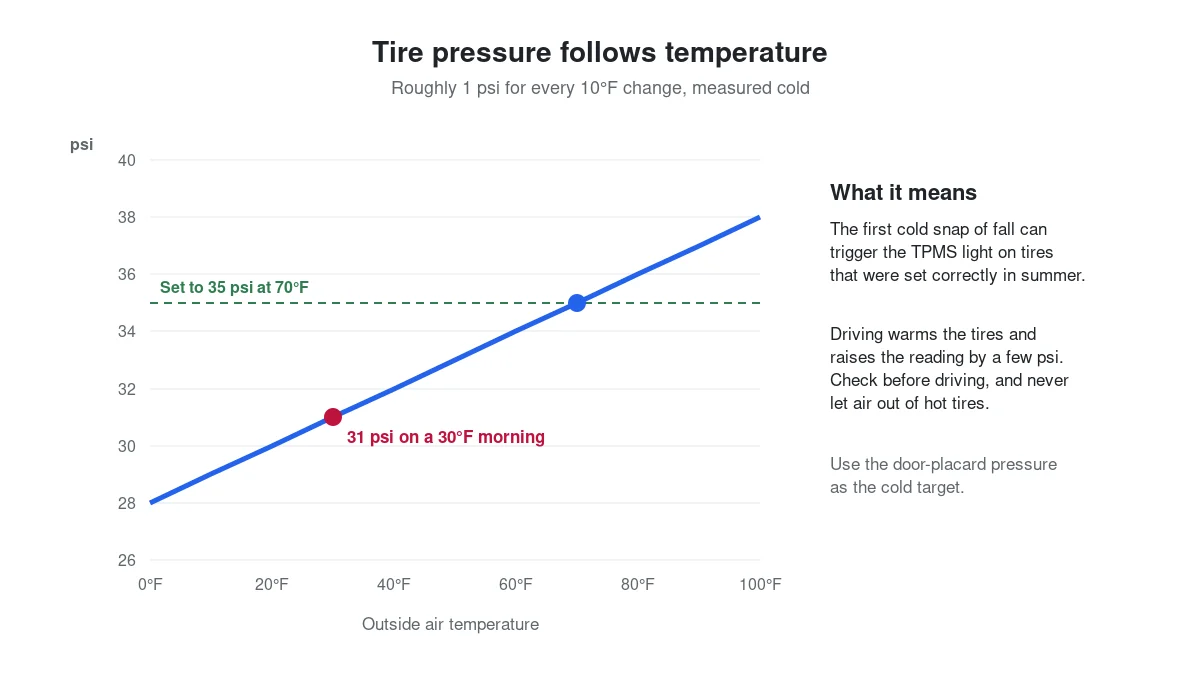
The same effect works in reverse: a tire checked in a heated garage, or after driving, reads higher than it will once it cools outside.
When does the tire pressure light come on?
The legal threshold
US federal safety rules require the warning light to come on within 20 minutes once a tire is 25% or more below the placard pressure, or below a minimum set for the tire type, whichever is higher. For a 35 psi placard, that’s about 26 psi. Some vehicles warn sooner than the law requires.
Why it goes off after you drive
Driving warms the tires, which raises the pressure back above the warning point, so the light may switch off a few miles down the road. The tires are still low when they cool again, so add air at the next stop rather than assuming the problem fixed itself.
A 25% drop is a lot
The warning only comes on once a tire is badly underinflated. A tire 5 or 6 psi low can already wear faster, handle worse and hurt fuel economy without any light. That’s why it’s worth topping up as soon as the temperature drops, not when the dashboard tells you.
How to set tire pressure in cold weather
- Check when the tires are cold, first thing in the morning or after the car has been parked for a few hours.
- Fill to the placard pressure on the driver’s door jamb. Don’t use the maximum printed on the sidewall.
- Mind a warm garage. If you fill tires indoors and park outside, they’ll read lower outside. Use this calculator to see by how much.
- Don’t let air out of warm tires. Pressure that reads high after driving is normal and drops back as the tires cool.
- Check again after a big temperature swing, and at least once a month through winter.
More detail in our guide to tire pressure in winter.
Cold weather tire pressure FAQs
How much does tire pressure drop in cold weather?
About 1 psi for every 10°F drop in air temperature. A tire set to 35 psi at 70°F reads about 31 psi at 30°F and about 27.5 psi at -10°F.
Why does my tire pressure light come on when it’s cold?
Cold air lowers the pressure in every tire. If your tires were already a little low, an overnight temperature drop can push one past the warning point, which by law is 25% below the placard pressure or a minimum for the tire type.
Why does the tire pressure light go off after I drive?
Driving warms the tires and raises the pressure above the warning point. The tires are still underinflated once they cool, so add air to the placard pressure.
Should I put more air in my tires in winter?
Fill them to the placard pressure, measured when the tires are cold at the outdoor temperature. In practice that means adding air as it gets colder. Never go above the maximum pressure on the sidewall.
Should I let air out if my tires read high after driving?
No. Pressure rises as tires warm up and falls back as they cool. Letting air out of warm tires leaves them underinflated once they’re cold.
How do I know if my tire is leaking or just cold?
Compare your reading with what the temperature alone would cause. If a tire reads several psi lower than expected, or one tire is much lower than the others, it’s likely leaking and should be checked.
Related guides and tools
- Tire pressure in winterPlacard pressure, TPMS lights and winter tires
- What tire pressure should I use?Finding the right PSI for your vehicle
- Sidewall max vs. recommended pressureWhich number to fill to
- Why tires lose pressureLeaks, valves, beads and more
- How often to check tire pressureA schedule that works
- Tire size decoderWhat XL and LT load ranges mean
- All tire toolsSize, age, cost and rebate tools
Sources
Checked November 2026. Readings are calculated with the ideal gas law for cold tires at sea level; real readings vary slightly with altitude, gauge accuracy and tire temperature.