


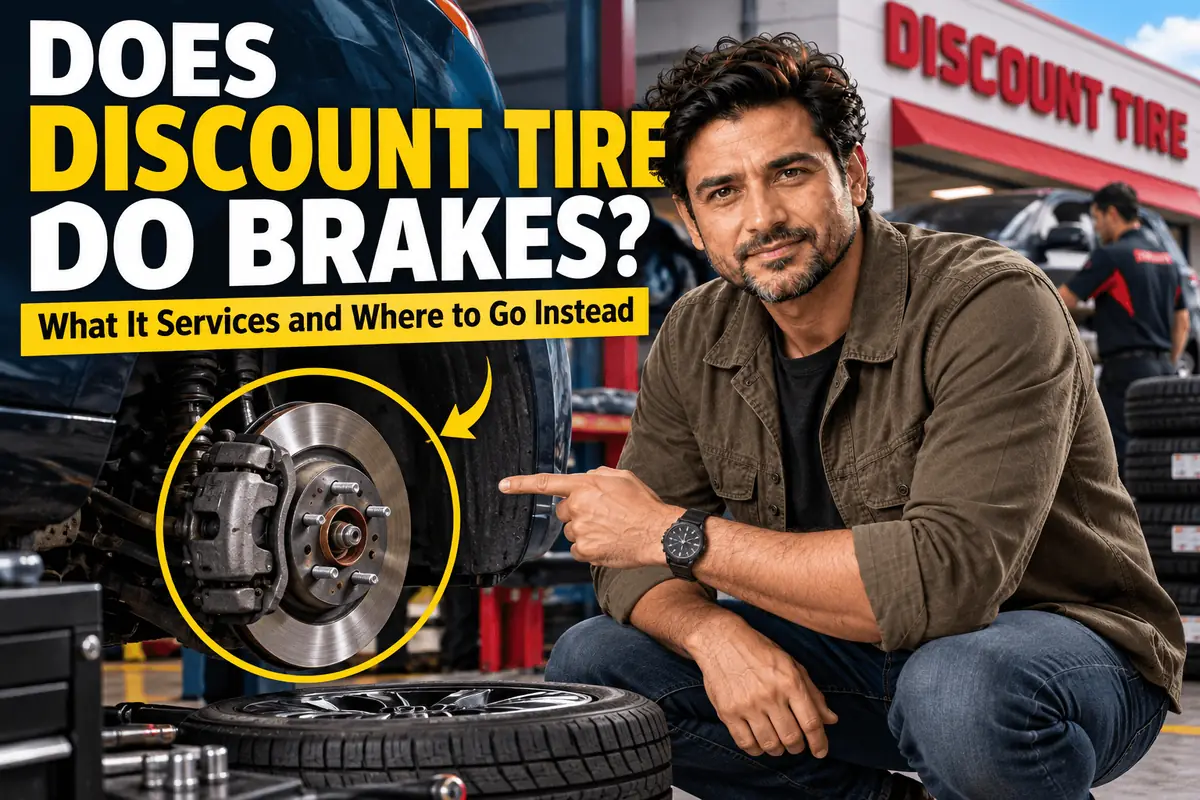
Your brakes have started to squeal, or the pedal feels a little softer than it used to, and the closest shop you trust is the Discount Tire down the road. It sells your tires, rotates them for free and gets you in and out fast, so it seems natural to ask whether the same crew can swap your pads while the wheels are off. The short answer is no. Discount Tire does not perform brake service, and it does not do oil changes either.
That surprises a lot of drivers, because many tire chains double as full-service repair shops. Discount Tire has built its business around a narrower idea: tires and wheels, done well, with nothing else competing for bay time. This guide explains exactly what Discount Tire does and does not handle, why brake work sits outside its lane and which kinds of shops make sense when your brakes need attention.
Table of Contents
The Short Answer: No Brake Service at Discount Tire
Discount Tire is a tire and wheel specialist. Its service menu covers mounting, balancing, rotation, flat repair, tire pressure monitoring system work and, at many stores, wheel alignment. Brake pads, rotors, calipers, brake fluid and oil changes are not on that list at any location.
The company was founded in 1960 by Bruce T. Halle in Ann Arbor, Michigan, and it now calls itself the nation’s largest independent tire and wheel retailer, with more than 1,200 stores across the country. In much of California, it operates under the America’s Tire name, and the service focus is the same there. Size has not pushed the company toward general repair. If anything, the scale is a result of staying focused.
If your brakes are grinding, pulsing or pulling, do not wait for your next tire visit. Book a brake inspection with a shop that performs brake repair.
Watch Out for Similar Names
Part of the confusion comes from independent businesses with similar names. Regional shops such as “Discount Tire & Brake” or “Discount Tire & Service Centers” exist in some markets, and some of them do offer brakes and oil changes. These are separate companies with no connection to the Discount Tire chain. If a listing for a “Discount Tire” near you advertises brake jobs, check the name and website closely before assuming it is the national retailer.
What Discount Tire Actually Does
Knowing the real service list helps you plan a visit and avoid a wasted trip. Here is how the menu breaks down.
| Service | Availability | Notes |
|---|---|---|
| Tire sales and installation | All stores | Core business, including wheels |
| Tire pressure check | All stores | Free, no appointment needed |
| Rotation and balance | All stores | Free for the life of tires bought at Discount Tire |
| Flat tire repair | All stores | Repairs within industry guidelines, or replacement if unrepairable |
| TPMS service and checks | All stores | Sensor diagnosis, service and replacement |
| Tire inspection | All stores | Tread, damage and wear checks |
| Wiper blade replacement | All stores | A small add-on service |
| Wheel alignment | Select stores | Not every location has alignment equipment |
| Road force balancing | Select stores | Useful for chasing stubborn vibrations |
| Winter changeover, tire storage, studding | Select stores | Mostly in cold-weather markets |
| Rim repair and refinishing | Select stores | Cosmetic and minor wheel damage |
| Mobile installation | Select markets | Expanded after the company acquired Tire Rack at the end of 2021 |
| Brakes | Not offered | Go to a brake or general repair shop |
| Oil changes | Not offered | Go to a quick lube, dealer or independent shop |
The free services carry real value. Free rotation and balancing for tires purchased there removes one of the most common reasons drivers skip rotations, and regular rotation is one of the cheapest ways to stretch tread life. If you are comparing where to buy your next set, our Tire Rack vs Discount Tire comparison digs into pricing, installation and how the two companies now work together.
Why Discount Tire Stays Out of Brake Work
Brake service is not a tire job with a few extra steps. It calls for different training, different tooling, a parts supply chain for pads, rotors, calipers and hydraulic components across thousands of vehicles, and the liability that comes with repairing a primary safety system. A shop that adds brakes and oil changes also needs lifts and bays for longer jobs, which slows down the quick tire turnarounds Discount Tire is known for.
By keeping its technicians focused on tires and wheels, the company can staff stores for high volume, keep wait times predictable and train deeply on mounting, balancing, TPMS and alignment. The trade-off for you is simple: you will need a second shop for everything else, including brakes.
Can They at Least Tell You Your Brakes Are Worn?
Discount Tire technicians remove your wheels during installation and rotation, so the brakes are physically in view. That does not make the visit a brake inspection. The stores do not diagnose or repair brake components, so you should not treat a tire visit as confirmation that your brakes are healthy. If you suspect a problem, get a dedicated brake inspection.
Where to Take Your Car for Brake Service
The good news is that brake work is one of the most widely available repairs in the country. Each type of shop brings its own strengths.
Dealership Service Departments
Dealers use factory-trained technicians and original equipment parts, and they have access to the latest technical bulletins and software for your specific vehicle. That matters more on newer cars with electronic parking brakes, integrated brake systems or advanced driver assistance features that need recalibration. Dealers are usually the most expensive option, but for a car still under warranty or a model with complex brake electronics, the expertise can be worth the premium.
Independent Repair Shops
A good independent mechanic often offers the best balance of price and personal service. Many will let you choose between economy, mid-grade and premium pads and rotors, and they are often more flexible about resurfacing versus replacing rotors. Quality varies from shop to shop, so look for certified technicians and recent reviews before you commit.
National Tire and Auto Service Chains
If you want the convenience of a chain but need brake work, several large tire retailers do offer it. Firestone Complete Auto Care performs brake inspection and repair, and so do Pep Boys and NTB. Les Schwab, a major tire chain in the western United States, offers brake service along with free brake checks. These chains tend to have standardized pricing and multiple locations, which helps if a warranty issue comes up while you are traveling.
Brake and Muffler Specialists
Shops such as Midas and Meineke built their names on brakes and exhaust. They focus heavily on routine brake jobs and tend to run frequent promotions on pads and inspections.
| Shop Type | Best For | Trade-Offs |
|---|---|---|
| Dealership | Newer vehicles, warranty work, complex brake electronics | Highest labor rates |
| Independent shop | Value, flexibility on parts, a long-term relationship | Quality varies by shop |
| Tire and auto chain | Convenience, multiple locations, nationwide warranties | Watch for upselling |
| Brake specialist | Routine pad and rotor jobs, frequent promotions | Less suited to complex diagnostics |
Signs Your Brakes Need Attention
Since your tire shop will not catch brake problems for you, it pays to know the warning signs yourself. Any of these is a reason to book a brake inspection soon.
- Squealing or squeaking when you brake, which can come from built-in wear indicators telling you the pads are getting thin.
- Grinding or growling, which often means the pad material is gone and metal is contacting the rotor. Stop driving as soon as practical and get it inspected.
- A soft or spongy pedal, or a pedal that sinks closer to the floor than usual, which can point to air in the lines or a fluid leak.
- Pulsing or vibration through the pedal or steering wheel under braking, often a sign of uneven rotor wear.
- Pulling to one side when you brake, which can mean a sticking caliper or uneven pad wear.
- A brake warning light on the dashboard, which can signal low fluid or a system fault.
- A burning smell after normal driving, which can indicate a dragging brake.
What a Typical Brake Job Involves
At a shop that does brakes, the work usually starts with an inspection of pad thickness, rotor condition, caliper operation, hoses and fluid. Common repairs include:
- Replacing worn brake pads, or shoes on vehicles with rear drum brakes.
- Resurfacing rotors if they are thick enough, or replacing them if they are worn below specification or badly scored.
- Servicing or replacing calipers that stick, leak or seize.
- Flushing and replacing brake fluid, which absorbs moisture over time and loses performance as it does.
- Replacing worn hardware such as clips, shims and springs.
Ask for an itemized estimate before approving work, and ask to see the old parts if a replacement is recommended. Prices vary widely by vehicle and parts quality, so a written quote is the only reliable number.
Simple Habits That Keep Brakes Healthy
- Follow the brake fluid interval in your owner’s manual. Many drivers forget it entirely.
- Brake smoothly and look ahead. Anticipating stops reduces heat and pad wear.
- Have the brakes inspected at a set interval, such as once a year or at every other oil change, even when nothing feels wrong.
- Address noises early. A pad replacement caught in time is cheaper than pads plus rotors.
- Keep your tires rotated and properly inflated. Tires and brakes work together, and even tread wear keeps braking predictable.
Related Reading
Frequently Asked Questions
No. Discount Tire does not replace brake pads, rotors, calipers or any other brake components. Its service menu is limited to tires, wheels and related work such as TPMS service and alignments at select stores.
No. Discount Tire does not offer oil changes at any of its stores. A quick lube shop, a dealership or an independent mechanic can handle that service.
Some independent businesses use similar names, such as “Discount Tire & Brake,” and they are not affiliated with the national Discount Tire chain. Check the business name and website to confirm which company you are dealing with.
Many stores do, but not all. Wheel alignment is offered at select locations, so check with your local store or its online listing before you book.
Free tire pressure checks are available at every store with no appointment needed. Rotation and balancing are free for the life of tires purchased at Discount Tire, and TPMS checks are included as well.
A dealership, an independent repair shop, a tire and auto chain such as Firestone Complete Auto Care, Pep Boys, NTB or Les Schwab, or a brake specialist like Midas or Meineke can all handle brake work. Choose based on your vehicle’s complexity, your budget and the shop’s reputation.
The Bottom Line on Discount Tire and Brakes
Discount Tire is an excellent place to buy, mount, balance and rotate tires, and its free services add real value for customers who buy their tires there. It is not a brake shop, and it does not pretend to be. Pads, rotors, calipers, brake fluid and oil changes all need to go elsewhere.
The practical approach is to split your maintenance: keep tires and wheels with Discount Tire if you like the service, and pick a dealer, independent mechanic or full-service chain for brakes. Just do not let the convenience of a tire visit stand in for a real brake inspection when the pedal or the noises tell you something has changed.
 Summarize this article with:
















Leave a comment