


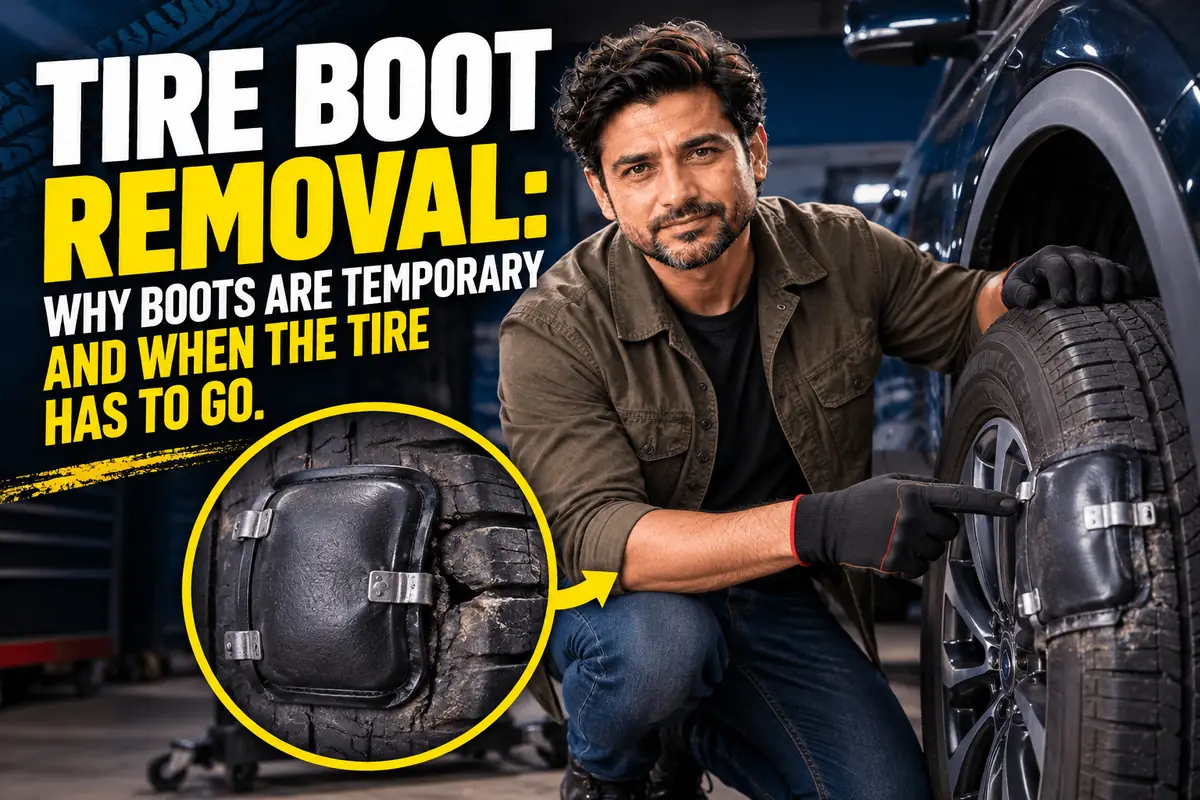
A tire boot usually enters your life on a bad day. A sharp piece of debris opens a cut too big for a plug, a roadside technician bonds a thick reinforcement patch inside the tire and you limp home with air in it. Weeks later the tire still looks fine, the car drives normally and it is tempting to forget the boot is there at all.
That is the trap. A boot is an emergency bridge, not a repair, and a booted tire can look perfectly healthy from the outside while the damage behind it keeps working loose. This guide explains what a tire boot is, how it compares with a plug or a patch, why it can only ever be temporary, what a shop does when it removes one and how to tell when the tire has to be replaced.
Table of Contents
What a Tire Boot Is
A tire boot is a thick, reinforced patch bonded to the inside of a tire to cover damage that is too large or in the wrong place for a normal repair. Where a standard patch seals a small puncture, a boot spans a cut, gash or structural injury and gives the casing enough support to hold air for a short time.
Boots show up in a few typical situations:
- Large tread cuts. A ragged tear wider than a nail hole cannot be sealed by a plug or a standard patch.
- Shoulder and sidewall damage. These areas flex constantly as the tire rolls, and normal repairs are not allowed there.
- Roadside emergencies. A boot can keep a damaged tire usable long enough to reach a shop.
- Waiting on a replacement. When the correct tire is not in stock, a boot sometimes buys a little time.
Every one of those situations has something in common. The damage is already beyond what the tire industry considers repairable, which is exactly why a boot was needed in the first place.
Boot vs. Patch vs. Plug
These three terms get used interchangeably, but they do very different jobs.
| Repair Type | Where It Goes | What It Handles | Permanent? |
|---|---|---|---|
| Plug alone | Pushed into the puncture from outside | Small tread punctures | No, a plug alone is not an acceptable repair |
| Patch alone | Bonded to the inner liner | Seals the liner but does not fill the puncture path | No, the injury must also be filled |
| Plug-patch combination | Fills the puncture and seals the liner | Tread-area punctures up to 1/4 inch | Yes, when done correctly by a trained technician |
| Tire boot | Bonded to the inside of the tire | Large cuts, shoulder and sidewall damage | No, it is a temporary measure only |
The US Tire Manufacturers Association sets the benchmark for passenger and light truck repairs. Its guidance limits repairs to the tread area, caps the puncture size at 1/4 inch (6 mm) and requires both a plug or rubber stem to fill the injury and a patch to seal the inner liner. A plug by itself is not acceptable, the tire must be removed from the wheel and inspected inside and repairs cannot overlap one another. Damage that reaches the shoulder or belt edge, or that enters the tread at an angle toward the shoulder, disqualifies the tire.
Measured against those rules, a boot fails on every count that matters. It covers damage larger than 1/4 inch or outside the tread area, and that damage cannot be made permanently safe.
Why a Boot Can Only Be Temporary
The problem is not the boot material. It is the damaged structure behind it.
A tire’s casing is made of cords and steel belts that carry the vehicle’s weight and hold the tire’s shape under pressure. When a cut slices through those cords, the tire loses strength at that spot. A boot covers the opening and helps hold air, but it cannot reconnect severed cords or restore the original strength of the casing.
Every revolution flexes the damaged area. Over time that flexing can loosen the boot at its edges, build heat around the injury and widen the cut. The sidewall is the worst place for this, because it flexes more than any other part of the tire and carries the load through every bump. A failure there can happen suddenly, with little warning.
Speed and heat make things worse. Highway driving, heavy loads and low inflation all increase flexing and heat buildup, which is the environment in which a weakened casing is most likely to give up.
Treat a booted tire as a way to get to a shop, not a way to keep driving. Keep speeds down, avoid the highway, check the pressure and replace the tire as soon as you can.
How to Tell If a Tire Has a Boot
Often you cannot tell from the outside. A boot sits inside the tire, and the tread and sidewall may show nothing unusual. A few clues can help:
- Service records. A roadside repair or “boot” entry on a receipt or vehicle history report is a red flag.
- The previous owner or shop. If you bought the car used, ask directly whether any tire has been repaired.
- A new vibration or thump. A boot and the damage around it can make a tire slightly uneven.
- A bulge near an old repair. Any bulge means the casing has been compromised and the tire needs replacing.
- A dismount and interior inspection. This is the only way to be certain.
If you are buying a used car and anything about the tires seems unclear, ask the seller or a shop to inspect the inside of any tire with a history of damage.
How a Shop Removes a Tire Boot
Boot removal is a shop job. It requires a tire changer and bead breaker, and a tire that has been booted almost always needs a professional judgment call on whether it can stay in service. Here is what the process typically looks like.
- The technician removes the valve core and lets all the air out of the tire.
- The bead, which is the edge of the tire that seals against the wheel, is broken loose on both sides.
- The tire is worked off the wheel on a tire changer without forcing it, so the bead is not damaged.
- The inside of the tire is examined before the boot is touched, looking for lifting edges, cracks, discoloration from heat, moisture or anything unusual around the repair.
- The boot is peeled or carefully worked free, using solvent and nonmetal tools so the inner liner is not torn.
- The original injury is inspected for size, location, exposed or broken cords and any separation in the casing.
- The inner liner is cleaned so the area can be judged clearly.
- The technician decides whether the tire can be repaired properly or must be replaced.
That inspection matters as much as the removal. Signs such as exposed cords, a rippled or creased inner liner, separation or rubber dust inside the tire suggest the tire was run low or flat, which can damage the casing well beyond the visible cut.
What the Inspection Usually Finds
In most cases, the damage behind a boot is too large or in the wrong place for a permanent repair. That is no surprise, because a damage small enough and central enough for a plug-patch combination would normally have received one in the first place.
| Damage Found | Location | Likely Outcome |
|---|---|---|
| Puncture 1/4 inch or smaller, no casing damage | Tread area | May qualify for a proper plug-patch repair |
| Cut or puncture larger than 1/4 inch | Tread area | Replace the tire |
| Any damage | Shoulder or belt edge | Replace the tire |
| Any damage | Sidewall | Replace the tire |
| Any damage | Bead area | Replace the tire |
| Exposed cords, separation or run-flat damage | Anywhere | Replace the tire |
Some tire makers set tighter limits or forbid repairs on certain tires, including some run-flat tires, so the manufacturer’s guidance can override the general rule.
When Replacement Is the Only Answer
Replace a booted tire if any of the following apply:
- The damage is in the sidewall, shoulder or bead area.
- The injury is larger than 1/4 inch.
- Cords or belts are exposed, cut or separated.
- The tire was driven underinflated or flat after the damage.
- There is a bulge, blister or new vibration near the repair.
- You do not know when or how the boot was installed.
- The tire is near the end of its tread life or is showing age-related cracking.
Replacing One Tire or Several
On a two-wheel-drive vehicle, a single new tire is often fine as long as it matches the size, type and construction of the others. Many shops will suggest replacing tires in pairs if the remaining tires are noticeably worn, and they typically put the newer pair on the rear axle for stability.
All-wheel-drive vehicles are pickier. A large difference in tread depth between tires can stress the drivetrain, so check your owner’s manual for the allowable difference before buying a single tire. Some shops can shave a new tire down to match the others.
Warranty and Cost Considerations
Manufacturer tire warranties generally cover defects in materials and workmanship, not road hazard damage such as cuts and impacts. If the tire was bought with a separate road hazard protection plan, check its terms, because it may cover part or all of a replacement.
A new tire costs more than another temporary fix, but the comparison is not close when you weigh it against the risk of a sudden failure at speed and the damage, towing and danger that can follow.
Boots and Run-Flat Tires Are Not the Same Thing
Run-flat tires have reinforced sidewalls built in at the factory, which let the vehicle keep moving for a limited distance after losing pressure, commonly up to about 50 miles at up to 50 mph depending on the tire. A boot is an aftermarket emergency patch inside an ordinary tire. Neither should be confused with a permanent fix, and many manufacturers restrict or forbid repairs on run-flat tires after they have been driven without air.
Frequently Asked Questions
No. A boot covers damage that is too large or in the wrong location for a proper repair. Industry repair guidance limits permanent repairs to tread-area punctures no larger than 1/4 inch, sealed with a plug-patch combination, so damage that needed a boot is beyond those limits.
Only as far as you need to reach a shop, at reduced speed and with the pressure checked. There is no reliable safe mileage, because the condition of the damage behind the boot is unknown and can change with every mile.
Occasionally. If the inspection shows the underlying injury is a tread-area puncture of 1/4 inch or less with no casing damage, a proper plug-patch repair may be possible. In most cases the damage is too big or in the shoulder or sidewall, and the tire must be replaced.
Not without a tire changer and bead breaker, and even then the hard part is judging whether the tire is safe. A tire shop can dismount the tire, remove the boot and inspect the casing in one visit.
Many will refuse. Reputable shops follow industry repair standards, and a technician who decides a tire is unsafe can decline to repair or reinstall it.
Manufacturer warranties typically exclude road hazard damage, which is what usually leads to a boot in the first place. A separate road hazard plan may cover replacement, so check its terms.
Only if you price in a new tire. Treat the tire as needing replacement and factor that into the price. Because you cannot know how long the boot has been there or how the tire was driven, it is not worth trusting.
Our Verdict on Booted Tires
A tire boot does one useful job: it gets a seriously damaged tire to a place where it can be dealt with properly. It does not restore the cords or belts that were cut, and the flexing, heat and load of everyday driving keep working on that weak spot whether the tire looks fine or not.
If you know or suspect a tire has a boot, have it dismounted and inspected. In the uncommon case where the hidden injury is a small tread puncture, a proper plug-patch repair may save the tire. In every other case, the safe answer is a new tire, and a sensibly priced replacement is a far better bet than a repair that was never meant to last.
 Summarize this article with:















Leave a comment