


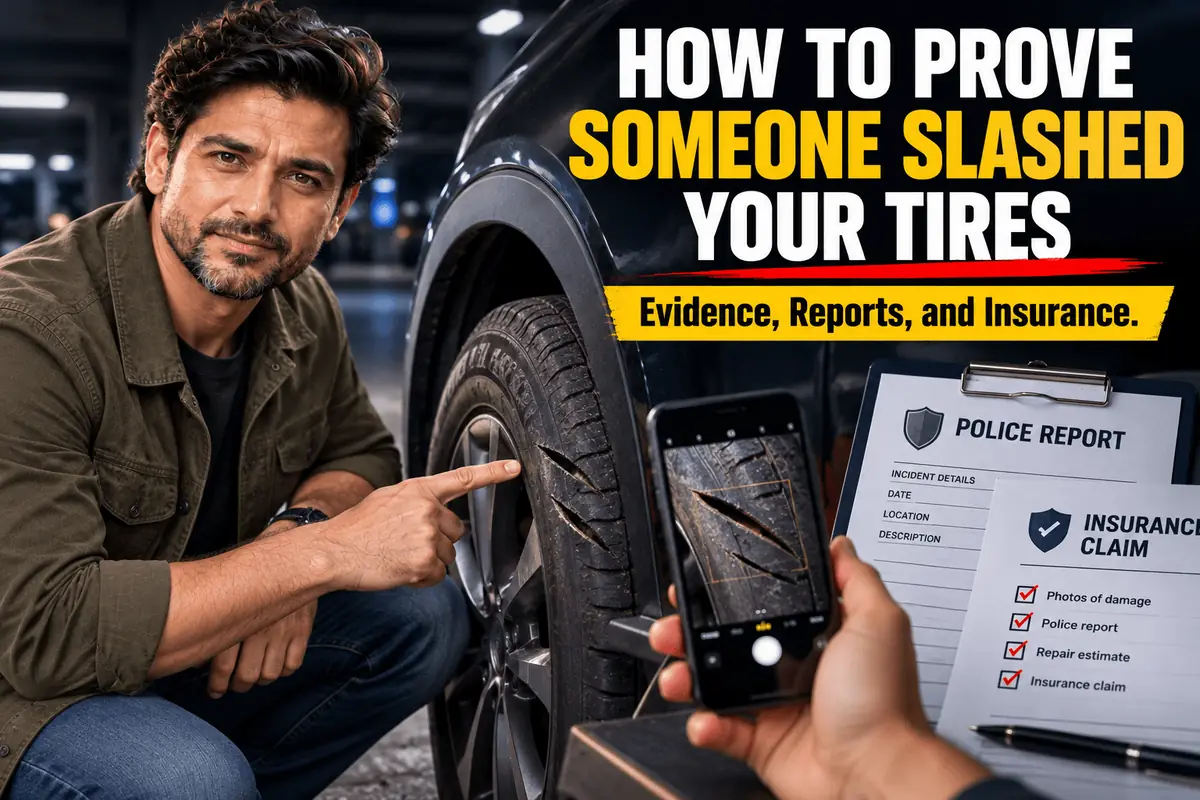
You walk out to your car and it sits low on one side, or on all four corners. A flat tire is annoying. A tire that someone cut on purpose raises harder questions: who did it, can you prove it, and who pays for the replacements? The answers depend less on who you suspect and more on what you do in the first few hours.
Proving vandalism is mostly about documentation. A clear record of the damage, an official police report, a professional opinion from a tire shop and any available video together make a far stronger case than a suspicion, however reasonable. This guide walks through how to tell slashing from ordinary tire damage, how to gather and preserve evidence, how to work with police and your insurer and what to avoid so that you do not weaken your own position.
Table of Contents
Is It Slashing or Ordinary Tire Damage?
Before you treat a flat as a crime, confirm that it looks like one. Plenty of tires go flat from nails, screws, curb strikes and pothole impacts, and those can look alarming at first glance. Intentional slashing tends to leave a distinct set of clues.
- Clean, straight cuts. A blade leaves a sharp-edged slit or stab mark. Road debris usually leaves a puncture with a foreign object still in it, while impacts leave ragged tears or bulges.
- Sidewall location. The sidewall is thinner and easier to cut than the tread, so vandals usually target it. Cuts often appear on the side of the tire facing the curb or sidewalk, where someone could crouch unseen.
- More than one tire. Several damaged tires at once, especially with similar cuts, points strongly toward deliberate action. Two unrelated punctures on the same night is unlikely.
- Damage while parked. If the tires were fine when you parked and flat when you returned, without the car moving, road damage is ruled out.
- Other signs of tampering. Scratched paint, a missing or loosened valve cap, a broken valve core or other damage to the vehicle can support the picture.
| Clue | Likely Intentional Slashing | Likely Puncture or Road Damage |
|---|---|---|
| Shape of damage | Clean, straight slit or stab with sharp edges | Round hole, often with a nail or screw still embedded, or a ragged tear |
| Location on the tire | Sidewall, often on the curb-facing side | Usually the tread for punctures, sidewall or shoulder for impact damage |
| Number of tires | Two or more at once | Usually one |
| When it happened | While the car was parked | While driving, often after a pothole, curb or debris strike |
| Air loss | Often fast and complete | Can be slow over days for a small puncture |
A tire with a nail in the tread and a slow leak is almost certainly road damage. Four tires with clean cuts in the sidewalls overnight in your driveway almost certainly are not. When the evidence is in between, a tire technician’s opinion carries a lot of weight, which we cover below.
First Steps at the Scene
Your priorities in the first minutes are safety and preservation.
- Do not drive on the tires. Driving on a cut tire can destroy it further and damage the wheel, and it can erase details that show how the tire was cut.
- Stay safe. If you think the person responsible may still be nearby, leave the area and call the police rather than investigating on your own.
- Leave everything as it is. If you see a knife, blade or other object near the car, do not touch it. Note where it is and tell the police.
- Start documenting before anything is moved. Photos taken before a tow truck or a spare tire changes the scene are the most valuable ones you will have.
How to Document the Damage
Good documentation turns an upsetting morning into usable evidence. Treat it as building a file that someone else, an officer, an adjuster or perhaps a judge, will review without having seen the scene.
Photos and Video
- Take wide shots showing the car, its location and the surroundings, including street signs, house numbers or parking space markers.
- Take medium shots of each damaged tire showing its position on the car.
- Take close-ups of every cut, with a coin, key or tape measure beside it for scale.
- Photograph any other damage, footprints, objects near the car and the condition of nearby vehicles.
- Record a short walk-around video that shows everything in sequence.
Make sure your phone’s date and time are correct and that location data is turned on for the camera if you are comfortable with that. The timestamp and location embedded in the file help establish when and where the photos were taken. Back the files up to cloud storage or email them to yourself the same day, and keep the originals unedited.
Write a Timeline
While details are fresh, write down when you last saw the car undamaged, when you found the damage, where the car was parked and anything unusual you noticed. Note recent conflicts, threats or messages if they are relevant, and save any texts, emails, voicemails or social media posts in their original form. Give this information to the police instead of acting on it yourself.
Look for Cameras
Video is often the strongest evidence available. Check for:
- Your own doorbell camera, home security cameras or dash cam, including any parking mode recording
- Neighbors’ doorbell and security cameras
- Cameras at nearby businesses, parking garages, apartment complexes or HOA entrances
- Traffic or municipal cameras, which usually require a police request
Act quickly. Many camera systems record over older footage after a set period, sometimes within days. Politely ask neighbors and businesses to save footage from the relevant time window. Some will share it with you directly, while others will only release it to police, so mention possible cameras in your report. Do not edit, trim or enhance footage yourself. Save the original file and note where and when it came from.
Find Witnesses
Ask neighbors, building staff, security guards or nearby workers whether they saw or heard anything. Write down their names, contact details and what they say they saw, and ask whether they would be willing to speak with police. Keep your questions open, such as “Did you notice anything around my car last night?”, rather than suggesting a particular person.
Filing a Police Report
A police report creates an official record that the damage was reported as vandalism, and most insurers expect one for a vandalism claim.
- Call your local police non-emergency number unless someone is in danger or the vandal is still present, in which case call 911. Many departments also accept online reports for property damage.
- Provide the date, time window and location, a description of the damage, the number of tires affected and any estimated cost.
- Mention any photos, video, witnesses and nearby cameras, and offer copies.
- If you have a reason to suspect a specific person, tell the officer the facts behind that suspicion and let police decide what to do with it.
- Get the report number before you hang up or leave. Your insurer, tire shop and any later legal process will refer to it.
- Ask how to obtain a copy of the report and how to add information if new evidence appears.
Police resources vary, and a property crime without video or witnesses may not lead to an arrest. The report still matters, because it documents the incident and supports your insurance claim and any later action.
Get a Tire Shop Statement
A written opinion from a tire professional is one of the most persuasive pieces of evidence you can add, especially to an insurance claim.
When the car reaches the shop, ask the technician to inspect each tire and put the findings in writing on shop letterhead or the repair order. A useful statement notes:
- Which tires are damaged and where the damage is
- The type of damage, such as a clean cut in the sidewall consistent with a sharp blade
- Whether the damage could plausibly have come from road debris or an impact
- Whether the tires can be repaired or must be replaced
- The technician’s name, the shop’s contact details and the date
Ask the shop to keep the damaged tires, or keep them yourself, until the police and insurance matters are settled. An adjuster may want to see them. A cut in the sidewall cannot be safely repaired under industry practice, so slashed tires generally have to be replaced. Our guide to fixing a slashed tire explains what can and cannot be repaired and what to expect when replacing a cut tire.
Insurance: What Comprehensive Coverage Pays
Vandalism to your vehicle, including slashed tires, is typically covered under the comprehensive portion of an auto policy. Liability-only coverage does not pay for damage to your own car. Check your policy and talk to your insurer, because terms differ.
| Factor | What to Know |
|---|---|
| Coverage type | Comprehensive coverage typically includes vandalism. Liability-only policies do not cover your own vehicle. |
| Deductible | You pay your comprehensive deductible first. If replacement costs less than or close to the deductible, a claim may not be worth filing. |
| Documentation | Insurers usually ask for the police report number, photos and a repair estimate or invoice. |
| Payout | Some policies pay the depreciated value of worn tires rather than the full price of new ones. |
| Your rates | Ask your insurer how a comprehensive claim may affect your premium before deciding. |
Get a written estimate for replacing the tires, plus any towing or wheel damage, and compare it with your deductible. If you have roadside assistance or towing coverage, that may cover getting the car to a shop. Keep receipts for every related expense.
What Not to Do
How you behave after finding the damage affects both your safety and the strength of your case.
- Do not confront anyone. Even if you are sure who did it, a confrontation can escalate into violence and can create legal problems for you. Give your information to the police.
- Do not retaliate. Damaging someone else’s property in return exposes you to criminal charges and civil liability of your own.
- Do not accuse people publicly. Naming a suspect on social media or to neighbors without proof can backfire, and in some situations could expose you to a defamation claim.
- Do not tamper with evidence. Do not move or handle objects found at the scene, dust for fingerprints yourself, edit photos or alter video. Changed evidence loses credibility.
- Do not throw the tires away. Keep them until police and your insurer no longer need them.
Legal Options and Their Limits
Tire slashing is generally treated as a crime, often under vandalism, criminal mischief or malicious mischief laws, but the specific charges, penalties and thresholds vary by state and by the value of the damage. If someone is identified and charged, a court may order restitution in some cases. You may also have the option of seeking compensation in civil court, such as small claims court, for replacement costs and related expenses.
We cannot tell you how the law applies to your situation, because it depends on where you live and the facts of your case. Ask the investigating officer about the criminal process, and consult an attorney licensed in your state before pursuing a civil claim or if you are dealing with a person who has threatened you.
Your job is to document and report. Identifying, charging and prosecuting a suspect is the job of the police and the courts.
How to Prevent Tire Slashing
No single step guarantees your tires are safe, but making your car a less convenient target helps.
- Park in a garage when you can, or in well-lit areas with foot traffic and visible cameras.
- Install a doorbell or security camera that covers your parking spot, and keep it recording at night.
- Use a dash cam with a parking mode that records when it detects motion or impact.
- Add motion-activated lighting near the driveway or parking space.
- Get to know your neighbors so that people notice and report unusual activity, or join a neighborhood watch.
- If an ongoing dispute or threats are involved, document them and report them to police before anything else happens.
Frequently Asked Questions
Slashing usually leaves a clean, straight cut or stab mark, often in the sidewall, and frequently affects more than one tire while the car is parked. A puncture is usually a round hole in the tread, often with a nail or screw in it. A tire technician can give a professional opinion.
Usually, yes. Most insurers expect a police report for a vandalism claim, and it makes the claim much easier. Get the report number and give it to your insurer along with photos and an estimate.
Comprehensive coverage typically covers vandalism, including slashed tires, after you pay your deductible. Liability-only policies do not cover damage to your own car. Some policies pay the depreciated value of worn tires rather than full replacement cost.
Usually not. Cuts in the sidewall cannot be safely repaired under standard industry practice, and slashed tires generally need to be replaced. A shop can confirm after inspection.
No. A confrontation can turn dangerous and can create legal trouble for you. Give your evidence and your reasons for suspicion to the police and let them handle it.
Possibly. You may be able to seek compensation in civil court, including small claims court, if the person is identified. Laws and procedures vary by state, so consult an attorney before taking that step.
Yes, generally. Tire slashing is usually treated as vandalism, criminal mischief or malicious mischief, though the charges and penalties vary by state and by the value of the damage.
Photograph the damage, file a police report and get repair estimates, since most insurers expect a police report for a vandalism claim. Do not retaliate, which exposes you to charges of your own.
Building a Case That Holds Up
Proving someone slashed your tires rarely comes down to one dramatic piece of evidence. It comes from a careful record: timestamped photos, preserved video, witness details, a police report number and a written statement from a tire shop describing the cuts. Each piece supports the others.
Stay calm, keep everything, and route your suspicions through the police rather than acting on them. That approach gives you the best chance at an insurance payout and, if a suspect is identified, the strongest footing for whatever comes next.
 Summarize this article with:
















Leave a comment