


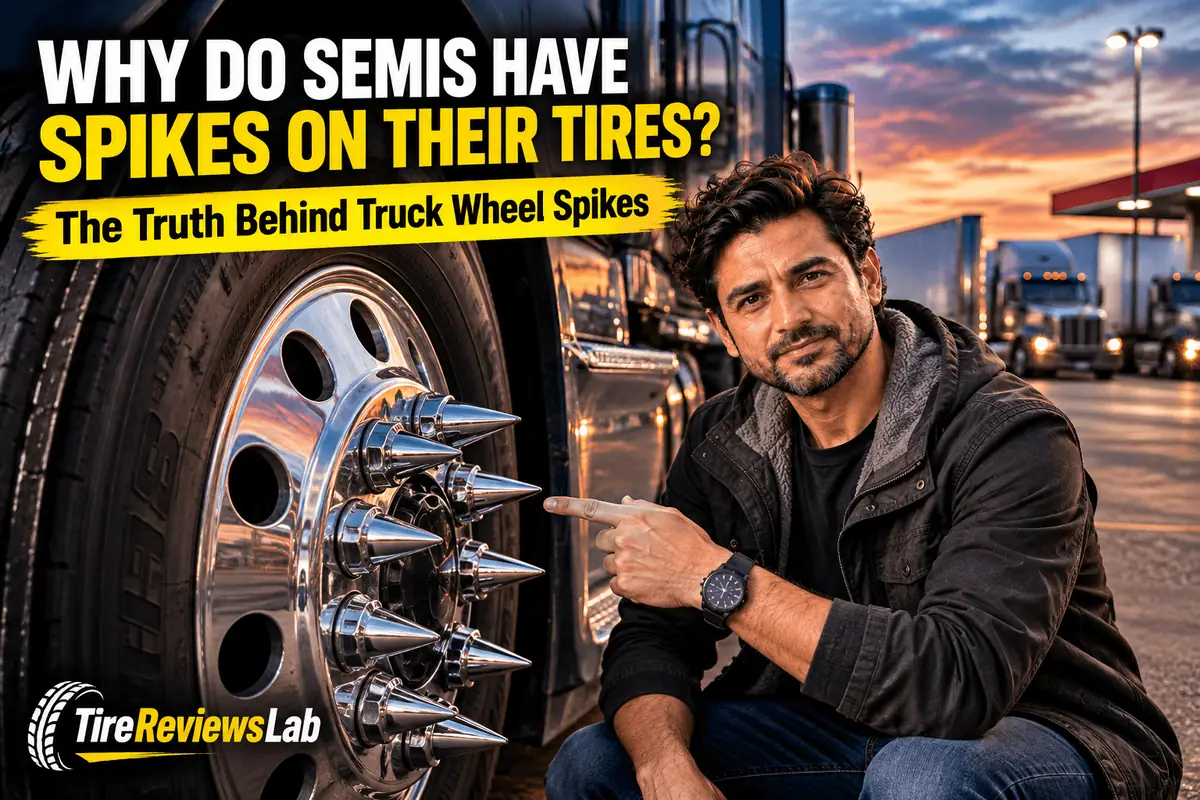
You are cruising in the right lane when a tractor-trailer pulls alongside, and suddenly there is a ring of gleaming chrome points spinning a few feet from your door. It is hard not to edge toward the shoulder. Are those spikes there to keep cars away? Do they help the truck grip in snow? Could they really shred your fender if the trucker drifted over?
The answer is far less dramatic than the look suggests. Those “spikes” are not on the tires at all, and they are not traction studs. They are extended lug nut covers, mostly decorative caps that fit over the nuts holding the wheel in place. This guide explains what they are made of, why truckers fit them, what the “Ben-Hur” myth gets wrong, how they differ from studded tires and chains, and where the real safety and legal questions lie.
Table of Contents
What Those Spikes Really Are
Every truck wheel is held on by a circle of lug nuts threaded onto studs that protrude from the hub. On a typical semi, each wheel position carries ten of them. Spiked lug nut covers are caps that slip or thread over those nuts and extend outward into a cone or point. They sit on the wheel, not the tire, and they have no structural job. Remove every one of them and the wheel stays exactly as secure as before.
Drivers and parts catalogs call them many things: spike lug nut covers, wheel spikes, semi spikes, bullet covers or pointed lug nuts. Shapes run from short, rounded domes and bullet tips to long, sharp cones several inches in length. Some feature a hexagonal base that mimics the nut beneath, and many are sold alongside matching hub covers that dress up the center of the wheel.
What They Are Made Of
Most spikes are chrome-plated plastic. It is light, inexpensive and delivers the mirror shine truckers want, though it cracks more easily and the plating can wear over time. Stainless steel and chrome-plated metal versions cost more and last longer, holding their finish better against road salt. Aluminum covers, including anodized versions in colors chrome cannot match, sit in between.
That material detail matters for the safety discussion later. A large share of the spikes on the road are hollow plastic shells, not solid steel.
How They Attach
Covers either thread onto the lug nut or press on with a friction fit or internal clip, and some use small set screws to lock them in place. They must match the nut size exactly. Many heavy trucks with hub-piloted wheels use 33 mm nuts, but sizes vary, so fit should always be confirmed before buying. A cover that does not match can rattle loose and fly off on the highway.
Why Truckers Put Spikes on Their Wheels
Style and Personal Expression
The biggest reason is appearance. For many long-haul drivers, the truck is both workplace and home for days or weeks at a stretch, and customizing it is part of trucking culture. Chrome trim, custom paint, LED lighting packages, polished wheels and personalized interiors all belong to the same tradition, and truck shows across the country celebrate it. Spikes are one of the quickest and most visible ways to give a rig a distinctive look, and for owner-operators in particular they are a statement of pride in the equipment.
Tastes vary. Some drivers love long, aggressive spikes, while others prefer short domes or bullet tips that look clean and modern. Plenty of fleets skip decorative covers entirely or set limits on what drivers can fit.
Protecting Lug Nuts and Studs
Covers do serve a practical purpose. A semi spends its life exposed to rain, road salt, slush and grime, and bare lug nuts and the exposed ends of wheel studs corrode. Rusted threads make wheel removal harder and can complicate proper torquing during service. A cover keeps much of that moisture and dirt off the nut and the stud tip, so the hardware underneath stays cleaner.
That protection works only if the covers come off occasionally. Pulling them during routine maintenance lets a technician clean the area, check the nuts and catch problems that a cover can hide.
A Visual Cue
Some drivers believe spikes make other motorists more aware of the truck’s wheels and encourage them to keep a little more distance. Whether they actually change how people drive is hard to say, and nobody should count on a wheel accessory as a safety device. Their visual effect is real, though. A ring of chrome points draws the eye to exactly where the truck’s wheels are.
The “Ben-Hur” Myth
The spikes owe much of their reputation to movies. The famous chariot race in Ben-Hur features wheels fitted with cutting blades used to wreck rival chariots, and action films have kept the image of the weaponized wheel alive ever since. So when people see a truck with long chrome points, they assume the purpose is to slash tires or tear into bodywork.
That is not what they are for. Truck lug nut covers are cosmetic accessories, not weapons, and the trucking industry does not install them to intimidate or damage other vehicles. Because so many are hollow chrome-plated plastic, they tend to crack, bend or snap off on hard contact rather than cutting through anything. Some drivers even field questions about whether the spikes deploy in an emergency, which is pure fiction.
That does not mean spikes are harmless in every case. A long, rigid metal spike that contacts another car in a sideswipe can scratch paint or add damage, and a sharp point is a poor thing to have near a person. The myth is the idea that they are built and fitted as weapons. Nor does a set of spikes say anything about how the trucker drives.
Spikes vs. Studded Tires and Tire Chains
Part of the confusion comes from the word “spikes” itself, which drivers in snowy states also use for traction devices. Lug nut covers have nothing to do with grip. They never touch the road and provide zero traction on ice or snow.
| Item | Where it sits | What it does | Affects traction? |
|---|---|---|---|
| Spiked lug nut covers | Over the lug nuts on the wheel | Decoration and nut protection | No |
| Studded tires | Small metal studs embedded in the tread | Bite into ice for grip | Yes, on ice |
| Tire chains | Wrapped around the tread | Grip on snow and ice, usually on mountain roads | Yes, in snow and ice |
| Loose lug nut indicators | Fitted over the lug nuts | Show if a nut has turned | No |
Studded tires carry small metal studs in the tread blocks that dig into ice. Their use is regulated by state, commonly limited to winter months and banned outright in some places, because they wear pavement on dry roads. Tire chains are the traction tool most closely associated with big trucks. Several mountain states have chain laws that require commercial vehicles to carry or install chains on designated routes during winter conditions. Neither one has anything in common with a chrome cone on the hub.
Loose Lug Nut Indicators: The Pointers With a Real Job
If you look closely at many commercial trucks, buses and trailers, you will see something else on the lug nuts: small, brightly colored plastic tags, usually orange or yellow, each with a pointed tip. These are loose lug nut indicators, and unlike spikes they have a clear safety function.
Each indicator fits snugly over a nut and turns with it. When installed, the tips are aligned in a consistent pattern, often pointing toward each other in pairs or all in the same direction. If a nut starts to back off, its pointer rotates out of line, and a driver doing a pre-trip walk-around or an inspector can spot it at a glance without putting a wrench on every nut. Some versions are made from plastics that deform or melt at elevated temperatures, which can also flag an overheating hub or brake. Road safety organizations encourage their use on heavy vehicles, though they are not universally required.
Here the contrast with decorative spikes is clear. Indicators make lug nut problems easier to see, while full covers can hide them. That is one reason drivers who run covers should pull them periodically and check the nuts underneath, and why some fleets favor indicators over decorative caps.
Are Truck Wheel Spikes Legal?
In most of the country, decorative lug nut covers are legal to run, but the rules are a patchwork, and long spikes can attract attention.
At the federal level, there is currently no specific standard governing hub caps or wheel ornaments. A federal safety standard once prohibited winged projections on wheel nuts, wheel discs and hub caps for passenger cars and multipurpose vehicles, out of concern that they could catch clothing or strike pedestrians, but it was rescinded in 1996. Hub caps and wheel covers can still be subject to safety recalls if a defect turns up.
A few states address the issue directly. Hawaii prohibits operating a vehicle, trailer or semitrailer on a highway with “dangerous wheels,” which its traffic code defines as any wheel, hubcap, lug nut cover or ornament that extends at least four inches beyond the outermost part of the wheel rim and could cause injury or damage with minimal contact. Washington bars hub caps, wheel discs and certain exposed wheel nuts that extend outside the vehicle’s body, as seen from above, if they have winged projections or pose a hazard to pedestrians and cyclists.
Beyond those, rules vary. Some states rely on general equipment or vehicle-width provisions, and enforcement can differ from one inspection station to the next. A trucker who runs interstate routes has to satisfy every state on the route, which is a big reason many choose shorter, rounded covers. Drivers considering long spikes should check the rules in the states where they operate, and fleets often set their own policies on top of that.
Short, rounded covers deliver most of the look with far fewer legal and safety questions than long, pointed spikes.
The Real Safety Questions
Most concern about spikes centers on people outside a vehicle. Cyclists, pedestrians and motorcyclists can end up very close to a truck’s wheels, at a crosswalk, in a narrow urban lane or, in states that allow it, while splitting lanes between slow-moving vehicles. A long, sharp spike adds a hard point exactly where someone might brush past, and riders have raised that worry in lane-splitting debates. The same concern drove the old federal rule on winged projections and the state laws above.
Detachment is another issue. A cover that is the wrong size, poorly fitted, cracked or corroded can work loose and become road debris. Lug nut covers are also a theft target at truck stops.
Responsible use comes down to a few habits:
- Choose covers that match the nut size exactly and install them by hand until snug, without overtightening.
- Inspect covers during pre-trip checks for cracks, looseness or missing pieces.
- Remove them periodically to clean the area and check the lug nuts underneath.
- Replace damaged covers promptly, and keep spares in the truck.
- Favor shorter or rounded designs, especially for city and interstate work.
- Check the rules in every state on your routes before fitting long spikes.
Frequently Asked Questions
No. They sit on the wheel, not the tire. They are covers that fit over the lug nuts holding the wheel to the hub, and they never touch the road or affect traction.
No. Lug nut covers provide no grip at all. Traction on ice and snow comes from the tires themselves, studded tires where permitted, or tire chains, which many mountain states require commercial trucks to carry or use in winter conditions.
They are not made as weapons, and most are chrome-plated plastic that cracks or breaks on contact. A long, rigid metal spike could scratch paint or add to damage in a sideswipe, but the idea that truckers fit them to shred other vehicles is a myth rooted in movies like Ben-Hur.
In most states they are, but rules vary. Hawaii prohibits wheel ornaments, including lug nut covers, that extend four inches or more beyond the rim and could cause injury with minimal contact, and Washington restricts wheel nuts and hub caps that protrude beyond the body and pose a hazard to pedestrians or cyclists. There is no current federal standard specifically covering hub caps or wheel ornaments, so drivers should check local rules.
Those are loose lug nut indicators. Each one fits over a nut, and all of the tips are lined up in a set pattern when installed. If a nut loosens and turns, its pointer moves out of alignment, making the problem easy to spot during an inspection.
Partly. They protect the lug nuts and the ends of the wheel studs from moisture, road salt and dirt, which helps prevent rust. They should still be removed now and then so the nuts underneath can be inspected and checked for tightness.
The Final Word on Semi Truck Spikes
The menacing chrome points on a semi are lug nut covers, and their main job is to look good. They give drivers a way to personalize a truck that often doubles as a home, and they keep salt and grime off the nuts and studs beneath. They do nothing for traction, they are not studded tires or chains, and they are not weapons, whatever Ben-Hur taught us.
The legitimate questions concern length and fit. Very long, sharp spikes can be a hazard to people close to the truck and can run afoul of rules in some states, while poorly fitted covers can come loose or hide a lug nut problem. Short, secure covers checked regularly, ideally alongside loose lug nut indicators, give truckers the look they want without the drawbacks. Next time a spiked rig rolls past, you can relax. Those spikes are mostly there for show.
 Summarize this article with:
















Leave a comment