


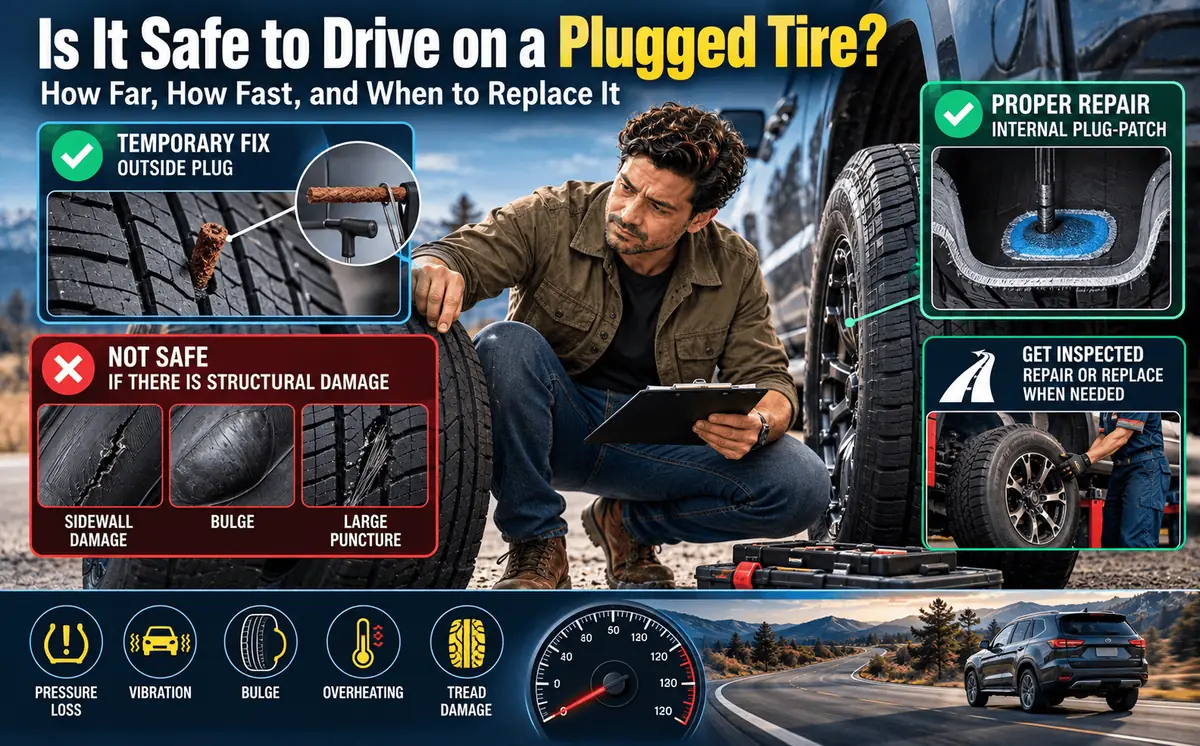
A nail in the tread, a slow leak, and a quick fix from a plug kit: that is how many drivers end up rolling around on a plugged tire. The car seems fine, the pressure holds, and the question becomes whether the plug can stay there for weeks or months. That is where trouble starts, because a plug inserted from the outside seals the hole but does nothing to repair the damage the nail caused inside the tire.
A plug is a perfectly reasonable way to get home or to a tire shop. It is not a permanent repair, and treating it like one raises the odds of a slow leak turning into a sudden failure. This guide explains what a plug does and does not do, how far and how fast you can reasonably drive on one, the warning signs that mean you should stop, and when a tire can be properly repaired rather than replaced.
Table of Contents
What a Tire Plug Does (and What It Doesn’t)
A puncture from a nail, screw, or sharp piece of debris opens a path for air through the tread and into the tire’s inner liner. A standard tire plug is a sticky, rubberized cord pushed into that hole from the outside with an insertion tool. Once trimmed, it fills the channel and stops the leak, often well enough that the tire holds pressure for days.
The limitation is what the plug cannot reach. The object that punctured the tire also damaged the steel belts and body plies underneath, and it may have been driven on while underinflated, which can damage the inner sidewall. A plug inserted from outside leaves all of that uninspected. Nobody looks inside the tire, nothing seals the inner liner, and moisture can still work its way into the belt package over time.
That is why tire industry repair guidance treats a plug by itself as a temporary fix. A proper repair is done from the inside, and it looks quite different.
Plug vs. Patch vs. Plug-Patch Combination
| Repair Type | How It’s Done | Permanent? | Best Use |
|---|---|---|---|
| Plug only (outside) | Rubberized cord pushed into the hole from outside the tire, tire stays on the wheel | No | Emergency fix to reach a shop or home |
| Patch only (inside) | Inner liner buffed, cement applied, patch bonded over the hole | No | Seals the liner but leaves the puncture channel open to moisture |
| Plug-patch combination (inside) | Tire dismounted and inspected, channel filled with a rubber stem and liner sealed with an attached patch | Yes, within repair limits | The proper permanent repair for an eligible tread puncture |
The plug-patch combination does two jobs at once. The stem fills the puncture channel so water cannot reach the belts, and the patch seals the inner liner so air cannot escape. Because the tire has to come off the wheel to install it, the technician also gets to inspect the inside for hidden damage, which is often the most valuable part of the process.
The Real Risks of Leaving a Plug in Long Term
Hidden Structural Damage
The biggest danger is not the plug itself but what it may be hiding. If the tire ran low on air before you noticed the leak, the sidewalls may have flexed far more than normal, breaking down the rubber and cords inside. That kind of damage is often invisible from the outside, and a tire weakened this way can fail without much warning, especially when hot and under load at highway speed.
Plug Failure
An outside plug sits in a tire that flexes thousands of times every mile. Heat, flexing, and road impacts can work a plug loose or cause it to start leaking again. A plug that pops out suddenly can turn a slow leak into rapid air loss, which is far more dangerous at speed than in a parking lot.
Low Pressure and Its Side Effects
A plug that seeps slowly causes a creeping pressure loss that many drivers miss. An underinflated tire runs hotter, wears its shoulders faster, responds more sluggishly to steering, and needs more distance to stop. If pressure falls far enough, the sidewall can fold and pinch against the wheel rim, damaging both the tire and the wheel. Your tire pressure monitoring system will usually warn you eventually, but it typically triggers only once pressure has dropped well below the recommended level.
How Far and How Fast Can You Drive on a Plugged Tire?
There is no official mileage limit for a temporary plug, because the outcome depends on the size and location of the puncture, the quality of the plug job, and the condition of the tire. A widely used, conservative rule of thumb is to treat a plugged tire as good for no more than about 100 miles, over a few days at most, while you arrange a proper repair.
Speed matters as much as distance. Heat buildup rises sharply with speed, and a plug or a damaged tire is more likely to fail when it runs hot. Until the tire has been inspected and repaired from the inside, keep speeds moderate, avoid long stretches of interstate driving where you can, and do not take a plugged tire on a road trip.
| Situation | Reasonable on a Fresh Outside Plug? | Why |
|---|---|---|
| Driving across town to a tire shop | Yes | Short distance, low speeds, quick path to a proper repair |
| A few days of local errands | Use caution | Acceptable if pressure holds; check it daily |
| Highway commute at 65+ mph | Avoid | Heat and stress raise the risk of plug or tire failure |
| Long road trip | No | Hundreds of miles of flexing and heat; get a proper repair first |
| Towing or carrying a heavy load | No | Extra load adds heat and strain on a compromised tire |
| Heavy rain, snow, or ice | Avoid | A sudden pressure loss is harder to manage with reduced grip |
Driving Habits That Help a Plug Survive
- Check pressure before every drive with a gauge, with the tire cold, and inflate to the pressure on your door-jamb placard rather than the maximum on the sidewall.
- Keep trips short and speeds moderate until the tire has been properly repaired.
- Go easy on the tire. Avoid potholes, curbs, hard cornering, and sudden braking, all of which load the tread and sidewall.
- Travel light. Extra passengers and cargo increase the load and heat in the tire.
- Look at the plug and tire each time you stop, checking for bulges, cracks, or a plug that has moved.
Warning Signs You Should Stop Driving Now
If any of these appear, pull over as soon as you can do so safely and do not continue on the tire:
- New vibration or shaking, which can signal tread separation, internal damage, or a tire losing pressure quickly
- A bulge, blister, or distortion on the tread or sidewall, a sign the internal structure is damaged
- Hissing or bubbling around the plug, which means air is escaping
- Pressure dropping between checks, or a tire pressure warning light coming on
- Steering that pulls or feels heavy toward the side of the plugged tire
A bulge on any tire is reason to stop using it entirely. It means cords inside have broken, and that tire cannot be repaired.
What to Do if the Plug Fails While You’re Driving
Air loss from a failed plug can range from a gradual sag to a fast deflation. In either case:
- Stay calm and hold the wheel firmly. Do not slam on the brakes. Ease off the accelerator and let the car slow down gradually while keeping it straight.
- Signal and move off the road to a safe spot well away from traffic, such as a wide shoulder, exit, or parking lot. Turn on your hazard lights.
- Stop, set the parking brake, and turn off the engine before getting out to look.
- Assess the tire. If it is flat, shredded, bulging, or the sidewall is damaged, do not reinflate it or drive on it.
- Install the spare if you have one and can do it safely, or call roadside assistance.
- Reinflate only a tire that is intact. If the tire has some air left and looks undamaged, a portable compressor can bring it back up so you can drive slowly to a nearby shop. A plug kit seals holes but does not add air on its own.
Never drive any distance on a tire that has gone flat. Running even briefly at very low pressure can wreck the sidewall and the wheel, and it turns a tire that might have been repairable into one that must be replaced. If you feel unsafe at any point, stay in your vehicle with your seat belt on if you are near traffic, and call for help.
Can a Plugged Tire Be Properly Repaired?
Often, yes. The fix is to have a tire shop dismount the tire, remove the outside plug, inspect the inside, and install a plug-patch combination. Industry repair guidance, including the procedures promoted by the Tire Industry Association and major tire makers, sets clear limits on which punctures qualify.
A Puncture Can Usually Be Repaired When
- It is in the tread area, the central part of the tire that contacts the road
- It is no larger than 1/4 inch in diameter
- The tire was not driven while seriously underinflated or flat, and shows no internal damage
- It does not overlap an earlier repair
- The tire has adequate tread depth remaining and no other damage such as bulges, separations, or cracking
The Tire Should Be Replaced When
- The puncture is in the shoulder or sidewall, where flexing is too severe for a reliable repair
- The hole is larger than 1/4 inch, or it is a cut, gash, or tear rather than a round puncture
- The inner liner shows damage from running flat, such as wrinkling, rubber dust, or marks
- Repairs would overlap, or the tire already has multiple repairs close together
- The tread is worn to or near 2/32 inch, the legal minimum in most states
- The tire is old, cracked, or weathered, even if the puncture itself qualifies
Some manufacturers restrict or prohibit repairs on certain tires, including some run-flat models, and some limit the speed rating of a repaired tire. Check your tire maker’s policy, especially on performance and run-flat tires.
Repair or Replace? Weighing the Decision
When a puncture qualifies, a proper plug-patch repair is far cheaper than a new tire and, done correctly, lets the tire serve out its remaining life. That makes it the obvious choice for a tire with plenty of tread left.
The decision gets more nuanced with a worn tire. If the tire is already close to replacement, paying to repair it may only buy a few thousand miles, and a new tire might be better value. Keep in mind that replacing a single tire on an all-wheel-drive vehicle can create a large difference in tread depth between tires, which some automakers warn can strain the drivetrain. In that case, the shop may recommend replacing more than one tire, or shaving the new tire to match. Our guide on whether you need to replace all four tires at once covers this in more detail.
A spare buys you time. With a full-size spare mounted, there is no reason to keep driving on an outside plug while you wait for a repair appointment. Without one, a temporary plug can be the difference between getting to a shop and waiting for a tow, which is exactly the job it does well.
Reducing Your Odds of a Puncture
You cannot avoid every nail, but a few habits help:
- Keep tires at the right pressure. Check monthly with the tires cold. Underinflated tires flex more and are more vulnerable to damage from road hazards.
- Rotate and inspect regularly. Rotating every 5,000 to 8,000 miles, or as your owner’s manual specifies, is a good time to look over each tire for embedded objects, cuts, and slow leaks before they leave you stranded. Our guide to tire rotation and alignment explains the patterns.
- Slow down around debris. Construction zones, gravel roads, and the edges of highways collect nails, screws, and sharp metal. Lower speed gives you more time to steer around hazards.
- Replace worn tires on time. Thin tread is easier to penetrate. Our guide to checking tire tread depth explains when to replace.
- Consider puncture-resistant options. Self-sealing tires, such as models built with Michelin’s Selfseal technology, contain a sealant layer that can close many small tread punctures. Run-flat tires, such as Bridgestone’s DriveGuard line, will not stop a puncture but let you keep driving a limited distance at reduced speed after one.
Related Reading
Frequently Asked Questions
For a short distance at moderate speed, usually yes, provided the puncture is a small one in the tread and the tire holds pressure. An outside plug is a temporary fix, though, and the tire should be dismounted, inspected, and repaired with a plug-patch combination as soon as you can arrange it.
Treat an outside plug as a fix measured in days and miles, not months. A conservative guideline is no more than about 100 miles over a few days. Some plugs hold far longer, but because nobody has inspected the inside of the tire, you cannot know what damage may be hiding.
It is best avoided. Higher speeds generate more heat and stress, which increases the chance of the plug working loose or a damaged tire failing. If a highway stretch is unavoidable, keep your speed moderate, check pressure beforehand, and get the tire repaired properly right away.
Yes, when it is installed from inside the tire on a puncture of 1/4 inch or less in the tread area, and the tire passes an internal inspection. A correctly repaired tire can be used for the rest of its tread life, subject to the tire maker’s policy on repaired tires.
No. Sidewall and shoulder punctures should not be repaired with a plug or any other method, because those areas flex too much for a repair to hold reliably. A tire with sidewall damage needs to be replaced.
Usually because the damage falls outside repair limits: the hole is too large, it is too close to the shoulder or sidewall, it overlaps a previous repair, the tread is too worn, or the inside shows damage from being driven while low or flat. Those limits exist because a repair in those conditions is not reliable.
Yes. A proper repair requires removing the tire from the wheel, so the assembly should be balanced again when it is remounted. Most shops include balancing in the price of the repair.
The Verdict on Plugged Tires
A plug is a good emergency tool and a poor permanent solution. Use it to get home or to a tire shop, keep the distance short and the speed moderate, and watch the pressure closely in the meantime. Then have the tire dismounted, inspected, and repaired from the inside with a plug-patch combination, or replaced if the damage falls outside repair limits. That small extra step costs little, and it is what separates a safe repaired tire from one that might fail when you least expect it.
 Summarize this article with:















Leave a comment