


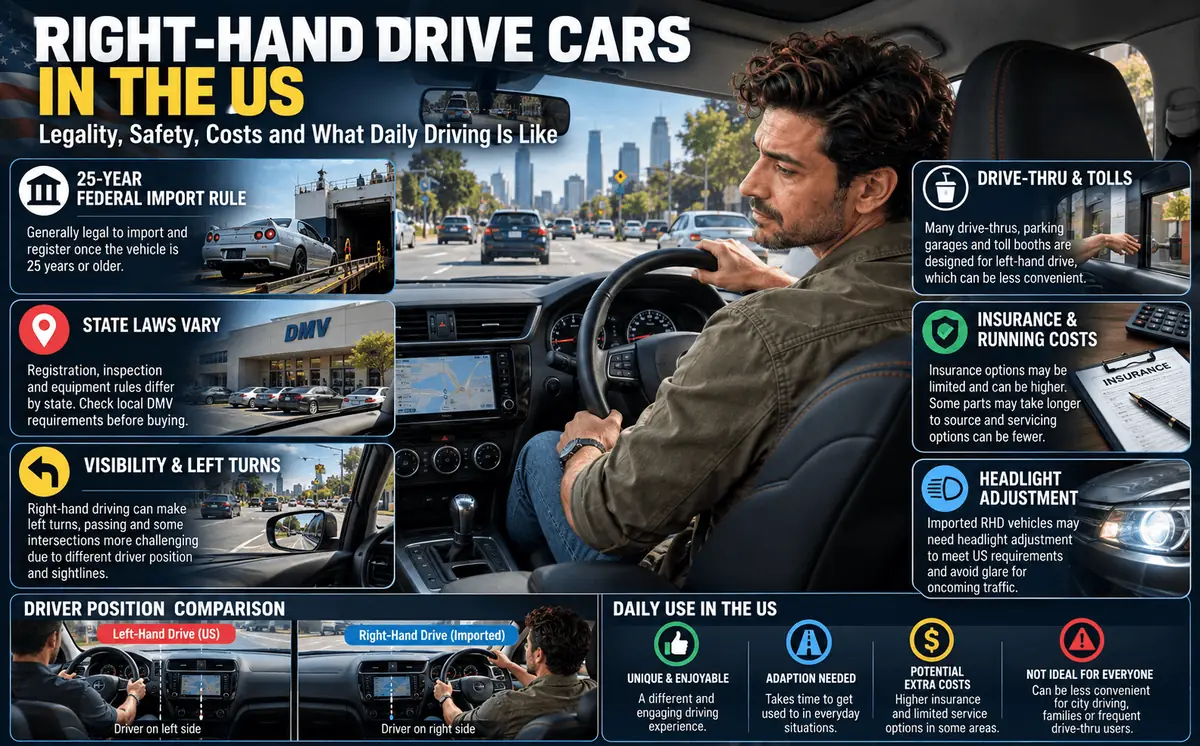
A right-hand drive (RHD) car puts the steering wheel on the right side of the cabin. That layout is standard in countries that drive on the left, including the UK, Japan, Australia, India, and South Africa. In the United States, where traffic keeps to the right and almost every car is left-hand drive (LHD), an RHD car is a rare sight. It is also an increasingly common purchase, thanks to a steady flow of Japanese and British imports that have aged into legal eligibility.
If you are thinking about buying one, the questions pile up quickly. Can you register it? Is it safe to drive on American roads? Will an insurer cover it, and can a local shop fix it? This guide works through the legal rules, the real safety trade-offs, the ownership costs, and the practical adjustments, so you can decide whether an RHD car fits your life or belongs in the “fun to look at” category.
Table of Contents
The Quick Answer
- Yes, RHD cars are legal to own and drive in the US. No federal rule bans the steering wheel’s position, and RHD vehicles can be titled and registered in every state.
- Importing is the hard part. A foreign-market car generally has to be at least 25 years old to enter the country without meeting current US safety standards.
- Daily life has friction. Left turns, passing on two-lane roads, drive-thrus, toll booths, and parking-garage ticket machines all become more awkward.
- Ownership costs can run higher. Parts sourcing, specialist labor, and insurance placement take more effort than they would for a common US-market car.
How the Law Works
Federal Import Rules: The 25-Year Rule
The steering wheel position is not what keeps most RHD cars out of the US. The obstacle is certification. Every vehicle imported for road use must comply with the Federal Motor Vehicle Safety Standards (FMVSS), which the National Highway Traffic Safety Administration (NHTSA) enforces, and with Environmental Protection Agency (EPA) emissions rules. Cars built for other markets almost never meet those standards as delivered.
The exemption that matters is age. NHTSA allows a vehicle that is at least 25 years old, counted from its month of manufacture, to be imported without FMVSS compliance. The EPA has its own, slightly shorter exemption: vehicles at least 21 years old in their original configuration are excused from US emissions requirements. In practice, the 25-year safety rule is the one that sets the clock, which is why enthusiasts track the calendar for cars like the Nissan Skyline GT-R and the Toyota Supra.
Newer foreign-market cars can only come in through narrow paths, such as modification by a NHTSA Registered Importer (expensive and limited to vehicles substantially similar to a US model) or the restrictive Show or Display exemption. For most buyers, if a foreign-market RHD car is younger than 25 years, it is not a realistic option.
RHD Cars Built for the US Market
Not every RHD vehicle on US roads is an import. Manufacturers have built RHD versions for American buyers, mostly for rural mail carriers who deliver to curbside mailboxes. Jeep has offered right-hand-drive Wranglers, and Subaru has sold RHD versions of models such as the Legacy and Outback. Because these were certified for the US, they register like any other car and avoid the import hurdles entirely.
State Registration and Inspection
Once a vehicle is legally in the country, each state handles titling, registration, and inspection. Requirements vary: some states want a customs entry form (CBP Form 7501), the EPA and DOT import declarations, or a foreign title translation; others add a VIN verification or safety inspection. California deserves special mention, since its emissions rules for imported vehicles are far stricter than the federal 25-year allowance and can make registration of many imports impractical.
Japanese mini trucks (kei trucks) are a special case. Several states have restricted them to low-speed or off-road use, or have revoked registrations, regardless of their age. If you are shopping for one, confirm your state’s current stance before you pay.
Before buying, call your state’s motor vehicle agency and ask exactly what documents it needs for an imported vehicle of that age and type. Doing this first can save you from owning a car you cannot register.
Safety on American Roads
An RHD car in right-hand traffic puts the driver on the curb side of the road, away from the centerline. That changes what you can see, and it is the root of most of the safety concerns.
Left Turns and Passing
When you wait to turn left across oncoming traffic, an RHD driver sits farther from the centerline than usual. If a vehicle is waiting to turn left from the opposite direction, it can block your view of oncoming traffic in the lane beside it. Judging gaps becomes harder, and the safest response is patience: stop fully, creep forward only as far as is safe, and wait for a clear view rather than guessing.
Passing on a two-lane road is the bigger problem. Sitting on the curb side, you cannot see around the vehicle ahead without pulling well into the oncoming lane. Many experienced RHD owners simply avoid passing on two-lane highways unless a passenger can confirm the road is clear, or unless the straightaway is long and open.
Lane Position and Mirrors
Drivers coming from LHD cars are used to sitting next to the centerline. In an RHD car, that instinct can pull the car toward the center of the road, because most of the car’s width is now on your left. Expect a learning period before you can place the car accurately. Make sure both outside mirrors are adjusted for your seating position, and consider adding a wide-angle mirror on the left side if the factory mirror leaves a large blind spot.
Headlights
Headlights on vehicles built for left-hand traffic aim their low beams toward the left side of the road. In the US, that throws glare into oncoming drivers’ eyes and lights less of your own shoulder. Many imports need headlight adjustment, replacement lamps, or beam-pattern converters, and some states check headlight aim during inspection.
Crash Protection
Older imports were built to the safety standards of their home market and era. A 25-year-old car will lack modern features such as side-curtain airbags, electronic stability control, and current crash structures, whatever side the steering wheel is on. Judge crash protection by the car’s age and design, and drive with that in mind.
Insurance
Insuring an RHD car is usually possible, but it can take more shopping. Some standard insurers are comfortable with popular imports; others decline them or apply surcharges, citing limited repair-cost data, imported parts, theft risk for desirable models, and the visibility concerns described above.
Specialty classic and collector insurers are often the best fit, especially for older or enthusiast vehicles. Their policies typically use agreed-value coverage, which protects you if a rare car is totaled, but they may come with mileage limits, storage requirements, and restrictions on daily use. If you intend to commute in the car, a collector policy may not allow it, and a standard policy may cost more than you expect.
Get firm quotes before you buy. Ask specifically how the policy values the car, whether daily driving is allowed, and how claims for imported parts are handled.
Parts and Service
The good news is that many RHD cars share most of their mechanical parts with LHD versions sold elsewhere, and sometimes with US-market models. Engines, transmissions, suspension, and brakes are often common across markets. The parts that differ tend to be the steering rack, dashboard, pedal box, wiper linkage, headlights, mirrors, and some trim and wiring.
The trouble starts when the model was never sold in the US. Local parts stores will not stock its components, so you may be ordering from overseas suppliers and paying for shipping and long waits. Older or obscure models make this harder still. Before buying, search for parts suppliers and owners’ clubs for that exact model; an active community is one of the best predictors of how easy ownership will be.
Routine maintenance such as oil changes and brake work is usually familiar to any competent mechanic. Diagnosis, wiring, and model-specific repairs are another matter, especially on imports with Japanese-language service information. A shop that specializes in imports is the ideal choice, but those shops are scarce in many areas, so check how far away the nearest one is.
Tires deserve a look too. Imported cars often arrive on old rubber, and age matters as much as tread depth. Check the four-digit DOT date code on each sidewall, and replace tires that are cracked or many years old before you drive the car hard. Some older imports also use metric or uncommon sizes that limit your choices. Our guide to reading a tire sidewall explains the codes.
Resale Value
Resale depends heavily on what you buy. Mainstream RHD cars, such as an everyday sedan or a postal-spec vehicle, have a smaller pool of buyers than their LHD equivalents. Dealers tend to offer less on trade-in, and a private sale can take longer.
Sought-after enthusiast imports are a different market. Well-known JDM models and rare classics can hold their value or appreciate, because the buyers who want them are specifically looking for an authentic RHD car. Condition, documentation, originality, and a clean import paper trail matter a great deal to those buyers. Neglected maintenance, caused by hard-to-find parts or a lack of qualified service, drags value down quickly.
| Factor | Mainstream RHD Car | Collectible RHD Import |
|---|---|---|
| Buyer pool | Small; most US buyers prefer LHD | Smaller, but highly motivated |
| Value trend | Usually weaker than LHD equivalents | Can hold steady or rise |
| What protects value | Low miles, easy parts access | Originality, records, clean import paperwork |
| Best place to sell | Private sale to RHD-minded buyers | Enthusiast forums, clubs, and specialist auctions |
Living With an RHD Car Every Day
Getting Used to the Controls
In most RHD cars, the pedals keep the same order as in an LHD car: clutch, brake, and accelerator from left to right. What moves is everything else. On a manual, you shift with your left hand. On many Japanese cars, the turn-signal stalk sits on the right side of the steering column and the wipers on the left, so expect to flick the wipers on a few times when you mean to signal.
Tips that shorten the learning curve:
- Practice in an empty parking lot first, working on turns, parking, and judging the car’s left edge.
- Move to quiet streets before tackling busy roads or highways.
- Treat every left turn deliberately: full stop, clear view, then go.
- Skip passing on two-lane roads until you are confident, and even then, use a passenger as a spotter.
- Keep distractions to a minimum until the controls become automatic.
- If you are struggling, a session with an instructor can help you build habits faster.
Drive-Thrus, Tolls, and Parking
Anything designed to be reached from the driver’s window becomes a stretch. Drive-thrus, toll booths, ATMs, parking-garage ticket machines, and gate keypads sit on the passenger side. Owners cope by using toll transponders, paying by app where possible, keeping a grabber tool in the car, or simply getting out to reach the machine. Curbside parallel parking, on the other hand, is easier, since you sit right next to the curb.
Attention From Others
RHD cars draw stares and questions. People at stoplights ask whether you imported it, pedestrians do double takes when the “passenger” seems to be driving, and friends will reach for the wrong door. Most of it is friendly curiosity, and many owners enjoy it. If you would rather blend in, factor that in.
Who Should and Should Not Buy an RHD Car
| Buyer Profile | Good Fit? | Why |
|---|---|---|
| Enthusiast seeking a specific JDM or UK model | Yes | The car is the point, and the community helps with parts and service |
| Rural mail carrier | Yes | Curbside access is a real advantage; US-market RHD models avoid import issues |
| Weekend or show-car owner | Usually | Limited miles reduce exposure to visibility and insurance issues |
| Daily commuter in heavy traffic | Think carefully | Passing, left turns, tolls, and parts delays add daily friction |
| Buyer who needs low running costs and fast repairs | Usually no | A common US-market car is cheaper and easier to keep on the road |
Frequently Asked Questions
Yes. No federal law prohibits RHD vehicles, and they can be registered in all 50 states. The car itself must be legally imported, which for foreign-market vehicles usually means it is at least 25 years old, and it must meet your state’s registration and inspection requirements.
Cars built for other markets usually do not meet US federal safety standards. NHTSA exempts vehicles that are at least 25 years old from those standards, so that age is when most foreign-market cars become legal to import. The EPA’s emissions exemption starts at 21 years for vehicles in original configuration.
Somewhat. It brings specific visibility challenges, especially when turning left and when passing on two-lane roads, and imported headlights may need adjustment. Careful driving habits reduce those risks, but they do not remove them, and an older import also lacks modern safety equipment.
It can be. Some insurers decline RHD cars or add surcharges, while collector insurers often cover them on agreed-value policies with mileage or usage limits. Rates vary widely, so get quotes before buying.
Options are limited. Some manufacturers have offered RHD versions of US-market vehicles, mainly for mail carriers, such as certain Jeep Wrangler and Subaru models. Brand-new foreign-market RHD cars generally cannot be imported for road use.
It is possible on some models, but conversion involves the steering rack, dashboard, pedals, wiring, and more. It is expensive, and on collectible imports it usually lowers the car’s value.
Final Verdict
A right-hand drive car is a legal and rewarding choice for the right owner in the US, particularly an enthusiast who wants a specific import or a mail carrier who needs curbside access. The trade-offs are real: harder left turns and passes, awkward drive-thrus and tolls, more effort to insure and maintain, and a resale market that rewards collectibles but not ordinary cars.
If you go ahead, verify import eligibility and state registration requirements before you pay, line up insurance and a parts source, fix the headlights and old tires, and give yourself time to adapt. For drivers who simply need dependable, low-hassle transportation, a US-market left-hand drive car remains the more practical choice.
 Summarize this article with:















Leave a comment