


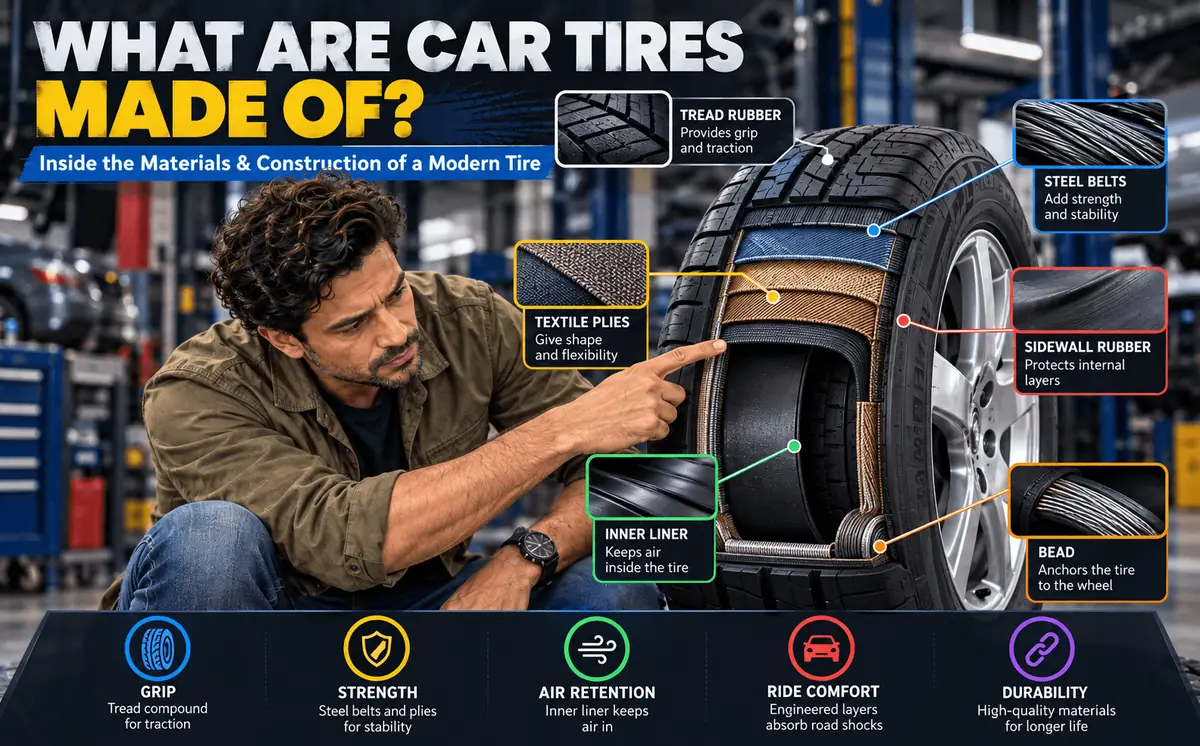
From the outside, a tire looks like a simple ring of black rubber. In reality, a modern radial tire is a carefully engineered composite of more than a dozen components and dozens of raw materials, from tree-grown rubber and industrial carbon to steel wire, polyester cord, and a long list of chemical additives. Each one is there for a reason: to help the tire grip, carry weight, hold air, resist heat, roll efficiently, and survive tens of thousands of miles of punishment.
Understanding what goes into a tire also explains why tires differ so much in grip, comfort, tread life, and price. This guide breaks down the main materials, then shows how they come together in each part of the tire.
Table of Contents
A Tire’s Main Ingredients at a Glance
| Material | What It Is | Main Job in the Tire |
|---|---|---|
| Natural rubber | Elastic polymer from the sap of the rubber tree | Strength, tear resistance, flexibility, low heat buildup |
| Synthetic rubbers | Petroleum-based elastomers such as SBR and BR | Grip, wear resistance, rolling resistance tuning |
| Halobutyl rubber | A specialty synthetic rubber | Airtight inner liner that holds inflation pressure |
| Carbon black | Fine carbon particles made from hydrocarbons | Reinforcement, abrasion resistance, UV protection |
| Silica | Silicon dioxide filler | Wet grip and lower rolling resistance |
| Steel wire | High-strength brass-coated steel cord | Belts under the tread and the bead bundles |
| Textile cords | Polyester, nylon, rayon, and aramid | Casing plies and cap plies |
| Oils and resins | Processing aids and plasticizers | Workability and flexibility, especially in cold weather |
| Antioxidants and antiozonants | Protective chemicals | Resist aging, cracking, and ozone damage |
| Curing agents | Sulfur, accelerators, and activators | Vulcanize the rubber into its final durable form |
The exact recipe varies by tire type and manufacturer, and compounds are closely guarded secrets. A winter tire, a high-performance summer tire, and a long-life touring tire use very different blends.
Natural Rubber
Natural rubber comes from the milky latex of the Hevea brasiliensis tree, grown mostly on plantations in Southeast Asia, including Thailand, Indonesia, Malaysia, and Vietnam. Workers tap the trees and collect the latex, which is processed into raw rubber.
Chemically, natural rubber is a polymer of isoprene with outstanding elasticity: it stretches under load and springs back. It also resists tearing well and generates relatively little heat as it flexes. Those qualities make it especially valuable in parts of the tire that work hard and must stay cool, such as the casing and sidewalls, and in truck and other heavy-duty tires. Many passenger tire tread compounds also include natural rubber, blended with synthetics to balance grip and wear.
Synthetic Rubbers
Synthetic rubbers, made from petroleum-derived chemicals, let engineers fine-tune a tire’s behavior in ways natural rubber alone cannot.
- Styrene-butadiene rubber (SBR) is the workhorse of passenger car tread compounds. Different grades can be tailored for grip, wear, and rolling resistance, and modern solution-polymerized SBR is widely used in fuel-efficient, high-grip treads.
- Polybutadiene rubber (BR) offers excellent abrasion resistance and low heat buildup, so it is often blended into treads to improve wear and rolling resistance, and used in sidewalls.
- Halobutyl rubber, a chemically modified butyl rubber, is almost impermeable to air. It forms the inner liner of tubeless tires, the airtight layer that keeps the tire inflated.
Most tire compounds blend several rubbers together. Changing the blend is one of the main ways manufacturers trade off grip, tread life, comfort, and efficiency.
Carbon Black
Carbon black is what makes tires black, but its color is a side effect. It is a fine powder of carbon particles produced by partially burning heavy oils or gas under controlled conditions.
Mixed into rubber, carbon black acts as a reinforcing filler. Its tiny particles bond with the rubber’s polymer chains, dramatically increasing strength, stiffness, and resistance to abrasion and tearing. Without reinforcing fillers, a rubber tread would wear away far faster.
Carbon black also helps protect the rubber from ultraviolet light, slowing the cracking and aging caused by sun exposure, and it helps conduct heat away from areas of the tire that flex the most.
Silica
Silica, or silicon dioxide, is the other major reinforcing filler, and it has transformed passenger tire performance over the past few decades. In tread compounds, highly dispersible silica combined with special coupling agents called silanes, which chemically link the silica to the rubber, offers two key benefits:
- Lower rolling resistance, which reduces the energy needed to keep the tire rolling and improves fuel economy or EV range
- Better wet grip, helping the tread maintain traction on rain-soaked roads
Silica also helps tread compounds stay flexible in cold weather, which is why it is common in all-season and winter tires. Most modern passenger tires use a blend of silica and carbon black, balancing efficiency, grip, and wear.
Steel
Steel gives a radial tire much of its strength and shape.
- Steel belts: Most passenger radial tires have two layers of high-strength steel cord belts beneath the tread. The cords are brass-coated so the rubber bonds tightly to them, and the two belts are laid at opposing angles to form a stiff, stable platform. The belts keep the tread flat on the road for even wear and good handling, add resistance to punctures, and help the tire hold its shape at speed.
- Bead bundles: At the inner edge of each sidewall, a bundle of high-strength steel wire forms the bead, a rigid hoop that locks the tire onto the wheel rim and holds it there under cornering and braking forces.
Textile Reinforcements
Fabric cords made from synthetic fibers do much of the structural work inside the tire.
- Polyester is the most common material for the casing plies of passenger tires. It is strong, dimensionally stable, and cost-effective.
- Nylon is often used for cap plies, an overlay wrapped around the steel belts in many tires, especially those with higher speed ratings. Nylon’s strength and fatigue resistance help hold the belts in place at high speeds.
- Rayon appears in some high-performance and premium tire casings for its stability and heat resistance.
- Aramid, the same family of fibers used in bulletproof vests, offers exceptional strength for its weight and is used in some high-performance, racing, and specialty tires.
In a radial tire, the casing ply cords run straight across the tire from bead to bead, at a right angle to the direction of travel. That is what makes it a radial tire, and it lets the sidewall flex for comfort while the belts keep the tread stable.
How It All Comes Together: The Parts of a Tire
| Component | Location | What It Does | Key Materials |
|---|---|---|---|
| Tread | Outer surface that contacts the road | Grip, water evacuation, wear resistance | Natural and synthetic rubber, silica, carbon black, oils, resins |
| Cap ply | Over the steel belts, under the tread | Holds belts in place at speed | Nylon or similar textile |
| Steel belts | Beneath the tread | Strength, stability, puncture resistance | Brass-coated steel cord in rubber |
| Casing (body ply) | The tire’s skeleton, bead to bead | Carries load and holds air pressure’s shape | Polyester or other textile cords in rubber |
| Sidewall | Between tread and bead | Flexibility, protection, ride comfort | Rubber compounds resistant to flexing, ozone, and weathering |
| Inner liner | Inside surface of the tire | Keeps air in | Halobutyl rubber |
| Bead and bead filler | Where the tire meets the rim | Locks the tire to the wheel; stiffens the lower sidewall | Steel wire bundle and hard rubber apex |
| Chafer | Around the bead area | Protects against rubbing on the rim | Tough rubber and fabric |
The Tread
The tread does the most visible work. Its compound determines how well the tire grips in dry, wet, and cold conditions, how long it lasts, and how efficiently it rolls. Engineers balance natural and synthetic rubbers, fillers, oils, and resins to suit each tire’s purpose: soft, sticky compounds for performance tires; durable, efficient blends for touring tires; and cold-flexible compounds for winter tires.
The tread pattern matters just as much. Grooves channel water away to resist hydroplaning, tread blocks provide biting edges, and sipes, the thin slits cut into the blocks, add grip on wet, snowy, and icy roads. Pattern design also affects noise and how evenly the tire wears. Our guide to checking tire tread depth explains why those grooves lose effectiveness as they wear.
The Sidewall
The sidewall has to flex millions of times without cracking, absorb impacts, and resist ozone and sun exposure. Its rubber compound typically leans on natural rubber and polybutadiene for flexibility and fatigue resistance, with antioxidants and antiozonants to slow aging. Sidewall stiffness affects both ride comfort and steering response.
The sidewall also carries the tire’s markings: size, load index, speed rating, DOT code with manufacturing date, and other information.
Additives That Make Rubber Work
Raw rubber on its own is soft, sticky, and unstable in heat and cold. A handful of additives turn it into something durable:
- Oils and plasticizers make the compound easier to mix and shape during manufacturing, and help keep it flexible at low temperatures.
- Resins can be added to fine-tune grip, especially in performance and winter compounds.
- Antioxidants and antiozonants protect against oxidation and ozone, which otherwise cause cracking and premature aging.
- Curing agents, primarily sulfur along with accelerators and activators such as zinc oxide and stearic acid, drive vulcanization.
How a Tire Is Made, in Brief
- Mixing: Rubbers, fillers, oils, and chemicals are blended in large industrial mixers to create different compounds for each component.
- Component preparation: Compounds are extruded into tread and sidewall profiles or calendered onto fabric and steel cords to create plies and belts. Bead wire is formed into hoops.
- Building: On a building drum, the inner liner, casing plies, beads, sidewalls, belts, cap ply, and tread are assembled into a “green” (uncured) tire.
- Curing: The green tire goes into a heated mold, where heat and pressure vulcanize the rubber and press in the tread pattern and sidewall markings.
- Inspection: Finished tires are inspected, and samples undergo testing for uniformity, balance, and quality.
Sustainability and the Future of Tire Materials
The tire industry is working to reduce its environmental footprint in several ways:
- Lower rolling resistance tread compounds improve fuel economy and EV range, which reduces emissions over a tire’s life.
- Renewable and recycled materials, such as bio-based oils and resins, silica derived from rice husk ash, recycled steel, and recycled carbon black and rubber, are increasingly being blended into tires.
- Alternative natural rubber sources, such as rubber from the guayule shrub and certain dandelion species, are being explored to reduce reliance on tropical plantations.
- Recycling end-of-life tires turns old tires into crumb rubber for rubberized asphalt, playground and sports surfaces, molded products, and fuel for cement kilns. Retreading extends the life of many truck tires.
Looking ahead, manufacturers are developing tires with embedded sensors that report pressure, temperature, and wear; self-sealing designs that resist small punctures; and tires engineered specifically for electric vehicles, which must handle extra weight and instant torque while staying quiet and efficient.
What This Means When You Buy Tires
Knowing what goes into a tire helps explain the differences you see in the store. Tires with advanced silica compounds tend to offer better wet grip and efficiency. Performance tires use stickier compounds that grip hard but wear faster. Long-life touring tires use durable blends that trade a little grip for mileage. Winter tires rely on compounds that stay soft in the cold. And more sophisticated constructions, such as nylon cap plies and premium casing materials, show up in tires built for higher speeds and sharper handling.
That engineering is a big part of what you pay for in premium tires. Our comparison of budget, mid-range, and premium tires explains when the extra cost is worth it, and our tire reviews break down how specific models perform.
Frequently Asked Questions
A blend of natural and synthetic rubber, reinforcing fillers such as carbon black and silica, steel and textile cords for strength, and chemical additives such as oils, antioxidants, and curing agents.
Because of carbon black, a reinforcing filler that strengthens the rubber, improves abrasion resistance, and helps protect it from UV light. Without fillers like carbon black, tires would wear out much faster.
Silica, combined with silane coupling agents, lowers rolling resistance for better fuel economy and improves wet grip. It also helps tread compounds stay flexible in cold weather.
Both. Natural rubber provides strength, tear resistance, and low heat buildup, while synthetic rubbers such as SBR and BR let manufacturers fine-tune grip, wear, and efficiency. A specialty synthetic rubber, halobutyl, forms the airtight inner liner.
Steel belts under the tread add strength, stability, and puncture resistance, and steel bead bundles lock the tire securely onto the wheel.
The casing ply cords run radially from bead to bead, at a right angle to the direction of travel, with stabilizing belts under the tread. That design gives a better balance of comfort, handling, tread life, and efficiency than older bias-ply construction.
Yes. End-of-life tires are ground into crumb rubber for uses such as rubberized asphalt and playground surfaces, made into molded products, or used as fuel in some industrial processes. Let your tire installer handle disposal.
The Bottom Line
A tire is far more than a ring of rubber. Natural and synthetic rubbers provide elasticity and grip, carbon black and silica reinforce the compound and shape its behavior, steel and textile cords give it strength and structure, and a precise blend of additives makes it durable and cures it into its final form. Every one of those choices affects how a tire grips, rides, wears, and rolls, which is why choosing the right tire for your car and climate matters as much as it does.
 Summarize this article with:















Leave a comment