


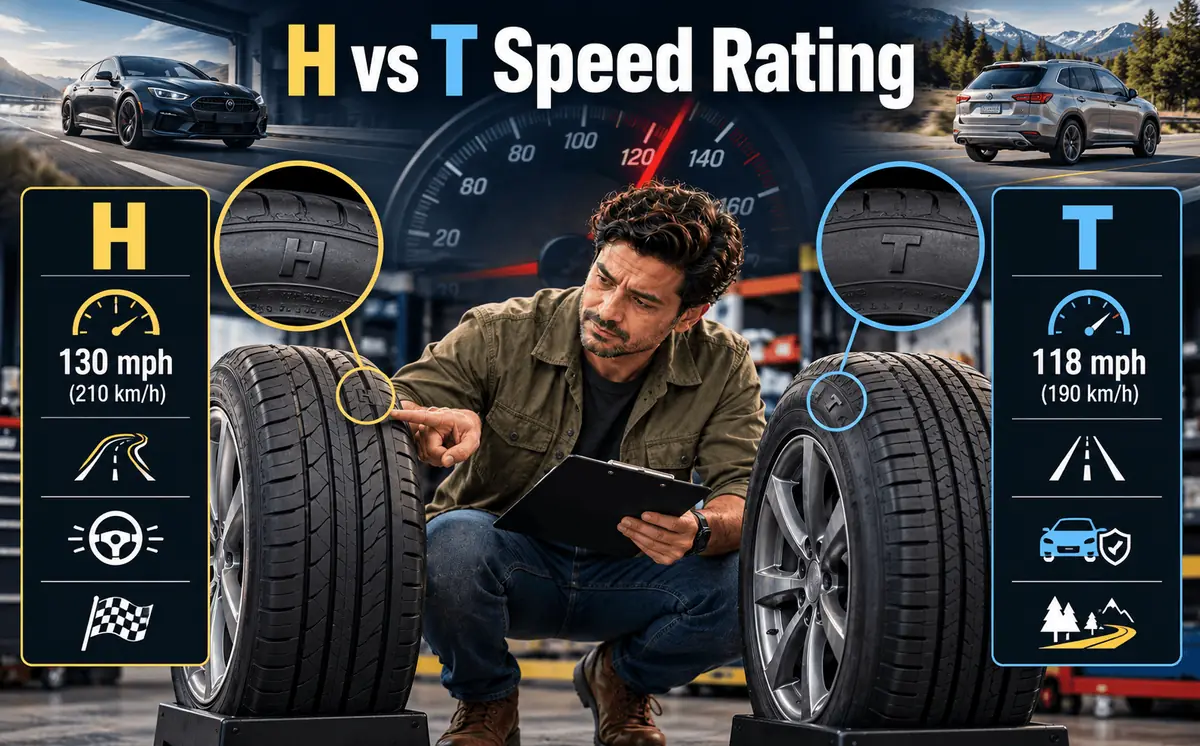
Most tire shoppers match the size, compare brands, and check the price. The letter at the end of the size code gets far less attention. Yet the difference between a T-rated tire and an H-rated tire shapes how your car steers, how it rides, how long the tires last, and how much heat margin you have on a hot summer highway.
On paper the gap looks trivial: 118 mph versus 130 mph, speeds few drivers ever approach. In practice, it signals two different design philosophies. Here is what separates them and how to choose.
Table of Contents
What a Speed Rating Represents
A speed rating is the maximum speed at which a tire can carry its rated load for a sustained period without failing, as determined in controlled laboratory testing. It is not an invitation to drive that fast, and it doesn’t account for real-world complications like under-inflation, road damage, or an overloaded vehicle.
On the sidewall, the rating follows the load index. In 215/60R16 95T, “95” is the load index and “T” is the speed rating.
The underlying issue is heat. A spinning tire flexes, and flexing generates heat; the faster it spins, the more heat it produces. A tire that can’t shed that heat can suffer internal separation and fail. Higher-rated tires use materials and construction that manage heat better, often including stiffer sidewalls and nylon cap plies over the belts.
Why H Ranks Above T
Speed ratings trace back to Europe in the 1960s, when there were only a few categories. S covered standard sedans (112 mph), H covered sports cars (130 mph), and V covered high-performance cars (149 mph). As vehicles diversified, more letters were added, including T at 118 mph, to fill the gaps. That’s why H sits out of alphabetical order, above T and U. It’s also why H still carries a performance-touring association and T is linked with mainstream family vehicles.
The T-Rated Tire: Built for Everyday Miles
Maximum speed: 118 mph (190 km/h)
Typical vehicles: minivans, family sedans, compact SUVs, and economy cars
T-rated tires are the workhorses of the passenger-car world, and many mainstream sedans, minivans, and compact crossovers leave the factory on them. They share several traits:
- Comfort-tuned construction. Without the need to stay rigid at 130 mph, the casing can be tuned to absorb potholes and rough pavement.
- Long tread life. Compounds are often chosen for durability, and T-rated touring tires commonly carry generous treadwear warranties.
- Value. They are usually less expensive to build and to buy than higher-rated equivalents.
Best for: drivers who prioritize a smooth ride and high mileage over cornering precision.
The H-Rated Tire: A Step Toward Performance
Maximum speed: 130 mph (210 km/h)
Typical vehicles: sport sedans, coupes, crossovers, and some luxury touring models
The real benefit of an H rating isn’t the top speed. It’s the handling that comes with the construction needed to achieve it:
- Stiffer sidewalls reduce flex in corners.
- Quicker steering response because the tire doesn’t roll over as much when you turn the wheel.
- Better heat resistance, often aided by nylon cap plies that help the tire run cooler.
H-rated tires often fall into the grand touring category, bridging standard touring tires and dedicated performance tires.
Best for: drivers who want a planted highway feel, enjoy a winding road, or drive cars with sportier suspension tuning.
Head-to-Head
| Category | T-Rated | H-Rated | Edge |
|---|---|---|---|
| Max speed | 118 mph | 130 mph | H |
| Handling and cornering | Softer, more sidewall roll | Firmer, more precise | H |
| Ride comfort and noise | Smoother, quieter | Firmer | T |
| Tread life | Often longer | Often shorter | T (generally) |
| Heat resistance | Good | Better | H |
| Price | Lower | Higher | T |
Handling and Cornering
This is the difference most drivers notice first. On a highway off-ramp or a winding road, an H-rated tire holds its line better. A T-rated tire’s softer sidewalls allow more rollover, which can make steering feel vague in quick maneuvers. On a car known for sharp handling, a T-rated tire can noticeably dull the experience.
Ride Comfort and Noise
The T-rated tire wins. Stiffer H-rated construction transmits more road texture, so expansion joints and pavement cracks are more noticeable. If your commute involves rough city streets or long, straight highways where you just want to cruise quietly, a T-rated tire will generally be more relaxing. Premium H-rated touring tires with noise-reducing tread designs have narrowed this gap.
Tread Life
As a rule of thumb, performance and tread life pull in opposite directions. H-rated tires often use grippier compounds that wear faster, while T-rated tires often use harder, abrasion-resistant compounds. It’s not universal; a budget T-rated tire can wear out faster than a premium H-rated one. But T-rated touring tires frequently carry longer treadwear warranties. Checking the specific tire’s warranty is the best indicator.
Heat Dissipation
H-rated tires are engineered to run cooler. While that’s essential at 130 mph, it also provides a margin at 70 to 80 mph, especially in hot climates and on long summer road trips. An H-rated tire is less stressed at 75 mph than a T-rated tire at the same speed, which is a real benefit for drivers who cover lots of highway miles in places like the desert Southwest.
Mixing H and T Tires
Avoid it. Never mix speed ratings on the same axle, and ideally don’t mix them on the same vehicle at all.
If an emergency forces a mix, for example a blowout with only a different-rated replacement available:
- Keep matching pairs on each axle to avoid pulling and unpredictable braking.
- Follow the vehicle and tire makers’ guidance on placement. Many advise putting the better-matched or higher-rated pair on the rear axle to reduce the risk of oversteer.
- Respect the lowest rating. With three H-rated tires and one T-rated tire, the vehicle is limited to the T-rated tire’s capability.
Mismatched tires can also confuse traction and stability control systems calibrated around consistent tire behavior. Our guide on replacing just one tire covers this situation in more detail.
Can You Downgrade from H to T?
Technically, a T-rated tire’s 118 mph capability exceeds legal speed limits. But downgrading below your manufacturer’s specification isn’t recommended, for three reasons:
1. Handling. The suspension was tuned around the stiffness of the original tires. A softer tire can make the car feel floaty and make emergency maneuvers less precise.
2. Liability. A tire with a lower rating than specified may be viewed as improper maintenance if a tire-related crash occurs, which could complicate insurance or legal matters.
3. Speed limiters. Some vehicles have electronic limiters set according to the factory tire rating. Fitting lower-rated tires can create a mismatch in which the car can outrun its tires.
The winter exception: it is common and accepted to drop one speed rating for dedicated winter tires, for example from H to T. Winter tires use soft compounds and deep tread that naturally limit speed, and winter conditions rarely allow high speeds anyway. Our winter tire guides can help you find a suitable set.
Upgrading from T to H
You can always move up. Fitting H-rated tires to a car that came with T-rated tires typically sharpens steering response. The likely trade-offs are a slightly firmer ride and a bit more road noise.
Finding Your Vehicle’s Speed Rating
Don’t rely solely on the tires currently mounted, especially on a used car, since a previous owner may have fitted the wrong ones.
- Owner’s manual: the tire or specifications section lists recommended size, load index, and speed rating.
- Door-jamb placard: the sticker on the driver’s door frame shows the tire size and service description, such as P205/55R16 89H.
- Current sidewall: if you know the tires are correct, read the last character of the service description, for example 225/50R17 94V or 195/65R15 91T.
Our tire size explainer helps decode the rest of the sidewall.
Which Should You Choose?
Choose T-Rated If…
- You drive a standard family sedan, minivan, or crossover
- You drive in a relaxed way and rarely exceed the speed limit
- Ride comfort, low noise, and maximum tread life are top priorities
- You want the most cost-effective option
- Your vehicle specifies T
Look for: quality standard touring all-season tires.
Choose H-Rated If…
- You drive a sportier sedan, coupe, or car with firm suspension
- You value steering precision and enjoy spirited driving
- You cover a lot of highway miles, especially in hot weather
- Your vehicle specifies H, in which case don’t go lower
Look for: grand touring all-season tires.
Whichever you choose, buy from a reputable brand and keep the tires properly inflated. A cheap, under-inflated H-rated tire is far more dangerous than a quality, well-maintained T-rated tire. Our roundup of the best all-season tires is a good starting point.
Frequently Asked Questions
Twelve mph. T-rated tires are approved up to 118 mph (190 km/h); H-rated tires up to 130 mph (210 km/h).
Generally it has more margin. Because it’s engineered for heat at 130 mph, it runs cooler at 65 to 80 mph and usually offers better stability in sudden maneuvers.
Yes. You can always fit a higher speed rating. Expect sharper steering and possibly a little more noise and firmness.
It isn’t recommended. The vehicle’s suspension and stability systems were developed around H-rated tire characteristics.
Generally, yes, since they often use grippier compounds. Check the specific tire’s treadwear warranty for the best guide.
The original European system had only S, H, and V. Other letters, including T and U, were added later to fill the gaps.
Yes, but dropping one rating for dedicated winter tires is widely accepted, since their soft construction limits speed and winter roads rarely allow high speeds.
102 is the load index, which corresponds to the weight each tire can carry, and T is the speed rating, meaning the tire is rated for sustained speeds up to 118 mph.
Q is a speed rating of up to 99 mph. It is common on winter and studded tires and on some mud-terrain tires.
The Verdict
T-rated tires are the smart, economical choice for mainstream family vehicles. They ride softly, run quietly, and often last a long time.
H-rated tires are worth it when handling precision, highway stability, or heat margin matter to you, and they are mandatory when your manufacturer specifies them.
Follow your placard, upgrade freely if you value the feel, and avoid downgrading except for a dedicated winter set.
 Summarize this article with:















Leave a comment