


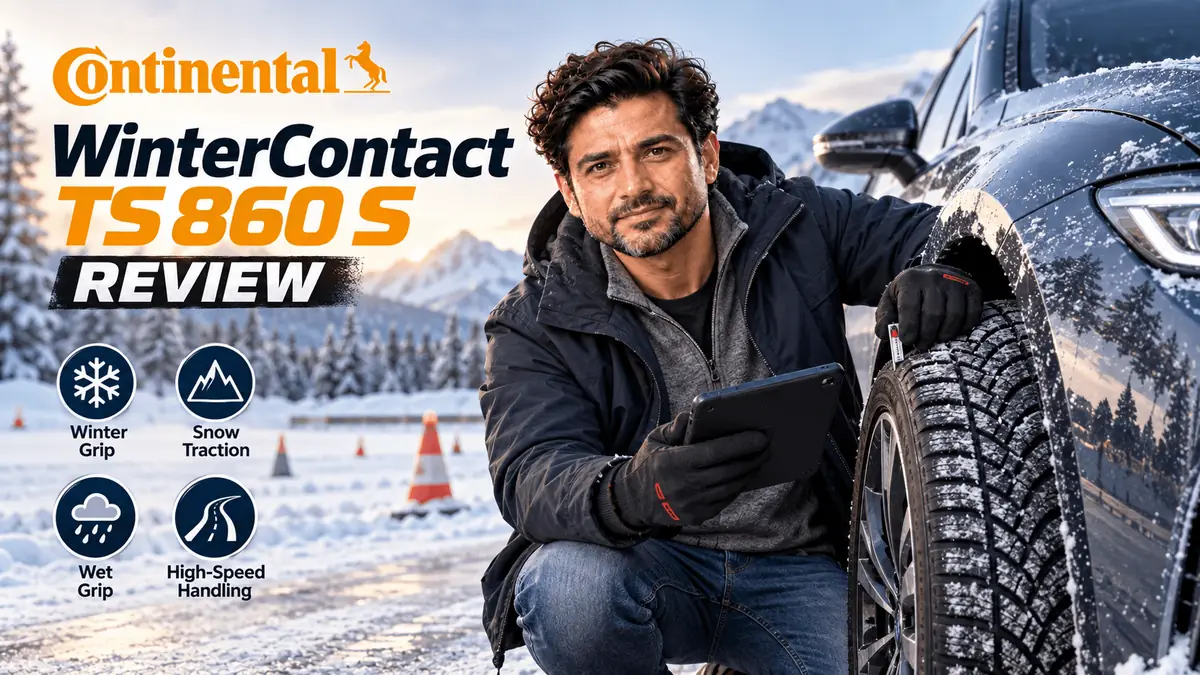
Putting winter tires on a Porsche 911, BMW M-car, or high-powered luxury sedan has always involved a compromise. Traditional winter tires make powerful cars feel soft and imprecise, and their lower speed ratings do not match the performance the car was engineered to deliver.
The Continental WinterContact TS 860 S exists to close that gap. The “S” signals its purpose: this is a high-performance winter tire for sports cars, luxury sedans, and performance SUVs. It delivers genuine snow and ice traction while holding on to much more of the car’s steering precision and high-speed stability than a conventional winter tire.
How this review was put together: We have not road-tested the TS 860 S. This review is based on Continental’s design information and warranty terms and on retailer listings, with sources listed at the end. Checked on October 22, 2026.
Table of Contents
What Makes the TS 860 S Different
The TS 860 S sits in Continental‘s performance winter category, alongside the WinterContact TS 850 P and TS 870. What sets it apart is its focus on the most demanding vehicles:
- Performance-oriented construction with reinforced sidewalls for cornering stability at higher speeds
- High speed ratings, typically H, V, W, or Y depending on size
- Sizes up to 21 inches, with widths from 205mm to 285mm
- A run-flat version, the WinterContact TS 860 S SSR, for vehicles that require run-flats
Its tread design combines a stable center section for straight-line precision with shoulders tuned for dry handling and an inner tread packed with multi-angle siping for snow and ice.
Snow Performance
In deep snow, the TS 860 S uses wide, V-shaped grooves to channel snow through the tread instead of letting it pack solid, while dense siping digs in for traction.
On packed snow, rigid shoulder blocks hold their shape under load, which keeps cornering precise and reduces the understeer that many winter tires suffer from. For performance cars on snowy mountain roads, that stability matters.
Unplowed roads and steep hills are where that design matters most.
Ice
The TS 860 S’s winter compound stays pliable at low temperatures, letting the tread grip the fine texture of an icy surface. Braking on ice is predictable and controlled, with many owners noting more grip than they expected from previous winter tires. The advantage is most noticeable on black ice and in near-freezing conditions where surfaces alternate between wet and icy.
For extreme arctic conditions with persistent deep snow and ice, a specialist such as the Nokian Hakkapeliitta R3 remains stronger. The TS 860 S targets regular but not extreme winters.
Dry and Wet Roads
This is where the TS 860 S earns its place on a performance car.
Dry pavement: Steering is responsive and precise, and the tire stays stable and planted at speed, with a feel that approaches that of a performance all-season tire. Dry braking distances are notably shorter than the winter-tire average, which is valuable during early winter and late spring when roads are cold but clear.
Wet roads: Wide circumferential grooves clear water efficiently, and the siping breaks through the water film for strong wet grip. The tire stays planted and communicative in wet corners.
Transitional weather: Morning frost, afternoon melt, and evening refreeze are handled with composure. The tire’s behavior stays consistent as surfaces change, which is exactly what drivers need on unpredictable winter commutes.
Comfort and Noise
The TS 860 S is quiet for a winter tire. Noise is nearly imperceptible at city speeds, a gentle hum in the suburbs, and more noticeable but steady at highway speed, without the pitch changes that make long drives tiring. Vibration damping is good on rough concrete and weathered asphalt.
Ride comfort is good for a performance winter tire, though drivers moving from soft touring tires may find the ride slightly firmer than expected, a consequence of its performance-oriented construction.
Tread Life and Warranty
Continental does not give it a mileage warranty, so there is no official tread-life figure. Winter-only use, correct pressures and swapping the tires off once spring arrives all help a set last several seasons.
As with any winter tire, deep-snow traction declines as the tread wears, and frequent use on clear, dry pavement accelerates wear.
Tread wear indicators help here. Many winter tire experts recommend replacing winter tires at around 4/32″ of tread, well before the legal minimum, to preserve snow traction.
Continental backs the TS 860 S with a six-year limited warranty against defects in materials and workmanship, including free replacement during the first year or first 2/32″ of wear. As with most winter tires, there is no mileage warranty.
Sizes and Vehicle Fit
The TS 860 S covers 16- to 21-inch wheels with widths from 205mm to 285mm:
- 16 and 17 inches: Compact premium models such as the Volkswagen Golf, Audi A3, and BMW 3 Series
- 18 and 19 inches: Luxury and performance sedans such as the Mercedes-Benz E-Class, BMW 5 Series, and Audi A6
- 20 and 21 inches: High-performance sports cars and luxury SUVs such as the Porsche 911, BMW X5, and Mercedes-Benz GLE
SUV and performance vehicle owners tend to rate the tire slightly higher than compact car drivers, which fits its design priorities.
Price and Value
In October 2026, SimpleTire listed it from about $138 (205/60R16) to $455 (295/35R20) per tire, depending on size. That places the TS 860 S in the upper-middle range of premium winter tires: typically more expensive than Dunlop or Hankook alternatives, but often less expensive than equivalent Michelin models.
For performance car owners, the value calculation includes something hard to put a number on: keeping much more of the driving character they paid for, even in January.
How It Compares
| Tire | Where it leads | Where the TS 860 S leads |
|---|---|---|
| Michelin Pilot Alpin | Dry handling at high speed; even wear | Snow traction; price |
| Bridgestone Blizzak LM005 | Hydroplaning resistance in slush and deep water | Dry steering precision and feedback |
| Pirelli Winter Sottozero 3 | Possibly quieter ride and slightly better efficiency | Snow traction |
| Nokian Hakkapeliitta R3 | Extreme winter and ice | Dry and wet versatility |
Consider alternatives if: You want longer tread life (Michelin X-Ice), stronger deep-snow grip (Bridgestone Blizzak), extreme-winter specialization (Nokian Hakkapeliitta), or a lower price (Vredestein Wintrac Pro or General Altimax Arctic).
Installation and Maintenance
- Install a full set of four. If you can only replace two, put the new tires on the rear axle regardless of drivetrain to reduce the risk of oversteer.
- Follow sidewall markings for mounting direction or orientation.
- Reset TPMS after installation if your vehicle requires it.
- Check pressure every two weeks in winter, with tires cold. Pressure drops about 1 PSI for every 10°F fall in temperature. Do not overinflate; it shrinks the contact patch and reduces grip.
- Rotate every 5,000 to 7,500 miles. Use a forward cross for front-wheel drive, a rearward cross for rear-wheel drive, and an X-pattern for all-wheel drive, where the tread design and fitment allow.
- Store carefully: Clean without applying tire dressings, bag each tire, and store in a cool, dry place away from sunlight and ozone sources. Store unmounted tires upright; hang or stack mounted tires and shift their position periodically.
- Swap in spring once temperatures stay above about 45°F (7°C).
Pros and Cons
Pros
- Strong snow traction, including deep and packed snow
- Predictable, controlled braking on ice
- Precise dry handling and short dry braking for a winter tire
- Strong wet grip and composure in transitional weather
- Quiet and comfortable for the category
- High speed ratings, sizes to 21 inches, and a run-flat version
Cons
- Premium price
- Deep-snow traction declines as the tread wears, as with any winter tire
- Faster wear with frequent dry-pavement driving
- Slightly firmer ride than touring-oriented winter tires
- Outmatched by specialists in extreme arctic conditions
Who Should Buy It?
Best for: Owners of luxury sedans, sports cars, and performance SUVs in regions with regular winter conditions who want to keep responsive handling.
Good fit for: Drivers of run-flat-equipped luxury vehicles, using the SSR version.
Look elsewhere if: You face extreme, persistent snow and ice (choose a Nordic specialist or the VikingContact 8), or your priority is the lowest cost.
Frequently Asked Questions
Luxury sedans, sports cars, and performance SUVs, including models such as the BMW 5 Series, Mercedes-Benz E-Class, Porsche 911, and BMW X5.
There is no mileage warranty or official figure. Used only in winter and stored properly, a set typically lasts several seasons.
Yes, the WinterContact TS 860 S SSR.
The TS 860 S generally offers stronger snow traction at a lower price, while the Michelin may have a slight edge in high-speed dry handling and more even wear.
No. Its winter compound wears quickly in warm weather. Switch to summer or all-season tires once temperatures stay above about 45°F.
Final Verdict
The Continental WinterContact TS 860 S lets performance and luxury cars stay enjoyable through winter. It delivers confident snow and ice traction, precise dry and wet handling, and a refined ride, backed by high speed ratings and sizes up to 21 inches. It costs more than mainstream winter tires, and deep-snow grip fades as it wears, but for drivers who want winter safety without giving up the car they love to drive, it is one of the best choices available.
Sources
Specs, warranty terms and prices were checked on October 22, 2026. Prices change often.
- SimpleTire: Continental WinterContact TS 860 S (price, no mileage warranty)
 Summarize this article with:













Leave a comment