


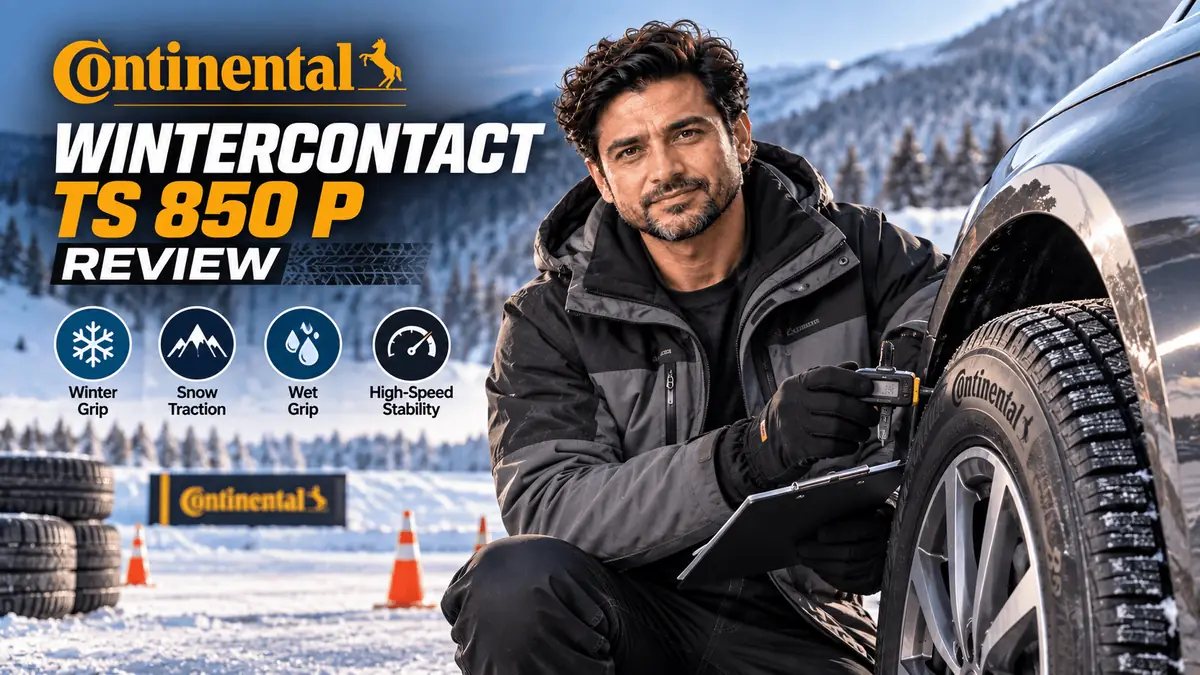
Many drivers put off buying winter tires for one reason: they remember how vague and soft their car felt the last time they ran them. The Continental WinterContact TS 850 P was built for exactly those drivers. It is a performance winter tire, sometimes called an alpine winter tire, that delivers certified snow capability while keeping steering precise and composed on the cold, wet, and cleared roads that make up most winter driving.
It is a different kind of tire from a Nordic studless ice tire such as the VikingContact 8, and understanding that difference is the key to deciding whether it suits you. One more thing to know before you shop: the TS 850 P launched in 2014, and Continental began replacing it with the WinterContact TS 870 P in 2021. It is still sold in some sizes, so this review also covers when it still makes sense to buy one.
How this review was put together: We have not road-tested the WinterContact TS 850 P. This review draws on Continental’s design information, European tire-label data, independent test results and owner ratings compiled by Tyre Reviews, and US retailer listings, with sources listed at the end. Checked on October 24, 2026.
Table of Contents
Performance Winter vs. Studless Ice Tire
Winter tires generally fall into two families:
- Studless ice and snow tires (such as Continental’s VikingContact 8) prioritize maximum grip on ice and packed snow for regions with long, harsh winters. Their very soft compounds can feel less precise on cleared roads.
- Performance winter tires (such as the WinterContact TS 850 P) balance snow traction with stronger dry and wet handling and higher speed ratings. They suit regions where winter brings a mix of snow, slush, rain, and cold, dry pavement.
The TS 850 P carries the Three-Peak Mountain Snowflake (3PMSF) symbol, so it meets the severe snow service standard. But its character is tuned for drivers who spend more of the winter on cold pavement than on sheet ice. If you are still deciding whether you need dedicated winter tires at all, our winter tires vs. all-season tires guide covers that choice.
Key Specifications
| Feature | Details |
|---|---|
| Category | Performance winter / snow |
| Winter certification | 3PMSF (severe snow service) |
| Model status | Launched 2014; replaced by the WinterContact TS 870 P from 2021, still sold in some sizes |
| Wheel diameters | 15 to 22 inches across global markets; US stock covers fewer sizes |
| Speed ratings | Mainly H (130 mph) and V (149 mph); some W (168 mph) |
| Load index range | About 91 (1,356 lbs) to 116 (2,756 lbs), depending on size |
| Run-flat versions | Yes, some sizes are SSR run-flat |
| EU label: rolling resistance | C or D in most sizes, a few B |
| EU label: wet grip | B or C |
| EU label: noise | 71 to 75 dB |
| Example price | About $328 per tire for 215/60R18 98H SSR run-flat (Tires Easy, October 2026) |
| Tread life | No official mileage figure |
Construction uses twin steel belts and a polyamide cap ply for stability at speed, and a directional tread with high sipe density for snow and slush. Continental offers the TS 850 P in common SUV sizes too, many of them in XL (extra load) versions for heavier vehicles.
Independent Test Record
Independent testing is where the TS 850 P built its reputation. Across 17 European magazine and auto-club tests tracked by Tyre Reviews, it finished 3rd on average, with a best result of 1st and a worst of 12th. Owners on the same site rate it 81% on average across 19 reviews covering roughly 150,000 miles of driving.
Those tests ran in European sizes, often against tires that are not sold in the US, so read them as evidence of a consistently strong all-rounder rather than a direct head-to-head with your shortlist. Its successor has kept that pattern: Continental reports that the TS 870 P was rated “very good” in a 2023 sport auto test, with top marks for snow braking, dry handling and rolling resistance.
Snow Traction
The TS 850 P’s dense, multi-directional siping creates thousands of biting edges that dig into snow, giving strong traction when accelerating from a stop and climbing hills. Its silica-enhanced winter compound stays pliable in the cold, conforming to the snow surface rather than skimming over it. That is the big advantage over all-season tires, which stiffen and lose grip as temperatures fall, and it shows most clearly in shorter, more controllable braking on snow.
Snow-retaining grooves also help. Snow packed into the tread grips the snow on the road better than rubber alone, adding traction in fresh snow.
Ice
The TS 850 P handles ice competently for a performance winter tire, with predictable feedback as grip runs out and progressive braking that lets the driver modulate the pedal. Drivers who regularly face glare ice or bitter cold for months at a time, however, will be better served by a studless ice tire such as the VikingContact 8 or a Nordic specialist such as the Nokian Hakkapeliitta R3.
Wet Roads and Slush
Wet performance is one of the TS 850 P’s strengths. Wide lateral grooves channel water away quickly, reducing hydroplaning risk, and its EU wet-grip grades of B or C are solid for a winter tire. In slush, the grooves and sipes cut through to the pavement below, avoiding the floating sensation that less capable winter tires produce.
For drivers in climates where winter brings more rain and slush than snow, this may be the most important reason to choose it.
Dry Road Handling
This is where the TS 850 P separates itself from softer winter tires. Its compound does not turn excessively soft in milder weather, and Continental tuned the sidewalls to balance winter flexibility with enough stiffness for precise handling. The goal is direct turn-in, clear on-center feel, and highway lane changes without the squirm common to winter rubber.
It will not match an all-season or summer tire for responsiveness. That character suits sport sedans and hot hatches such as the Volkswagen Golf GTI, BMW M340i, and Audi S4, whose owners want winter safety without losing their car’s character entirely.
Comfort and Noise
For a winter tire, the TS 850 P is tuned for comfort. It absorbs broken winter pavement well and keeps the typical winter-tire hum under control at highway speed. EU noise labels of 71 to 75 dB, depending on size, sit in the normal range for the category, which makes it a reasonable companion for long winter highway drives.
Tread Life and Efficiency
There is no official tread life figure, and Continental does not publish a treadwear mileage warranty for this model. Wear tends to be even when the tire is run on a well-aligned car and rotated on schedule. Using winter tires extensively on warm, dry roads will shorten their life considerably.
On the European tire label, rolling resistance is C or D in most sizes, with a few B. That is typical rather than exceptional for a winter tire. EV owners should expect some winter range loss, as with any winter tire, and should compare the label grade for their exact size.
Price and Warranty
Pricing varies widely by size and by whether the tire is a run-flat. In October 2026, the 215/60R18 98H SSR run-flat listed at about $328 per tire at Tires Easy, so a set of four comes to roughly $1,310 before mounting and balancing. Prices for other sizes vary, and stock is patchy now that the TS 870 P has taken over.
Check whether your size is a run-flat. SSR in the size marks Continental’s Self-Supporting Runflat construction. Run-flats suit cars that came with them and carry no spare, but they ride firmer and cost more. If your car did not come on run-flats, choose a standard version. Our run-flat tire guide explains the trade-offs.
On warranty, there is no treadwear mileage coverage to compare. Continental’s US limited warranty covers its passenger tires against workmanship and materials defects for up to 72 months from purchase, and Discount Tire notes that Continental’s satisfaction trial runs 30 days for winter lines instead of the usual 60. Ask the seller to confirm coverage on your exact size before you buy.
Because this model is being phased out, also check the DOT date code on the sidewall. The last four digits show the week and year of manufacture; ask for recent production rather than tires that have sat in a warehouse for years.
Vehicle Fit
The TS 850 P’s size range covers many European sedans, crossovers, and sport compacts, including:
- Compact cars: Volkswagen Golf, Ford Focus, Honda Civic
- Executive sedans: BMW 3 Series and 5 Series, Mercedes-Benz C-Class and E-Class, Audi A4 and A6
- Crossovers and SUVs: Audi Q5, BMW X3, Mercedes-Benz GLC, Volvo XC60
- Electric vehicles: Possible in matching sizes, but heavier EVs often need XL (extra load) tires, so check the load index carefully
Always match the size, load index, and speed rating on your vehicle’s door placard. Its handling character is particularly well matched to European sedans and sport compacts.
TS 850 P vs. TS 870 P
Continental began replacing the TS 850 P with the WinterContact TS 870 P in 2021. The newer tire keeps the same job, performance winter grip for larger and more powerful cars and SUVs, and the same basic compound approach. The main change is the tread: the TS 850 P’s V-shaped pattern gives way to four wide circumferential grooves for faster water evacuation, and Continental says snow, ice, and dry performance improve by up to 6%.
If both are offered in your size at a similar price, the TS 870 P is the newer design and the safer default. The TS 850 P still makes sense when it is clearly cheaper, when it is the only option in your size, or when you are replacing one or two tires on a set already on the car. Do not confuse either tire with the WinterContact TS 870, a separate model aimed at small and mid-size cars.
How It Compares
| Tire | Type | Choose it instead if |
|---|---|---|
| Continental WinterContact TS 870 P | Performance winter (direct successor) | It is available in your size at a similar price |
| Bridgestone Blizzak LM001 | Performance winter | You want a performance winter tire that is widely stocked in the US, including run-flat sizes |
| Bridgestone Blizzak LM005 | Performance winter | You want a newer premium design for a car, crossover, or SUV |
| Continental WinterContact SI | Winter, US-market | You want a Continental winter tire built for the North American lineup |
| Continental VikingContact 8 | Studless ice and snow | You face long stretches of glare ice and extreme cold |
The TS 850 P’s case rests on balance: consistent top-three finishes across many independent tests rather than a win in any single area. Its weakness today is age and availability, not ability.
Care and Maintenance
- Install a full set of four, especially on all-wheel-drive and four-wheel-drive vehicles.
- Follow the rotation arrow on the sidewall for the directional tread.
- Rotate every 5,000 to 7,000 miles, front to back on the same side. Directional tires cannot be crossed side to side unless they are remounted on the wheels. Our tire rotation and alignment guide covers the basics.
- Check pressure at least monthly, with tires cold, and set to the vehicle placard.
- Check alignment and balance at the start of each winter.
- Swap out in spring once temperatures stay above about 45°F (7°C).
- Store properly: Clean off salt and grime, and store in a cool, dry place away from sunlight and ozone sources, ideally in tire bags.
Pros and Cons
Pros
- 3PMSF-certified snow traction
- Strong, consistent independent test record (3rd on average across 17 tests)
- Good wet grip and slush performance for a winter tire
- Composed handling on cleared roads for a winter tire
- H, V, and some W speed ratings for performance vehicles
- Available in run-flat (SSR) and XL sizes
Cons
- Older design, replaced by the TS 870 P from 2021
- Premium price, especially in run-flat sizes
- Patchy US size availability
- Not as capable on glare ice as studless ice tires
- No published treadwear mileage warranty
- Wears quickly if used in warm weather
Who Should Buy It?
Best for: Drivers of sedans, sport compacts, and premium crossovers in regions with mixed winters of snow, slush, rain, and cold, dry pavement, when the TS 850 P is cheaper than the TS 870 P or is the only option in their size.
Good fit for: Enthusiasts who want winter safety without giving up precise handling.
Look elsewhere if: You face months of glare ice and extreme cold (choose a studless ice tire such as the VikingContact 8), the TS 870 P is available at a similar price, or your budget calls for a less expensive winter tire.
Before You Buy
- Confirm the size, load index, and speed rating on your door placard.
- Check for SSR in the size, and skip run-flats unless your car came with them.
- Check the DOT date code and ask for recent production.
- Compare the price against the TS 870 P in the same size.
- Budget for mounting and balancing, and consider a dedicated set of wheels to make seasonal swaps cheaper.
Frequently Asked Questions
No. It is a performance winter tire. It carries the 3PMSF symbol for severe snow, but it balances snow grip with dry and wet handling rather than maximizing ice traction.
Yes. It has been replaced. Continental began phasing in the WinterContact TS 870 P as its successor in 2021, and the TS 850 P remains on sale in some sizes while stock lasts.
Choose the TS 870 P if both are available in your size at a similar price. The TS 850 P is worth buying when it is clearly cheaper or the only tire that fits your car.
There is no official mileage figure and no treadwear warranty. Using the tires only in winter, rotating them on schedule, and keeping alignment in check gives the best life.
Some sizes are. Look for SSR in the tire size. If your car did not come with run-flats, choose a standard version.
Yes. The range includes common SUV sizes, many in XL (extra load) versions. Check that the load index matches your vehicle placard.
No. Its winter compound wears quickly in warm weather. Switch to all-season or summer tires once temperatures stay above about 45°F.
It can be, in sizes that meet your vehicle’s load requirements. Its rolling resistance is typical for a winter tire, C or D in most sizes, so expect some winter range loss, as with any winter tire.
Final Verdict
The Continental WinterContact TS 850 P earned its reputation the hard way: consistent top-three finishes across years of independent testing, good wet and slush grip, and composed manners on cleared roads. It still does that job well. The catch in 2026 is age. Continental replaced it with the TS 870 P from 2021, US stock is patchy, and many listings are pricier run-flat sizes.
Buy the TS 850 P if it is the better price in your size or the only fit for your car; otherwise, start with the TS 870 P. Drivers facing long stretches of glare ice should choose a studless tire such as the VikingContact 8.
Sources
Specs, prices, and warranty notes were checked on October 24, 2026. Prices change often.
- Rerev: Continental WinterContact TS 850 P (US price, run-flat size details)
- Tyre Reviews: WinterContact TS 850 P (launch date, sizes, EU label data, test record, owner ratings)
- Que Choisir: WinterContact TS 870 P (TS 870 P replacing the TS 850 P, tread changes)
- Tyrepress: WinterContact TS 870 launch (TS 870 positioning)
- Continental: sport auto winter tire test, 2023 (TS 870 P test result)
- Discount Tire: Continental Total Confidence Plan (warranty and trial terms)
 Summarize this article with:













Leave a comment