


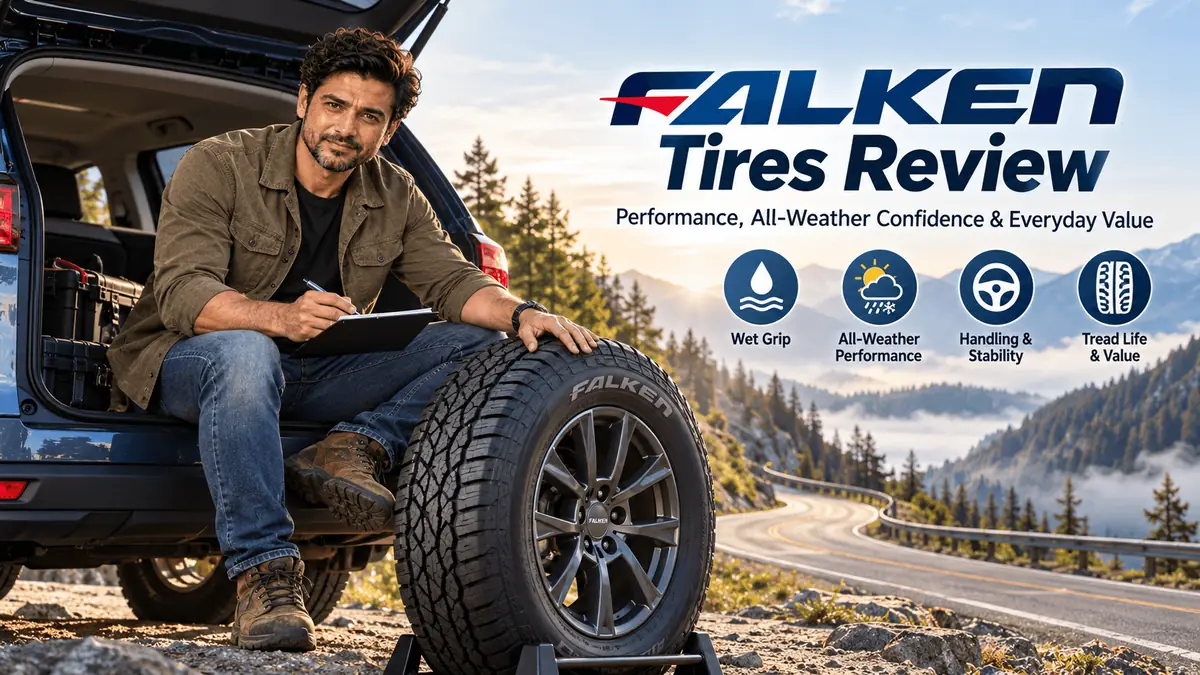
Falken’s catalog stretches from track-capable Azenis performance tires to rugged Wildpeak off-roaders, with comfort-oriented touring tires and dedicated winter models filling in the rest. That range is a strength, but it also means the phrase “Falken tires” doesn’t describe one product — it describes a brand strategy. A driver cross-shopping a Ziex all-season tire is making a completely different decision than someone comparing Azenis RT660s against a set of Michelin Pilot Sports. This review breaks the lineup down by what each family is actually built to do, how Falken performs against pricier competitors in dry, wet, and winter conditions, and which models make sense depending on your vehicle, climate, and budget.
Table of Contents
A Japanese Tire Maker Built on Sumitomo Engineering
Falken was founded in 1983 in Akashi, Japan, and operates as a subsidiary of Sumitomo Rubber Industries, one of the larger tire manufacturers in the world. That ownership structure matters in a practical way: Falken can draw on Sumitomo‘s manufacturing scale, materials research, and global distribution while still competing on price against companies many times its size. Over more than four decades, the brand expanded from a domestic Japanese tiremaker into a company selling in more than 100 countries. SimpleTire notes that Falken tires sold in the US can be made at a plant in Buffalo, New York, as well as in Japan or Thailand.
How this review was put together: We have not road-tested Falken tires for this overview. It is based on Falken’s published warranty terms and retailer ratings, with sources listed at the end. Checked on October 22, 2026.
The Azenis line has functioned as Falken’s technical proving ground since early on — the models that get raced and pushed hardest, with construction and compound work that later filters down into the rest of the catalog. That’s a common pattern among mid-tier tire brands, and it’s part of why Falken’s everyday tires tend to punch above their price point rather than feeling like an afterthought next to a flashier flagship line.
What Falken Actually Sells: A Lineup Built Around Use Case
Falken organizes its tires around four fairly distinct driving priorities, and understanding that structure makes shopping the lineup much easier. A driver chasing cornering grip has almost nothing in common with one who wants a quiet commuter tire that lasts 70,000 miles, and Falken builds separate model families for each of those buyers rather than trying to stretch one tire across every use case.
Azenis: The Performance Flagship
The Azenis RT615K+, RT660, and RT660+ sit at the extreme-performance end of the lineup, aimed at track days, autocross, and drivers who want maximum dry and wet grip over long tread life. The Azenis FK510 softens that focus slightly into a more street-friendly ultra-high-performance summer tire, while the FK001 A/S and FK460 A/S extend Azenis grip into all-season form for drivers who still want sporty handling through a cold snap. On the truck and SUV side, the FK453CC, FK510 SUV, FK510A SUV, and FK520 bring that same cornering-focused engineering to crossovers and performance SUVs that see more curves than gravel.
Ziex, Sincera, and Aklimate: Everyday Comfort and All-Season Traction
For commuters and daily drivers, Falken’s Ziex and Sincera lines emphasize a quiet ride, predictable all-season grip, and long tread life over outright cornering ability. The Ziex ZE950 A/S and ZE960 A/S, along with the Sincera SN250 A/S and SN250A A/S, cover sedans and coupes, while the Aklimate targets drivers who want a single grand-touring all-season tire that handles everything from summer road trips to a light winter storm without a tire change. The Ziex CT50 A/S, CT60 A/S, CT60A A/S, ZE001 A/S, and ZE001A A/S extend that same comfort-first approach to crossovers and SUVs.
Wildpeak and Rubitrek: Trucks, SUVs, and Off-Road
Wildpeak is Falken’s answer to the truck and SUV market, and it spans a wide range of intended use. The Wildpeak H/T HT01A and H/T02 are highway-focused tires for SUVs and light trucks that rarely leave pavement. Moving toward rougher terrain, the Wildpeak A/T Trail, A/T Trail 01A, A/T3W, A/T3W A, and A/T4W are all-terrain tires built for a mix of highway driving and dirt roads, with the Rubitrek A/T01 covering similar ground. At the aggressive end, the Wildpeak R/T01 is a rugged all-terrain tire for drivers who spend more time off-road, and the Wildpeak M/T01 is Falken’s maximum-traction mud-terrain tire for serious off-road use.
Winter-Specific Tires
Falken also builds dedicated cold-weather tires rather than relying solely on all-season models for snow and ice. The Eurowinter HS01 and the studdable Winterpeak F-Ice 1 are engineered specifically for winter compounds and tread design, and the Espia EPZ II rounds out the winter range for drivers in regions where an all-season tire simply isn’t enough.
How Falken Tires Perform on the Road
Dry Grip and Handling
On dry pavement, Falken’s tread compounds and pattern designs favor confident braking and cornering, and that shows up most clearly in the Azenis line, where steering response and high-speed stability are the whole point. Even outside the performance tires, Falken’s everyday models deliver responsive, predictable steering feel for city driving and highway cruising rather than the vague, disconnected feel that can show up in some budget-tier tires.
Wet-Weather Traction
Falken leans on a technology it calls 3D Canyon Sipe Technology — essentially a dense network of thin slits cut into the tread blocks — to increase the number of biting edges available for wet grip. Combined with circumferential and lateral grooves that channel water out from under the tread, that siping helps the tire maintain contact with the road rather than riding up on a layer of water. Falken says this improves wet grip, though we have not compiled independent wet-braking data across its lineup.
Snow and Ice Performance
Falken’s dedicated winter tires — the Eurowinter HS01, Winterpeak F-Ice 1, and Espia EPZ II — use deep, aggressive tread patterns and a rubber compound that stays pliable in freezing temperatures, which keeps the tire biting into snow and ice rather than hardening and skating over the surface. That combination shows up in shorter braking distances, more consistent acceleration on packed snow, and steadier cornering than an all-season or summer tire can offer in the same conditions. It’s worth being clear about the limits, though: Falken’s all-season models, like most all-season tires on the market, lose grip noticeably on deep snow or glare ice, and drivers in harsh winter climates are better served by a dedicated winter tire — whether from Falken or another brand — rather than expecting an all-season tire to do a winter tire’s job.
Ride Comfort and Road Noise
Falken tunes its tread patterns and rubber compounds to absorb road imperfections rather than transmit them straight into the cabin, and that engineering choice pays off most in the Ziex, Sincera, and Aklimate lines, where a smooth, controlled ride over rough pavement is a primary design goal. Falken’s tread and construction methods are also aimed at keeping road noise low. Performance-oriented Azenis models trade some of that hushed comfort for stiffer sidewalls and grippier compounds, which is the usual trade-off with any performance tire — a bit more road noise and firmness in exchange for sharper handling.
Treadwear, Durability, and Expected Lifespan
Treadwear ratings are a standardized measure of how long a tire is expected to last relative to a reference compound, and Falken’s longer-wear touring models also carry strong treadwear warranties: the Sincera SN250 A/S is covered for 80,000 miles on T-rated sizes and 75,000 on H- and V-rated sizes, according to SimpleTire. Long coverage like that reduces both the frequency and the total cost of tire replacement over a vehicle’s ownership period.
Durability extends past the tread itself. Falken builds its casings and belt packages to hold up under heavy loads and high-speed driving, and the tires show good resistance to punctures, cuts, and other road damage — an important consideration for anyone running Wildpeak tires on gravel roads or job sites where sidewall damage is a real risk.
Pricing: How Falken Stacks Up Against Premium Brands
Falken tires typically cost 20 to 30 percent less than comparable tires from Michelin, Bridgestone, or Continental, and that gap widens meaningfully once you’re buying a full set of four. The real question for any budget-conscious shopper isn’t whether Falken is cheaper — it clearly is — but whether the performance and treadwear justify the savings, and the answer depends on which Falken tire you’re looking at.
In the ultra-high-performance and all-season categories, Falken’s value case is strongest. The Azenis FK510 draws consistent praise for its grip and steering feedback at a price well below comparable Michelin or Goodyear UHP tires, and the gap to the very top of the performance segment is narrow enough that most drivers won’t notice it outside of a track environment. The Ziex all-season lineup follows a similar pattern, offering a strong balance of comfort, traction, and tread life for less than what a premium touring tire typically costs.
What Real Owners Say About Falken Tires
Retailer ratings for Falken’s touring tires are strong: the Sincera SN250 A/S averaged 4.7 out of 5 across 74 reviews on SimpleTire in October 2026. We have not compiled verified ratings across the full lineup.
The main limitation is extreme winter conditions: all-season tires, Falken’s included, lose grip on deep snow and ice, which is the general limitation of all-season tires as a category rather than a Falken-specific shortcoming. Drivers in genuinely harsh winters should look at Falken’s dedicated winter lines instead.
Warranty Coverage and Roadside Assistance
Falken backs its passenger and light truck tires with a limited warranty against defects in materials and workmanship, and many models add a treadwear mileage warranty — up to 80,000 miles on T-rated Sincera SN250 A/S sizes and 55,000 miles on the Wildpeak A/T3W. Check the current warranty booklet for any road hazard or roadside coverage.
Falken Tires at a Glance
| Tire Family | Best For | Main Strengths | Main Limitations |
|---|---|---|---|
| Azenis | Sports cars, performance sedans, spirited driving | Dry and wet grip, precise steering response, high-speed stability | Shorter tread life than touring models, road noise on some sizes |
| Ziex / Sincera / Aklimate | Daily commuters, sedans, crossovers | Quiet ride, long tread life, balanced all-season grip | Not built for aggressive cornering or track use |
| Wildpeak / Rubitrek | Trucks, SUVs, crossovers used on dirt roads or trails | Load capacity, rugged construction, on- and off-road traction | More road noise and rolling resistance than highway tires |
| Eurowinter / Winterpeak / Espia | Drivers in snowy or icy climates | Dedicated cold-weather compound, deep biting-edge tread | Softer, less efficient in warm weather; seasonal swap required |
Which Falken Tire Is Right for You
With a lineup this broad, the right starting point is your vehicle and your driving conditions rather than the brand name itself.
By Vehicle Type
- SUV or light truck carrying heavier loads or towing: Wildpeak A/T Trail or Wildpeak M/T, which offer higher load ratings and more rugged construction.
- Sedan or coupe used mainly for commuting: Ziex or Sincera all-season models for comfort and tread life.
- Sports car or performance sedan: Azenis FK510 or RT660 for maximum grip and handling response.
By Driving Conditions
- Harsh winters with regular snow or ice: a dedicated winter tire such as the Espia EPZ II, rather than relying on an all-season tire.
- Mild climate with mostly dry roads: Ziex CT60 A/S or Sincera SN250 A/S for a balance of year-round performance and longevity.
By Priority
- Maximum performance: Azenis FK510 or Azenis RT660 for sports cars and high-performance vehicles.
- Comfort and quiet: Sincera SN828 or Sincera SN201 A/P, tuned for a smooth, low-noise ride while still holding reasonable wear characteristics.
- Off-road capability with daily drivability: Wildpeak A/T3W or A/T4W for trucks and SUVs that split time between pavement and trail.
Falken vs. Michelin, Bridgestone, and Other Premium Brands
Falken doesn’t try to out-engineer Michelin or Bridgestone at the very top of the performance ladder, and in a handful of niche performance categories, premium brands still hold a real edge. Where Falken competes effectively is everywhere else: well-rounded grip and braking across dry, wet, and light winter conditions, a lineup broad enough to cover nearly any vehicle type, and pricing that consistently undercuts comparable premium models by a meaningful margin. Falken also backs many of its tires with treadwear warranties comparable to what larger brands offer, so buyers aren’t sacrificing peace of mind to get the lower price. For most everyday driving situations, the practical difference between a well-chosen Falken tire and a similarly specced premium tire is smaller than the price gap would suggest.
Falken Tires: Pros and Cons
Pros
- Strong wet and dry grip thanks to advanced tread compounds and dense siping
- Comfortable, quiet ride across the Ziex, Sincera, and Aklimate lines
- Long treadwear warranties on touring lines, up to 80,000 miles on the Sincera SN250 (T-rated)
- Pricing that runs 20 to 30 percent below comparable premium-brand tires
- Broad lineup covering performance, touring, truck/SUV, and dedicated winter needs
Cons
- Pricing isn’t the lowest in the budget tier, so hardcore bargain shoppers may find cheaper alternatives
- Some models run louder than comparable premium-brand tires
- All-season models, like the category generally, struggle in deep snow or on ice compared with dedicated winter tires
- Fewer specialized or niche-application options than the largest global tire brands
Full Falken Tire Lineup (Reference)
For reference, here is Falken’s current U.S. tire lineup grouped by category.
| Extreme Performance Summer |
|---|
| Azenis RT615K+ |
| Azenis RT660 |
| Azenis RT660+ |
| Ultra High Performance Summer |
| Azenis FK510 |
| Ultra High Performance All-Season |
| Pro G5 CSV |
| Azenis FK001 A/S |
| Azenis FK460 A/S |
| Ziex ZE950 A/S |
| Eurowinter HS01 |
| Grand Touring All-Season |
| Aklimate |
| Sincera SN250 A/S |
| Sincera SN250A A/S |
| Ziex ZE960 A/S |
| Studdable Winter / Snow |
| Winterpeak F-Ice 1 |
| Temporary / Compact Spare |
| FK-090 |
| Street / Sport Truck Summer |
| Azenis FK453CC |
| Azenis FK510 SUV |
| Azenis FK510A SUV |
| Azenis FK520 |
| Crossover / SUV Touring All-Season |
| Wildpeak H/T HT01A |
| Ziex CT50 A/S |
| Ziex CT60 A/S |
| Ziex CT60A A/S |
| Ziex ZE001 A/S |
| Ziex ZE001A A/S |
| Highway All-Season |
| Wildpeak H/T02 |
| On-Road All-Terrain |
| Wildpeak A/T Trail |
| Wildpeak A/T Trail 01A |
| Wildpeak A/T3W A |
| Off-Road All-Terrain |
| Rubitrek A/T01 |
| Wildpeak A/T3W |
| Wildpeak A/T4W |
| Rugged All-Terrain |
| Wildpeak R/T01 |
| Off-Road Maximum Traction |
| Wildpeak M/T01 |
Frequently Asked Questions
Yes. Backed by more than four decades of manufacturing experience and Sumitomo Rubber Industries’ engineering resources, Falken delivers strong grip, handling, and durability at prices below most premium competitors.
Treadwear warranties run up to 80,000 miles on T-rated Sincera SN250 A/S sizes, while performance and all-terrain models carry less.
The Wildpeak family covers this segment well: the A/T3W and A/T4W for on- and off-road all-terrain use, the M/T01 for serious off-road traction, and the H/T02 for a highway-focused ride with SUV load capacity.
Falken’s tread compounds, grooves, and 3D Canyon Sipe Technology combine to move water away from the contact patch efficiently.
Falken’s dedicated winter tires, including the Espia EPZ II, perform well in snow and ice thanks to deep tread patterns and a compound that stays pliable in cold temperatures. Falken’s all-season models handle light snow reasonably but, like most all-season tires, aren’t a substitute for a winter tire in harsh climates.
Falken tires typically cost 20 to 30 percent less than comparable models from Michelin or Bridgestone while delivering performance that’s close enough for most drivers to notice only a small difference, if any, outside of extreme or track conditions.
Falken provides a limited warranty against defects and, on many models, a treadwear mileage warranty. Check current terms for any road hazard or roadside coverage.
The Azenis FK510 and RT660 are Falken’s top picks for performance driving, offering strong grip, responsive handling, and confident braking for sports cars and performance sedans.
Sumitomo Rubber Industries, one of the larger tire manufacturers in the world. Falken was founded in Akashi, Japan, in 1983 and draws on Sumitomo’s manufacturing scale, materials research and distribution.
Final Verdict: Are Falken Tires Worth Buying?
Falken earns its reputation as a value-oriented alternative to premium tire brands rather than a compromise. The Azenis line delivers real performance credibility for drivers who want sharp handling without a premium-brand price tag, the Ziex and Sincera lines are genuinely well-suited to daily commuting with their quiet ride and long tread life, and the Wildpeak family gives truck and SUV owners a capable option for everything from highway commuting to light off-roading.
No single tire family covers every need — drivers in serious winter climates should still step up to a dedicated winter tire, and anyone chasing the absolute peak of performance may still find a reason to pay more for a top-tier premium brand. But for the large majority of everyday driving situations, Falken’s combination of pricing, warranty support, and design makes it an easy brand to recommend, particularly for drivers who want dependable, well-rounded tires without paying a premium-brand markup.
Sources
Specs, warranty terms and prices were checked on October 22, 2026. Prices change often.
- SimpleTire: Falken Sincera SN250 A/S (warranty by speed rating, price, ratings, plants)
 Summarize this article with:














Leave a comment