


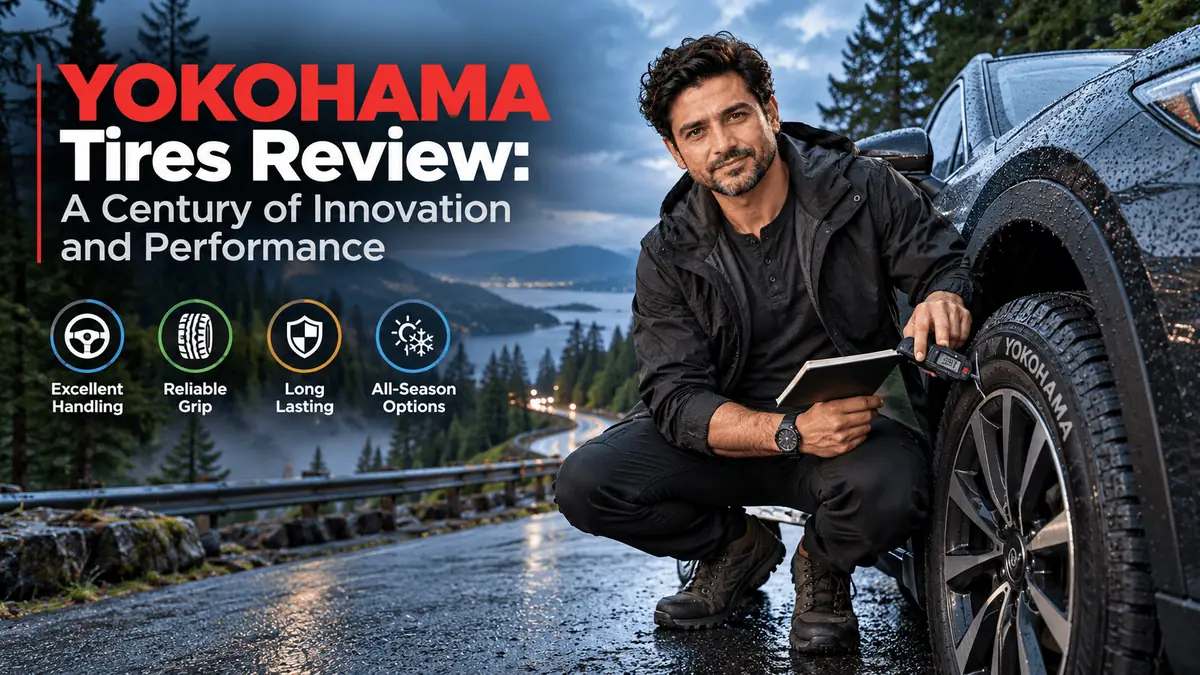
Yokohama doesn’t carry the brand recognition of Michelin or Goodyear on this side of the Pacific, and that gap is exactly why so many shoppers hesitate over it mid-search. The name feels less familiar, the retail presence is smaller, and it’s tempting to default to whatever the big three happen to be selling at the local shop. But Yokohama has been building tires since 1917, and its current US lineup — fuel-focused BluEarth all-season tires, performance-tuned ADVAN models, and rugged Geolandar options for trucks and SUVs — competes directly with the household names on price, warranty coverage, and everyday performance. The real question isn’t whether Yokohama counts as a legitimate tire brand. It’s whether this particular lineup fits your vehicle, your climate, and your driving habits better than whatever is sitting next to it on the shelf.
| Category | Yokohama Tires — Brand Snapshot |
|---|---|
| Founded | 1917, Yokohama, Japan; headquartered in Tokyo |
| Best for | Drivers who want Michelin/Bridgestone-level performance at a lower price, plus buyers who prioritize fuel efficiency or long tread-life warranties |
| Main lineup | All-season and performance tires for passenger cars (including the ADVAN line), all-terrain and mud-terrain tires for trucks and SUVs (Geolandar), winter tires, and commercial truck/bus tires |
| Signature technology | BluEarth (low rolling resistance) and Orange Oil compound (natural rubber blend for grip and tread life) |
| Price position | Mid-range — generally on par with or slightly below Michelin, Bridgestone, and Goodyear |
| Warranty highlight | Tread life coverage up to 85,000 miles (Avid Ascend LX) |
| Main limitation | Smaller US dealer footprint and lower name recognition than the largest global brands |
Table of Contents
A Century in the Tire Business
Yokohama Rubber traces its history back to 1917, when the company was founded in the Japanese city that gave it its name. Two decades later, in 1938, it produced Japan’s first pneumatic tire built specifically for passenger vehicles, a milestone that put the company at the front of the country’s emerging automotive industry. From that starting point, Yokohama grew well beyond its home market, building manufacturing plants across multiple continents to supply tires to North America, Europe, and other regions. Today the company is headquartered in Tokyo and produces tires for nearly every category of vehicle found on US roads, from compact sedans to heavy commercial trucks.
How this review was put together: We have not road-tested Yokohama tires for this overview. It is based on Yokohama’s published warranty terms and retailer ratings, with sources listed at the end. Checked on October 22, 2026.
What Yokohama Actually Sells
For passenger cars, the lineup splits along fairly familiar lines. All-season tires spread traction, handling, and durability evenly across the calendar, which makes them the default pick for most drivers in regions that don’t see extreme winters. Step up into the ADVAN performance line and the priorities shift: stiffer construction and more aggressive contact patches trade away some of that all-around balance for sharper cornering grip and more direct steering feedback — a trade-off that matters to drivers who care how a car feels through a bend, not just how many miles a tire lasts.
On the truck and SUV side, Yokohama’s Geolandar tires take a different approach entirely. These are built around reinforced sidewalls, more aggressive tread blocks, and construction meant to survive load-bearing duty and rough terrain, whether that’s a work truck hauling equipment or an SUV headed off pavement on weekends. Yokohama also produces tires for commercial vehicles, including buses and long-haul trucks, engineered around the higher loads and mileage demands that fleet operators deal with every day.
The Technology Behind the Grip
Two technologies show up repeatedly across Yokohama’s catalog, and understanding them explains a lot about how the company positions individual models.
BluEarth is Yokohama’s rolling-resistance platform, built to squeeze more fuel economy — or more range, on EV-oriented models — out of a tire without giving up grip or handling. Yokohama has folded BluEarth into several product lines rather than confining it to one model, so shoppers comparing multiple Yokohama tires may see the name attached to more than one option.
Orange Oil is the more unusual of the two. Yokohama blends natural rubber compounds derived from orange peel oil into the tire, which the company says improves tread life and wet grip while trimming the environmental footprint compared with a fully petroleum-based compound. It appears most often in Yokohama’s higher-performance lines, where wet and dry grip both carry real weight in the buying decision.
On the tread side, Yokohama’s patented Triple Tube and Micro Tube designs move water out from under the tire faster, which cuts down on hydroplaning risk in heavy rain. Combine that with the company’s use of advanced silica compounds — including silica derived from rice husk ash in some lines — and the strategy becomes clear: extract more tread life and wet-weather grip from the compound without asking drivers to choose between them.
Performance and Durability on the Road
Yokohama’s passenger tires are designed for responsive steering and solid wet grip, but we have not compiled independent test data across the lineup. Retailer ratings for its long-life touring tire are strong: the Avid Ascend LX averaged 4.7 out of 5 across 47 reviews on SimpleTire in October 2026.
Off pavement, Yokohama’s all-terrain and mud-terrain tires earn similar marks for puncture resistance and traction on loose or uneven ground — a meaningful distinction if your truck or SUV sees genuine off-road use rather than just the occasional gravel driveway.
Sustainability: More Than a Marketing Line
Yokohama treats environmental impact as part of the manufacturing process rather than something added after the fact. The company has shifted toward renewable energy and more efficient methods at its production facilities, invested in recycling technology that reuses tire materials, and worked rice husk ash-derived silica into some compounds instead of relying solely on petroleum-based inputs. On the product side, the lower-rolling-resistance BluEarth line is built specifically to reduce vehicle emissions and cut fuel consumption. Yokohama also publishes sustainability reports outlining its environmental targets, giving shoppers who care about this a way to check progress rather than take the marketing at face value.
Pricing, Warranty, and Value
Yokohama generally prices its tires in the same range as Michelin, Bridgestone, and Goodyear for comparable categories — sometimes matching them, sometimes landing a bit below. That puts the brand firmly in mid-range territory: not a budget option, but not the priciest name on the shelf either.
Warranty coverage is one of Yokohama’s stronger selling points. Its longest, the Avid Ascend LX, carries an 85,000-mile tread life warranty, according to SimpleTire, while performance models such as the ADVAN Apex V601 carry 25,000 miles. For a driver planning to keep a set of tires for the long haul, that combination of competitive pricing and above-average warranty coverage does real work: it lowers the effective cost per mile even when the sticker price looks similar to a competitor’s.
Customer Support and Ownership Experience
Yokohama warranty claims, covering workmanship and material defects as well as treadwear, run through its authorized dealers, where installation, rotation and warranty inspections can be handled in person.
Industry Recognition
Yokohama vs. Michelin and Bridgestone
On raw performance and durability, Yokohama holds its own against Michelin and Bridgestone rather than trailing behind them — the gap that once separated Japanese and European tire technology has largely closed. Where Yokohama pulls ahead is sustainability positioning: the BluEarth line’s low rolling resistance and reduced-carbon-footprint approach undercuts what several established competitors offer in the same eco-focused space.
| Factor | Yokohama | Michelin / Bridgestone |
|---|---|---|
| Everyday performance | Competitive dry and wet grip across the mainstream lineup | Strong, well-documented performance across nearly every category |
| Pricing | Mid-range; usually at or below comparable Michelin/Bridgestone tiers | Often at the top of the pricing range, especially for Michelin |
| Warranty | Up to 85,000 miles (Avid Ascend LX) | Varies widely by line; flagship models often match or exceed this |
| Sustainability focus | BluEarth low-rolling-resistance line and Orange Oil compound | Growing eco-focused lines, but not always the pricing advantage |
| Dealer availability | Smaller US network than the largest brands | Extensive nationwide dealer and retail presence |
Choose Yokohama over the bigger names when the priority is stretching a tire budget without dropping down to a true economy brand — the pricing gap versus Michelin in particular can be significant for comparable performance. Stick with Michelin or Bridgestone when brand-name resale value or the widest possible dealer footprint in your specific area outweighs the price difference.
Who Should Buy Yokohama Tires?
Before choosing a specific model, confirm the tire size, load rating, and speed rating your vehicle requires — that information lives in the owner’s manual or on the placard inside the driver’s door jamb, and matching it correctly matters more to safety than any brand comparison.
- Daily commuters who rack up steady highway miles and want long tread life plus better fuel economy should look at Yokohama’s BluEarth all-season tires.
- Drivers who want sharper handling and are willing to trade some ride comfort and tread life for it are better served by the ADVAN performance line.
- Truck and SUV owners who tow, haul, or head off-road regularly should look at Geolandar all-terrain or mud-terrain models built for reinforced sidewalls and aggressive tread.
- Drivers in regions with real winter weather should check Yokohama’s dedicated winter tire options rather than relying on an all-season model.
- Fleet operators and commercial drivers can consider Yokohama’s truck and bus tires, which are built around higher load ratings and mileage demands.
Once you’ve narrowed the category, decide whether to buy online or through a local dealer. Online shopping is often more convenient and competitively priced, but an in-store visit gets you a professional opinion tailored to your specific vehicle and driving conditions, plus correct installation and balancing on the spot. Whichever route you take, ask about a rotation schedule up front — even a well-built tire wears unevenly without it, and skipping rotations is one of the fastest ways to void a treadwear warranty.
Pros and Cons
Pros
- A century of manufacturing experience and global scale back a lineup that covers nearly every vehicle type on the road.
- BluEarth technology delivers fuel-efficiency-focused tires without an obvious grip or handling penalty.
- Warranty coverage up to 85,000 miles on the Avid Ascend LX is competitive with far more recognizable brands.
- Mid-range pricing versus Michelin, Bridgestone, and Goodyear makes Yokohama a reasonable way to save money without stepping down to an economy brand.
- A genuine sustainability program, not just a single eco-labeled tire line.
Cons
- Lower brand recognition in the US than the largest global names, which can mean fewer local dealers depending on where you live.
- Performance-oriented ADVAN models are priced closer to competitors’ premium tiers, so the value advantage isn’t uniform across the entire catalog.
- Shoppers used to seeing extensive third-party long-term test data for Michelin or Bridgestone may find less of that specific to Yokohama’s newest releases.
Frequently Asked Questions
Yes. Yokohama has manufactured tires since 1917 and produces a broad lineup — from all-season and performance passenger tires to all-terrain, mud-terrain, and commercial truck tires — that competes directly with Michelin, Bridgestone, and Goodyear on performance and warranty coverage, typically at a slightly lower price.
The two brands are close on everyday performance and durability. Yokohama’s main advantage is pricing, since it generally sits at or below Michelin in comparable categories. Michelin’s advantage is brand recognition and a larger US dealer network, which can matter if local service access is a priority.
Many do. Tread life warranties vary by model, up to 85,000 miles on the Avid Ascend LX. Actual tread life still depends on driving habits, alignment, and regular rotation.
Yokohama’s dedicated winter tires are built for cold-weather traction and are a better choice for snowy climates than relying on an all-season model. All-season Yokohama tires handle occasional light snow reasonably well but aren’t a substitute for a true winter tire in areas with serious winter weather.
Yokohama sits in mid-range pricing territory — generally on par with or slightly below Michelin, Bridgestone, and Goodyear for similar tire categories, and above true budget or economy brands.
BluEarth is Yokohama’s approach to reducing rolling resistance, aimed at improving fuel economy or EV range without sacrificing grip or handling. It appears across several Yokohama product lines rather than a single model.
Yes. Select models carry tread life coverage up to 85,000 miles, which is competitive with — and in some cases better than — what more widely recognized brands offer at similar price points.
Yokohama is one of the world’s top-ten tire makers and has built tires since 1917. It sits just below Michelin, Bridgestone and Goodyear on brand recognition in the US, but holds its own against them on performance and durability.
They are close. Yokohama competes directly with Goodyear on performance and warranty coverage and is typically priced at or slightly below comparable Goodyear tires. Goodyear has more brand recognition in the US.
It is mid-range on price rather than top-shelf, usually at or slightly below Michelin, Bridgestone and Goodyear and well above economy brands. On performance and durability, though, it holds its own against those premium names.
Final Verdict
Yokohama earns its place on the shortlist rather than sneaking onto it by default. The brand’s core strengths are concrete: a lineup that covers nearly every vehicle type, genuine warranty coverage that rivals far bigger names, a real sustainability program built into the manufacturing process rather than a single marketing line, and pricing that consistently undercuts Michelin without asking drivers to settle for a true economy tire. The compromises are equally real but narrower — a smaller US dealer network than the biggest global brands, less brand-name cachet at resale, and a premium performance tier that doesn’t carry the same pricing advantage as the mainstream lineup.
For commuters chasing tread life and fuel efficiency, truck and SUV owners who need a tire that can actually handle rough terrain, and budget-conscious buyers who still want a warranty they can rely on, Yokohama is worth cross-shopping seriously against the bigger names rather than dismissing on unfamiliarity alone. Drivers who weight dealer convenience or resale branding above everything else may still lean toward Michelin or Bridgestone — and that’s a reasonable call too. But on the merits of the tires themselves, Yokohama holds up.
Sources
Specs, warranty terms and prices were checked on October 22, 2026. Prices change often.
- SimpleTire: Yokohama Avid Ascend LX (85,000-mile warranty, prices, ratings)
- SimpleTire: Yokohama ADVAN Apex V601 (25,000-mile warranty)
- Yokohama: Geolandar A/T G015 (60,000/50,000-mile warranty)
 Summarize this article with:













Leave a comment