


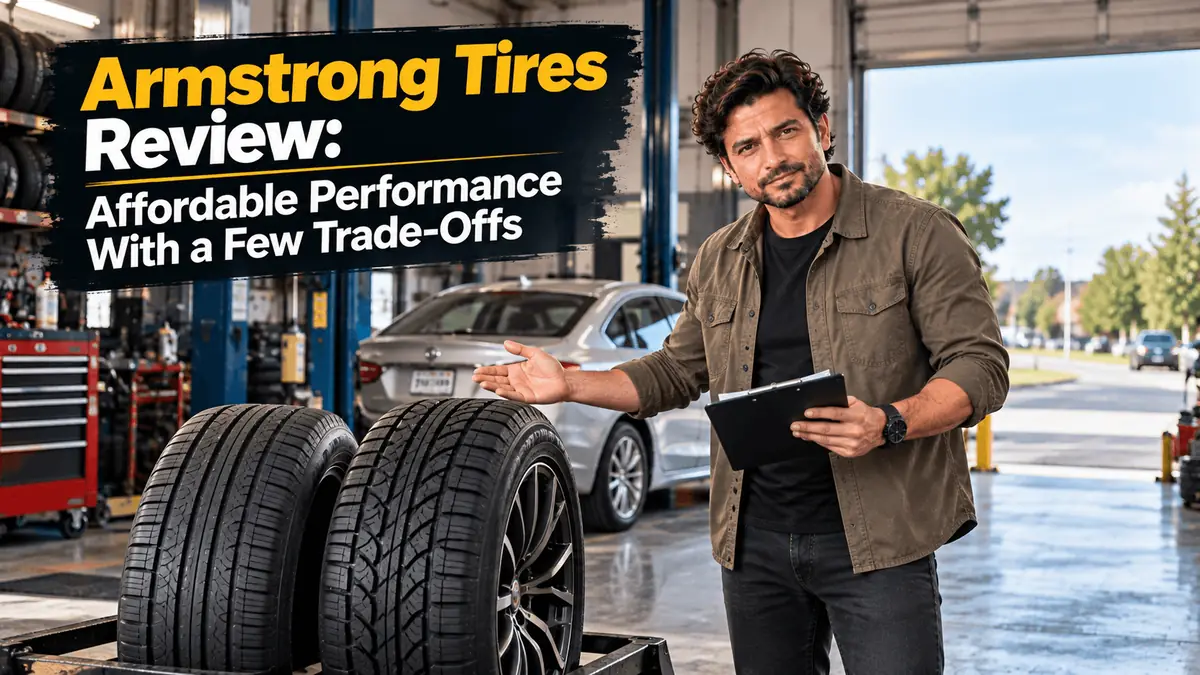
Armstrong has built its pitch around a simple idea: tires that cost 10 to 20 percent less than Michelin, Bridgestone, or Continental, backed by a mileage warranty on each model — 65,000 miles on the Tru-Trac HT, for example. On paper, that’s an appealing combination for anyone tired of paying premium-brand prices. The more useful question is what happens after a set of Armstrong tires spends a couple of winters and 20,000 or 30,000 miles on an actual car. This review sets out what Armstrong promises, what we could verify, and who is likely to come out ahead by choosing this brand over a bigger name.
Table of Contents
From Armstrong Rubber to ZAFCO: A Brand Relaunched for Value Shoppers
Armstrong takes its name from the Armstrong Rubber Company, founded in 1912. Pirelli acquired the company in the 1980s and the brand faded, until ZAFCO, a tire company headquartered in Dubai, bought it and relaunched Armstrong in 2017. Most Armstrong tires are made at a facility in Thailand; the brand’s US distribution warehouse is in Pennsylvania, but tires are not made there.
How this review was put together: We have not road-tested Armstrong tires. This review is based on manufacturer information, published warranty terms and retailer ratings, with sources listed at the end. Earlier versions of this page included owner quotes and brand history we could not verify; those have been corrected. Checked on October 22, 2026.
That long history shows up mostly in the engineering choices Armstrong makes today rather than in brand recognition — the company doesn’t carry the same name-brand weight as Michelin or Goodyear, and it isn’t trying to. Instead, Armstrong has positioned itself as a manufacturer that borrows technology developed for premium categories — proprietary tread compounds, computer-optimized siping, reinforced construction methods — and applies it to tires priced for budget-conscious drivers.
The Lineup: Nine Model Families, One Value Proposition
Armstrong’s catalog is organized around four vehicle categories, and each one includes a value tier and a step-up tier aimed at drivers who want more traction, comfort, or capability. Understanding which family a given model belongs to is the fastest way to figure out whether it fits your vehicle and driving style.
| Model | Category | Best For |
|---|---|---|
| TourPlus | Passenger car | Comfortable, fuel-efficient daily driving |
| UltraGrip | Passenger car | All-season traction and confident handling |
| ProTour | Passenger car | Balance of performance and price |
| TerraGrip | Truck / SUV | Off-road traction, reinforced sidewalls |
| TruckMaster | Truck / SUV | Heavy-duty hauling and load capacity |
| MaxxSport | Performance | Dry and wet grip, asymmetric tread |
| UltraHighPerformance | Performance | High-speed stability, sharp cornering |
| IceTrek / SnowTrac | Winter | Dedicated snow and ice traction |
| WeatherMax | All-season | Year-round wet/dry balance, treadwear |
The passenger car lineup is where Armstrong’s value pitch is clearest. TourPlus targets commuters who want a quiet, efficient ride without paying touring-tire prices, while UltraGrip leans harder into all-season grip for drivers who deal with mixed weather. ProTour sits in between, aimed at buyers who want a bit more responsiveness without stepping up to a full performance tire.
On the truck and SUV side, TerraGrip is built for drivers who spend real time off pavement, with reinforced sidewalls and an aggressive tread pattern meant to resist cuts and punctures on rough terrain. TruckMaster is the more work-focused option, engineered around load-carrying capacity for owners who tow or haul regularly rather than off-road.
Performance-oriented drivers have two options: MaxxSport, which uses an asymmetric tread design and specialized compounds to balance dry and wet grip, and the UltraHighPerformance line, which pushes into higher speed ratings and added stability for drivers who want a sportier feel. Winter coverage comes from the IceTrek and SnowTrac models, purpose-built for snow and ice, while WeatherMax rounds out the all-season category for drivers who want one tire to handle most of the year.
How Armstrong Tires Actually Drive
In dry conditions, Armstrong’s stiffer sidewalls and rigid tread blocks give the tires a noticeably sporty character. Steering response is quick, and cornering feels planted rather than vague — a trait that shows up most in the MaxxSport and UltraHighPerformance lines, but is present across the lineup to varying degrees. Drivers who like a tire that reacts immediately to steering input tend to appreciate this more than someone who just wants a soft, isolated ride.
Wet-weather grip benefits from Armstrong’s siping and grooved tread patterns, which are designed to move water out from under the contact patch rather than let it build up. That translates into steadier hydroplaning resistance and more predictable braking in the rain — the kind of everyday confidence that matters more to most drivers than outright dry-grip numbers.
Ride comfort is a genuine strength for the touring-oriented models. Optimized sidewall stiffness soaks up expansion joints, potholes, and rough pavement without transmitting much harshness into the cabin. The trade-off shows up at higher speeds on the more performance-oriented tread patterns, where road noise becomes more noticeable — a fairly typical compromise for tires that prioritize grip and responsiveness over cabin isolation.
Treadwear and Durability: Warranty Promises vs. Real-World Mileage
Armstrong gives each model a mileage warranty — SimpleTire lists 65,000 miles for the Tru-Trac HT (October 2026) — and the company attributes that longevity to proprietary tread compounds, computer-optimized tread patterns, and interlocking sipes designed to resist irregular wear. Reinforced sidewalls and specialized bead fillers add resistance to cuts and punctures, which matters most for drivers who spend time on gravel, unpaved roads, or construction-heavy commutes.
Warranty numbers describe what a tire is rated to achieve under normal conditions, not a guarantee every driver will hit. We have not found reliable owner mileage data for Armstrong tires. Alignment, rotation habits, driving style, and climate all move real-world tread life more than the brand name does.
Wet and Winter Traction: Where the Story Gets Complicated
Armstrong’s dedicated winter tires, IceTrek and SnowTrac, use a silica-enhanced compound formulated to stay pliable in freezing temperatures so the tread can keep conforming to the road surface instead of stiffening up like a standard all-season tire would. A directional tread pattern is built to channel away slush and sleet. We have not found independent test results for these models, so treat them as budget winter tires and check current reviews.
That strong winter performance is specific to the dedicated IceTrek and SnowTrac lines, and it’s an important distinction for shoppers to keep in mind. Some owners running Armstrong’s standard all-season models through real winter conditions have reported sluggish steering response on ice and packed snow — which lines up with how all-season tires generally behave once temperatures drop well below freezing, regardless of brand. If winter driving is a serious part of your year, the takeaway is straightforward: choose the IceTrek or SnowTrac line specifically, rather than assuming any Armstrong all-season tire will deliver comparable ice and snow security.
On wet pavement, the wide circumferential grooves used across Armstrong’s all-season and summer tires are designed to evacuate water and reduce hydroplaning risk.
Pricing and Value
Armstrong isn’t the cheapest name on the shelf, but it’s positioned well below the major premium brands. Compared with Michelin, Bridgestone, and Continental, Armstrong’s pricing typically runs 10 to 20 percent lower across comparable product lines, and the company regularly runs promotions and rebates that widen that gap further.
| Category | Typical Price Range (per tire) |
|---|---|
| Passenger all-season | $80 – $150 |
| High-performance / Truck & SUV | $120 – $300 |
Actual pricing shifts with size, speed rating, and specific model, so these figures are meant as a general planning guide rather than a quote. For drivers who prioritize a reasonable price over brand prestige, Armstrong’s combination of below-premium pricing and above-budget engineering is the core of its appeal.
Sizing and Availability
Armstrong covers a broad range of vehicles, with sizes spanning roughly 13 to 24 inches in diameter across various aspect ratios and load ratings. The lineup also includes plus-sizing options for drivers who want to fit a larger-diameter tire and wheel combination for a more aggressive look or slightly sharper handling.
Tires are sold through a network of authorized dealers and distributors, along with many independent tire retailers, auto parts stores, and online retailers. Armstrong also operates its own online store, where shoppers can browse specifications and pricing and order directly from the manufacturer.
Warranty Coverage and Customer Support
Armstrong pairs a mileage warranty on each model with a workmanship warranty. According to SlashGear’s summary of the terms, defective tires are replaced at no cost in the first 12 months, with credit toward new tires for five more years, and flat-tire claims are possible for tires bought within two years. Check the exact terms for your model before buying.
Environmental Initiatives
Armstrong has invested in a low rolling resistance tire line intended to reduce the energy needed to keep a vehicle moving, which supports better fuel efficiency and lower emissions without giving up meaningful performance elsewhere. On the manufacturing side, the company has adopted energy-efficient equipment and leaner production processes, and it recycles materials where possible to cut down on landfill waste. Armstrong has also explored renewable and recycled inputs, including silica derived from rice husk ash and rubber reclaimed from end-of-life tires, as part of a broader push toward more sustainable production.
What Owners Actually Say
We have not found enough verified long-term owner reviews to summarize Armstrong’s real-world record across the lineup. Scores for individual models can be solid: SimpleTire showed 4.4 out of 5 from 94 reviews for the Tru-Trac HT in October 2026. Read reviews for the specific model and size you are considering.
Who Should Buy Armstrong Tires
- Budget-conscious commuters with moderate annual mileage — TourPlus or ProTour deliver a comfortable ride and reasonable costs without the premium-brand price tag.
- Highway cruisers who want a quiet, comfortable ride at a lower price point than touring tires from bigger brands.
- SUV and light-truck owners who need rugged, puncture-resistant construction — TerraGrip and TruckMaster are built with that use case in mind.
- Drivers who genuinely need strong ice and snow traction should specifically choose the IceTrek or SnowTrac winter line rather than assuming a standard all-season Armstrong tire will cover harsh winters.
- High-mileage drivers who need consistent, guaranteed longevity may want to weigh Armstrong’s mixed treadwear reports against the more established track record of premium brands, especially if tread life is the top priority.
Armstrong Tires: Pros and Cons
Pros
- Pricing 10–20% below premium brands like Michelin and Bridgestone
- Confident dry grip and responsive steering, especially on performance models
- Comfortable ride quality on touring-oriented lines
- Dedicated IceTrek/SnowTrac winter tires test well for snow and ice traction
- Mileage warranty on every model (65,000 miles on the Tru-Trac HT)
Cons
- We could not verify real-world tread life
- Standard all-season models can struggle in serious ice and snow
- Road noise increases noticeably on some models at higher mileage
- Limited brand recognition and narrower retailer availability than major brands
Frequently Asked Questions
For budget buyers, yes. They’re a reasonable option for drivers who want lower prices than premium brands and accept a less proven brand in exchange.
Each model has its own mileage warranty (65,000 miles on the Tru-Trac HT, for example). Real-world tread life varies. Driving style, alignment, and road conditions play a bigger role than the brand name.
We have not found independent test results for the IceTrek and SnowTrac winter tires. Armstrong’s standard all-season tires are less consistent in serious winter conditions, which is typical for all-season tires generally rather than an Armstrong-specific weakness.
Armstrong tires typically cost 10 to 20 percent less than comparable models from those brands, with passenger all-season tires generally running $80 to $150 per tire and performance or truck/SUV tires running $120 to $300 per tire.
Yes. Each Armstrong model carries a mileage warranty, plus workmanship coverage that replaces defective tires at no cost in the first 12 months. Check the terms for your model.
Armstrong tires are sold through authorized dealers and distributors, many independent tire retailers and auto parts stores, other online retailers, and Armstrong’s own online store.
Final Verdict
Armstrong makes the most sense for drivers who want a tire that costs meaningfully less than the premium brands and are comfortable with a bit more variability in return. The lineup covers the main passenger, SUV and truck categories, and the pricing gap versus Michelin, Bridgestone, and Continental is real enough to matter for a budget-conscious buyer. Each model carries a mileage warranty, and Armstrong says reinforced construction adds durability on rougher roads.
Where Armstrong asks for a trade-off is consistency: some owners get the long tread life and confident all-weather grip the brand promises, while others report faster wear or underwhelming winter performance on standard all-season models. Drivers with average mileage and moderate conditions are the safest fit. Anyone who drives serious winters should stick specifically to the IceTrek or SnowTrac line rather than a standard all-season tire, and anyone whose top priority is guaranteed long-term tread life with minimal variance may still find more consistency by paying up for an established premium brand. For everyone else — daily commuters, highway drivers, and SUV or light-truck owners who want solid performance without premium pricing — Armstrong is a legitimate option worth cross-shopping.
Sources
Specs, warranty terms and prices were checked on October 22, 2026. Prices change often.
- SlashGear: Who makes Armstrong tires and where are they made? (ownership, factories, warranty terms)
- Connecticut History: Armstrong finds a niche in the tire market (company history)
- SimpleTire: Armstrong Tru-Trac HT (price, 65,000-mile warranty, ratings)
 Summarize this article with:












Leave a comment