


The Pirelli Scorpion Winter 3 is the third generation of Pirelli‘s winter tire for SUVs. Put car-sized winter tires on a 5,000-pound SUV and the physics work against you. As a result, the extra weight and higher center of gravity load the tread harder and smear the contact patch under braking. They also wear down the biting edges that do the work on snow. This Pirelli Scorpion Winter 3 review looks at how well the new tire handles that problem.
Still, it arrives with more to prove than most new tires. The Scorpion Winter 2 was a capable but rarely dominant tire, typically finishing mid-pack in independent SUV winter comparisons. The new model borrows its tread pattern from Pirelli’s award-winning Cinturato Winter 3. Its compound comes from the P Zero Winter 2, and its carcass is built for heavier vehicles. Early independent results are promising. However, the first test results come from Europe, where Pirelli aimed the launch, so U.S. buyers have less data to go on.
Below, we cover what changed and how the tire did in its first head-to-head test. We also look at where it falls short and which SUV owners should watch for it.
How this review was put together: We have not road-tested the Pirelli Scorpion Winter 3. This review is based on Pirelli’s published information, EU tire label data and independent magazine tests. Sources are listed at the end. Details were checked on November 2, 2026; availability and terms change, so confirm them for your size.
Table of Contents
Pirelli Scorpion Winter 3 at a Glance
| Category | Summary |
|---|---|
| Tire type | Dedicated winter tire for SUVs and crossovers, three-peak mountain snowflake (3PMSF) rated |
| Best for | Owners of mid-size and large SUVs who face regular snow, slush, and cold rain |
| Main strengths | Class-leading wet braking in its first independent test, strong snow grip, consistent grip as the tread wears (per Pirelli) |
| Main limitations | Higher rolling resistance than key rivals, mid-pack dry braking, no treadwear mileage warranty expected |
| Sizes | 30 sizes at launch, 18 to 22 inches, V and W speed ratings |
| Special versions | Elect (EVs and plug-in hybrids), PNCS (noise-reducing foam), Seal Inside (puncture sealing) |
| Replaces | Pirelli Scorpion Winter 2 |
| Price position | Premium, in line with other flagship SUV winter tires |
Why Pirelli Built a Separate Winter Tire for SUVs
SUVs and crossovers now account for more than half of global new-vehicle sales, according to Pirelli. Consequently, that shift has changed what a winter tire has to do. First, a heavier vehicle presses the tread into the road with more force, which concentrates pressure in certain parts of the contact patch. In turn, that uneven pressure speeds up wear in some areas. As the tread wears unevenly, the sipes and edges that grip snow disappear faster than they should.
For example, most winter tire marketing focuses on how a tire performs when new. Instead, Pirelli started the Scorpion Winter 3 project at the other end of the problem, looking at how the tire behaves under heavy loads over time. To solve this, engineers reshaped the contact patch to smooth out pressure peaks. Pirelli says the result is a tire that keeps roughly the same number of biting edges on the road as the tread wears down. If that holds up in real-world use, it fixes a common frustration with winter tires. Too many sets feel excellent in their first season and noticeably weaker by their third.
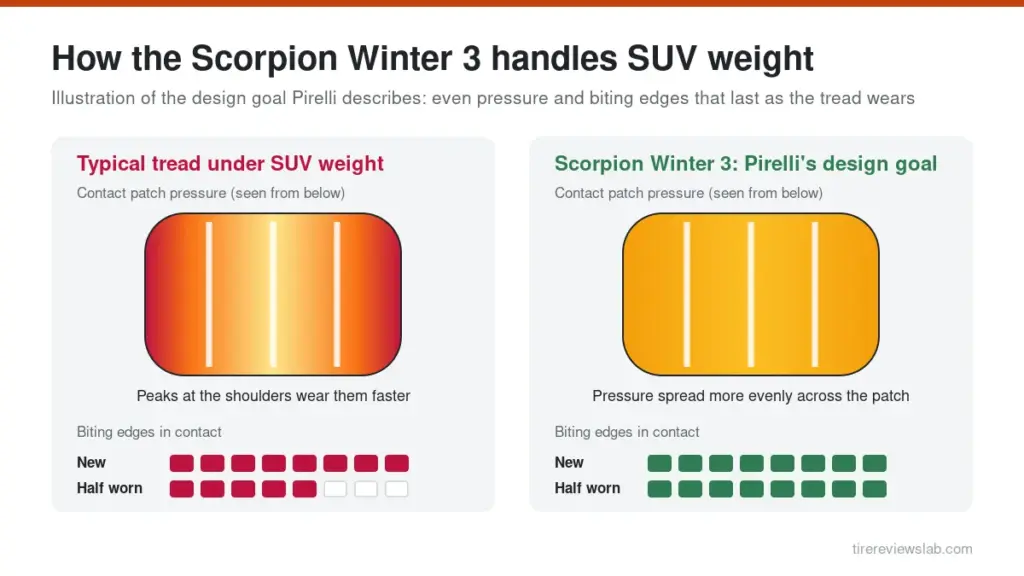
Similarly, the internal structure gets the same treatment. The Scorpion Winter 3 doesn’t share a carcass with Pirelli’s passenger car winter tires. It uses a dedicated construction rated for the weight of modern SUVs, including electric models with heavy battery packs.
What’s New: Tread, Compound, and Construction
The Scorpion Winter 3 is best understood as a combination of proven pieces from elsewhere in Pirelli’s winter lineup, adapted for heavier vehicles.
A Tread Pattern With a Winning Pedigree
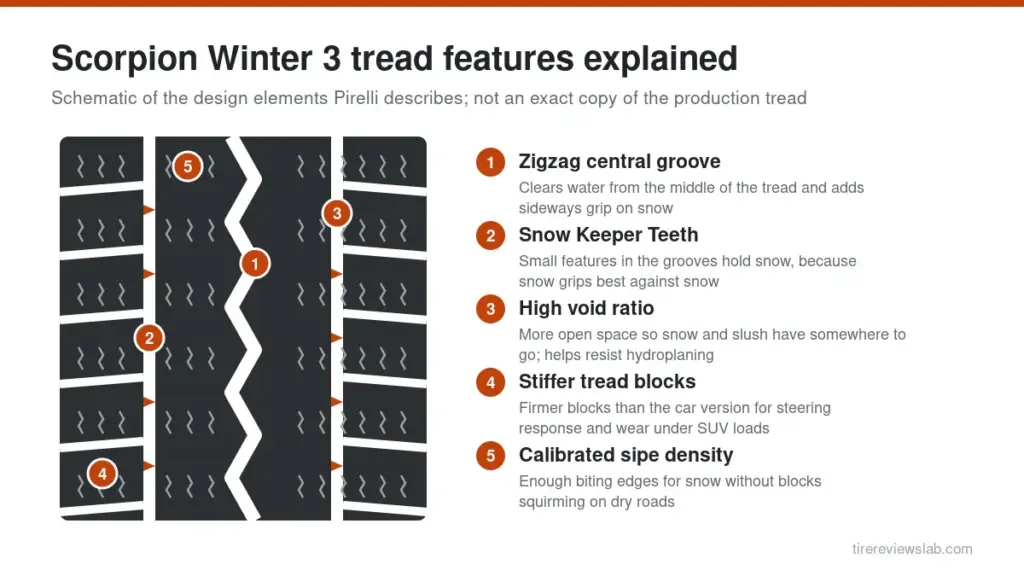
To begin with, the tread design comes largely from the Cinturato Winter 3, the passenger car winter tire that won the 2026 ADAC winter tire test in Germany. Three key features carry over:
- Zigzag central groove: channels water away from the center of the tread. It also adds sideways bite when cornering on packed snow.
- Snow Keeper Teeth: Pirelli’s patented small features inside the grooves trap and hold snow. Snow grips best against snow, so packing the grooves turns the tire’s own load of snow into a source of traction.
- High void ratio: more open space gives snow and water somewhere to go. That improves grip in slush and helps resist hydroplaning.
In addition, Pirelli made SUV-specific changes on top of that shared design. The tread blocks are stiffer than on the car tire. That improves steering response and wear resistance under heavy loads. Pirelli also tuned the sipe density so the blocks don’t squirm on dry pavement. That squirm is a common complaint with soft winter tires on tall vehicles.
A Compound Borrowed From Pirelli’s Performance Winter Tire
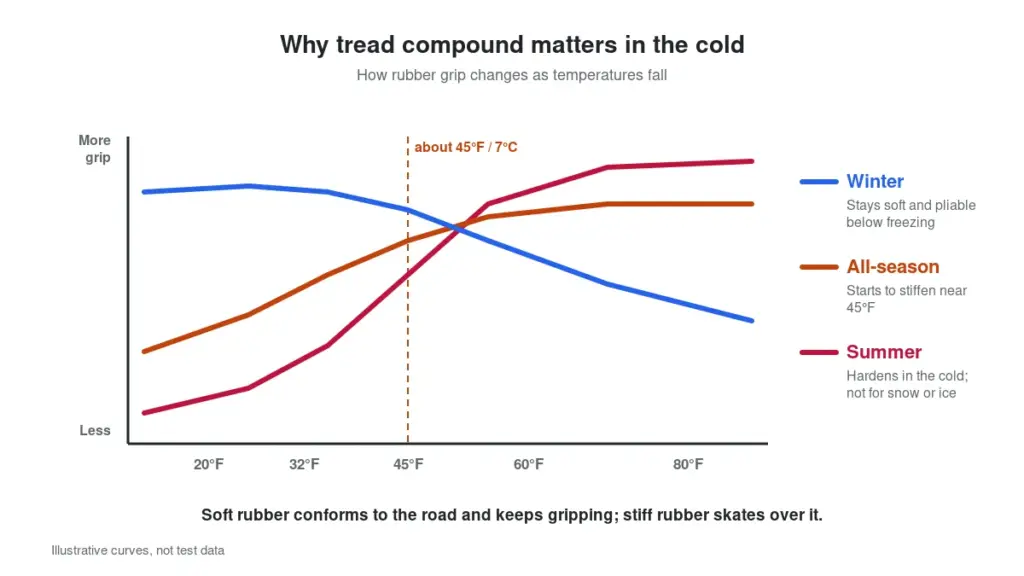
Likewise, the rubber draws on development work from the P Zero Winter 2, Pirelli’s high-performance winter tire for sports sedans and coupes. It uses what Pirelli calls Dual-Core Polymer, which the company says grips across a wider range of surfaces. In addition, plasticizers keep the compound flexible across a broader temperature range. In practice, the tire should stay pliable on a frozen January morning. It also shouldn’t turn greasy on a 40-degree day of cold rain.
Developed in the Simulator and in Lapland
Pirelli’s engineers at its Bicocca headquarters in Milan leaned heavily on virtual development. Computer simulation and driving simulators refined the design before any physical prototypes were built. After that, real-world testing took place at the Sottozero Center, Pirelli’s proving ground in Swedish Lapland. Moreover, its indoor facilities allow snow and ice testing year-round. In particular, the simulator work focused on dry handling, an area where many SUV winter tires feel vague and slow to respond.
How the Scorpion Winter 3 Performs
Pirelli’s central claim is that the Scorpion Winter 3 removes the usual trade-off between snow grip, wet grip, and dry-road stability. Fortunately, there is some independent evidence to weigh against that claim, along with the tire’s official European label data.
First Independent Test: A Narrow Win
The Scorpion Winter 3 took first place in a 2026 winter tire test by the Italian automotive magazine Al Volante. Specifically, testers ran six tires in size 235/60R18 on an Alfa Romeo Stelvio Q4. The field included serious competition:
| Finish | Tire |
|---|---|
| 1st | Pirelli Scorpion Winter 3 |
| 2nd | Goodyear UltraGrip Performance 3 |
| 3rd | Nokian Snowproof 3P |
| 4th–5th | Michelin Alpin 7, Bridgestone Blizzak 6 |
| 6th | Dynamo Winter Sport |
However, how it won matters as much as the result. The Pirelli did not dominate every discipline. It posted the shortest wet braking distance in the group. On snow, where a winter tire earns its keep, it finished second only to the Goodyear. Dry braking was mid-pack, it didn’t lead either hydroplaning test, and its winning margin over the Goodyear was very small.
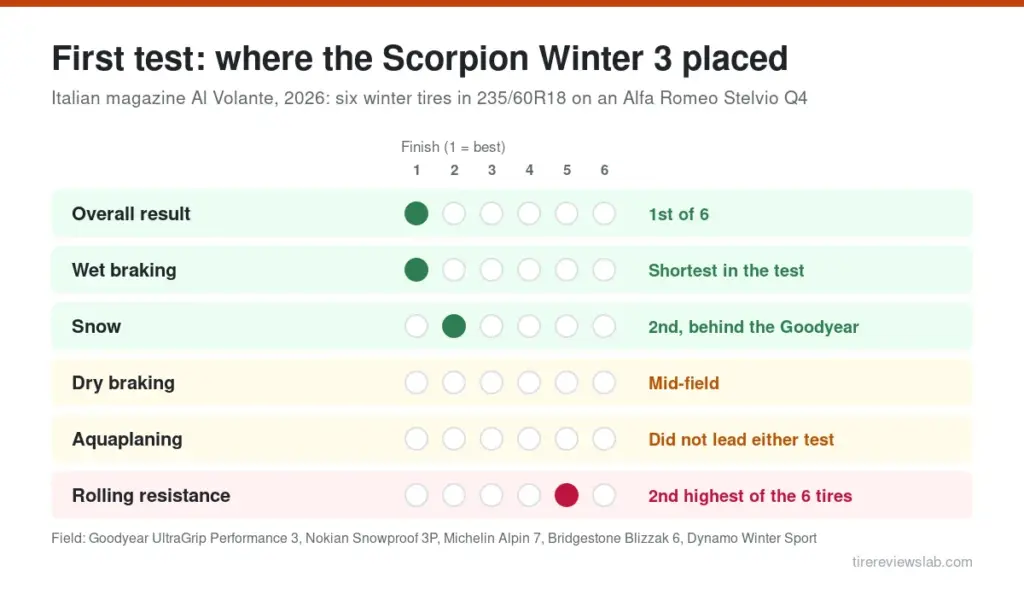
In other words, that profile describes a well-rounded tire rather than a runaway class leader. It’s also a single test in a single size, so it counts as an encouraging first data point, not a final verdict. Still, it’s a clear step forward from the Scorpion Winter 2. That tire finished third in Auto Bild’s 2023 SUV winter test and fourth in both the 2024 Auto Strassenverkehr and 2025 Auto Bild comparisons.
Wet Roads and Slush
Overall, wet performance is the Scorpion Winter 3’s strongest suit on paper and in testing. Every launch size carries an A rating for wet grip on the European Union tire label, the highest grade available. Moreover, the tire’s shortest-in-test wet braking result backs that up.
For U.S. drivers, this is arguably even more important than outright snow grip. In the Mid-Atlantic, the Pacific Northwest, and the lower Midwest, much winter driving happens on cold, wet pavement and slush. That’s exactly where winter tires pull ahead of all-seasons. A winter tire that brakes well on a 35-degree rainy highway is doing real safety work on most days of the season.
Snow Traction
Snow performance also looks strong. It finished second on snow behind the Goodyear UltraGrip Performance 3. As a result, it finished ahead of established names like the Michelin Alpin 7 and Bridgestone Blizzak 6. The 3PMSF symbol on the sidewall confirms it meets the industry standard for severe snow service.
That said, it’s worth being clear about what kind of winter tire this is. The Scorpion Winter 3 is a European-style winter tire. It balances snow, wet, and dry performance for regions where roads are plowed and treated. In contrast, it is not a studded tire or a Nordic-style ice tire built for weeks of glare ice and deep unplowed snow. Drivers who regularly face sheet ice may get more from a dedicated studless ice-and-snow design. That includes much of the upper Midwest, northern New England, and the Mountain West.
Dry Handling and Stability
Meanwhile, Pirelli invested heavily in dry handling through its simulator program, and the stiffer tread blocks support that goal. Even so, the independent results were respectable rather than exceptional, with dry braking landing in the middle of the field. On a heavy SUV, steady behavior on dry, cold pavement still matters. After all, many winter days bring clear roads at temperatures well below the point where all-season tires lose grip.
Noise and Comfort
Additionally, all launch sizes fall into EU noise classes A or B, with about a quarter in class A. Meanwhile, external noise measures 71 to 72 dB. In short, that’s a typical figure for a premium winter tire on an SUV. Alternatively, drivers who want a quieter cabin can look for sizes with Pirelli’s PNCS (Pirelli Noise Cancelling System). It adds a sound-absorbing foam layer inside the tire to cut cabin noise.
Rolling Resistance and Efficiency
On the other hand, this is the clearest weakness. Rolling resistance ratings on the EU label fall into classes B and C. In the Al Volante comparison, the Scorpion Winter 3 had the second-highest rolling resistance of the six tires. In practice, higher rolling resistance means the vehicle works a little harder to keep moving. That shows up as slightly lower fuel economy or, on an electric SUV, slightly less winter range.
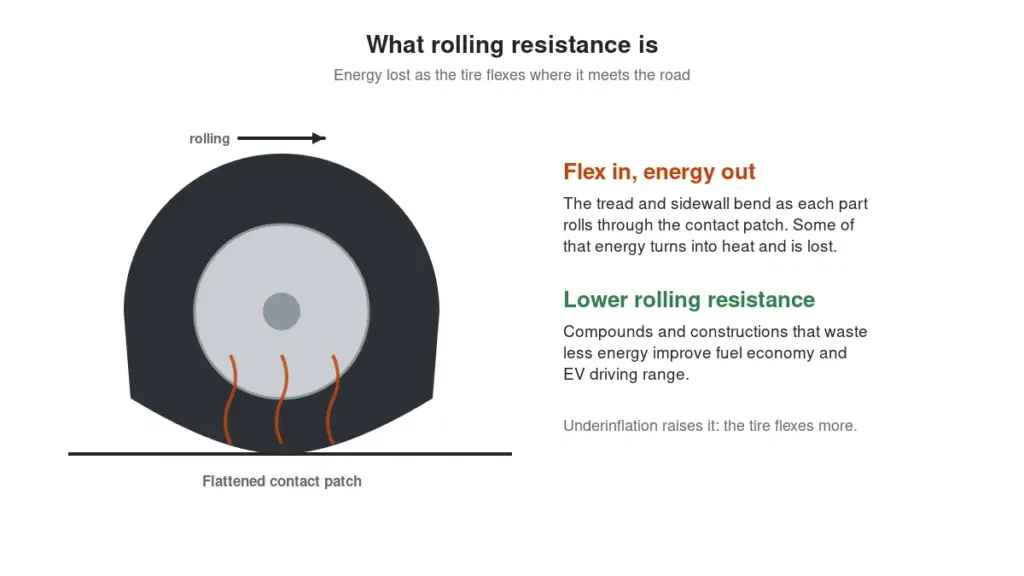
Admittedly, over a single winter season the difference is modest. But EV owners already lose range in cold weather. For them, it’s a factor worth weighing against the tire’s grip advantages.
Scorpion Winter 3 Versions: Elect, PNCS, and Seal Inside
In addition, selected sizes of the Scorpion Winter 3 come with three of Pirelli’s specialty technologies. In fact, choosing the right version can matter as much as choosing the right tire.
Elect is Pirelli’s technology for electric and plug-in hybrid vehicles. These tires are built to handle the extra weight and instant torque of electric drivetrains while helping support battery range and cabin quietness. Pirelli says Elect technology can increase range by up to 10%. However, that figure comes from Pirelli’s own Elect development work, not from testing of this winter tire. Read it as a sign of what the technology can do, not a promise for your vehicle.
PNCS adds a layer of sound-absorbing material inside the tire. As a result, it reduces the cavity noise that resonates through the cabin. It’s especially worth considering on luxury SUVs and EVs, where the absence of engine noise makes tire noise more noticeable.
Seal Inside uses a sealant layer inside the tire to seal many punctures from nails, screws, and road debris. As a result, the tire can hold its air pressure. Pirelli says this technology covers close to 85% of the accidental causes of pressure loss. On a winter tire, therefore, that has obvious appeal: changing a flat on a snowy shoulder is one of the least pleasant tasks in driving.
Original Equipment Heritage
Historically, the Scorpion name dates back to 1986, when Pirelli developed it for high-riding vehicles and first fitted it to the Lamborghini LM002. The family has since grown to cover summer, all-season, winter, and off-road tires, with a strong focus on original equipment development. Today, Pirelli counts more than 1,200 Scorpion homologations, including bespoke versions for Aston Martin, Porsche, Lamborghini, Lotus, Audi, BMW, Jaguar Land Rover, and NIO.
This matters for buyers because Pirelli typically develops marked versions of its tires for specific vehicles. As a result, expect to see Scorpion Winter 3 sizes carrying automaker markings, such as N for Porsche or MO for Mercedes-Benz, as approvals roll out. If your vehicle’s manufacturer specifies a marked tire, those versions are tuned to that vehicle’s suspension and handling characteristics and are generally the best choice.
Availability, Pricing, and Warranty for U.S. Drivers
Is the Scorpion Winter 3 Sold in the U.S.?
Pirelli announced the Scorpion Winter 3 in October 2026 with a clear focus on Europe. The timing lands ahead of winter equipment rules that take effect in several European countries in mid-November. Even so, the tire is already listed by major U.S. online tire retailers.
However, Pirelli’s U.S. website had not added a Scorpion Winter 3 product page as of early November 2026, and the Scorpion Winter 2 is still widely sold. Because sizes are rolling out, check your exact size with a retailer or an authorized Pirelli dealer. Pirelli’s U.S. press room is the place to watch for official announcements.
What It Costs
As a premium SUV winter tire offered only in 18-inch and larger sizes, the Scorpion Winter 3 isn’t cheap. For instance, early European retail pricing places it alongside the most expensive tires in the segment, with large-diameter sizes costing considerably more than 18-inch fitments. For comparison, its predecessor has typically sold in the U.S. from just under $200 to well over $600 per tire, depending on size. Expect the new model to land in a similar bracket in the U.S. In addition, Elect, PNCS, and Seal Inside versions will likely cost more than standard sizes.
Warranty Coverage
Pirelli’s standard limited warranty in the U.S. covers defects in workmanship and materials, but the company does not extend its treadwear mileage warranty to winter tires. The Scorpion Winter 2 carries no mileage warranty, and buyers should expect the same for its successor. That’s common for winter tires. After all, tread life depends heavily on how many months the tires stay on the vehicle and how quickly they come off in spring. Confirm the specific terms with your dealer or on Pirelli’s U.S. website at the time of purchase.
Scorpion Winter 3 vs. Scorpion Winter 2
| Category | Scorpion Winter 3 | Scorpion Winter 2 |
|---|---|---|
| Rim sizes | 18 to 22 inches (30 sizes at launch) | 18 to 23 inches |
| Tread design | Based on the Cinturato Winter 3, with zigzag central groove and Snow Keeper Teeth | Earlier Scorpion design with extendable sipes |
| Compound | Derived from the P Zero Winter 2, with Dual-Core Polymer | Previous-generation winter compound |
| Independent test record | 1st of 6 (Al Volante, 2026) | Typically 3rd to 4th in major SUV winter tests |
| EU wet grip | A in all launch sizes | A in many sizes |
| Specialty versions | Elect, PNCS, Seal Inside | Elect, PNCS, Seal Inside |
| U.S. availability | New; listed by major online retailers | Widely available |
Of course, if you already run Scorpion Winter 2 tires with plenty of tread left, there’s no urgent reason to switch. If you’re buying a new set once the Scorpion Winter 3 reaches your size, the new model is the better choice. In particular, its wet-road braking is the clearest gain.
How It Compares With Rival SUV Winter Tires
The Scorpion Winter 3’s first test put it directly against the tires most U.S. buyers will be cross-shopping, and the results point to clear differences in emphasis.
Vs. Goodyear UltraGrip Performance 3: The closest rival in its first test, finishing just behind the Pirelli overall. Specifically, the Goodyear was stronger on snow, while the Pirelli was better in the wet. Choose the Goodyear if snow traction is the absolute priority; choose the Pirelli if most of your winter miles are on cold, wet pavement.
Vs. Michelin Alpin 7: Michelin’s European-style winter tire finished behind the Pirelli in the Al Volante test. Admittedly, Michelin has a long reputation for even wear and refinement. On the evidence so far, though, the Pirelli holds the edge in both wet and snow grip. Our Michelin tires review covers the brand’s full winter lineup in more detail.
Vs. Bridgestone Blizzak 6: The Blizzak name carries enormous weight with U.S. winter drivers, but the European Blizzak 6 also finished behind the Pirelli in this test. Note, however, that North American Blizzak models are often studless ice tires built for harsher conditions. One example is the Blizzak DM-V2. That makes them a different kind of product from the Scorpion Winter 3.
Vs. Nokian Snowproof 3P: Nokian‘s performance winter tire finished third overall and posted lower rolling resistance than the Pirelli. Consequently, efficiency-minded drivers, especially EV owners, may find that trade-off appealing.
In the end, none of these tires is the right answer for every driver. The Scorpion Winter 3’s advantage is balance: no glaring weak spots in safety-critical areas, with wet braking as a standout strength.
Who Should Buy the Pirelli Scorpion Winter 3
- Luxury and performance SUV owners: Think Porsche Cayenne, BMW X5, Audi Q7, or Range Rover. Above all, these drivers need a winter tire that keeps handling sharp in large wheel sizes.
- Drivers in wet, slushy winter climates: Its wet braking makes it a strong match where winter means cold rain and slush more than deep snow.
- Electric SUV owners: The Elect versions are built for the weight and torque of EVs, though the higher rolling resistance is worth weighing against winter range concerns. Our roundup of the best winter tires for EVs covers alternatives.
- Drivers who keep tires for several seasons: Pirelli claims grip stays consistent as the tread wears. If that holds up, the tire should age better than many rivals.
Who Should Look Elsewhere
- Drivers facing regular sheet ice or deep unplowed snow: A Nordic-style studless ice tire or a studded tire will deliver more grip in the harshest conditions.
- Owners of smaller crossovers on 16- or 17-inch wheels: The Scorpion Winter 3 starts at 18 inches. Instead, Pirelli’s Cinturato Winter 3 covers smaller crossovers.
- Budget-focused buyers: Premium pricing and large wheel sizes put this tire well above mid-range alternatives. Our guide to the best snow tires for trucks and SUVs is a better starting point.
- Buyers who want a long track record: With one independent test and no owner reviews yet, a proven rival such as the Goodyear UltraGrip Performance 3 may feel like the safer choice.
Pros
- Won its first independent test against top premium rivals
- Shortest wet braking distance in that test
- Strong snow traction, second only to the Goodyear in testing
- A-rated wet grip on the EU label in every launch size
- Contact patch designed to hold grip consistent as the tread wears
- Elect, PNCS, and Seal Inside versions available
Cons
- Rolling resistance is higher than several key competitors
- Dry braking was only mid-pack
- Not designed for severe ice or deep unplowed snow
- No treadwear mileage warranty expected
- Only available in 18-inch and larger sizes
- Very new, with one independent test and few owner reviews
Final Verdict
The Pirelli Scorpion Winter 3 is the most convincing SUV winter tire Pirelli has produced. Borrowing a proven tread pattern from the Cinturato Winter 3 and a compound from the P Zero Winter 2 has paid off. The result won its first head-to-head test without a serious weakness in the areas that matter most for safety. Wet braking is the standout, and snow grip is close to the best in class. Pirelli’s focus on grip that lasts as the tread wears also tackles a real problem for winter tire buyers.
Even so, it isn’t perfect. Rolling resistance trails several rivals, dry braking is average, and the winning margin in its only independent test so far was slim. One test in one size isn’t enough to crown a class leader. Over time, more comparisons will tell a fuller story.
Owners of mid-size and luxury SUVs face wet, slushy, and snowy winters. For them, the Scorpion Winter 3 deserves a spot at the top of the shortlist once it’s sold in their size. On the other hand, drivers who face severe ice or who prioritize efficiency above all may be better served elsewhere. Finally, it’s a brand-new tire with little owner feedback so far, so early buyers are trusting one strong test and Pirelli’s engineering.
FAQ
Yes, it’s starting to appear. Pirelli launched the Scorpion Winter 3 in October 2026, and major U.S. online tire retailers already list it. However, Pirelli’s U.S. site had no product page yet in early November 2026, so check availability in your size.
Yes. It carries the three-peak mountain snowflake rating for severe snow service. In its first independent test, it also finished second on snow, behind only the Goodyear UltraGrip Performance 3. However, it isn’t designed for extended sheet ice, where a studless ice tire or studded tire performs better.
Wet performance is its strongest area overall. Every launch size carries an A wet grip rating on the EU tire label. In addition, it recorded the shortest wet braking distance among six tires in its first independent comparison.
At launch, it came in 30 sizes covering 18- to 22-inch wheels, with V and W speed ratings. In addition, selected sizes are available with Elect, PNCS, or Seal Inside technology.
It can be, especially in the Elect versions, because they’re built for the weight and torque of EVs. However, the trade-off is rolling resistance, which tested higher than several rivals and can slightly reduce winter driving range.
Pirelli does not extend its treadwear mileage warranty to winter tires in the U.S., and its predecessor carried no mileage warranty. The standard limited warranty covering workmanship and material defects still applies.
First, if your current set still has plenty of usable tread, there’s no urgent need. When it’s time for a new set, the Scorpion Winter 3 is the stronger choice, particularly for wet braking, once it’s available in your size.
Pirelli Scorpion Winter 3 Specifications (Reference)
| Specification | Details |
|---|---|
| Tire category | Winter / Snow, SUV and crossover |
| Severe snow rating | Three-peak mountain snowflake (3PMSF) |
| Rim diameters | 18, 19, 20, 21, 22 inches |
| Sizes at launch | 30 |
| Section widths | 225 mm to 315 mm |
| Aspect ratios | 30 to 60 series |
| Speed ratings | V, W |
| Key tread technologies | Zigzag central groove, Snow Keeper Teeth, high void ratio, SUV-specific stiffened blocks |
| Compound | Dual-Core Polymer with plasticizers for a wider temperature window |
| EU wet grip rating | A (all launch sizes) |
| EU noise rating | Class A or B (71 to 72 dB) |
| EU rolling resistance rating | Class B or C |
| Specialty versions | Elect, PNCS, Seal Inside (selected sizes) |
| Predecessor | Pirelli Scorpion Winter 2 |
Sources
Specs, availability and warranty terms were checked on November 2, 2026.
- Pirelli press release: Scorpion Winter 3 launch (official announcement: sizes, technologies and development details; accessed November 2, 2026) \n\n\n\n
- Pirelli U.S. press releases (Pirelli’s official announcements, including the Scorpion Winter 3 launch)
- Pirelli Scorpion Winter family on pirelli.com (official product page: Elect, PNCS and Seal Inside technologies)
 Summarize this article with:












Leave a comment